Monday February 11, 2019 – Disembark the MV Aegean Odyssey, Transfer to Hilton Hotel for the next few days and afternoon City Tour, on our own, of Colombo, Sri Lanka.
We bid Judy and the others we had met on board farewell the night before as they had to be on their respective coaches before 6 AM to catch their flights home. Judy was the first to disembark as she had the early Oman Airline flight to catch back to England. We had to be off by 10 AM as we were remaining in Colombo. Anne and I were able to leisurely disembark as we are headed to the Hilton Hotel where we will spend the next few days visiting Sri Lanka on our own. Checking in at the Hilton we got the good news that as our regular room on the executive floor was not yet available, would we mind being upgraded to a two-room suite? What a hardship!! A very nice start to our time in Colombo and the area.
As we leave the ship, and before going into the rest of our stay in Colombo and environs, I would like to mention a few observations about the ship, staff, food and in general the experience.
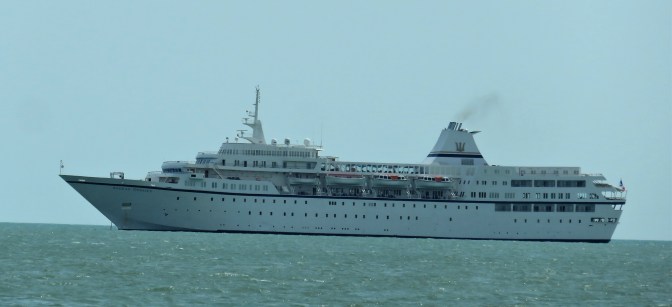


Note the barbed Wire outside our Cabin balcony (with the light on)
A few Pictures of the Inside as we leave for the last time


- Overall, we were very happy with the experience. Staff were attentive, food was good, the ship being as old as it is had some issues but got us where we needed to go. The passengers were an older group (average age 72) mostly British and well educated, broadly travelled and accomplished in their respective fields of endeavor.
- The nearly 50-year age of the ship (keel laid June 18, 1971, Launched August 22, 1973) did create an issue with air conditioning not working all the time properly, the water in the sink and shower was always brown (not dirty) due to rusty pipes. Repeated reporting to the authorities about brown water never resolved the issue. Drinking water in bottles was provided daily as was ice and other such amenities. Interesting that as I write this the A/C in the cabin just went off!!
- The cruise / excursion staff were all young University graduates and did their jobs admirably. An excellent feature was that in each cabin there were 2 Quiet Vox apparatuses in the charger which we used to hang around our necks with an earbud. The various guides used a transmittal device which permitted us to be some 20 yards away from the guide and still able to hear what the guide had to say.
- We were assigned a color and a number sticker on the cruise card and that indicated the tour group you would be on for the entire trip. Colors were assigned by cabin type, we were Red 2. This allowed us to be with the same people on all the tours and the Ship staff took names as you bordered the coach. This is much more personal than the usual form on larger ships of assigning a colored sticker to be places on one’s shirt and thus assigning the tour group. This much more personalized service was evident throughout the cruise as the number of people was much smaller than on other large cruise lines. A definite plus for this.
- In the cafeteria you walked around with your tray and plate, but service was by the staff to avoid transmittal of disease with multiple passenger handling of serving utensils. Also, waiters were at the ready to take your tray once your food selection was made, to your table and serve you water, tea, coffee etc.
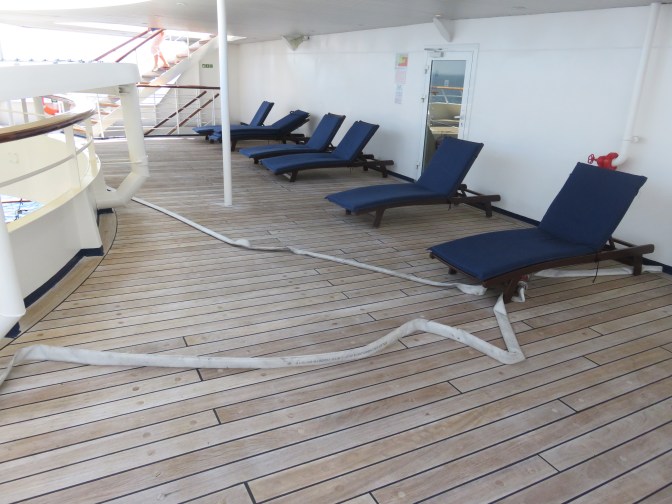
- The water hoses (usually used for fire suppression) were constantly out on the decks in the case of a pirate attack. In such eventuality, we were educated what to do and the hoses would be used to fend off possible attackers.
- There were really four or five main gathering areas – The formal restaurant Marco Polo on deck 3; The pool area and continuous tea and coffee self service area on Deck 8 and then on Deck 6 the Cafeteria which was both inside as well as outside on the rear deck; The Charleston lounge which served for dancing, music and drinks bar; The Ambassador lounge with its fixed bench seats in a semicircle and floating chairs around multiple fixed small oval drinks tables, dance floor, piano stage and screen used for movies, concerts and lectures.
- We experienced the medical center and the Italian Doctor Gino, with excellent service. Even the head of housekeeping and the captain came to the medical center to meet with Judy to make sure she was OK after her tripping and head cut accident.
- Since it is a small ship, we could go into and dock near the center of town as opposed to larger vessels that require a deep-sea port. This was most evident in Yangon. We were concerned that being on the open ocean in a small vessel, we might expect greater movement, fortunately, this did not occur as the seas were relatively calm.
- Television in the cabin was basically non-existent. Even the channel with the ships position and maps was hard to read and the time not changed as we changed time zones until later in the day.
- The noon briefing by the Greek Captain, seldom took place at noon and was often up to 30 minutes late and the information provided was not very informative.
- The speakers in general were excellent. Sandy Primrose the Botanist and Nigel Cox, the diplomat was particularly superb. The Myanmar chap was difficult to understand but provided interesting information. The American with an eye patch on his Right eye, had a great deal of experience and knowledge about Myanmar, but his delivery was in monotone and dull.
- The cruise director seemed flighty and scatterbrained, not introducing the speakers but making confusing and often irrelevant statements, preferring to chat about her high heeled shoes and confused about the current daily activities as she was working on the daily bulletin dome weeks ahead.
- Waiters and cabin staff, mostly from the Philippines, were good and attentive.
- It would have been interesting to hear from the captain about the ship – history, statistics, etc. but no information was provided either in the cabin or verbally. However, we did find that we travelled 2,515 nautical Miles (4,660 Km or 2,895 miles), the length is 461 feet and 67 feet wide with a draught of 20 feet. We think there is an owner somewhere that leases the Vessel to Voyages to Antiquity and that lease is up in August 2019. At which point the organization of the group that was on board calling themselves “Road Scholars” will take over for 2-3 years.
- Internet availability was spotty and only in the area around the reception. An “internet room” provided screens, but Wi-Fi was only available on the couches by the purser’s office despite advertising it was available in the library. A gathering room on the 8th deck supposedly had internet but was taken over by a group playing duplicate bridge so was basically off limits to others.
- The Captain held 2 cocktail parties but did not seem to appear for either or if he did, said nothing and no reception line.
- The last daily bulletin explained some of the consumed food statistics for the cruise: – 53,500 eggs; 400 Kg Chicken; 2,100 bottles of wine (which were included in each meal); 640 Kg fish; 1,520 Kg of Meat; Rice – 96Kg by passengers and 480 Kg by the (mainly Philippines) crew; 800 Kg Potatoes; 320 Kg Onions; 240 Lt of Oil etc. ….
Now to our afternoon on our own having completed the Cruise section, we retained a hotel car and driver for half a day to see the sites of Colombo. As we drove around, the good driver pointed out many buildings and points of interest.
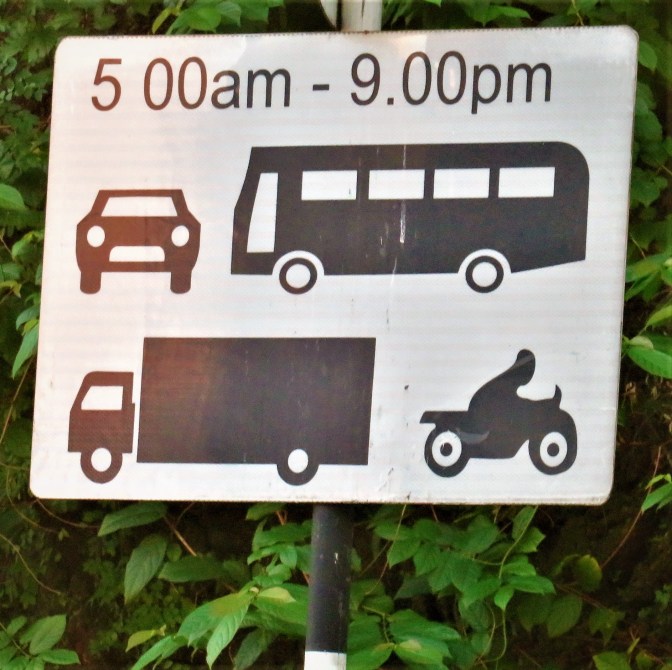
With signs like this, no wonder the traffic is like it is ….
Our first stop was at the 120+ year old Gangaramaya Buddhist Temple and Museum. Of note is the Bo / Bodhi Tree brought from Anuradhapura (which is thought to have been propagated/ had its origin with the original Bo tree planted in 288 BC. The various holy buildings are constructed around the tree. It has a spectacular museum of donated items of all sorts and types (Gold Statues, paintings. Watches, ivory, typewriters, bowls etc.). All in great need of a good dusting and cleaning. It is decorated with carved wood, brass, gold, stone statues and sculptures and other Buddhist Art. There are many meeting places, residential halls, holy places and a major complex of interconnected spaces making it one of the most venerable and extraordinary temples in the country.


From there we took a short walk to the Seema Malaka Buddhist Temple which is mainly used for meditation and part of the Gangaramaya Vihara Temple, is unique in that it is built entirely on stilts in Lake Beira. The original 19th Century structure was slowly sinking into the water in the 1970’s so the current temple was built in 1976, funded by a local Muslim businessman. Of note apart from the seated Buddha and the propagated Bo tree from the original, are platforms and “altars” to Vishnu, Shiva, Kataragama and Ganesha. A Buddha’s foot imprint with the various past lives symbols is at the entrance, and as with most temples, a place where monetary offerings are placed. All around the main worship area are pictures of locations sacred to Buddha like Sripadaya where Buddha’s left footprint in imprinted during his third visit to Sri Lanka.


The next brief stop was the Independence Memorial Hall erected to commemorate the Independence of Ceylon from the British on February 4th, 1948. A statue of the art. Hon. Don Stephen Senanayake (1931-1952) – Father of the Nation and first Prime Minister 1948 to his death on March 22, 1952. It is an open hall with 60 columns as 60 was the lucky number of the day of independence on the location where the formal ceremony of self-rule was held. It contains many Buddhist carved scenes. Our driver asked a disabled gentleman to give us the tour. Much of what we asked he was unable to answer but we were glad to give him some funds for his efforts.


A drive through the Royal Colombo Golf Course, Cemetery etc. led us some 12 miles South of Colombo, to the old colonial hotel – The Royal Mount Lavinia Hotel – where we had a lavish buffet lunch on the patio on a promontory overlooking the coast towards Colombo. A gorgeous sight.


After a late lunch we made our way back to the hotel, stopping briefly at the Red Mosque or Jami ul-Alfar, so named as it is distinguished by its red and white Candy striped construction, located in the Pettah Bazaar District. We also made a short stop at the Laksala handicraft shop where we got some silver top tea.


To round out the day we also stopped at the Catholic Church of the Golden Shrine of the Infant Jesus based on the Holy Infant child Jesus of Prague. The side chapel had the holy sacrament exposed.
A terrific day where we were able to get a good feel of Colombo.

 Roger & Anne Travels