During these days we were at Sea, sailing between Andaman and Colombo across the Indian Ocean. The days were filled with excitement, mainly lectures, meals and chit-chat.
Thursday February 7, 2019 – At Sea. The day was somewhat relaxing with two lectures and meals being the excitement of the day.
The first lecture by Sandy Primrose described the exotic fruits of the area we are visiting. However, he started with some interesting information about Bananas. 120 Million tons of Bananas are produced and consumed each year, with 60 Million of this being Cavendish Bananas. It was not until 1903 that the start of commercialization of Bananas. These were the Grand Michelle variety they but suffered a systemic “Panama Disease” and most banana plants died off. The Cavendish could be planted in the same fields as the Grand Michelle and were apparently immune from the disease. This however is now changing, and the Cavendish are being affected by the same Panama Disease and subject to being wiped out.
Even though there have been great advances in genetic engineering and breeding resistant strains, this is difficult with the Cavendish as it is Triploid. Eating bananas can be diploid (dual genetic makeup of Musa acuminata), Triploid (3) or Quadriploid (4). Genetic adjustment / substitution is more easily achievable when there are 2 or 4 genetic elements. Cavendish seeds (the little black specs) have been bred down to almost nothing, for taste, and are sterile, so vegetative propagation is needed (roots, grafting etc.)
Plantains or Cooking Bananas contain both Musa accuminata as well as Musa balbiana and typically have more seeds embedded in the flesh. The banana originated in South East Asia and then was spread to the Middle East and to the Caribbean. Bananas are principally water and carbohydrates with 1 % protein and high in Potassium. Enough technical biology!!!!
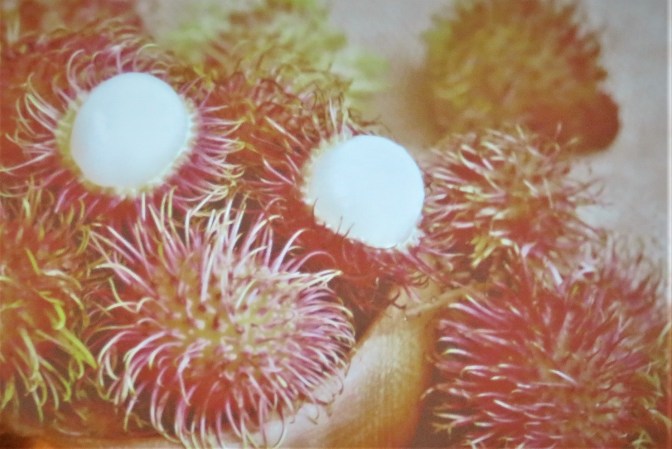
Other fruits of this area are Rambutan or “hairy Lychee” as it looks like red messed up hair on the outside and like a white lychee on the inside. Other Lychee relatives are Landsat and Cat’s Eyes (Mara kucing) and Pulatan with shorter red “hair”.
A very popular one is the Carambola (Averrhoa carambola) or Star Fruit. One of the negatives of eating this is that it breaks down certain Rx medications rendering them less effective (like grapefruit that breaks down statins like Lipitor). However, on the positive side due to it being high in Oxalic Acid it can be used to clean silver or remove rust stains from clothes! Other fruits like the red colored Salak which looks a little like a strawberry with a thick skin and white lychee like texture (but not shape) on the inside. The very popular Dragon Fruit which is red on the outside with green shoots and white with hundreds of black dots interspersed on the inside.
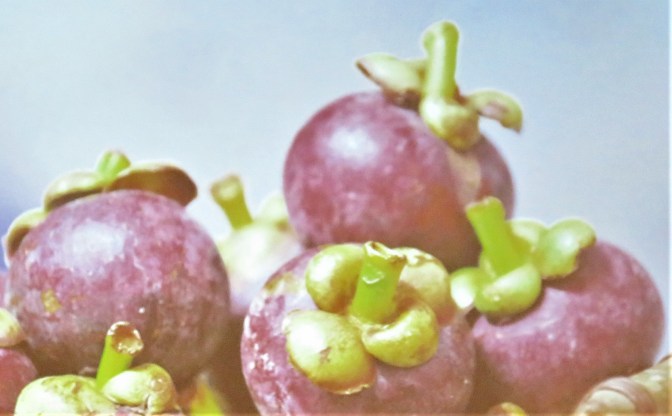
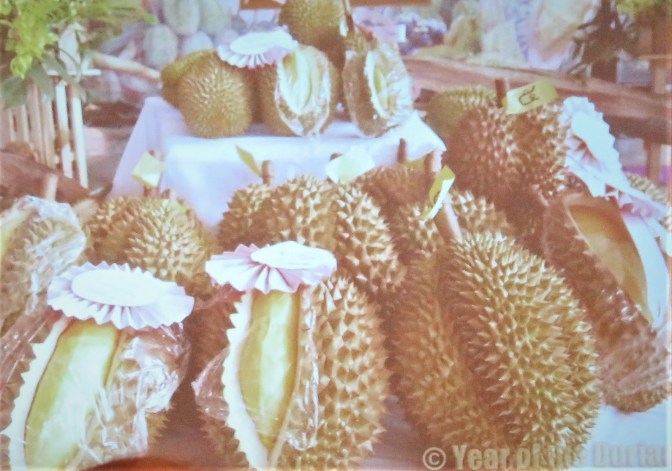
The enormous Jack Fruit which can be twice the size of watermelons and grows on trees looking a little like a coconut which due to its high protein level can be used as a meat substitute. Yang Lang is used as a nutraceutical reportedly to Lower blood pressure, aphrodisiacs and in aroma therapy. Turmeric, which is a member of the ginger family is used not only in cooking to add color (big secret – sprinkle on par-boiled potatoes before roasting to help keep the yellow color and not change the taste OR use to color rice yellow in lieu of the more expensive saffron). It supposedly cures everything and is used to paint faces, bodies, hair and sprinkle all around in religious ceremonies. It does have antiseptic properties and can help cure certain skin ailments. Henna Tree can be used as temporary tattoos. The leaves are made into a powder, mixed with water, tea, lemon juice, sugar (to thicken) etc. and made into a paste. That is then used as paint for intricate hand painting for example before a wedding and left to dry for 5-6 hours. During this drying it oxidizes and paints the skin. After 3-4 weeks this all disappears as new skin replaces the old. Coconut Arrack is a popular alcoholic beverage (60% alcohol or 120 proof) distilled from certain coconuts. Perhaps though, the last three discussed are the most interesting. Coconuts can float on the sea for 100-200 days and if then on land can sprout. A coconut is often planted when a child is born and after 7 years can provide that child with a wide array of products. It is a very important crop in SE Asia. The Durian is the King of Fruits and has a disgusting odor and bad taste but is growing tremendously in popularity. It is said by some that the taste is like “putting garlic and onion into your mouth and French kissing your week-old dead grandmother”.
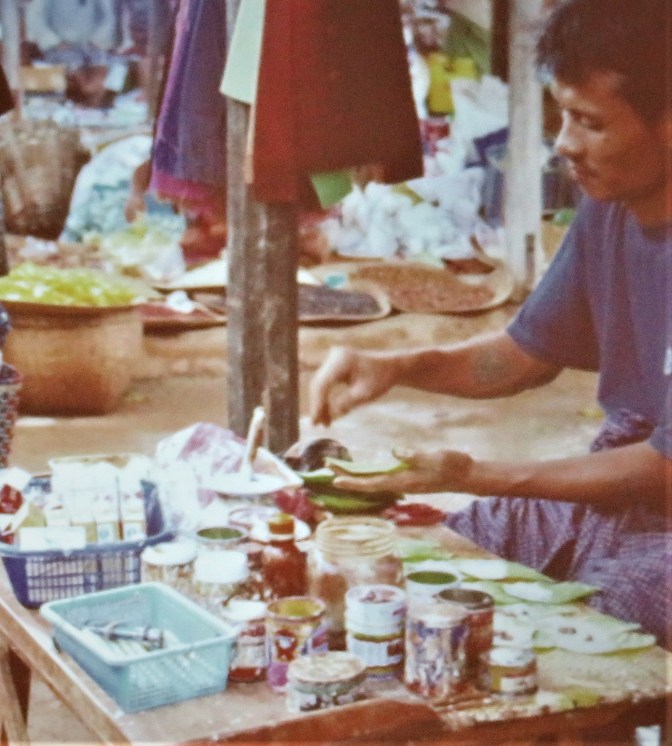
The last one we will discuss is the Betel Nut Palm (Areca catechu). Chewing it causes oral cancer. The nut is powdered and placed on leaves with other ingredients and tied up in bundles which are chewed. The tongue, mouth and teeth go bright red and the user then spits out bright red blobs that stain pavements or anything that it touches. Over 1 Million tons are produced each year and is growing despite deformed faces and cancer of the mouth.
Harry one of the Cruise staff gave a very similar talk the following day.
That afternoon Bob Taylor showed pictures of trips he has taken all around Myanmar. However, his monotone voice and confusing picture locations made it exceedingly boring.
Friday February 8, 2019 – At Sea in Indian Ocean towards Sri Lanka.
Sandy Primrose once again gave a fascinating Botanical lecture. This time it was “Plants, Murder and Medical Mysteries”. How parts of plants, particularly now pollen, has been used to solve crimes. He discussed various plants and parts of plants and the various criminal cases that were solved using plant material. Also, certain diseases that became epidemics caused by plants.
Loathsome Rot where hands and in general human extremities would turn black, wither and fall off. This only occurred in the countryside with poorer people and the cause was found to be the ergot fungus in rye bread. City people ate wheat bread. Ergotomy occurred where blood flow to the limbs was stopped thanks to eating tainted rye bread. In Salem, Massachusetts and the famous witch trials, it was thought that people went mad not because of being possessed, but when ergot gets into bread it makes it red and then eventually turns into LSD and this psychedelic drug caused the temporary madness. This LSD end product caused mass appendicitis in 1951 in Pont Saint Espirit. Morning Glories when affected by the Ergot fungus produce the psychedelic effect. Other incidents involved Broad leaf plants and the Misery of the Mast in the 4 corners region (UT, CO, AZ, NM states) of the USA causing hemorrhagic fever and renal diseases. Lyme disease involves plants and the deer tick with the bacteria Borella burgdoferi.
As far as deliberate poisonings one of the earliest to be used was Hemlock which when ingested starts numbing the feet then legs etc. until it reaches the heart and paralyses that causing death.
Fox Glove Leaves can cause Congestive Heart Failure. In general terms a useful medication is one where the Therapeutically favorable dose is 100 times or more than the lethal dose. In Fox Gloves that ratio is 7.
Digitalis can cause a mummified state of corpses if ingested to an excess as in the case of Francesco fella Scala. David Yallop writing “In God’s Name” indicates that Pope John Paul I died 33 days after assuming the pontificate died due to digitalis poisoning.
Brigadier General John Nicholson and the Cricket team Captain Bob Woodmere after Pakistan lost a test match to Ireland, we’re both poisoned by Actinate (Actinium ferox). This was also the fate of an Indian love triangle with the lover being Actinate poisoned. Alexander Solzhenitsyn was poisoned in 1971 by Risen developed by Grigory Mauranovsky working at the Russian Laboratory number 1 that was set up to develop poisons that were not traceable. It is developed from Castor Oil and must be injected to be lethal. If ingested it causes severe abdominal pain, but not death. Thus, the invention of umbrellas that are modified to inject the passer by in secret. Gelsemium elegans is known (Sir Arthur Conan Doyle) as the Widow Maker due to its use in killing off enemy men and almost untraceable.
The Lindbergh baby killing was solved on part by tracing Botanical evidence to the home of Bruno Kaufman. He discussed many other cases solved by botany and more recently by pollen evidence. All fascinating.
Next was the Port lecture about Colombo, Sri Lanka where we arrive on February 10 at 1AM.
The afternoon lecture was Bob Taylor droning on about a subject he knew little of and seemingly enjoyed even less. “English Writers of Colonial Burma and Ceylon: – George Orwell, Leonard Woolf (husband of Virginia Woolf) and Harold Robinson. Books by these authors are: –
Wolfe – “Village in the Jungle”
Orwell – “Burmese Days” and essays – “Shooting an Elephant” and “A Hanging”.
Robinson – “A Modern De Quincey”
Saturday February 9, 2019 – At Sea on route to Colombo.
Another day in the Indian Ocean filled with interesting lectures from our two favorite lecturers – Nigel Cox talking about Kandy as the HQ of the Allied Forces during WW2 and Sandy Primrose talking about Tea given that Ceylon is one of the main Tea producers in the world thanks to the British.
The evening ended with a Captain Farewell Cocktail Party.
Nigel’s Talk “Mountbatten in Ceylon; When Kandy was the Headquarters of the Allied Struggle against Japan in South East Asia” was very interesting, but he took s few minutes to clarify some mid-statements / misunderstandings about Port Blair and the Cellular Jail.
The Guides and even the written “propaganda” at the Jail made it out that the British took political prisoners to Port Blair to torture, mistreat, hang and in general never let them put alive and it was only when the Japanese came in during WE2 that the few prisoners left alive in the Jail were released. The reality was that most of the prisoners were murderers, rapists and the worst offenders. The majority were released once their sentence was completed and about half were repatriated to their homes in India, the other half decided to stay and make a life in the Andaman Islands. Many people living there today are descended from these “prisoners”. There were about 83,000 prisoners that were incarcerated during its time of which about 1,000 were political prisoners (during 1810-1816 WW1). All these were repatriated in 1937. There was indeed hard labor, and flogging did happen and a few were indeed hanged for behavior while incarcerated. One third of the prisoners died and were killed by the Japanese during their brief occupation as they thought the prisoners were British Spies. 8 Japanese were hanged as war criminals.
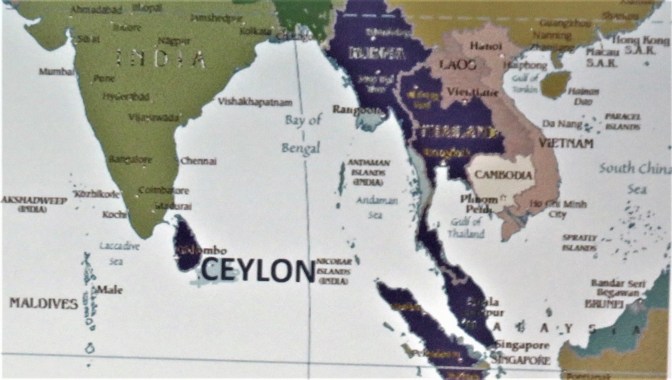
Now to the main part of the talk on Kandy and Mountbatten. Admiral of the Fleet Louis Mountbatten (1900 to 1979) or Prince Louis of Battenberg, entered the Naval Academy at the age of 13 and became a midshipman in 1916. In early 1920 he accompanied King Edward on a trip to the East and met Edwina Ashley in India who was to be his wife. In 1943 Winston Churchill sent him as Supreme Commander SE Asia based in Delhi. In April 1944 based on the advances that the Japanese were making in SE Asia he moved his headquarters to Kandy, Ceylon – now Sri Lanka. He remained there until after the surrender of Japan which took place 15 August, but the official surrender was on September 2nd 1945 in Singapore and he left Kandy September 9. He eventually in February 1948 became Viceroy to India. It is interesting that although the independence of Ceylon was in February 1948 it was not until 1972 with the creation of the republic with the President seated in Kandy that the name was changed to Sri Lanka.
The Disembarkation briefing took place followed by Sandy’s final lecture “Robert fortune and the Great Tea Heist” in the Afternoon.
There is evidence that Tea was being drunk by Emperor Shen Nung in 2737 BC Where leaves from the Camellia sinensis were used to flavor hot water. The “Terra-cotta Warriors” in Xian, China had Tea in 2 BC. Thus, Tea or “China Drink” became widely enjoyed. It was originally made into bricks until in the Ming Dynasty that leaves were used. It is thought that Marco Polo was the one who brought Tea to Europe. The Dutch East India Company were the first to commercialize Tea, with the first Tea-House in London being Garraway’s Coffee House in 1657. Charles II was drinking Tea in 1663 and soon thereafter Parliament imposed a 25p which was reduced to 5p by William Pitt and eliminated completely in 1964. Due to its high cost in the early days, Tea was kept in fancy lacquered boxes in the Dining Room for all to see. In 1700, 50 Tons of Tea was imported to England and by 1800 this had grown to 15,000 tons at a profit of £100 per ton! The Chinese insisted that all purchases of Tea be paid in Silver. At the time a major issue, but when Britain grew poppies and produced opium for Chinese consumption the tables were turned and payment for opium had to be made in Silver. There was always a battle to see how fast ships could bring the new crop of tea back to England from China. As Tea is bulky but light, the ballast for the ships was porcelain from China thus the name for dinnerware is China.
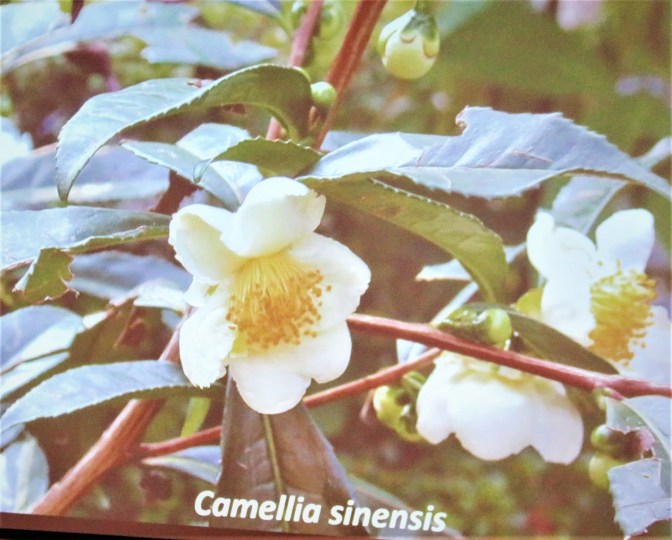
Due to the seeming monopoly of Tea from China, Robert Fortune was sent in 1849 to gather tea plants to send to India where similar growing conditions existed and could be controlled by the British. He was able to get 13,000 plants and 10,000 seeds however due to the humidity, the seeds were Moldy by the time they reached India and the plants died in Customs. His next trip he collected 24,000 plants and 17,000 seeds for India which formed the basis of the crop of Tea from India and collected 32,000 plants for the USA but due to the Civil War, they never reached America.
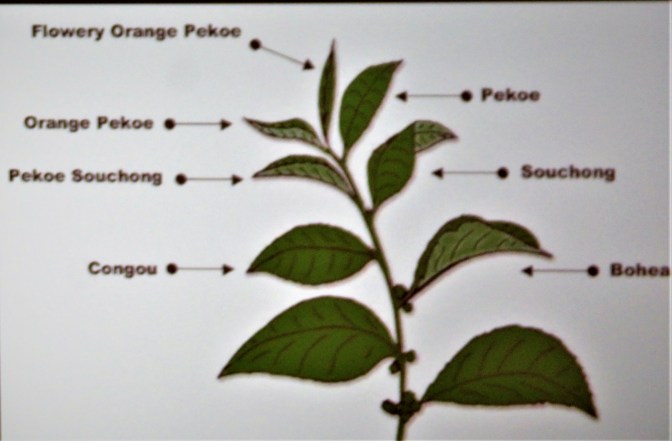
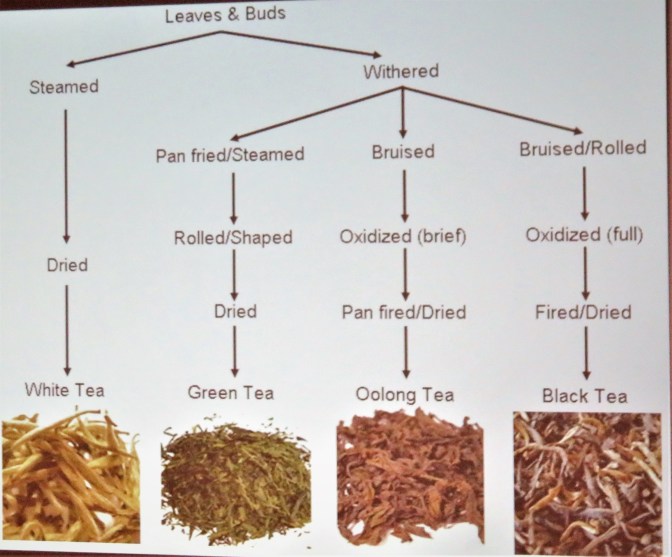
The first 7 leaves of the plant are classified as follows, starting with the smallest first leaf – Flowery Orange Pekoe, Orange Pekoe, Pekoe, Pekoe Sauchong, Souchong, Congo and Bohea. Today the first two early morning emerged leaves are had picked with gloves and are Gold and Silver tips respectively and are never touched until the user puts them into the cup to make the tea. The leaves and buds are either steamed and dried making White Tea, OR withered. If withered the leaves can be 1) Pan Fried / Steamed, then rolled / shaped, and dried to make Green Tea OR 2) Bruised, briefly oxidized, pan fried and dried to make Oolong Tea OR 3) Bruised, Rolled, fully oxidized, fried and dried to make Black Tea.
Thomas Lipton owned a supermarket and by 1852 sent James Taylor Scott to buy thousands of Tons of Tea which he sold through his supermarket. Today the tea that is used in tea-bags which is about 95% of the tea used, is the powder that is left from processing of the leaves. Iced Tea was introduced in St. Louis In 1904.
Today the major exporters of Tea are – Kenya 25%; China 18%; Sri Lanka 17%; India 13%; Vietnam 7%; Argentina 4% etc. Most teas today are blended with English Breakfast being the most widely consumed, followed by Earl Gray (after the UK Prime Minister in the 1930’s and Russian Caravan.
Sandy Primrose concluded his lecture saying that he lives in High Wycombe in Buckinghamshire, England; lectures at Cambridge and has some 50 “packaged” talks he can give to societies requesting his services. He does not charge but does ask for a donation to his favorite charities. He has authored 2 books, due for release in 2019 which are – “Plants, Murder and Medical Mysteries” and “The Modern Plant Hunters; the Search for Interesting and Unusual Plants”, by Pimpernel Press in the UK and Yale University Press in the USA.
This evening was the Cocktail Party by the Captain bidding us all farewell and what was to be the Passengers Talent Show and Fairy Tale recounting, but not one passenger signed up, so the show was cancelled.

 Roger & Anne Travels