Monday September 9, 2019 – Stornoway, Outer Hebrides, Scotland on the island of Lewis (& Harris). Tender Port.
Stornoway is the largest town in the Hebrides (Western Isles) with a population of 8,000 (12,000 in the entire parish or “Greater Stornoway”) and the administrative center of the Hebrides. Even though Lewis and Harris are considered two Islands they are actually connected with 2/3 of the land being Lewis and 1/3 being the Southern sector – Harris (Home of the famous Harris Tweed Jackets). The Outer Hebrides extend 130 miles off the coast of Scotland and consist of Lewis, Harris, Benbecula, North Uist, South Uist and Barra.
It was inhabited by Vikings by the 12th century and there is evidence of a castle built here by the Vikings which was completely destroyed by Oliver Cromwell’s troops in 1653. The Gaelic spoken here is similar to Old Norse. The small town gradually grew as a fishing port. In 1844 Sir James Mathewson built Lewis Castle and in 1918 Lord Leverhulme bought the Island of Lewis for £143,000 and tried to develop the Island. On 1/1/1919 HMS Iolaire sank near the entrance of the Harbour causing the largest loss of life (203 people) and a memorial in the Harbour was installed 100 years later, consisting of a number of poles in the shape of the ship that are exposed at low tide but covered at high tide. In 1922 Lord Leverhulme gave the castle to the people of Lewis. Thus it can only be used for the benefit of the people. In World War II the castle served as a hospital.
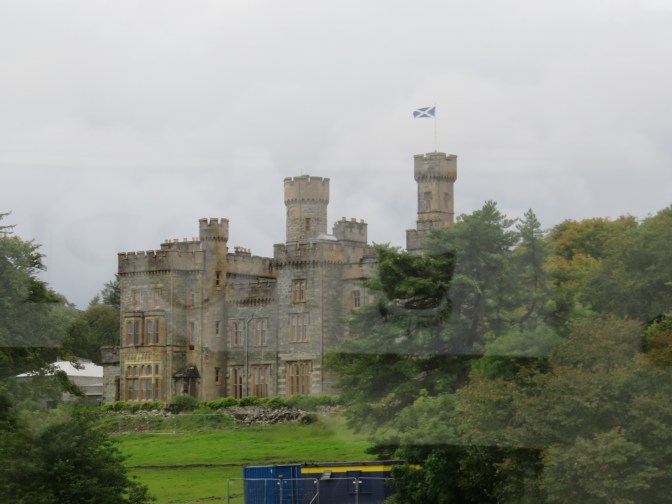
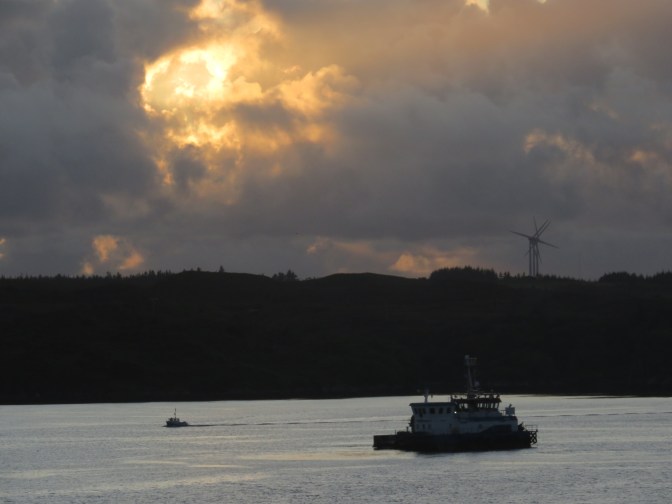
We arrived on time but due to the currents, the captain had a difficulty in securing the ship at anchor so we did not start the tendering service to shore an hour or so after originally planned. This was of concern as we were only to have 45 minutes between the arrival of the morning tour and the departure of the afternoon tour that we had booked. The Cliffords had booked one in the morning – “The Black-Houses and Calanais stones” but none in the afternoon.
The Black-Houses were where the natives lived in one room dark (few windows) houses at an angle with the animals below the house so that any water first went through the house then the animals. The Calanais (Callanish) Standing Stones which similar to Stonehenge consists of 13 Standing Stones with a central monolith built about 3,000 BC. Lines radiate out in all directions and a total of 11 circles have been found.
Anne and Roger took off on the “Breathtaking Harris” tour (Bus 4; Guide Lorna; Driver DJ from Harris) which took us South to the “Island” of Harris. It is interesting to note that Christopher and Janey had their 18K acres of shooting, hunting, trapping etc lodge just off the road we took at the juncture of Lewis and North Harris. We stopped at the main town of Harris – Tarbery where we spent most of the hour learning about Harris Tweed and purchasing examples of the work. For cloth to carry the famous “Orb” and Harris Tweed label, the wool, dyes, weaving and preparation of the cloth all has to be done in Harris and the weaving done by hand and at home. The fabric has to be weaved by a mechanical (pedal powered) loom at the weaver’s home or adjunct building to their home. No commercial and no motor powered equipment can be used.


(Harris Tweed Isle of Harris, Caberfeidh, Tarbert, Isle of Harris, Western Isles HS3 3DJ +44-(0)-1859-502-040 or 727 or 505. Info@harristweedisleofharris.co.uk ; http://www.harristweedisleofharris.co.uk)
Lewis is somewhat flat with little vegetation over a foot high, Harris was much more hilly and many trees, all planted by locals. We briefly wandered in the town, but soon headed further south to the Horgabost sandy beach.
We stopped in various places for photos and admired the scenery.
All residents who want to have Peat as a source of heat in the winter must register with the town authorities who give you specific plots to work. Each year in May, the family cuts brick like sections of peat from the ground. Peat is made of compressed organic material over many years. The harvested peat is then put into piles and allowed to dry in-situ until September, when it is collected and brought to the home for winter use.


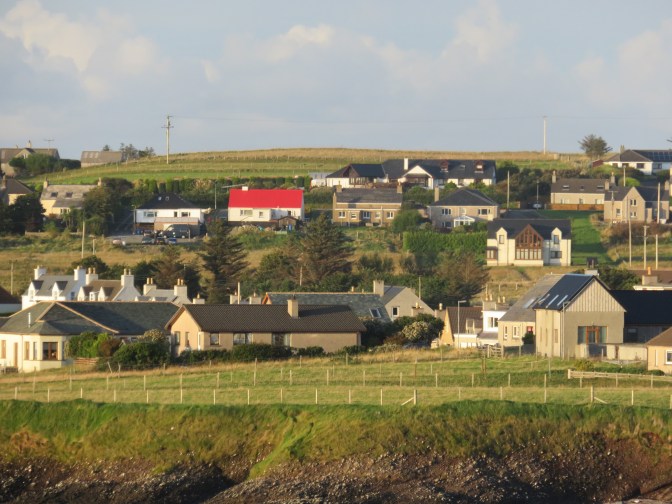
We passed many crofts which are small houses surrounded by a small farm. The family may own the house but not the land, may have a long lease, may pass on from one generation to the other the abode and indeed there are various categories of “ownership” of the Crofts. Most people now only use the farming of their crofts as part of their income adding another or even 2 additional jobs.
When we returned to Stornoway, we thought we had missed the afternoon tour, but were soon told that it has been postponed so was to set off in 1/2 hour. Anne ran into town and got sandwiches and water as lunch between tours.
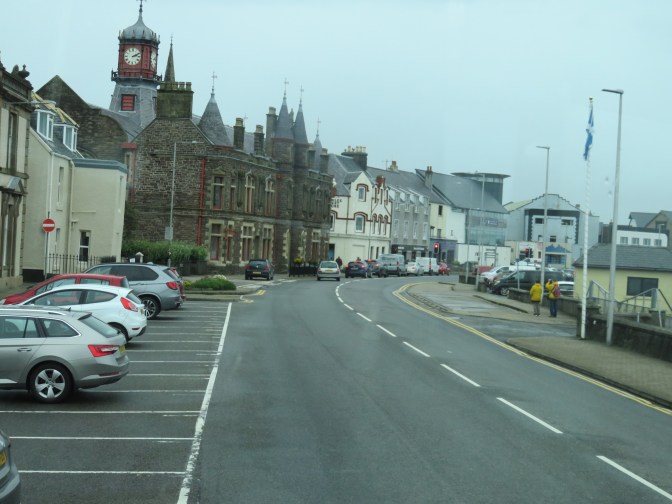
The Afternoon Tour “Lewis Far North Discovery” (Bus 20; Carole Guide & Alexander driver) started north west from Stornoway heading to the northern most tip of Lewis. We were 1 hour late in departing at 3pm and headed North-West to Barvas and from there North-East towards Port Ness. The first stop was at the beach headland and the sheltered fishing boat harbor and a nice cafe made a refuge from the rain and cold wind, so we enjoyed tea. The one exciting part was seeing golden eagles flying, which were majestic.


The next stop seemed like it was in a small town with many of the houses having peat piles for winter heating. The guide mentioned we were to visit the church but none were evident. We followed the guide along a narrow footpath through easements of private homes and fields to a small stone building in the middle of a field. It was here that we found the St. Moluag’s Scottish Episcopal Church with a service on the 1st Sunday of the month and prayers for the sick followed by evening prayer on the 3rd Sunday of the month. The building dates to the early 12th Century and it is believed that it was originally consecrated in the 6th Century and was where Christianity was first preached in Lewis. At one point it was referred to as St. Olaf the Black of Norway. It is one chapel of four places of holy pilgrimage in Scotland for the cure of insanity. It is felt that madness can be cured by tying the mad person to the altar overnight and by morning the person is cured. The small chapel holding some 40 people is simple with 3ft thick stone walls and a separate small building off the transept that could only be accessed from the outside and had a small slit so the people with leprosy (for whom the side chapel was built) could be part of the service without being part of the rest of the congregation.


Our final stop was the Butt of Lewis red brick lighthouse that is 37 meters high and 52 meters above sea level (Latitude 58•30.92’N and Longitude 06•15.71W). It is at the northernmost point of Lewis and in the Guinness book of records as the windiest place in the United Kingdom. It was designed by David & Thomas Stevenson (family of Robert Louis Stevenson). It was established in 1862 and automated in 1998.


Spectacular scenery was everywhere during the stay and the weather changed constantly. We got back to the ship on the last (6pm) tender, but did not leave until 8pm due to a medical emergency. Dinner in the Lido cafeteria and an early bed were the finish of the day and a storm / large waves were present all night as we changed time going back 1 hour during the night.

 Roger & Anne Travels