Wednesday September 11, 2019 – In Akureyri, Iceland.
The Norse Viking Helgi Magritte (the slim) Eyvindarson settled the area in 874AD. By 930 there was tremendous erosion as settlers cut down all the trees to build houses and to heat their homes. Today some 10 million trees are planted each summer in the hope of getting them to grow, but the lava sand with little top soil is difficult. However, by 2010 there has been a 20.3% increase in Vegetation. It is now considered the Capital of Northern Iceland. It has been an important fishing village, but Tourism now is the predominant economic activity with more than 200 cruise ships stopping here each summer. Main contact with the rest of the world is by air although a 2 1/2 day ferry from Denmark via the Faroe Islands runs during the summer. It is situated at the head of the 40 mile long Eyjafördur, Iceland’s longest Fjord. Akureyri is in the North Eastern part of the country some 272 miles from the capital Reykjavik to it’s South-West. In 1785 there were only 10 (Danish) inhabitants and by 1885 it had grown to a mere 286 people. It is located some 60 miles south of the Arctic Circle (60 degrees North), but being a volcanic island situated at the confluence of the Eurasian and North American Tectonic plates, there is a lot of geothermal heat and indeed it is the predominant mode of heating houses. Indeed some 25% of the electricity used is produced using geothermal methods. Iceland gained independence from Denmark on June 17, 1944 and becomes a founding member of NATO.
We docked early (Starboard to dock) The Cliffords had arranged to have a private car and driver / guide for the day, which was perfect as we got a chance to see so much. Rikky (her actual name was Ragnheiõur Ragnarsdóttir) met us by the Quay and was terrific. She and her husband own their own tour buisness (No17 Private Service – Phone +354-896-5318; E-mail no17@no17.is web http://www.no17.is). As we sped off through the 7 mile tunnel (Right hand drive) to our first stop the waterfall, and indeed throughout the day she provided us with a great deal of information. Some of the interesting facts are: –
- Akureyri has a population of 18,500, with Iceland having a population of 338,000 of which 2/3rds live in and around Reykjavik.
- Virtually all are natives as only 2.2% immigration is allowed and very restricted.
- The Viking settlers created their first parliament in 930 AD, 300 years before England.
- Virtually all electricity is produced by renewable energy. Hot water is free, education to the age of 16 is mandatory and free. College and University can be funded through student loans that are payable after 2 years of earning a salary at the rate of the equivalent of one month’s salary per year and the loan has to be paid by age 67 when retirement is mandatory.
- Women never change their name when married and use “son of or daughter of “Father’s Surname”.
- There is a zero alcohol consumption policy as far as driving. No alcohol can be consumed if you are driving.
- The use or possession of Marijuana is illegal and punishable by prison terms.
- LGBTQ rights are complete with same sex marriages being legal and indeed a recent president was openly Gay.
- Gun ownership is not permitted, however under certain circumstances hunting rifles are permitted. However the individual must go through arduous training and examinations both theory and practice, must store rifle and ammunition separately in secure cabinets that are secured to the ground and subject to police inspection at any time.
- The island can be self sufficient in food production with massive greenhouses heated and lit by geothermal power. Animals (many sheep and reindeer as well as horses, cows etc are put out to pasture in the higher areas while the valleys are used during the summer for growing grasses, used to feed the animals inside during the winter.
- Healthcare is mostly free for all including tourists, but a small Co-pay for doctors visits and medications are charged which is capped.
- There is a welfare system to aid handicapped and senior citizens.
- One if the best trout rivers in Europe is the Laxá running from Lake Myvatn and licenses per rod run about US$1,200 per day.
- The often repeated joke based on the lack of trees and those that do exist are small despite growing for many years. The joke is – “How do you find your way if lost in an Icelandic forest? Answer – Stand up”!
Our first stop was at Godafoss (Waterfall of the Gods) on the Í Skjálfandafljóti river. Legend has it that Porgeir Ljósvetningagodi, the Law Speaker and chieftain of Ljósavatn county who lived in the Ljósavatn farm threw the golden statues of the pagan gods into the waterfall and destroyed them bringing an end to paganism and the decision in 1000 AD that the country adopt Christianity. We wandered up the river to the impressive horseshoe waterfall and then over the walking bridge for photographs. We observed Tamagan birds (like grouse) that change their plumage from brown in the summer to white in the winter as camouflage. A very impressive start to the day.


Our next area was to circumnavigate along the ring road Lake Myvatn (midge lake due to the millions of flying midges – 200 tons a summer which feed the ecosystem). The 37 Sq Km lake is fed from underground water and only one river flows from the lake carrying a volume of 35 Cubic Meters per second. The lake is very shallow averaging 2 meters (6 1/2 feet) with the deepest part being 3 1/2 meters.

The first stop was at the “Pseudo Craters” (Skútustaōagígar) firmed 2300 years ago when a thin level of molten lava ran over the marshy area. The water below boiled creating steam and pressure causing the earth to “explode” through the lava forming mini volcanic cones. They are pseudo craters as there is no volcanic activity below. Here we walked the mile or so trail seeing the various cones and walking the rims (some 20-30 meters in diameter) amidst the grazing sheep.


The next stop was twofold. One to enjoy a delicious lunch of nicely spiced trout freshly caught from the lake that morning, and second to see “the field of trolls”. Dimmuborgir (black castles) is a 2,000 year old field of contorted volcanic pillars. This was one of the most spectacular parts of the day. The lava field was pushed up in places into pillars and then cooled into these figure like structures, one looking like a gothic cathedral, another a round hole, and many with what appear to be faces of trolls. Legend has it that a group of trolls were having a great party and not realizing that daylight was about to be upon them (when they become pillars) they madly rushed out trying to get home. However the sun appeared and they were converted into these strange shaped pillars / mini Hills / structures. It was fun to see the Troll without a nose, the kissing trolls etc during the mile walk into this low lying area. Care must be taken to stay on the path as large holes appear all over the fields and one can fall through and never be seen again. There was a system of 9 kilometers of caves in the lava that had collapsed. This was the inspiration of the “Game of Thrones”. There is even a place where one can observe the fissure between the Eurasian and North American Tectonic plates. Here one could stand with one foot on either side of these plates. A much more impressive site where this occurs was later on the agenda of the day. It is the only place in the world where you can have one foot in Europe and the other in North America.


During lunch, the trout was accompanied by local vegetables and potatoes and a delicious bread. We were really taken with this dark brown moist and spongy bread so the guide gave us the recipe of Hverabrauö (Hot-Springs Bread): –
In a large bowl mix together –
- 15 cups of Rye flour
- 3 cups white flour
- 2 cups sugar
- 1 cup maple or corn syrup (it tasted as if it were molasses)
- 20 teaspoons of baking powder
- 1 teaspoon of salt
- 2 liters of milk
Knead the dough until hard to knead
Get a turkey roasting pan with cover and smear the sides and bottom with butter or olive oil to prevent sticking.
Place the dough in the roasting pan.
Bake at 100C (212F) for 12 hours.
Cut into usable pieces and freeze what is not consumed.
NOTE – In the North West of Iceland where the earth is hot due to geothermal activity, the locals dig a pit in the earth, place a disused washing machine drum in the pit and the dough in the cooking recipient is placed in the drum and baked for 24 hours covered with a metal cover at ground level heated only by the hot earth. One of our last stops was to visit a field where various of these “natural ovens” were cooking the bread.
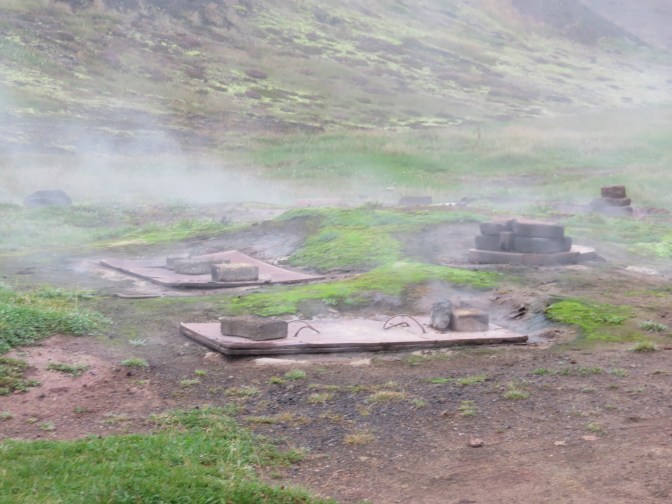
I digress, but returning to the tour, our next stop was in private land (Vogar Farm) where coaches do not go (although a foreign coach was there accidentally) and there are 2 caves filled with water. It is called Girjótagjá. One in which the men swam with no need of clothes in the 45C (113F) naturally heated water, and the other females swam similarly attired!! Apparently some men found a connection between the two!! Swimming is now prohibited as there was an accident, but interesting to visit. During the 1975-1984 eruption of the nearby Krafts volcano, the magma heated the water in these caves to 60C (140F) – too hot to use.
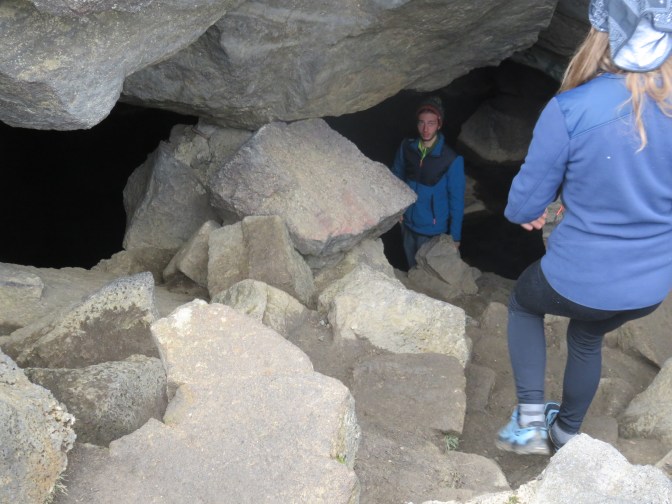
However of greater interest was the amazing geological phenomena where a rift between the North American and Eurasian Tectonic plates is clearly visible. There is a deep opening of the earth with a width at the top of 3 to 7 meters meters (10-22 feet) or more. One could not see the bottom of the gulley. This opening gets bigger by two centimeter or more a year. One year recently, due to seismic activity, the plates shifted open by nearly 2 meters. It was interesting standing with one foot in Europe and the other in North America! Reminiscent of a time many years ago in Ecuador near Quito, when I stood with one foot in the Northern Hemisphere and one in the Southern OR at the Greenwich Observatory in London where you stand with one foot on either side of GMT East and West.


We then proceeded to the bubbling sulphur fields – Námafall Hverir. Walkways are placed over the multicolored boiling earth’s mantel. The east’s crust in this area is barely some 3 Km below the ground Vs the usual 27-30 Km. Thus the earth is molten and bubbling with pops of new holes coming up through the mud. Surface water seeps through the ground and is superheated by the magma returning to the surface making the bubbling earth and also producing the sulphur smell. In the mud pots the gas forms sulphuric acid which then melts the alkaline surface rocks causing also the molten earth. The surface clay is very fine so Hospital “booties” help prevent one’s shoe soles from tracking the mud all over. Stepping off the walkways can lead to instant severe burns as the surface temperature is over 200C (424F) in places. The smell of Hydrogen Sulphide is omnipresent and the area is reminiscent of pictures of desolate surfaces on other planets. At one point before WWII the Germans would harness the Sulphur to form gunpowder.


A fascinating experience similar to what we saw in Rotorua in New Zealand, but there, one was at a greater distance from the bubbling earth.
Our next stop was at the Geothermal Krafla Power Plant which generates most of the electric power (60 Mega Watts as of 1999) for the region. A video in the visitors center explained how the heat from the magma of the nearby Krafla volcano is used to heat cold water / create steam which drives the turbines to form electricity. 40 bore holes have been made capped with aluminum geodesic domes which protect the bore hole pipe junction from the elements. The hot water is also used to keep homes warm in the winter as it is piped to nearby towns, all driven by nature.


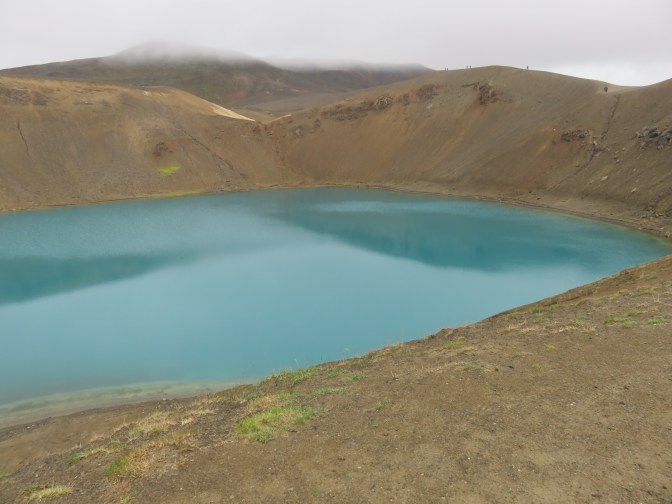
A short distance away is the Viti pseudo-crater formed in the 1720’s at the time of the Krafla fires, and is vast with a diameter of a mile at the top, (around which one can walk), to the Icy milky turquoise blue lake in its center measuring some 40 meters in depth.
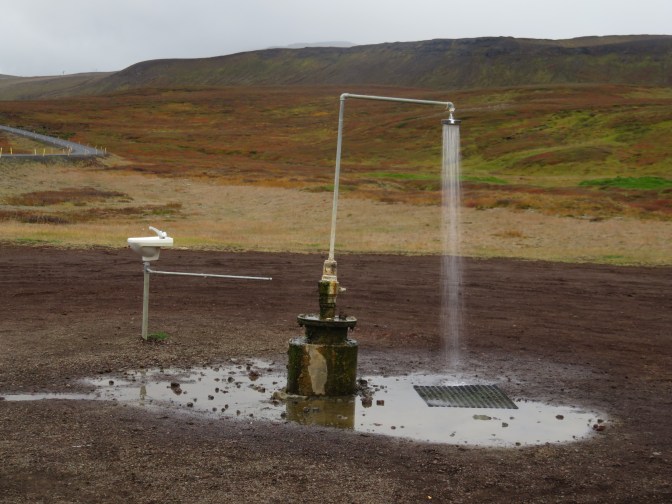
A couple of other brief stops at picturesque spots and the place for baking bread in the ground, led us to our “favorite” amusing stop. A shower by the roadside in the middle of this vast valley that uses the warm round water to run 24 hours a day and 365 days a year. Some people actually use it. The artist who created this also put in a washbasin and a toilet out in the open. The washbasin is still there but the toilet was stolen.
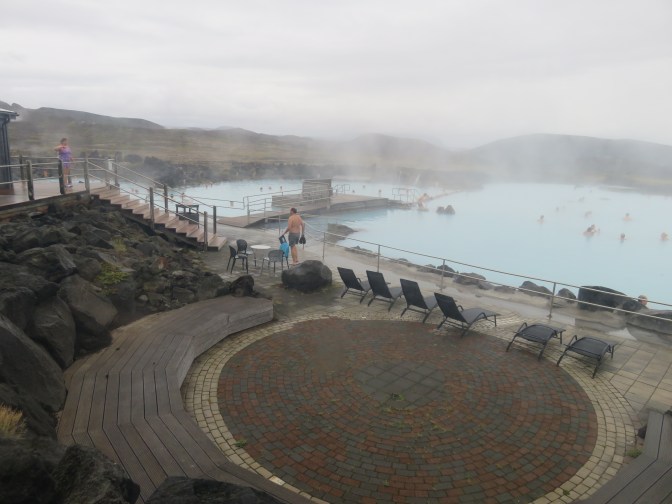
The final stop of the day was at the Myvatn Nature Thermal Baths. A building where one showers before going into the thermal bath (with swimming trunks). The outside milky turquoise water pools are full of minerals and are cooled from the 60+C that comes from the earth to a more tolerable 38-40C. (www.myvatnnaturebaths.is) This is the North’s version of the Blue Lagoon near Reykjavik which we will visit in a couple of days). There were far fewer people there and would have been a good place to go, but time did not permit.
After a long day we drove rapidly back to the ship and boarded with 5 minutes to spare. The staff was pulling up the final things on the dock to put onto the ship as we boarded. Very soon thereafter the Captain said, all are aboard, so we are off. A very full and exhilarating day.
We dined in the cafeteria and then saw the sensational UK comedian / juggler – Pete Matthews. We sat in the front row and he had us in absolute stitches of laughter all the way through and also did a brilliant job juggling axes, knives and anything else. Diana decided to work on her diary so Nelson, Anne & Roger went to this show and the only seats available were in the front row. There was an empty seat between Nelson and a lady, we found was called Dolly from California with a Russian or Slavic accent. She is the classic curmudgeon, nothing is right with anything and all should bow down and deal with her every wish even if to the detriment of other passengers. She is easy to spot as she walks with a cane, which she may or may not need, and changes her woolen knit cap daily. Anyway, the Juggler / comedian started to pick on Nelson and he played along with it brilliantly. However at one point he stood on the arm rests between Nelson and Dolly. He tried to interact with Dolly, but she was having nothing to do with it so moved one seat further away. This of course led to more laughs. We were to come across her several more times.
Overnight we sailed to our next port of call – Isafjordur.

 Roger & Anne Travels