Saturday September 28, 2019 – At Sea.
There was some confusion about whether it was last night or tomorrow night as to which day we gained the hour back from European to UK time. However, at 6:50 AM the captain woke us all up with the news that one of the guests had to be evacuated for medical reasons by helicopter and that we would not allowed on the balconies or decks during the helicopter procedure. We now knew that the change of hour had not taken place.
After breakfast we both had a terrific massage, spent time in the spa pool followed by an interesting lecture on the rise of the American skyscraper by Seth Gopin. It was interesting to find out that the term skyscraper actually came from the old clipper ship days where on the main mast above the uppermost main sail one could add another sail called the skyscraper. This was the highest sail on the ship. In 1882 in Michigan there was an article about the tall buildings and these were referred to as skyscrapers. A hat maker would refer to the large sail like hats for ladies as skyscrapers.
There was some discussion about George Fuller buying this triangular piece of land in New York between Broadway and fifth Avenue and building his headquarters and calling it the Fuller Building. However soon after its construction it became known as the flat iron building given it was built like the sides of an iron to iron shirts. Most houses in those days were built in the ‘post and beam’ or posts like in Stonehenge with the lintel on top. This type of construction would not work well for skyscrapers as is evidenced by the 1780 apartment house at 46 Rue de Valois in Paris. So a lot of new technology had to be developed such as cast iron in the 1770’s and steel in the 1850’s as well as nuts, bolts and rivets creating a superstructure but did not have load bearing walls. Also Plumbing needed to be taken higher than a couple of floors, communication / telephones to communicate between floors needed to be developed as well as a way for people not having to walk up more than six flights of stairs. Early elevators often fell down to the ground when the rope pulling them up and down broke. So Otis elevator company developed a ratchet like structure so that if the rope broke the car carrying the people would only fall a couple of inches. To sell and explain this, and thus make it viable for sale, the Otis Brothers would take their invention to State Fairs. One of the brothers would be in an open elevator and the other would be at the top cutting the rope. When people realized that it was safe, the elevator business started to take off. The first building to have this new technology was the Equitable Life Insurance Company building of 1870 in New York.
Since most of the early architects building skyscrapers in New York were from Europe they brought with them the style of decor for the outside of the buildings that were fashionable in Paris London etc. so many of the early skyscrapers like the flat iron building had a lot of this French decor influence.
With all these new skyscrapers being built in New York, a problem arose that the people on the ground had no light so on June 1, 1906 the Commission on Buildings Districts and Restrictions issued a final report on the set back principal which always runs from the center of the street through the top of the building and allows sunlight for the pedestrians.
The afternoon, post siesta, was taken up with a lecture on “Space law? Yes, Space Law: Introduction and Overview”, by the pre-eminent expert in the field of Space law – Joanne Gabrynowicz. This is a body of law developed since 1957 to address the issues raised by human space activities. It exists at the international and national levels and is an amalgam of many kinds of law including liability law; insurance; Arms control; intellectual property and Sovereign relations.
What catalyzed the need for Space Law was the Sputnik I launched October 4, 1957 which led many (given the US / USSR Cold War) to be worried about the militarization of Space and creating Nuclear bombs (used only 10 years earlier in Japan) in Space. In 1967 the Outer Space Treaty and four others were adopted. This covers physical persons as well as corporate and Sovereign persons and basically says it can only be used for peaceful purposes and for cooperation between all people.
A formal dress evening was the order of the night, followed by drinks at the Commodore Club and an early night.
Sunday September 29, 2019 – At Sea.
Anne woke early and off to Mass after which the four of us breakfasted and we went off to the Captain’s Ecumenical Church Service. We then attended a very interesting lecture by Sue (Astronaut Alan Bean’s wife) and Amy Bean, his daughter. Alan died May 26, 2018. It was very interesting to hear what the wives and children were doing and feeling while their husband’s were off in space. Alan Bean was on Apollo 12 and was the 3rd man to walk on the moon. Apollo 11 with Armstrong and Aldrin had a 50/50 chance to actually land and return. So Apollo 12 & 13 were trained to land on the moon in case 11 could not make it. After 11 being successful, 12 did not go to the Sea of Tranquility but to an area near the 2 year previously successful Surveyor mission and had as one of the objectives to clip off it’s TV Camera to see how the equipment weathered in Lunar conditions. He also spent 2 months on Skylab in 1973. After he retired, he became an accomplished artist painting Astronaut & lunar related pictures.
We enjoyed a nice lunch at the Veranda Restaurant, as a gift from Cunard for being Diamond members.
A somewhat lazy afternoon wandering the ship and attending a scene from Oscar Wilde’s “The Importance of Being Ernest” by RADA actors. Other scenes are to take place around the ship at different times.
We were full from lunch so ended up with a light dinner in the cafeteria and to the show – A comedian from Liverpool, who was quite amusing, and holds the Guinness World Record for non-stop joke telling (101 hours and 39 minutes) – John Martin.
Monday September 30, 2019 – At Sea.
Morning (8 AM) massage with Tiffany (for Anne) and Gigi (for Roger), was followed by Dr. Dan Wilkins talk about “Our Place in the Universe”.
Next, Stephen Attenborough, who is the head of Virgin Galactic, Sir Richard Brandon’s Space Venture spoke on space tourism. There are currently 60 Virgin Businesses with a US$21 Billion annual revenue, 69,000 employees in 35 countries. At the moment only 578 people have flown in Space (509 men and 69 women). Of these 356 are from the USA (306 men / 50 women); 120 from Russia (116/4 men to women); China 11 (9/2) and 86 (78/8) from the rest of the world. The objective is to use a two bodied aircraft to carry a third space craft to the highest possible part of the atmosphere and then launch the rocket to go into space. Thus had been done various times, a Space Port has been built in New Mexico and some 600 people have put up US$200,000 to be on the space tourism mission. They are no longer taking applications, but hope to start operations in a couple of years.
General Sir Simon Mayall KBE CBE spoke on the “Rise and Fall of the Ottoman Empire”. This was very complex, fascinating, but somewhat confusing as there are so many players in so many different places that it was difficult to follow. Sunni and Shia Muslims follow different teaching of the successors of Mohamed – Hasan Inn Ali and Husain Inn Ali and Son Ali Inn Abi Talib.
Professor Joanne Gabrynowicz spoke On “United States Space Law 1958 to 2019”. 50 years of Space Law in which the Law follows technology.
In the evening, Louis Hoover sang his “Salute to Sinatra”. He is a Grammy and Emmy nominated singer and creator of “The Rat Pack” show, done at the London Palladium, Royal Albert Hall and indeed seen by over 15 million people worldwide.
Tuesday October 1, 2019 – At Sea
The first lecture of the day was by General Sir Simon Mayall KBE CBE who was the head of the British troops in the Middle East and Afghanistan. The subject was making of the Modern Middle East. He discussed all of the different leaders and governments and the historical perspective of how we are where we are in the Middle East and North Africa today. He discussed not only the Sunni and Shia and Muslims in general, but also Arab versus Persian versus the Other groups like the house Saad in Saudi Arabia and the importance of each one. Leading to keeping a very tenuous stable / volatile environment.
Amy Bean the daughter of the Moon Walking Astronaut Alan Bean, chatted about Alan’s love for Art. Not only was he an astronaut that had walked in the moon, but as an accomplished painter he could bring some of the feelings and intricacies to his paintings. Most included moon dust, bits of patches he wore on the space suit and a boot print of his moon boots causing a 3-D effect and he used the hammer and other instruments he used on the moon. Each painting has a story and Amy shared with us some of them.
The last lecture of the day was by the Space Lawyer Joanne Gabrynowicz on The International Space Station (ISS). The Space station can be seen from various different points of view The Astronaut experimentation point of view the government point of view and Funding and from the lawyers point of view. To the latter, one sees all the different components of the various countries that created them and of which they are the sole owners. It is within their domain, power, management and indeed territory to control those pieces. It is somewhat like an embassy in a county whereby the Japan experiment module, for example is Japanese soil. So agreements have to be in place between the various nations to use their space and equipment. The US “owns” and paid for about 70% of the ISS. The Chinese have their own Space station which is exclusively theirs. Apart from the US and Japan (Japan Experiment and Logistics Modules, The Exposed Facility and manipulator system), the other counties that have built and own parts of the Space Station are Russia (Docking, Service and Research Modules), Europe (The Columbus Orbital Facility Lab), Canada (The Robotic Arm) Italy (multi-purpose logistics Module) and Brazil.
Initially it was a political decision (not scientific) to get various allies together to work on s common, non bellicose, good for humanity space station. In 1988 the International Space Station Intergovernmental Agreement was signed between the member countries – Europe, USA, Canada and Japan. Memoranda of Understandings (MOU) were created between NASA and the member nations respective space agencies – USA = NASA; Europe = ESA; Canada = CSA and The Government of Japan as it was going through changes in it’s Space Agency. Two other side agreements were made between NASA and Italy’s ASI and Brazil’s AEB.
In 1992 and until 1998, Russia entered with an agreement between NASA and the Russian RSA. However, Russia was not a full member nation as the other partners did not agree to have them included. In 1998, Russia was accepted as a full member nation. The objective of this agreement was to establish A long term international cooperative framework for a permanently manned civil space station for peaceful purposes in accordance with international law. The main parts of the law of the ISS cover Jurisdiction, Tort, Intellectual Property and Criminal bodies of law. All the partners are responsible for their own parts, but the US has the general oversight. If for example the equipment in the Japanese Module is needed by a German Astronaut to do an experiment, a barter system of goods and services is set up between the two nations (not exchange of Funds). The issue then becomes if that German Astronaut comes up with a new invention working mostly in the US lab but needing the Japanese lab equipment for a critical part of the research, who is the owner of that intellectual property? This is just one simple issue in the ISS Law. It really brought home how complex not only the experiments are but the legal and government aspects of such a joint venture.
This was followed by a 1 hour presentation by RADA students and graduates of some scenes from “Much Ado about Nothing”. They have been doing scenes of Oscar Wilde’s plays around the ship.
In the Carinthia room that was a very interesting question and answer hour with the two astronauts that were on board Robert Fiske from Canada and Ulrich from Germany.
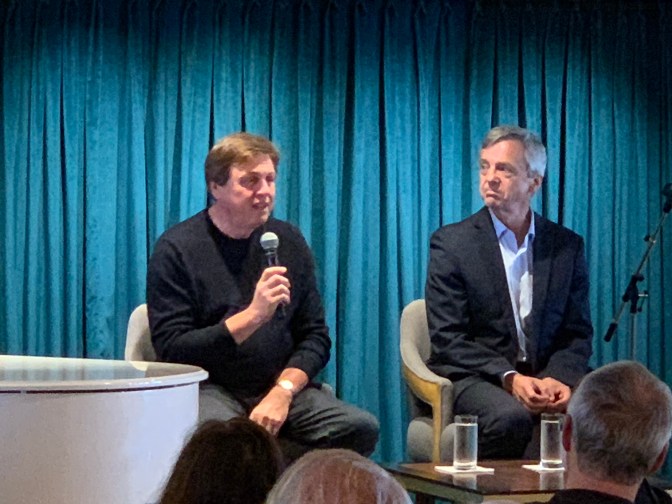
It was free-flowing and many questions were asked but a few interesting points came out. Namely artificial intelligence (AI) is more and more being used to be able to do activities in space. There was a lot of discussion about going to Mars. One of the more interesting points that I found, was that because of the way that Earth and Mars go around the sun your launch window to be able to travel between the two planets only occurs every two years and that launch window is about one month in duration, otherwise one cannot enter into Mars orbit. Furthermore it is only every 15 years that the two planets are close so that the trip could be made with only half the amount of fuel that is normally required. This brings about various different issues:
- Time taken to travel from Earth to Mars is approximately 200 days.
- Once you get to Mars your duration on the planet window to be able to return to Earth orbit is either approximately one month OR you have to wait for over a year.
- This means that for humans going to mars it will be 200 days going 200 days returning and over a year there, so the mission would lost approximately 2 1/2 years from takeoff to return to Earth.
- This means that a lot of work needs to be done on the moon where there is no launch window as it is in the same orbit as Earth long before one can go to Mars.
- It is also the reason why it is only every two years that the space agencies around the world send probes to Mars.
- The last time that Mars and Earth were in close proximity was in 2018 thus 15 years from that date 2033 is the next conceivable time for people to go from Earth to Mars as that is when they are the closest. It is unlikely that technology will be such that the 2033 target can be met thus the next probable time for humans to go to Mars would be 15 years after that or 2048. This date is much more likely.
- The plan is during this period to use the moon for a lot of experimentation and at some point in time send a robotic mission to Mars to prepare a habitat for humans to live in. That would be the first major part to be completed before going to Mars.
- The second major project would be for another robotic mission to go to Mars to be able to use the ice water that has been detected under the surface of Mars and to break it up into hydrogen and oxygen. This oxygen would be needed for humans to live in the habitat created. Also the oxygen and hydrogen would be required as fuel to return The space transport vessel back to Earth. It is not possible to carry enough fuel to take a space vehicle to Mars and return it to Earth.
- Another critical element is food. It is not practical to try to carry food for 2 1/2 years on the mission to Mars, as one would require another spaceship so somehow transport the food. So technology needs to be developed to grow food in the spaceship and Mars. Currently work is being done with items like lettuce and radishes.
While many more items were discussed this gives one a understanding of the complexities that are facing NASA and other Government and private agencies in the space business.
This evening we had a really nice Shellfish and steak dinner at the Veranda, with a brief end to the day in the Commodore Club. A busy but complete and stimulating day.
Wednesday October 2, 2019 – At Sea
Up early for breakfast at 7am as our last massage of the trip was at 8am. A great way to end the voyage followed by the spa bubble pool and different saunas. A quick look at the Atlantic Crossing stuff on the shop, lunch early so we could go to the last lecture by the Canadian Astronaut Robert Thisk. This one was on behavior and human interaction when on long term space flight. There are several key competencies for Behavior on the International Space Station (ISS). These are – Self Care / Self Management; Communications; Cross Cultural Skills;Teamwork and Group Living; Leadership; Conflict Management; Situational Awareness and Decision Making and Problem Solving. Of these, Self Care / Self Management; Teamwork and Leadership are the key three.
He gave various examples of how things went well and badly on the ISS while he was there for 6 months. It was interesting to hear that the price for 2 hour of Astronaut time to do your experiments is US$70,000 per hour. (Twitter @RobertThirsk Web – http://www.RobertThirsk.ca).
A visit to the bridge was followed by a lazy siesta driven afternoon and dinner.
Thursday October 3, 2019 – At Sea
Our last day at sea, which as usual is more about organizing and packing and finishing up odds and ends. However, there were some interesting lectures on The Crusades, and the very interesting “Supermassive Black Holes” by Dr. Dan Williams, RADA group doing a witty presentation about the history of Cunard.
Friday October 4, 2019 – Arrive New York
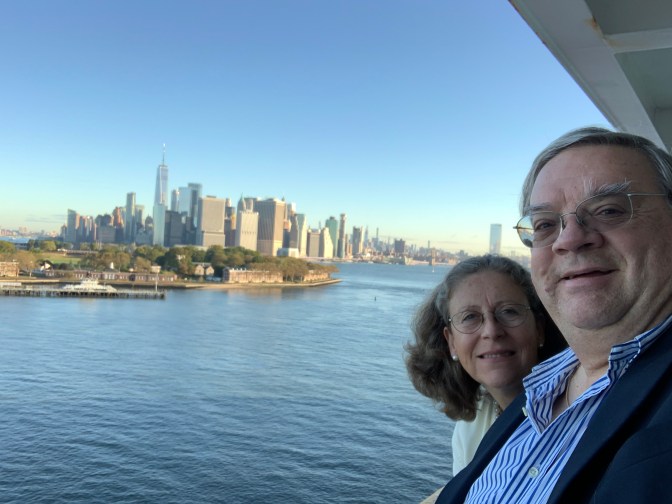
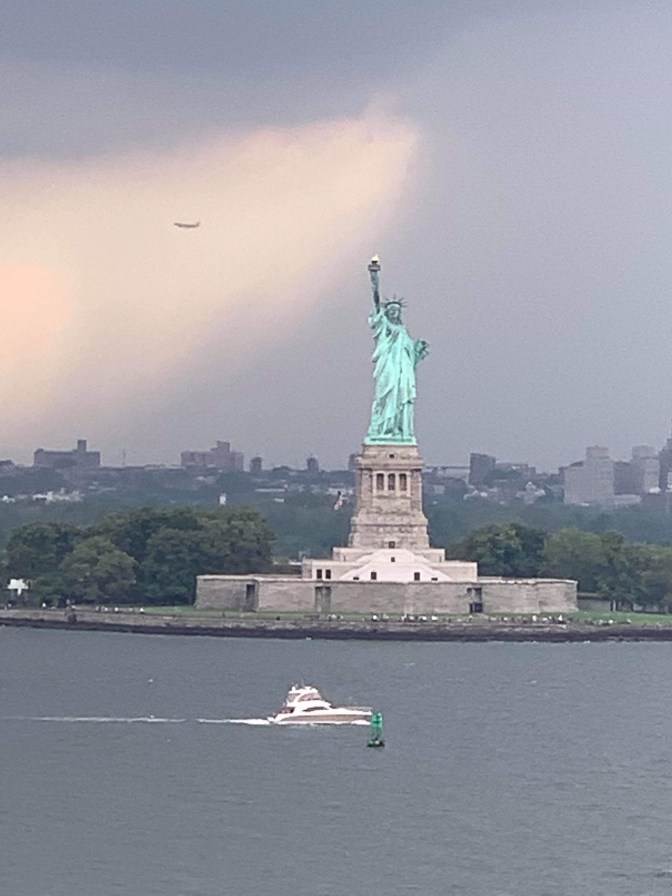
We were awake as we passed under the Verrazano Narrows bridge at 4 AM (due to a balance between draft and height at low tide to get under the bridge. We docked (Port to Quay), so as we were on the Starboard side we had a great view of the New York Harbor, Statue of Liberty, lower Manhattan. We watched the sunrise, spectacular. After a quick breakfast, we headed ashore, collected our collective 28 pieces of luggage, piled it all into the Suburban, which a driver came to pick us up, and headed to the apartment. Anne & the Cliffords took a Taxi as there was no room in the car. We stopped briefly in NY for a bit of shopping, then headed to the Mañanitas for lunch and to Vermont. Thus ended a fabulous 6 week, multiple holiday.

 Roger & Anne Travels