Monday, February 03, 2020 – At sea en route to Salvador, Brazil.
An interesting lecture by Dr. Carin Bonder PhD (Biology) (Fraser Valley University British Columbia, Canada) and previously a professional dancer. She has a Half shaved head and flighty. She spoke on “Wild Moms of the Amazon and Beyond”. An interesting discussion about how different species deal with raising their young.
The next lecture by Dr. Sue Bowler (Leeds University) “No place like Home – Living on an Active Planet”. She talked about plate tectonics and the Earth as an active, ever-changing planet.
We decided to lunch in the Veranda Restaurant and featured some interesting grapes that are more like tubes 1 to 2 inches in length each.
In the afternoon an excellent full 2 1/2 hour full production of Neil Simon’s Plaza Suite was performed in the theatre. It tells the story of four different groups of people that stayed in the same suite at the Plaza Hotel in Los Angeles. 1) A divorced couple arguing over their daughter, 2) A married man with a wife and a call girl. 3) An Oscar nominated actress in a “sham” marriage with her Gay husband and 4) Two couples after a tennis game where traveling friends can result in issues.
The evening performance was the amusing Marc Palmer – a South African Comedian, now residing in Wokingham UK.
Tuesday, February 04, 2020 – At sea en route to Salvador, Brazil.
It was a busy day at sea with 4 lectures, the Crossing of the Equator Ceremony and an excellent concert by a Latin duo with 30 different instruments.
Dr. Sue Bowler the astronomer started with “Meet the Neighbours: Exploring the Solar System”. Earth and other potentially habitable planets and moons was the thrust of the discussion. What are the limits of life from a pH standpoint and temperature. How much pressure can some living creatures stand, living for example miles under the sea near a hot chimney at 300C, for example, or midges that live at the top of the Himalayas. Thus, when life is considered on other planets it can be any of these types. Humans share 99% of their DNA with chimpanzee’s but also 50% of common DNA with bananas. So life May look nothing like us! She further discussed Venus, Mars and their potential or life as well as other of our solar system planets. She mentioned “JunoCam” – NASA/JPL-Caltech/SwRI/MSSS/GeraldEichstädt/SeánDoran – as a place to observe certain planetary phenomena. The inner moon of Jupiter – Titan seems to be the most likely body to have some form of life in our system.
Question and Answer session with Claire Balding OBE the BBC sport presenter and equestrian with Royal connection moderated by the Entertainment Director – Neil Kelly (a 4 time national winner in Baton Twirling)! An interesting insight into how she got her beginnings in the radio then TV presenter rising to national prominence.
We missed the Carin Bondar talk on animals being the best of friends.
The fascinating talk by Michael Kushner – “A Journey to Station X” – Bletchley Park went through the process of how the German code and cyber transmissions were broken including the Enigma machine. He was an employee at Bletchley Park so told a first handed talk.
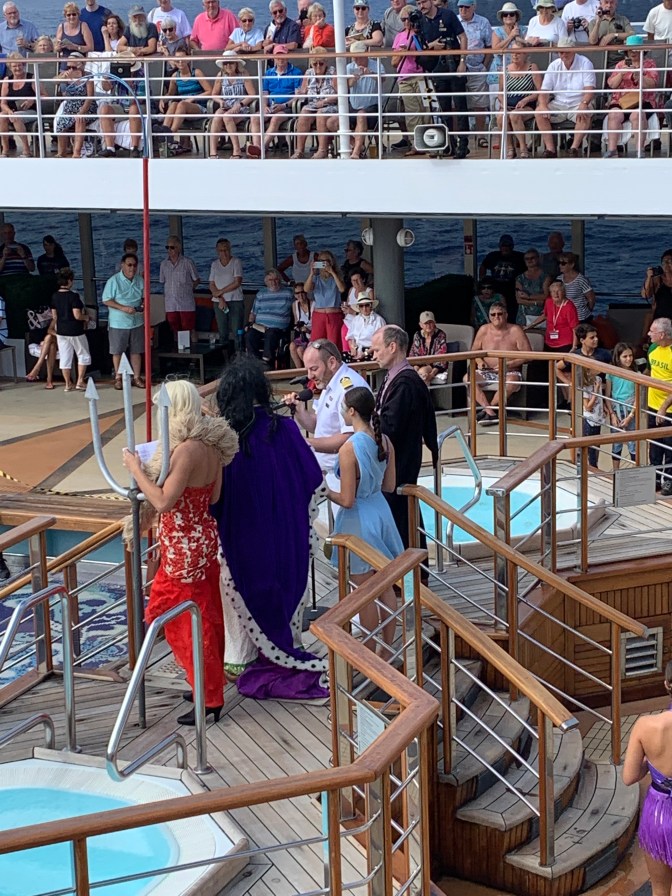
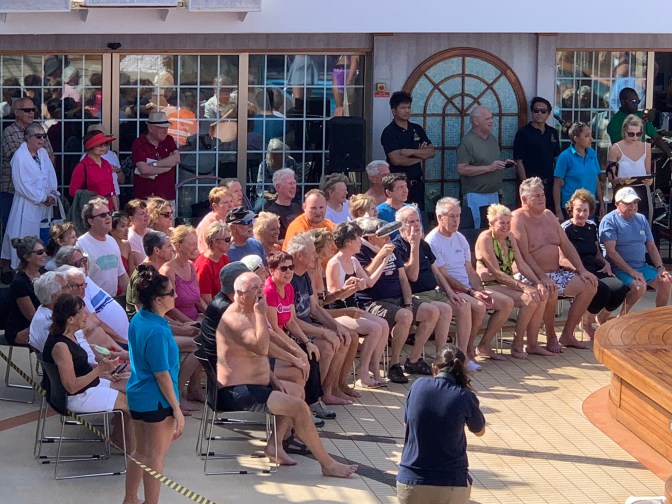
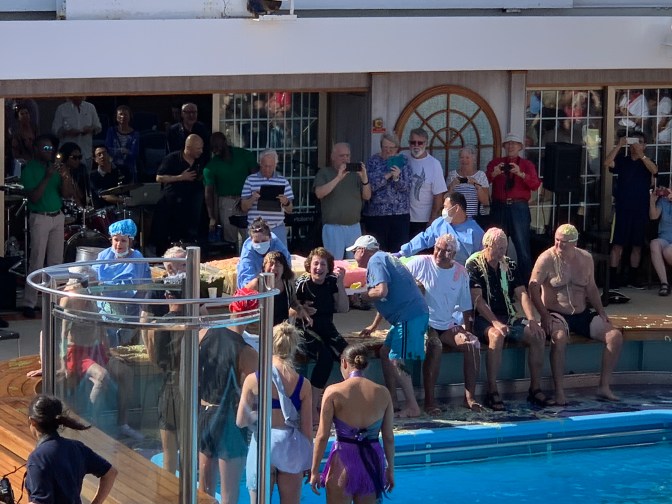
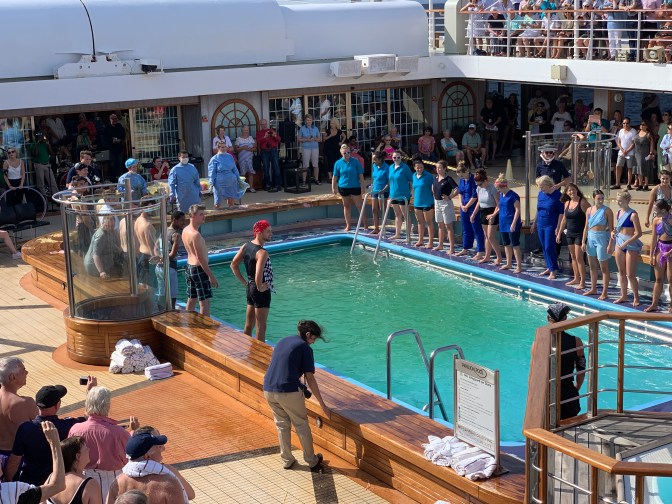
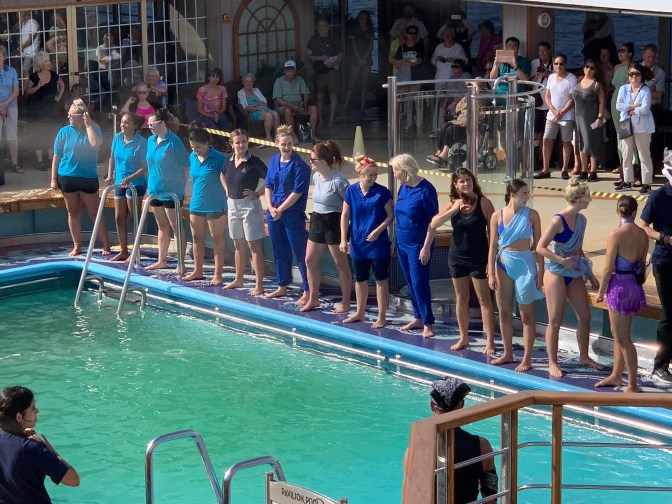
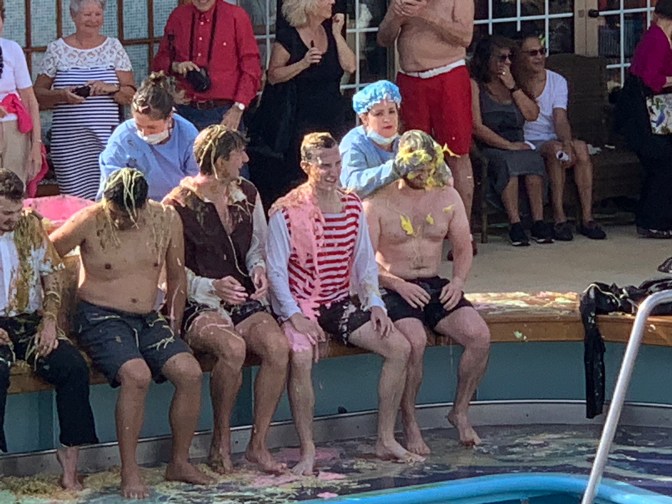
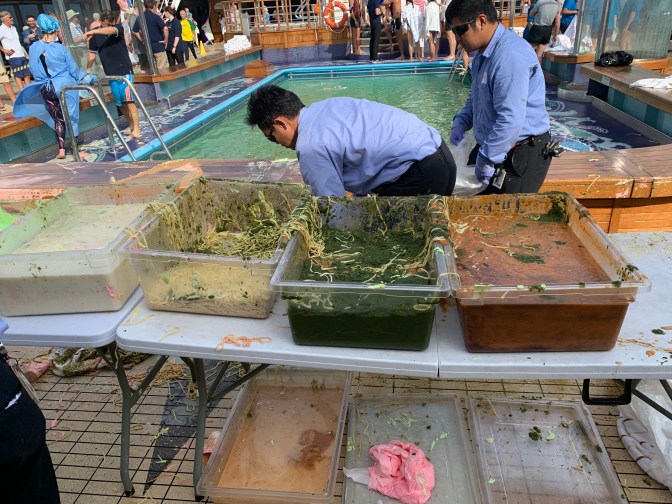
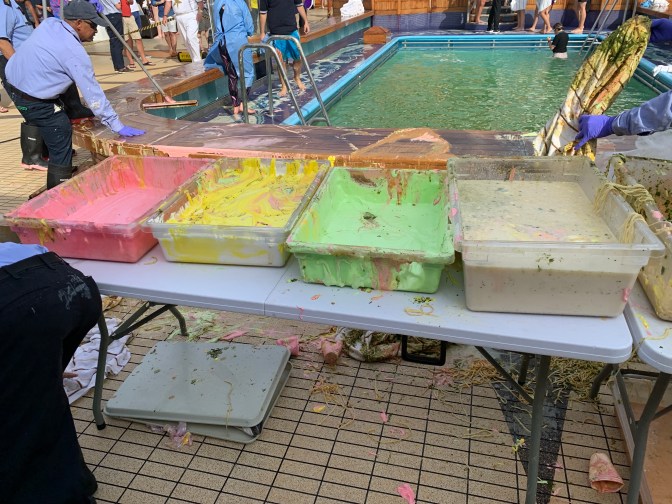
The always amusing “Crossing the Equator” ceremony took place in the afternoon where Pollywogs (those who have never had a Maritime crossing of the Equator) are converted, after due “punishment” into Shellbacks (those who have). King Neptune of the Deep, his Queen and Seaweed Court presided with the judge. All are found guilty of such major infractions as pushing more than one lift (elevator) button or taking extra chocolates from the cart of the cabin steward. For these crimes, the individuals are punished by having “slop” (scraps of unwanted food from prior meals) placed on their heads and bodies and rubbed in. All takes place in front of the cheering crowd, before being they are thrown into the swimming pool. Some dozen male and equivalent number of female pollywog members of staff in addition to the “slop” bath, also competed in a couple of tournaments. 1) Passing a hula-hoop along the line and back of the group of people all while holding the next person, arm in arm. One needed to step through it without breaking the arm-in-arm. The women won. 2) A swimming relay race the length of the pool of 5 people (3 at one end and 2 at the other) wearing the overall of the engineers. The same overall had to be put on before the lap, then with it on, swim the lap, then it is taken off for next contestant to put, on at each end of the pool. The men won.
Then all remaining slop was put on the staff and into the pool.
A fun way to “Cross the Line”.
The evening show was “Yalba” – duo (Latin men) who play musical numbers and sing using 30 different instruments. The content featured songs from around the world – Peru, Mexico, Greece, Russia, UK and other countries were featured. A talented duo and an entertaining evening.
Wednesday, February 05, 2020 – At sea en route to Salvador, Brazil.
Michael Kushner “Sink the Bismarck” – How the British Navy was able to sink the formidable German battleship (with 64 vessels) – The Bismarck, while loosing the HMS Hood in the process.
Even though after WW-I, the Germans were limited in the size of their ships to 10,000 tons, later amended to 35,000 tons, Hitler (who was seasick and did not like the Navy) ordered the construction of 2 “sister” Battleships – The Bismarck (after Otto Von Bismarck) and the Tupitz (after Alfred Von Tupitz) at 54,000 tons. Other dimensions of the Bismarck are – Length 251 meters, Beam 36 meters; armored belt 320mm thick; Deck cover 120mm thick; 3 turbine engines 150,000 HP; Fuel 8,000 tons and Range 9,000 miles at 16 knots with 2092 crew.
It’s main forward and aft guns had 380mm shells with 12 mile range and side cannons of 37mm and 20mm shells. It also had 4 float planes (Arado 196) that could be catapulted off the ship and retrieved by winching aboard after sea landing.
The key dates following the order to build, until it was sunk were:-
1936 Jul 1 – Hull laid at Blohm & Voss Shipyard.
1939 Feb 14 – Construction complete.
1940 August – Commissioned into German Navy followed by sea trials in the Baltic
1940 December – Hamburg for final fitting at a total cost of 71,642,000 Reichsmarks.
1941 March – Final sea trials
1941 May 5 – Hitler performs the last final inspection and the ship sets sail under Admiral Gunter Lutyens a week later, but leaves with tanks missing 200 tons of fuel.
1941 May 18 – First full day of service.
1941 May 19 – At sea and picks up the cruiser Prinz Eugen as part of its battle group, together with 3 destroyers.
1941 May 20 – Starts sail North of Denmark and South if Sweden, where it is spotted, on route to the North Atlantic around the north of Iceland to start its mission which was to block the supply lines from North America to Europe.
1941 May 21 – At anchor while it gets repainted in Atlantic Ocean Camouflage. There is still no top up of fuel during this stop. RAF plane spots it’s location but by the time the bombers get there the battle group have moved.
1941 May 22 – Battle Group heads North towards Iceland. UK Admiral Sir Jack Tovey sails with HMS Victorious, King George V and Repulse; Admiral Sir Lancelot Holland sets sail with HMS Hood and Price of Wales and the HMS Norfolk and Suffolk start to trail the Bismarck.
1941 May 23 – Bismarck Group NW of Iceland being trailed by Suffolk and Norfolk that have superior Radar. Bismarck fires guns for the first time at war and the vibrations knock out the radar room.
1941 May 24 – Battle of Denmark Straights in which HMS Prince of Wales and HMS Hood open fire on Bismarck. The latter is sunk in 9 minutes on the 5th Bismarck Salvo which hit the munitions area. It has heavy guns, is fast, but has no armor. The Price of Wales is also badly damaged, but it scores damaging blows to the fuel tanks of the Bismarck. Admiral Latjens retreats. Winston Churchill, hearing the news send the command to sink the Bismarck at all costs.
1941 May 25 – Bismarck heads to France to get repaired and Prinz Eugen released from battle group. The Hunt for Bismarck is on with shells being fired from both sides. Swordfish torpedo planes (from HMS Victorious) attack the Bismarck. Due to bad weather and avoidance tactics Bismarck looses the British ships.
1941 May 26 – Admiral Lutyens sends 2 long messages saying he is being followed. He receives birthday greeting messages from Hitler. Radio interference locates the Bismarck and the RAF Catalina spots the Bismarck. The British fleet, due to a navigational error go in the wrong direction. HMS Sheffield locates and reports position. 15 Swordfish planes are sent off from HMS Ark Royal and a torpedo hits Bismarck rudder so it is no longer able to maneuver.
1941 May 27 – Last report from Bismarck saying it cannot gain control and the order is given to “Finish her off” at 8:44. By 9:05 Bismarck’s turret knocked out, by 9:31 it’s guns were silenced and by 10:39 the Bismarck is sunk. This was Day 10 after it went into service. About 120 sailors were saved as POW’s and sent to Canada before the British fleet, fearing it had U-Boats approaching, made a quick getaway.
A total of 64 ships were used in this effort – 5 Battleships; 3 Battle-cruisers; 2 Aircraft Carriers; 8 Submarines; 13 Cruisers and 33 Destroyers.
The sister ship of the Bismarck – The Turpitz was sunk in Tromso Fjord (Norway) on the 12th November 1944 using 29 Tallboy bombs (12,000 lbs).
The other talk was by Dr. Sue Bowler on “Other Earths: The search for Exoplanets”. She was good at explaining the complex way that through Doppler Effect Spectroscopy celestial bodies can be mapped. Basically, in the visible spectrum certain wavelengths of light from a planet that is stationary are obtained – The “Fingerprint”. If the planet or portion of the planet is moving away there is a shift towards the red end or IR shift of the various absorbed wavelengths (lines not there on visible light spectrum) and if it is moving closer there is a shift towards the blue end or UV shift. Thus if a body is rotating, part will appear to be moving closer to the observer (UV Shift) and part will appear to be moving away (IR shift) as is apparent in the Doppler effect. (An ambulance or police siren coming toward you will sound different from that vehicle traveling away from you = Doppler effect).
As a planet moves in front of it’s sun one can measure the brightness relative to time. This will give you a measure of the size of the sun and planet.
The Kepler mission (2009-2018) focused it’s mission on observing the area around the galaxy that forms the 3rd star of the constellation Orion’s sword Cygnus. It observed many regular patterns of “planet” passing past it’s sun (KOI-872). Likewise it observed many hundreds of other planets. As part of all this work, when analyzing the Habitable or “Goldilocks” area of each solar system – i.e. Not too close or hot to the sun and not too far away or cold various possible planets were found. The most promising is 452b which has a similar distance from it’s sun, surface temperature, size, rotation, gasses (Methane, Carbon Monoxide etc) as Earth and as such may have life, however it is many millions of years away from us to visit.
This though, brings up an interesting point that Carl Sagan and others worked on. Namely, if you are on another planet looking to see if Earth has life (in any form), what would be the key characteristics that you would look for? The result of the “What is Life” question was – A) Complex, B) Highly Organized; C) Able to Use Energy; D) Responsive to the Environment; E) Able to grow and reproduce; and F) Able to undergo evolution.
The afternoon was taken up with various activities such as Deck Quiots, Shuffle Board and some administrative tasks.
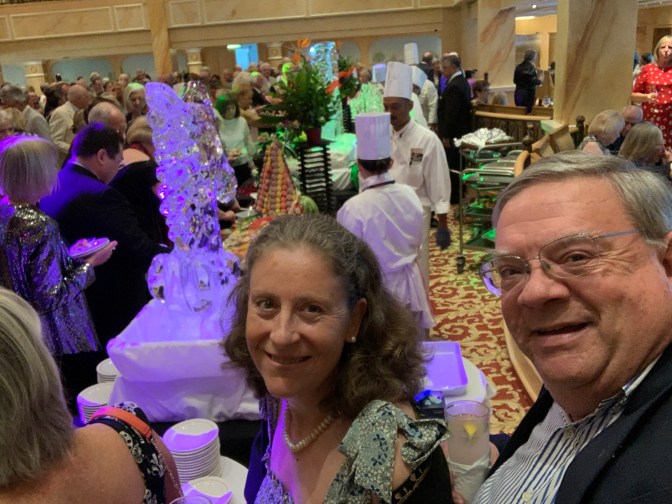
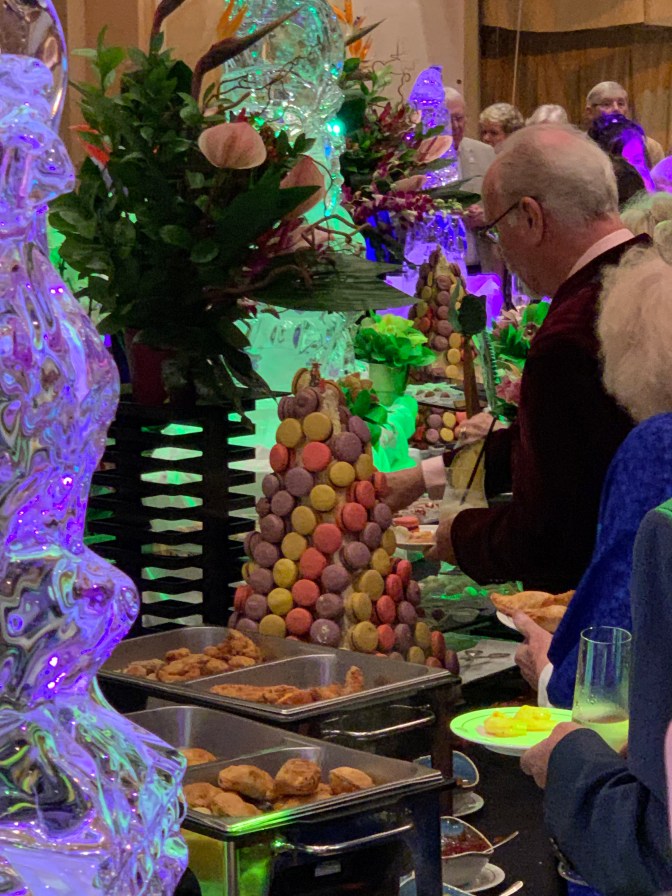
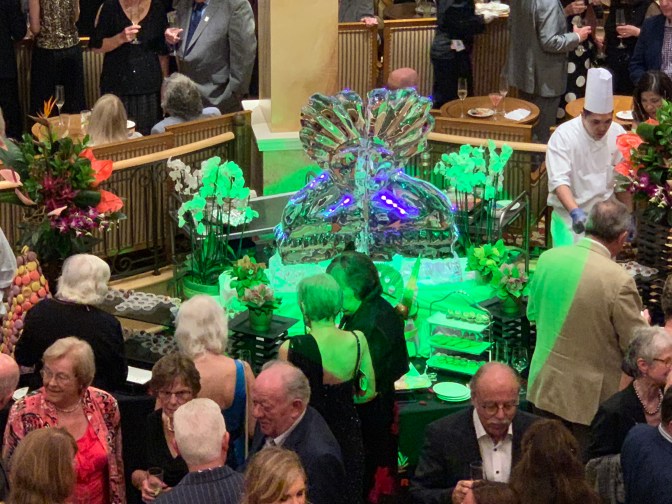
We were invited to the Captain’s cocktail party for all those that are taking the full trip around South America, which is usually the best of the parties.
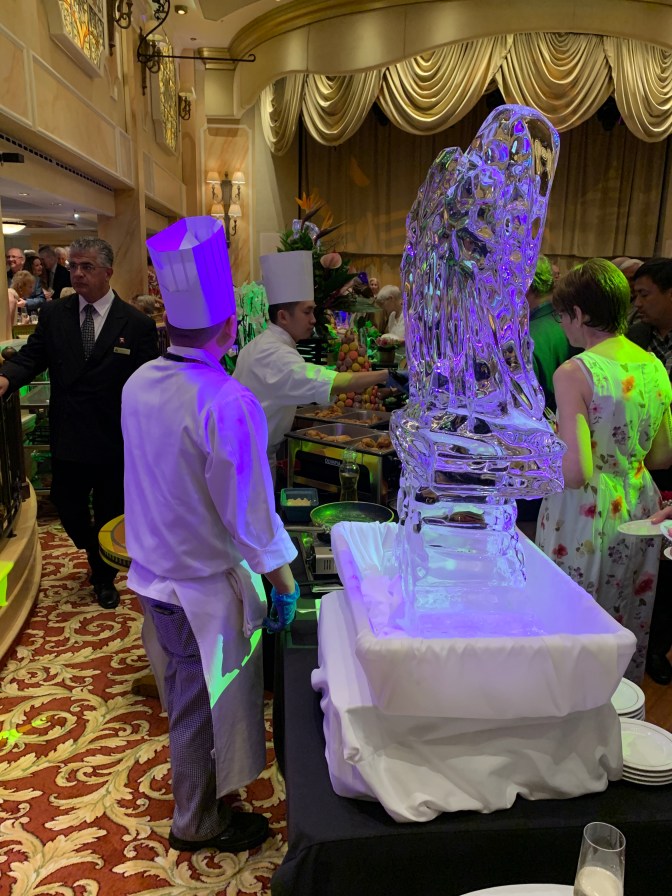
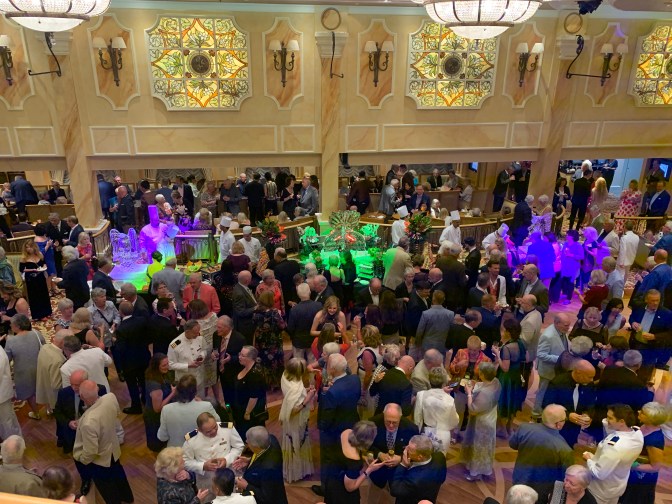
The event show was West End Actor Bruce Morrison who presents the musical theatre of “Andrew Lloyd Webber”. A dramatic singing of many of Lloyd-Webber’s compositions.
Thursday, February 06, 2020 – At sea on route to Salvador, Brazil
The day started with an interview by the security officer on the Manaus incident.
The first lecture attended was Dr. Carin Bondan on “Strategies of Successful Parasites”. There are four types of “Co-existence” – Symbiosis (one life form exists in balance with another life form and cannot live separately); Mutualism (live together our of convenience) – EG Ducks walking with Elephant for protection; Commensalism – EG barnacles on whale’s fun; and Parasitism – “one who eats at the table of another” from Greek – Parasitos or Latin Parasitus.
There are two types of parasites – Ectoparasites (live outside host either on the host body or not – such as head lice) and Endoparasites (live inside the host such as heart worm in dogs).
However there are certain atypical parasites, such as: –
A) Brood Parasites – where the mother of a species of birds lays the eggs in the nest of another type for that mother to raise and feed the parasitic species. The eggs are laid quickly (a few minutes as opposed to 1/2 hour) and timed so they hatch a few days before the host’s eggs thus getting the jump on feeding. Extreme cases include the parasite mother either making a hole in the eggs of the host or even rolling the eggs out of the nest.
B) In the Sea Beam fish, microspoidium enters the fish on which it feeds forming cysts and tissue inflammation. Thus it establishes suitable conditions for growth and protection against the immune system of the host. These can be transferred to humans in undercooked fish.
C) The large scale Mullet can have the parasite of “tongue eating louse”. Here the parasite enters through the gills and cuts off circulation to the tongue, and attached itself to the stump of the tongue of the fish so it receives first ”go” at any food entering the bucal cavity.
D) The blood-spotted swimming crab can get a parasitic barnacle (Rhizocephalans) in which the parasite sets itself up initially in the reproductive system and gradually replaces all of the insides of the crab with rhizome type structures. When the crab no longer exists and dies and consumed by another crab, the life cycle can continue.
In summary, 40-50% of animals in the planet are affected by parasites in one way or another.
The next lecture was on “Hitler’s Secret Weapons” as part of the Bletchley park series by Michael Kushner. The first Saturn 5 Rocket with Apollo X was launched on November 9, 1967 after Wernher Von Braun went to the USA after the war to establish the rocket program. But to start years earlier. Hitler promised that Germany would never be bombed, so when it was, he determined retribution and ordered secret weapons to be built. These were the V1 (Doodlebug) the V2 Ballistic Missile and the B3 Super-gun – which was not successful.
Hermann Oberth was the father of German rocketry and a mentor to Wernher Von Braun, yet Fritz Gosslau was the man with an idea for a flying bomb working for Argos Aircraft Company. A very large center was set up in Peenemunde, a remote seaside town to work on “flying bombs”. The British started monitoring what was happening in these mega-structures intercepting communications when possible and using photo-reconnaissance. The place was eventually bombed, but despite a lot of ordinance, operations continued.
The first V1’s traveling at 500 mph and carrying 1 ton of Amazon (TNT & Ammonium Nitrate) were launched at London on the 13th June 1944. Defended of Anti-aircraft guns and Barrage Balloons it was not very effective. Through use of double agents (Carbo & Zigzag pseudonyms) the Germans were convinced that their bombs were hitting too far North of London and so they had to recalibrate. In actuality, they were hitting on target but this move made the bombs explode South East of London in fields. Overall 8,025 V-1’s were deployed having 14,600 tons of explosive, damaging / destroying 1,127,000 structures and 22,892 casualties.
The V-2 powered by liquid oxygen and ethanol based on Von Braun’s A4 rockets and 1 ton of Amitol, was first tested on 30th October 1942 traveling 118 miles and was 2.5 miles off target. Building was underground using concentration camp labor from Buchenwald until a closer camp – Dora – was constructed. The first actual bomb was sent on September 8, 1944 doing damage on Staveley Road in Chiswick and 3 killed. It travelled at an average speed of 2,685 mph with the same amount of explosive material. Several more were sent and reported as gas explosions. A total of 505 bombs were built at peenemunde and 5,917 at the alternate site by the camp of Mittelwerk. Of these 1,358 hit London and 1,664 at Belgium.
The V-3 super fun was never effective.
The evening saw a performance of the Mucial “Top Hat”, which we enjoyed. The first performance on a Cunard ship took place while we were on Board last year, where the director was interviewed and we saw the opening night. Tonight was also well done.

 Roger & Anne Travels