Friday, February 07, 2020 – Salvador, Brazil.
Salvador da Bahia or just “Salvador” it often just “Bahia” is on the Northeast coast of Brazil and the capital of the State of Bahia with it’s 404 cities. It was the first to establish a municipal council and was the Capital of the country for 214 years (1549 to 1763). It moved to Rio de Janiero which was closer to Minas Gerais where Gold was found in the mines and remained the Capital until relatively recently (1763 to 1963). It subsequently was moved to Brasilia in 1963 which was built specifically as a Capital City. Salvador is one of the oldest cities in the country and third most populous (3MM) after São Paulo (12MM) and Rio (6MM). However, in the 2020 census, Brasilia (2.4MM in 2010) may overtake Salvador in population. Brazil has a total population of 212MM and divided into 26 States plus Brasilia. It is the 5th largest country both in Area (after Russia, China, Canada and USA) and also 5th largest in population (after China, India, USA)
It is steeped in African roots having received 3-4 million slaves (more than half of all slaves brought to Brazil) from Africa that brought their customs, religion and food. Brazil was The last country to abolish slavery on May 13, 1888 after a rebellion that was started by a man who statue is in the upper village. Many slaves that were brought from Africa died during the journey and the corpses were just thrown overboard. The transportation was in the lower part of a ship which was only some 3 feet high, the slaves were chained and only had enough room to lie on their sides next to each other. In general, once they were in Brazil and working they were treated in such a way that the average lifespan was seven years after they had arrived in Brazil. Currently 70% of the population (2+MM) of the residents are of African origin. It has a temperature range from 21•C in Winter to 35•C in Summer.
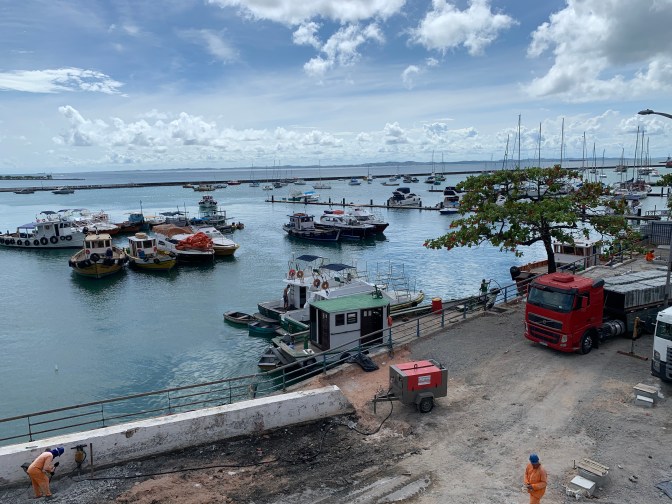
It is situated in the second largest Bay in the world – Bahia de Todos os Santos, named after “All Saints Day” (November 1, 1501) when it was “discovered” (Canada’s Hudson Bay is the largest). The bay with its 30 kilometers of beaches has 14 forts that were constructed to ford off the invading armies particularly from France and The Netherlands. Three of these are in the area where the first village was formed. San Antonio Fort with the first lighthouse in the Americas and still operational was built in 1591. The Dutch (major battles in 1628 and 1632) took rosewood (Jacaranda) for doors, windows etc. and a local (Pao do Brazil) tree for red paint.
The main economic driver today is Agribusiness – cattle, soya, Tobacco, sugarcane (for auto alcohol production now 30% Alcohol and 70% petroleum) and used to be Cocoa (now surpassed by Nigeria). The minimum wage is US$250 per month (Local Reis are 4:1 Vs US$). A good apartment, in a good part of town will run from US$250K to US$2 million and up. The city subway (underground) transportation system was planned to have 13 Kilometers at a cost of US$500 MM and ready for use in 2004. In actuality it was only 6.5 Kilometers, cost US1 billion and opened in 2014 in time for the World Cup and only took people from the shopping center to the stadium. Since then 2015 – 2020 it was expanded by a private concern and now has 35 kilometers of tracks for service.
The excellent guide (Coach 4, drive RHS, Port side to dock) was a student at university and spoke excellent English. He was proud that Salvador (aka Bahia) has the largest Carnival celebrations in the world lasting a week. Whereas the more famous Rio Carnival is more of a parade of samba “schools” (Neighborhoods), the one in Bahia is various groups of musicians playing African originated Aché music on an electric bus (total of 25) and followers walking 3-4 miles through the streets singing with onlookers joining in. In the afternoon and evening the drinking and partying takes place each day. Carnival starts 13 days from the day we were there, so all the preparations were well underway. Statues were boarded up. Bleachers were under construction and the buildings along the route were being spruced up. There are three ways to experience this. 1) At no cost is to participate from the crowded streets as best as one can given the 1 million people that participate each year and known as the popcorn people; 2) To buy a specific shirt for US$300 which permits you to follow along closely behind one of the music trucks; OR 3) The VIP way which is mostly for tourists, but also some important locals, and costs between US$100 and US$700 per person, in which specially constructed viewing platforms with all the food and drink and air-conditioning that you might want are included. There are approximately 300,000 tourists that come to the carnival each year.
The City is divided into an upper and Lower area. The lower area is filled with many historic buildings that lie in partial ruin and empty due to legislation. It is the home to the many homeless and crack / drug addicted population so not advisable to be in the area after dark. The government wants to keep the integrity of the old colonial historic district but makes it very difficult and extremely costly to get permits to restore the buildings which most can not afford. So they remain empty and falling apart. There is some effort to have the Universities take over and modify the buildings.
An elevator (lift) between the upper and lower City segments was built in 1873, but used only for goods and animals that come into the dock and go up the 70 meters (220 feet) to the city center. In 1913, it was renovated and now carries people at 26 per lift (4) for the 30 second ride, carrying some 100 people per minute all day.
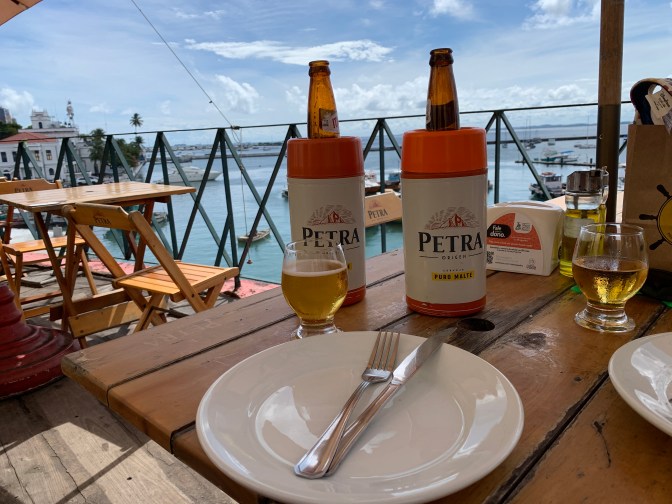
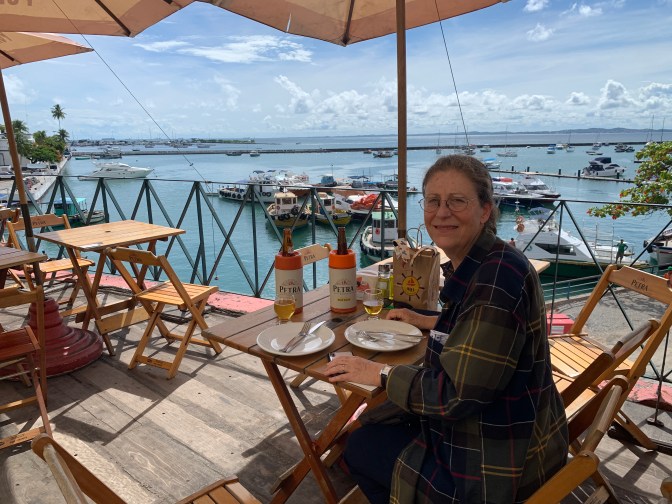
The lower part of the lift is opposite the artisan “Modelo Market” and has 2 restaurants overlooking the bay, where we had lunch later.
There is a very large island (Itaparica) in the middle of the bay that has 2 cities – Veracruz and Itaparica, a Club Med resort and a population of 100,000.
Of note is that Independence of Brazil from Portugal was brought about not by war but by a deal between father and son. In 1808 Napoleon invades Portugal and the royal family are forced to flee to Brazil where they remain for 14 years. The King then went back to Portugal and the son remained in Bahia, Brazil. In 1822 there was an agreement between the King and his son, in which Brazil was to be independent of Portugal and remain under the rulership of the son. Initially Salvador did not accept the independence until July 2nd, thus the names of a square and streets bearing that date/name.
The current second largest company in Brazil after Petrobras the oil giant, is Itaipava owned by a local billionaire, producing beer. This company is buying up breweries and more all over the world and now owns such brands as Corona, Budweiser, Stella, Miller, Tim Horton’s, Burger King etc.
There are some 300 churches in Bahia city many built during it’s hay day when it was the most important city. Brazil has one of the biggest Roman Catholic populations in the world with some 61% claiming to be Catholic (130 million). The first Brazilian Saint, a woman from Salvador who started the hospital for the poor, was canonized by the current (Argentinian) Pope on October 13, 2019.
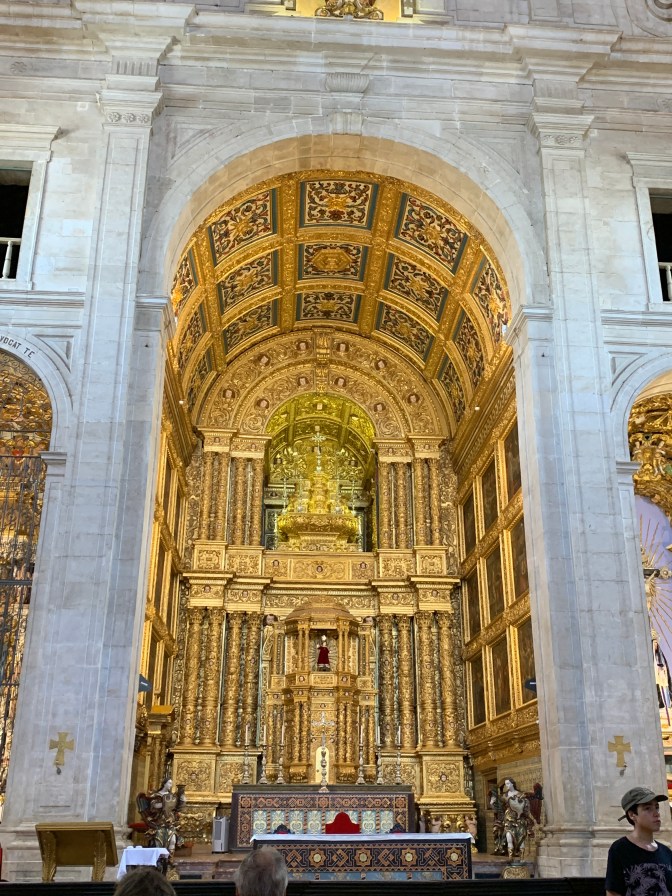
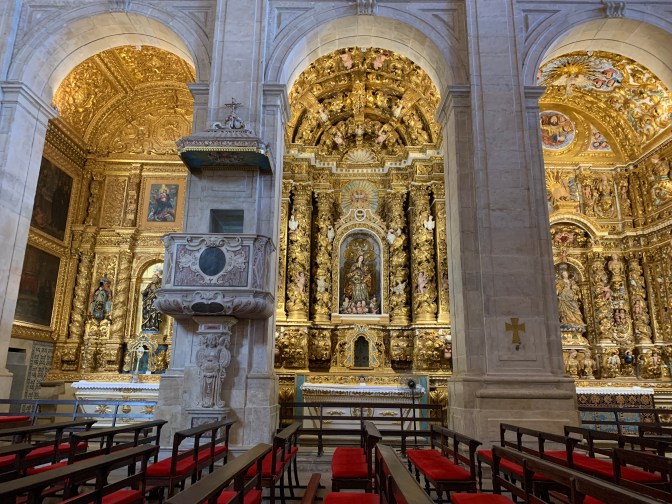
The main Municipal Square in the upper town has many points of interest, but of particular note are the Cathedral at one end and the spectacular San Francisco church and “annex” – The 3rd secular Saint Francisco (Francis) of Bahia Church complex, founded in 1635 by Benedictine monks. A gorgeous church with elegant carvings in gold leaf, banquet halls, vestment rooms and a cloister with beautiful blue tile scenes etc.
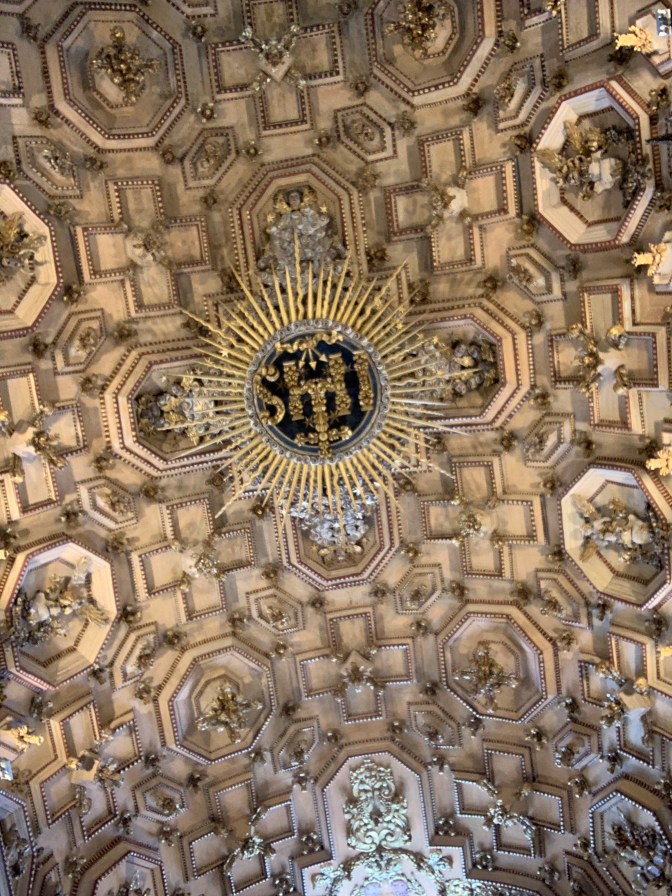
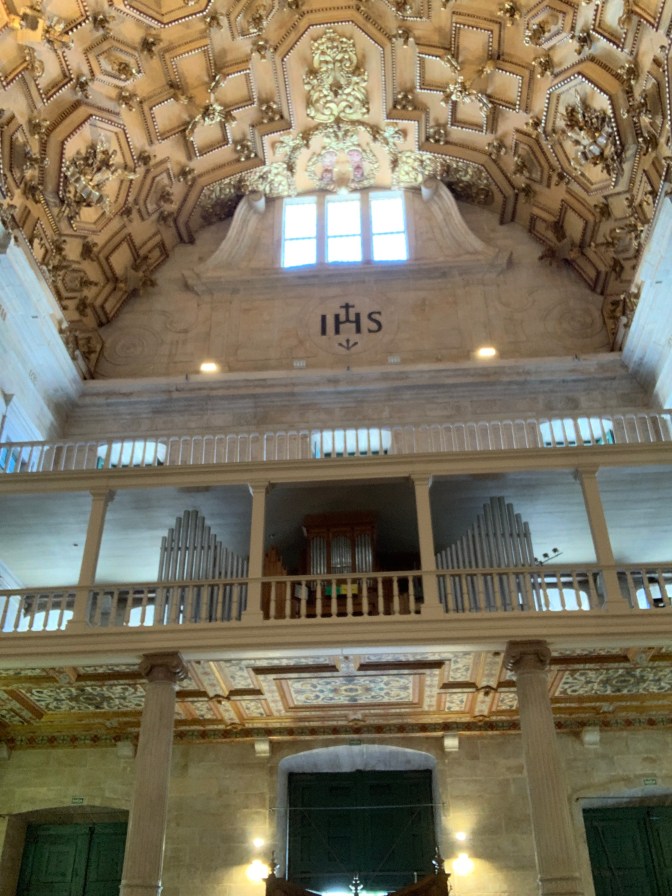
If one were to walk out from there and not see anything else, one would think it to be spectacular. However, entering the St. Francisco Church, with it’s 800 kilos (1800 lbs) of Gold all over the spectacularly wood (Jacaranda) carved arches, niches, side altars and main altar, everything else pale’s in comparison. The cloisters (1743-46) with spectacular blue European tile depicting scenes of the Hermits and life of St. Francis and side rooms make it the “must see” of all places in the city. To quote the pamphlet given to visitors – “The decoration gives the impression of profuse exuberance of arabesque forms whose style and unity is only interrupted by straight lines of the ceiling.” In 1587 the first Franciscans arrived and took up residence near the poor chapel where the convent is today. In 1591 the small convent was started and expanded to the new convent in 1686 due to the influx of Franciscans. The foundation stone of the new church was in 1708 and the church inaugurated in 1713. The construction was completed in 1723 and the decoration and interior completed in 1750.
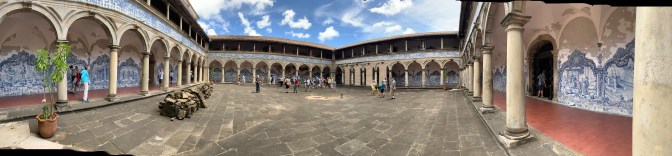
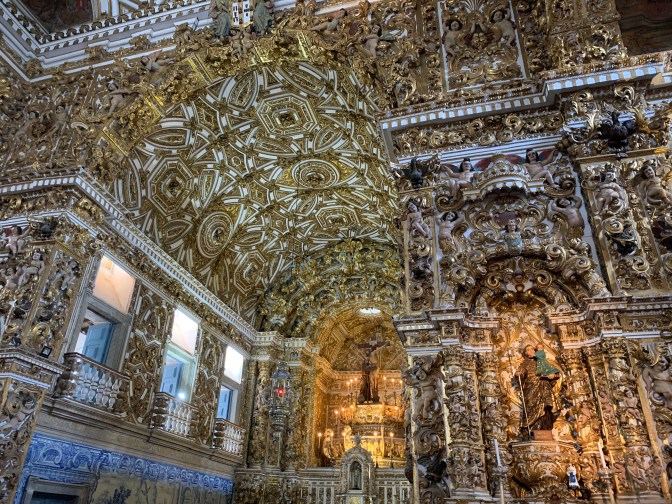
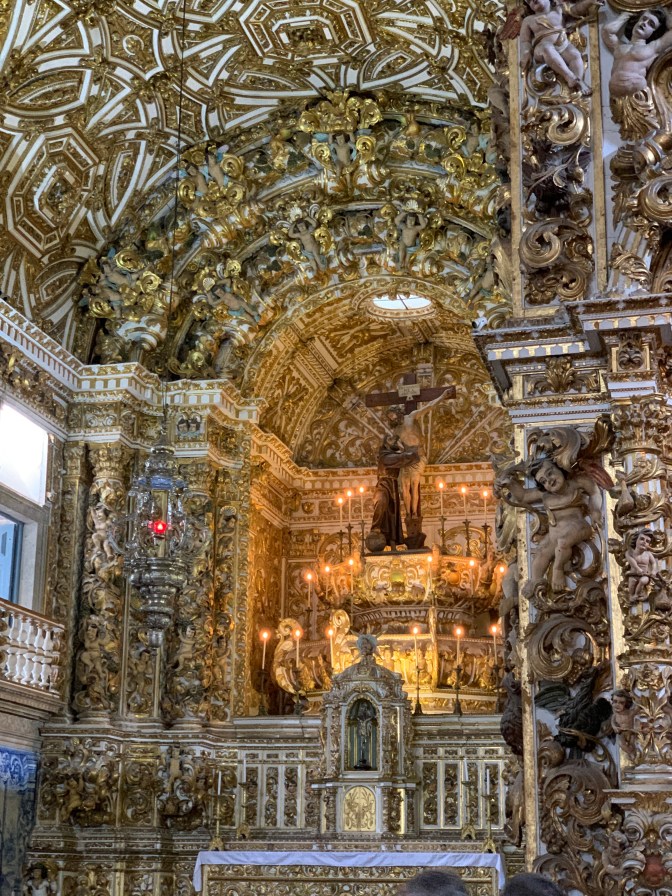
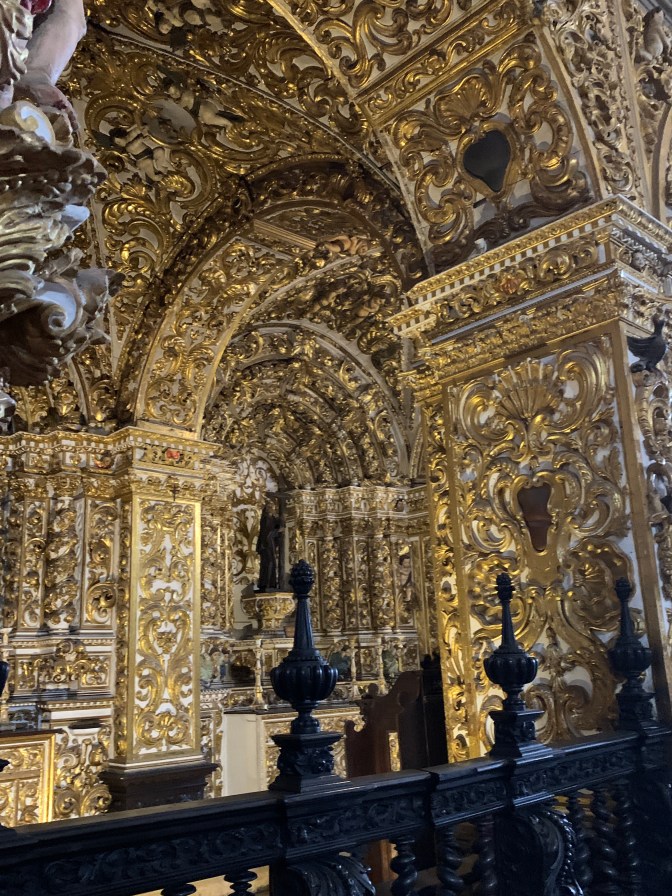
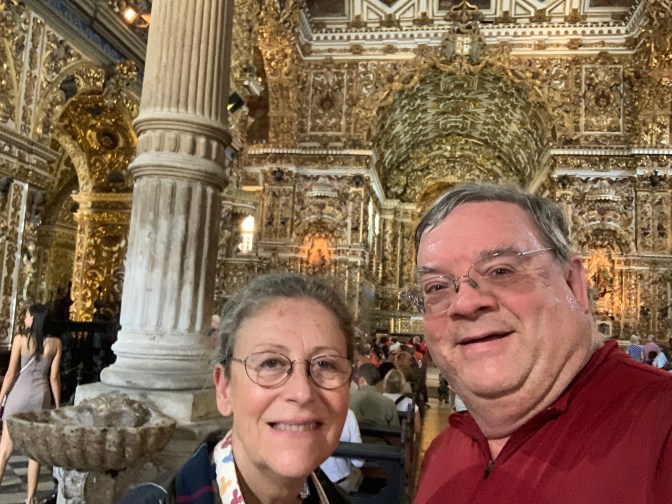
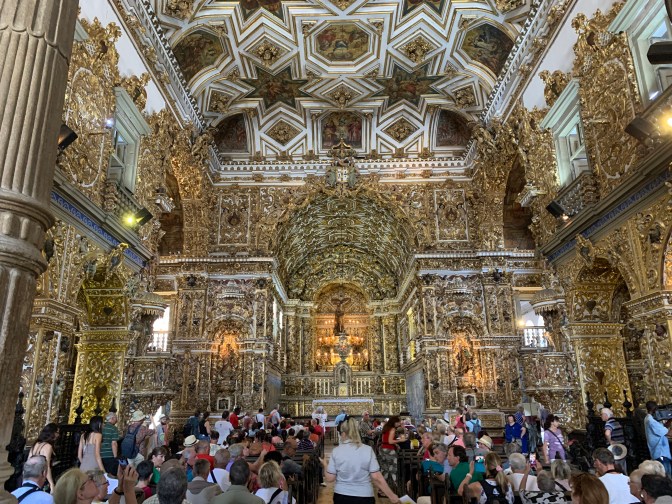
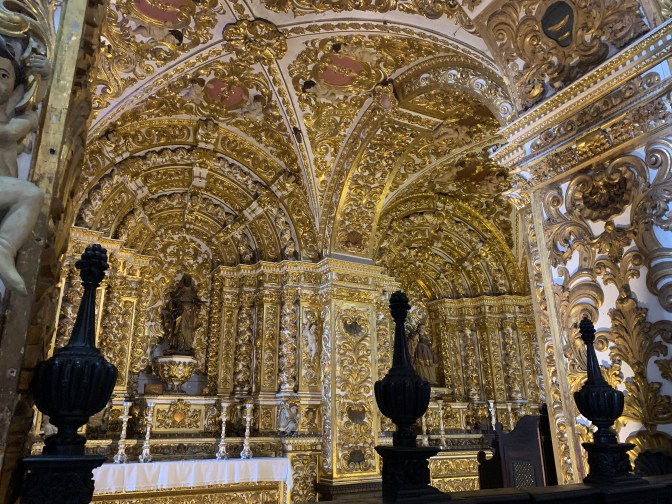
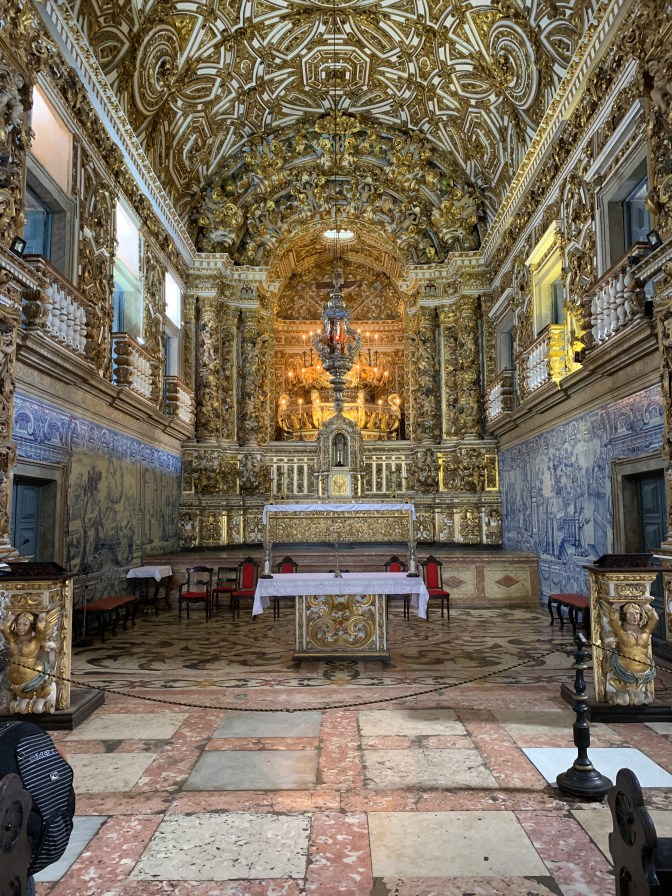
Leaving this spectacular church we enjoyed a fresh coconut from the local vendor before heading to the cathedral. Another building of intricate carving and Gold, which again in and of itself, is spectacular, but is no match after seeing St. Francis. We then wandered to the lift to go to the lower city, and as we were “senior citizens”, we were waved through without having to pay the R$0.15!!
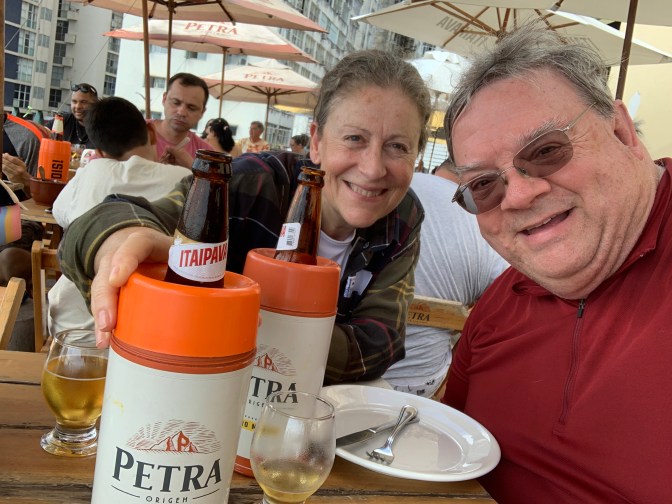
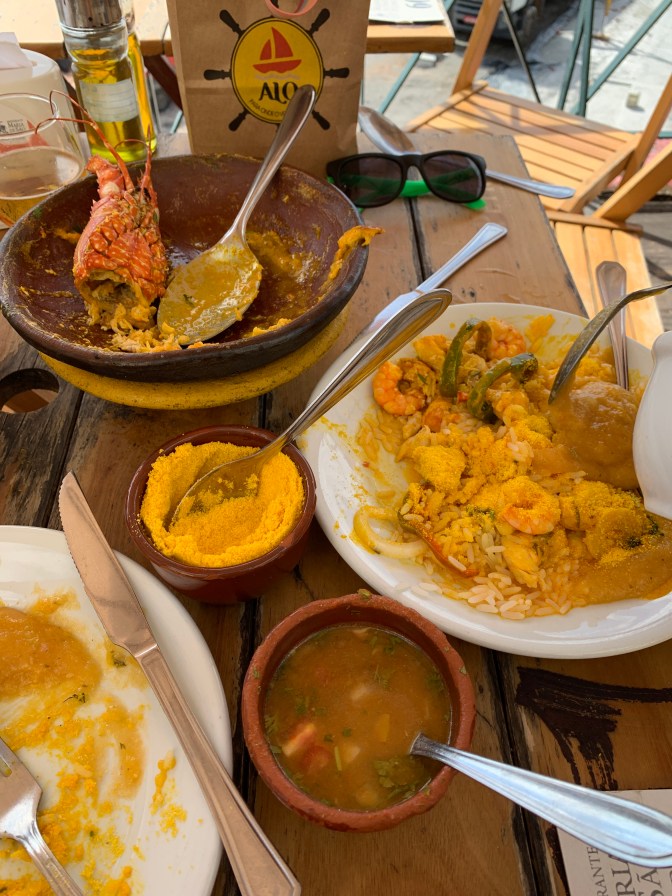
After getting to the bottom of the lift, we wandered over to the market, making our way to the María de São Pedro Restaurant for the delicious local dish of lobster and shrimp with vegetable stew in manioc and coconut sauce (which is poisonous if not cooked properly), accompanied by rice, farofa (cooked Manioc root flower), a delicious sticky / gelatinous starch (of unknown origin, but possibly beans) and pimenta (Hot sauce). This was washed down by 3 liters of Petra beer sitting on an open air balcony overlooking the bay. A spectacular end to our day in Bahia.

 Roger & Anne Travels