Friday, February 21, 2020 – Ushuaia, Argentina
We docked, port side to dock pier with cargo ship opposite about 7:30 AM. We were met by our car, guide and driver – Perla Rojas; phone +54-92901-46-57-44; email perlaush@hotmail.com – Excellent guide and driver who has been guiding for 30 years in Ushuaia. She works during the Summer season (October to March) almost every day in English 50% and Italian 50%. It was a happy surprise for her working with us in Spanish. Apart from Tourism, both National and International, the main work is – 35% of the population work in Government and 35% in Industry making TV, Washers, Microwaves etc.
Ushuaia (in Yámana = Bay Penetrating Westward) is located on the north side of the Beagle Channel in Argentina at the bottom of the Tierra del Fuego (28,274 Sq Miles / 18.2 Million Acres) Island facing the Chilean Islands of Navareno and Hosta. It is the southern most city in the world and has been growing population from some 4,000 people 30 years ago to some 70,000 people today. Puerto Williams on the Southern / Chilean side of the Beagle Channel is making that claim but is still a relatively small town. If one were to go around the world at the same Latitude as Ushuaia, there is no other land mass that you would encounter, only Sea. It is 2000 miles south of Buenos Aires and over 500 miles south of the north coast of Tierra del Fuego Island.
The Yámaha or Yaganes natives lived in the area and were the early settlers of the area. They were nomadic, hunter gatherers seldom staying in one location for more than a few days. They were a Matriarchal Society where the men were used for hunting, but the women did everything else. There purportedly is one very old woman who still can speak the language, but dictionaries and grammars prepared once the language is completely extinct. The Spaniards killed off virtually all the locals with diseases and other actions. They were unclothed and used the fat from seals to rub all over their bodies to protect them from the cold. Temperatures today run from about -10C in the winter to +18C in the summer, which gets 17 hours of daylight a day. In 1520 when Magellan first sailed these waters it was the light from their fires that prompted him to call this area Tierra del Fuego – Land of Fire.
HMS Beagle, under the command of Robert Fitzroy led an expedition in the 1830’s with Charles Darwin aboard, to the area. Thus the name of the Beagle Channel on which Ushuaia stands. The City was founded by Augusto Lasserre on (Beagle channel to the South and Marrial mountains to the North October 12, 1884. The region was incorporated into Argentina and Ushuaia was named a City and regional capital in 1893. It is exempt of Goods and Services Tax. In the late 1800’s a penal colony was established and the prisoners were used as laborers to build the prison on, railroad and other such structures. It ceased being a prison in 1947 under President Peron. The former 380 (6X9feet) cell prison (Corner of Yaganes and Gobernsdor Streets) is now a private maritime museum. Other museums we drove by but did not visit, were The Museum of the End of The World built in a 1903 building on Maipa Avenue and Rivadavia Street, now run by the Government and apparently rather rundown. The Museo de Marquetas – Mundo Yármana (54 Rivadavia Street) is a better alternative.
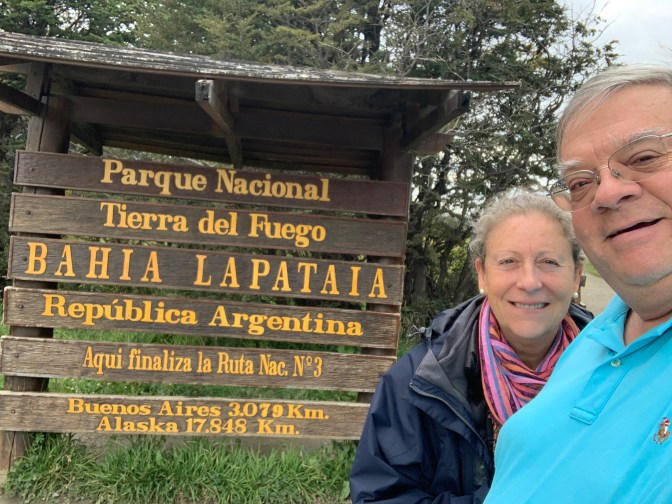
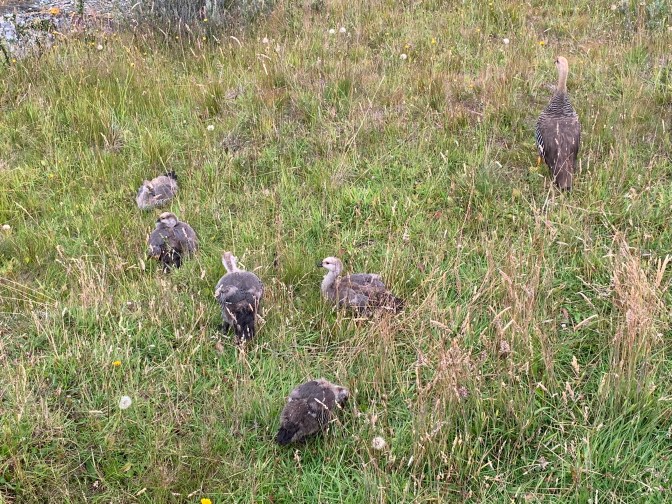
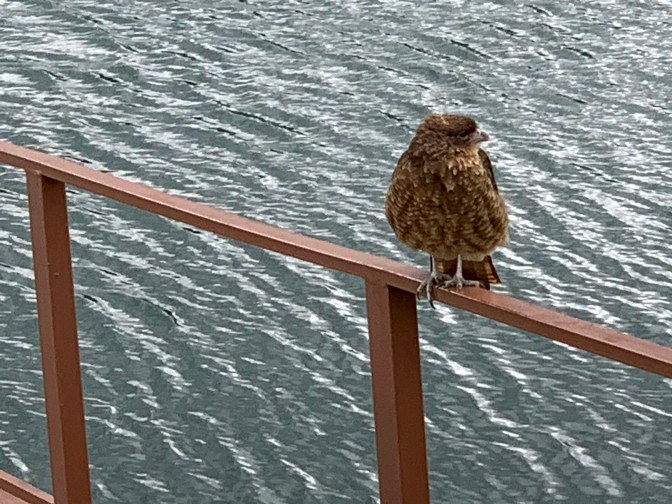
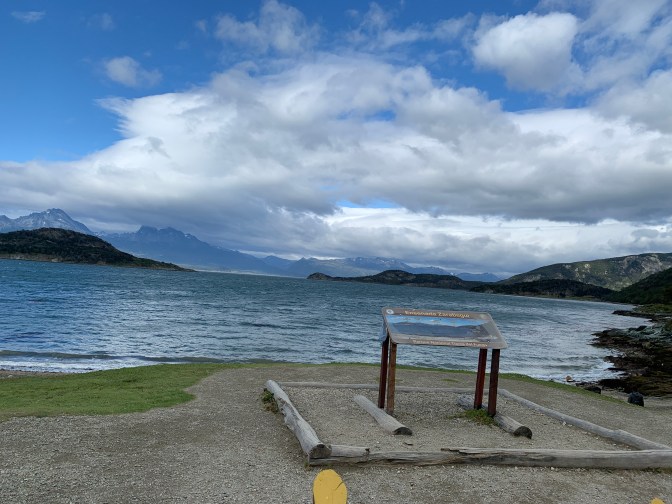
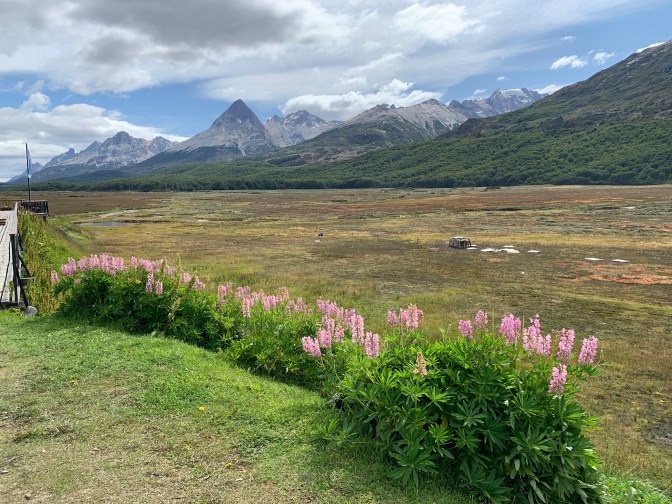
We went left (West) off the pier past The 1913 Casa Beben, taking some back streets so as to try and beat the coaches to the park at the end of the world. The 63,000 hectare – Tierra del Fuego National Park (as the “End of the World Park” is called) can be reached either by a tourist train going most of the way there, followed by a mini-bus, OR a drive from Ushuaia for 12 kilometers on mostly unpaved roads which form part of the “Pan-American Highway” that starts in Alaska. Literally, the highway ends and there is water! A sign stating “The Malvinas / Falkland Islands are Argentinian” is the first thins you see. Also a sign, in Spanish, saying:- “National Park of Tierra del Fuego, La Pataia Bay, Argentine Republic. Here finishes National Route 3. Buenos Aires 3079 Kilometers / 1913 miles and the start of the road in Alaska – 17,816 Kilometers / 11049 miles)“. The scenery is gorgeous with the various inlets and mountains. The River Lapetaia meets the Lapetaia Bay at this point. We were lucky as we were the first ones there so we had the place to ourselves. On the boardwalk, leading to a pier known as Port Arias, constructed over the bog, we saw a native bird family – parents and 4 chicks by the side of the walk and the serene beauty of raw nature was spectacular. A brown Owl like bird and other were close by, thinking there might be some food nearby. The area is an Archaeological site as a great deal of information can be obtained from sediment studies. The rotting vegetation accumulated at a rate of about 1 year being equivalent to 1,000 years of history. Some of these bigs are 10-15 meters deep, so should give us an understanding of live going back many Millennia. There was a large colony of Clams and Mussels visible in the intertidal zone. As we rounded the walk to turn back to the car, we encountered the first of many throngs of coaches arriving at the lookout point. The silence was broken, so it was time to move on.

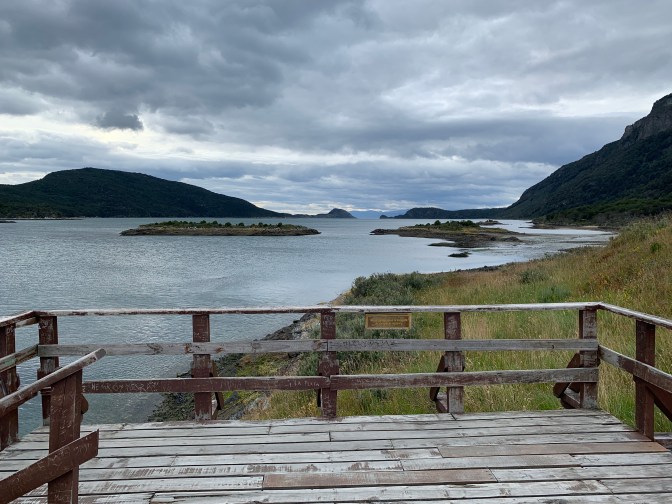
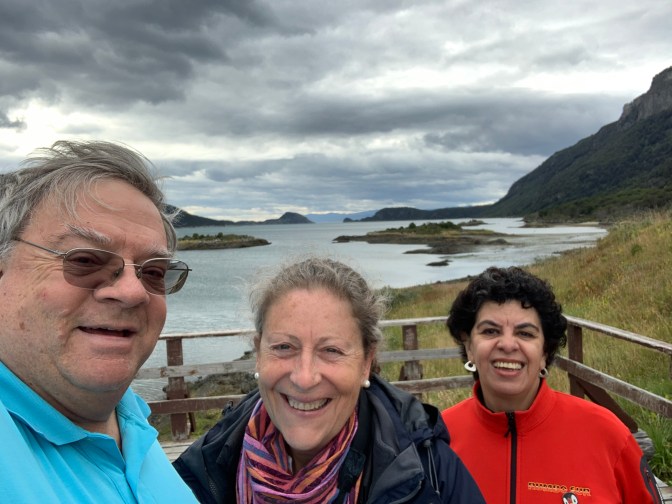
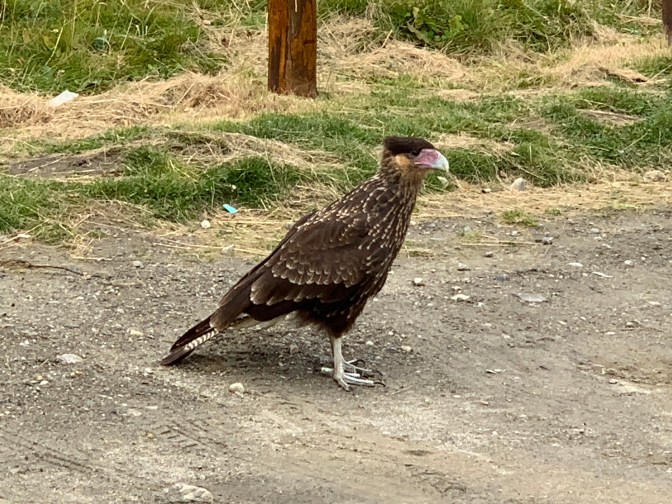
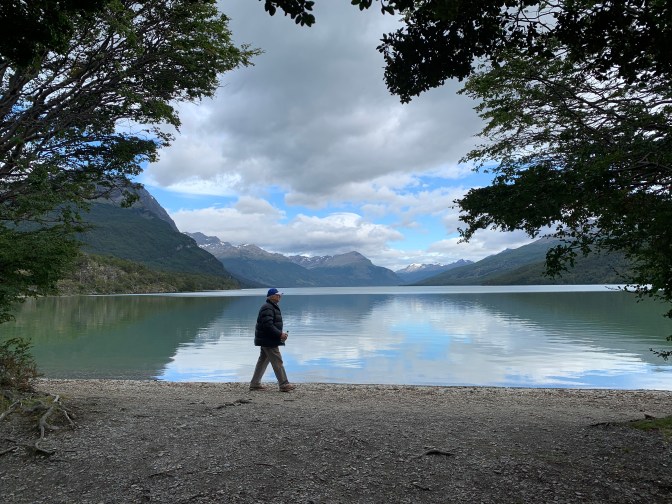
No visit to this area is complete without seeing Roca Lake or Lago Acigami in the native Yámana language meaning “elongated basket”, which is the shape of the lake. It is where the lake flows through a narrows leading to the Lapetaia River and to the lake of the same name. The guide explained about the three types of trees, two deciduous and one evergreen and the various plants and fruits growing wild. A “pit stop” for liquid exchange at the Alakush visitors center was a needed stop before heading to lake Ensenada Zaratiegui. A great view of a beautiful lake / estuary with the mountains riding majestically and the view of Isla Redonda, Chile’s Hoste Island, Iran point etc. We are barely a mile to the Chilean border.
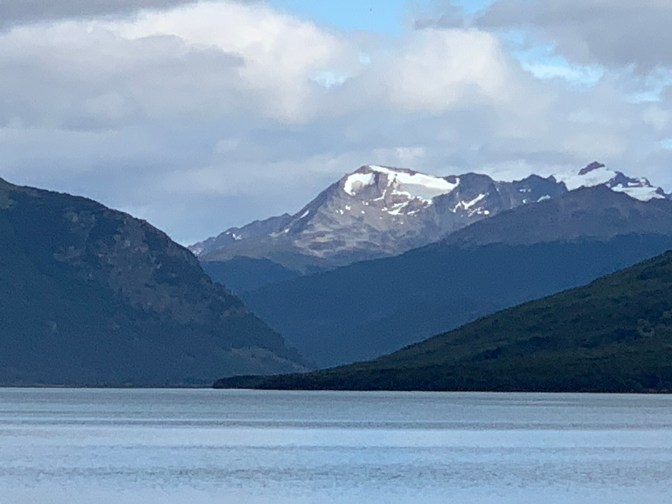
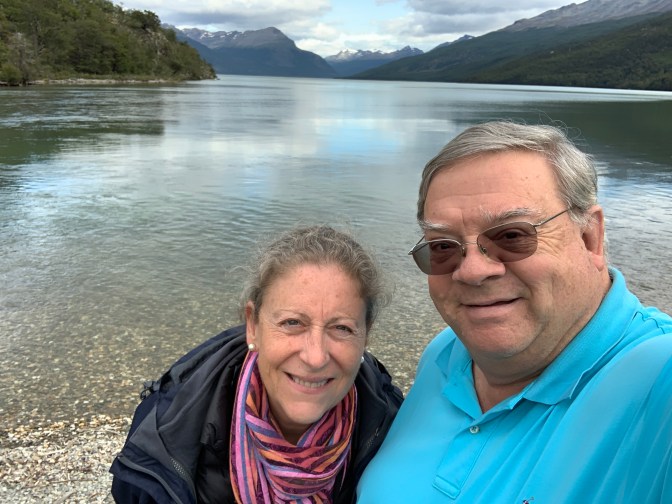

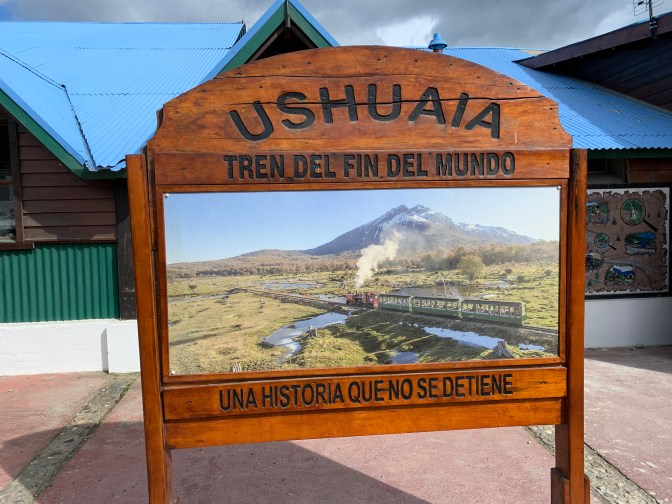
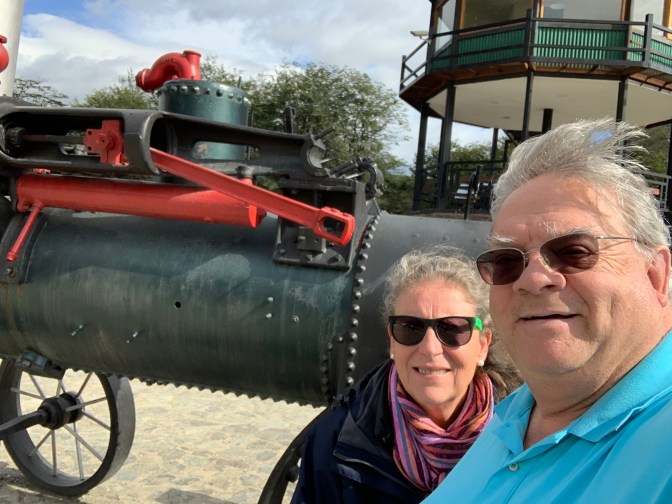
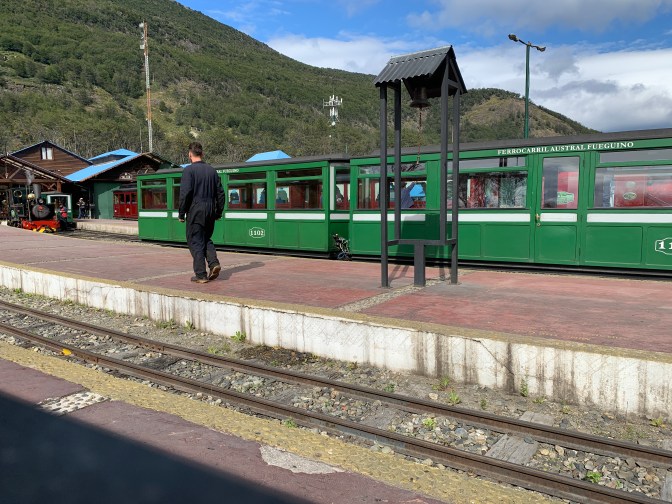
We stopped at the tourist train station (Ferrocarril Austral Fueguino) to see the history of the laying of the tracks by prisoners and the various engines and cars that have been used over the years.

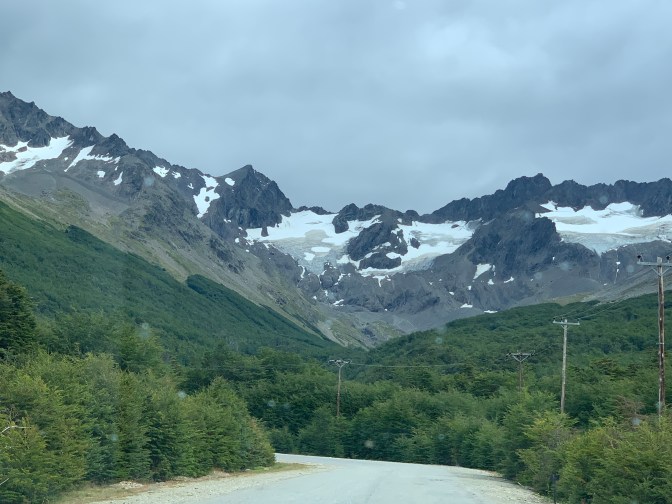
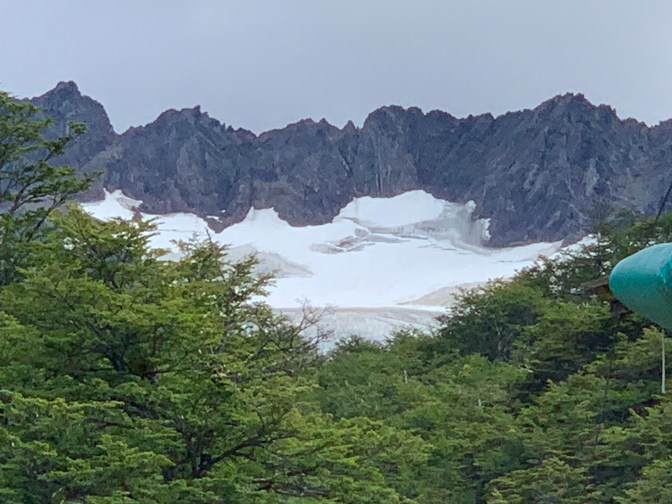
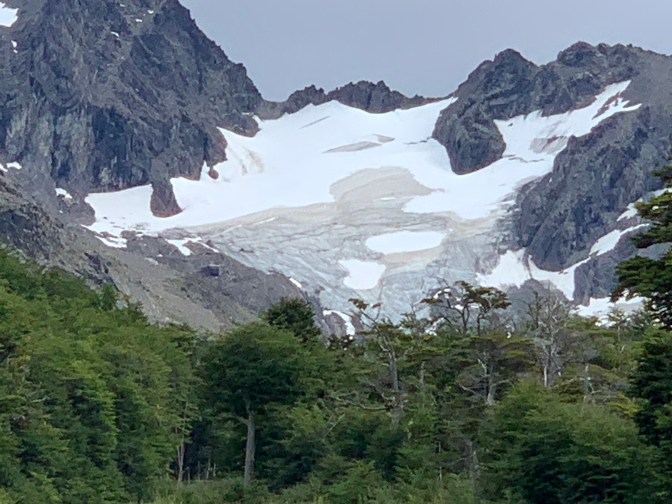
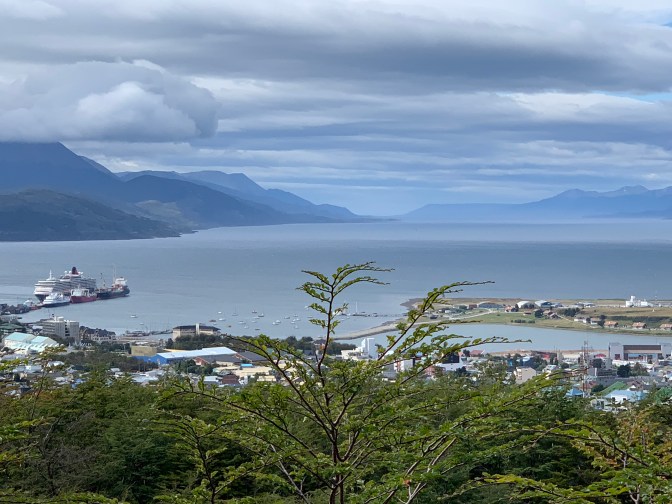
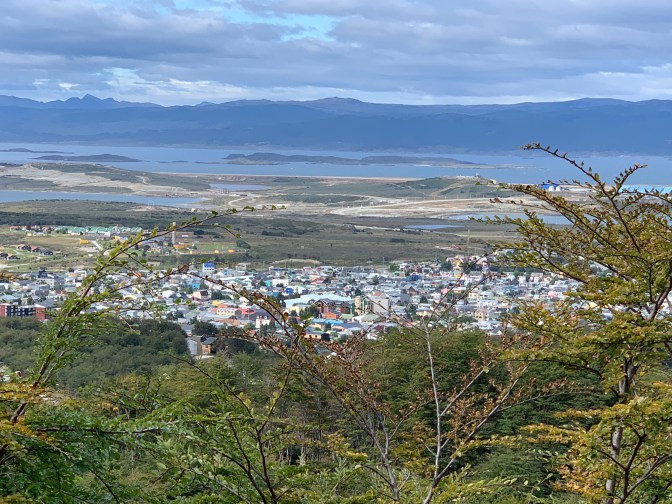
Returning to Ushuaia which is some 20 Kilometers long and only a few streets wide given the proximity of The Andes, we passed the Ushuaia Rugby Club (Established in 1982) and stopped at the “Parroquia Sagrada Familia” (Sacred Family Parish) in the middle class Neighborhood. While the main church was closed we were invited to sit in the small chapel inaugurated on May 1, 2010 open 24 hours a day, with Exposed host / perpetual adoration chapel of Pope JOHN PAUL II, which was very special. We then headed up the mountain to the Glacial Martial / Martial Glacier. Of interest here is that the Andes, which should run North-South as in Peru Chile etc but because the “West to East bend” of Tierra del Fuego, at the “bottom of the world” the Andes run East-West ant thus the town is actually on the southern side of the Andes. As we drove up the mountain to the glacier and the Refuge Café & Bar situated at the base of the glacier from which one can walk up about 2 hours to get to the ice. On the road up to “Base Camp” we passed some of the luxury hotels – Altos Ushuaia, Wyndham Garden Glacier Hotel and Las Vegas Ushuaia Resort. The largest Luxury hotel and newest of the lot was near the mountain pass we were to take past Olivia mountain. All these are on the mountain and have terrific views of the Beagle Channel and the Glacier. Perla explained that since she moved to Ushuaia 35 years ago, the glacier covered about 3 times as much of the Mountain and there is great concern as the glacier provides most of the drinking water for the city. On the way down we stopped for a brief moment at the “Mirador Camino de L.F. Martial” a view point with a fantastic view of the bay, the city, the airportand the mountains behind. At this point the Beagle channel (Onachaga in Yámana) is 15 Kilometers wide, but gets as narrow as 1 kilometer towards the Pacific side.
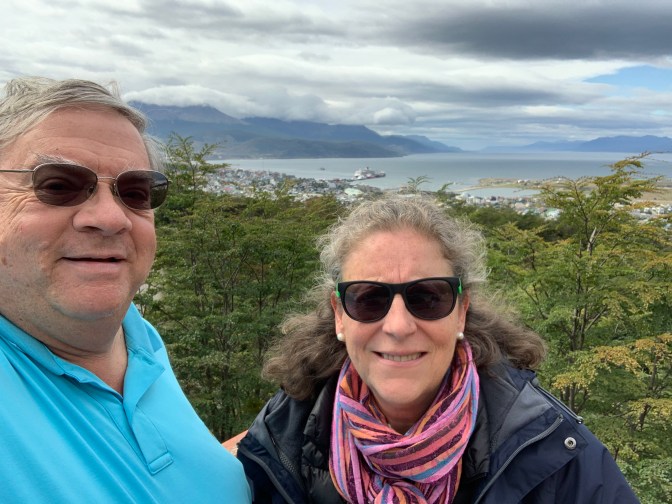
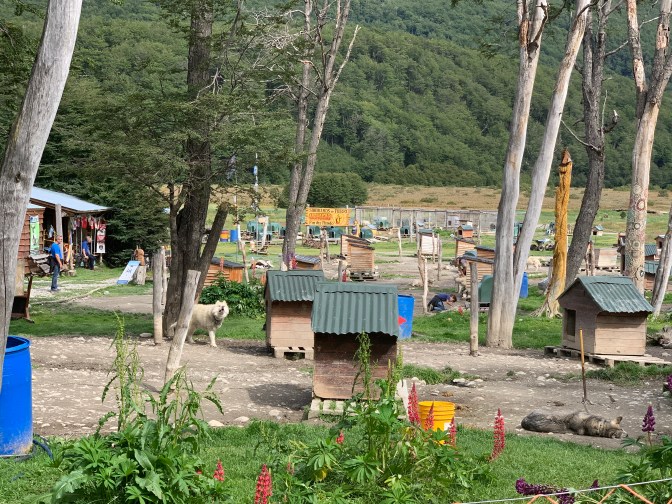
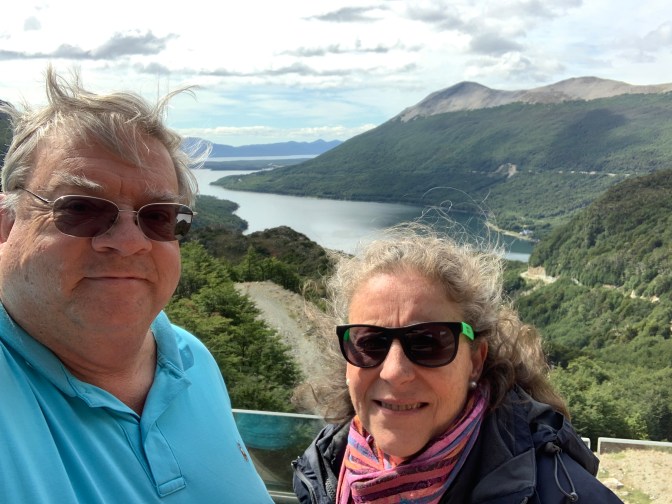
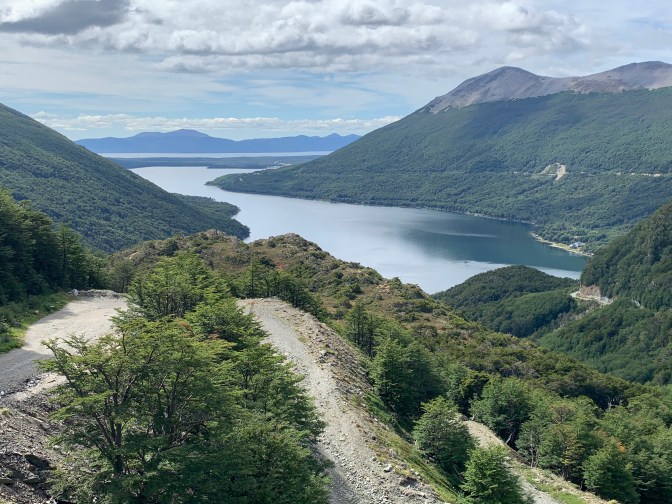
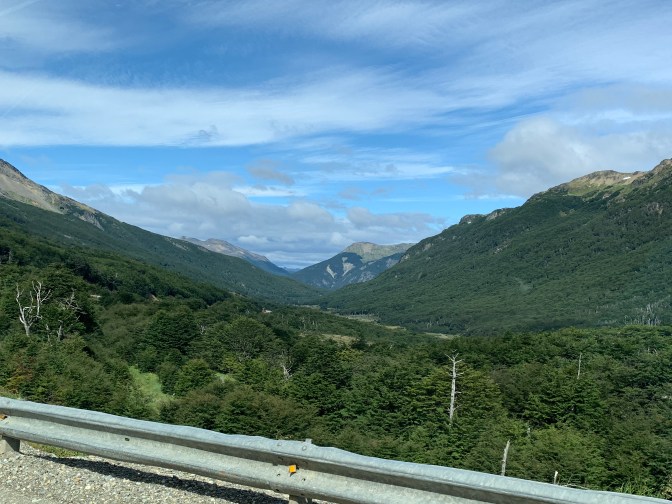
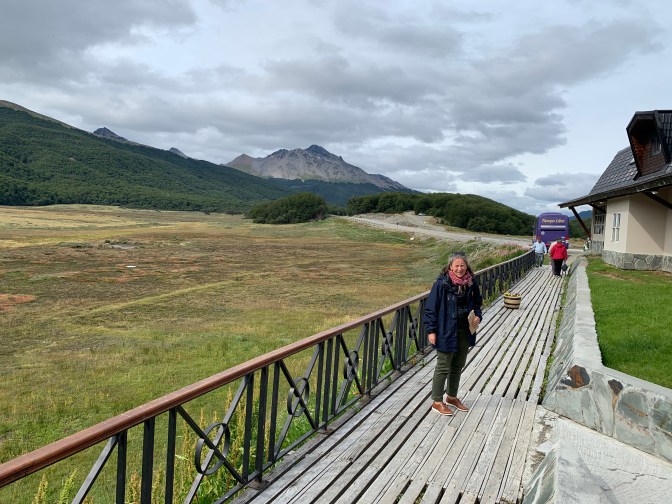
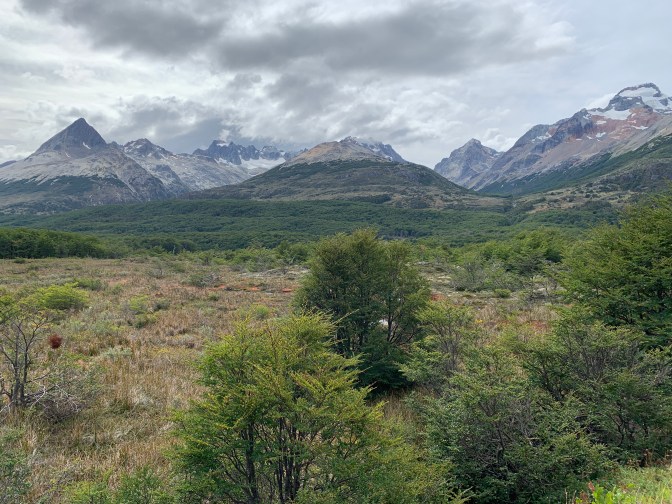
Next, after going back into town, we headed to the Eastern part of town. We were to visit the Olivia valley and travel over the pass behind Olivia Mountain (1326 meters, previously PaleoNunatak, but called Uliwala in Yámana = Harpoon Pointed Extreme) with it’s characteristic triple peak and razor sharp central peak coming to a sharp point and resembling a spear point. Two other mountains of note are Cloché which was covered by glacier and resembles a smooth topped muffin. The other easily discernible one is the Mountain of the Five brothers with it’s 5 sharp peaks. We travelled behind these peaks over the pass into the valley behind to the Garibaldi View point overlooking the “Lago Escondido” / Hidden lake. It is so named as it is often covered in fog thus not visible. Fortunately, we were able to see it clearly as it was a perfect day. On the way out of the Park, into the City and now on our way out of the city, we were stopped by police to review papers as well as seat belt use. The driver gets fined if all passengers do not have seat belts on, even in a coach. On the way through the pass we stopped at one of the two restaurants “Villa las Cotorras” that are used by the locals. This one has next door a Dogsledding establishment – Siberian Park (Sinerianos de Fuego Ushuaia – Centro Invernal “Las Cotorras; Ruta No 3 Km 3016; +54-92901-49519; siberianosdefuego@hotmail.com). There must be about 40 Siberian Huskies, each with their own huts and pens, and provide sled rides for visitors in the winter. Even in the summer there is a walk behind the dogs that is offered for ARG$800 (US$13) for a 50 minute ride. The restaurant has a separate hut where lamb (the traditional food of the area) is cooked. The lamb is sliced in half through the ribs and placed on a long skewer through it’s center and held out “butterflied”. The skewer is placed in a circle around an open wood fire for 4 hours and several are cooked at the same time.
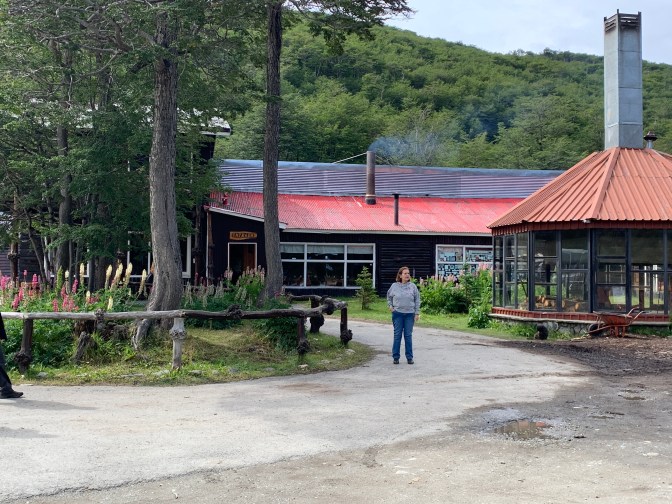
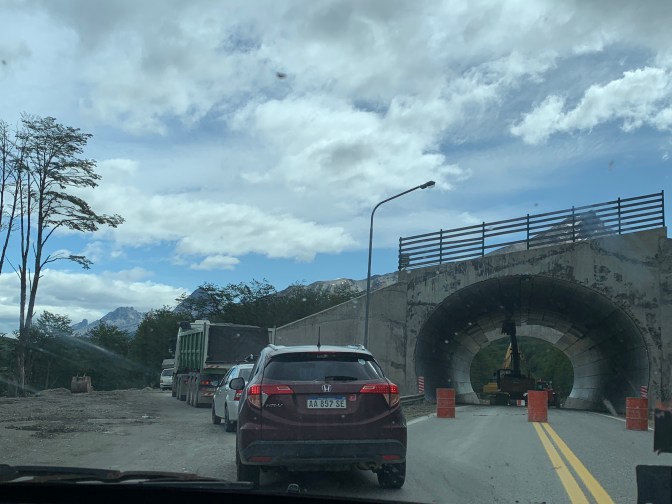
As we continued over the pass we passed the “Cerro Castor” (Besver mountain) alpine ski resort (furthest south in the world) that was being repaired. The bridge under which cars travel and over which skiers descend had holes in the corrugated roof so were being replaced.
Of note is the name. Some 2 dozen beavers were introduced to the area from Canada with the idea of ranching and using their coats to sell for fur. This never happened, and as there are no natural predators, the beavers now number in the 70,000 and are growing, creating beaver dams everywhere and causing lots of problems with many trees having no leaves.
The view of the lake and beyond from Garibaldi pass was well with the drive. Perfect day and a perfect way to end the sightseeing views.
On our return we stopped at the restsurant and Nordic Ski resort of Tierra Valle Mayor for a local meal of Lamb cooked on the skewer, salad bar and washed down with a local Beagle Cream Stout. The desert / pudding was the highlight, being a flan with cream, biscuits in a Dulce de Leche (caramel) sauce.
As we got to the city we passed by the old prison, now maritime museum, getting to the dock half an hour prior to ship’s departure.
The sail away was beautiful and then at dusk 8-9PM, we skipped the theatre and were on the 9th floor bow deck with the resident ornithologist and biologist. What we saw were thousands of birds (his first estimate was 250,000 and then as we continued to see more, he upped the estimate to over 1 million birds) flying low over the water but mostly floating on top of the water. They are Sandy XX (I forget the full name). Apparently they live on the many islands in the channel, but wait for dark to go to their burrows as other predator birds (we saw several Albatrosses) would attack and kill them as they are very slow and vulnerable in land. Several dolphins were also present. A great end to a fantastic day. Indeed all around this area we were lucky to see whales, dolphins, fur seals, albatrosses and many other birds that only exist around these areas. We would congregate on the open deck in front of the Gym on the 9th floor where the two lecturers on wildlife, would teach us and point out things that we were seeing. Great excitement reigned as possible if whales or dolphins passed close by, but certainly the shear quantity of birds we saw that evening were nothing short of amazing! Alfred Hitchcock’s “The Birds” had a mere handful in comparison!

 Roger & Anne Travels