Sunday March 1, 2020 – Coquimbo and La Serena, Chile
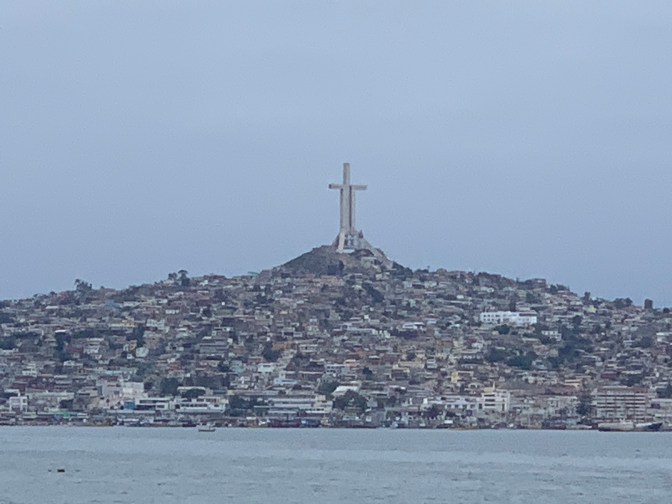
We docked early, Starboard to quay and had a terrific view of the city of Coquimbo. The name of the town of Coquimbo comes from the Quechua meaning “Puerto plateado de aguas tranquilas” (Silver Port of peaceful waters). The usual morning Haze covered the city, but one could easily make out the brightly colored houses painted so that Fishman could see their homes as they returned in the harbor. Most evident was the large 35 meter high cross on the top of the hill which was most impressive.
We disembarked and soon met up with out private car, driver – Rafael Rojas (cell 569-615-561-85) and guide – Ignacio Medina (inmedina@uc.cl cell – +569-6646-9738). Ignacio is a university student with a degree in astronomy and currently working on his MSc in Physics at the University of Chile in Santiago. The driver was excellent and added a lot of information. The guide did what he needed to do, but read a great deal of the information he provided. He had an agenda and we had a different one. However, having had the bad experience in the other port, we made sure our agenda was followed, which caused him a bit of confusion.
I should perhaps digress a bit here, stating why I give all the information about the individuals in many of my postings. The reason is that if any reader or indeed ourselves, return, one can book a private tour directly whether you are in town for a stay or off a cruise ship and are willing to take the risk of getting back in time before the sail away.
We took off to see the main square and as it was Sunday, it was filled with many vendors in the “pop-up” market. As we drove through the streets and saw the many brightly colored houses, we became aware that about 60% of the population are in some way associated with the fishing industry.
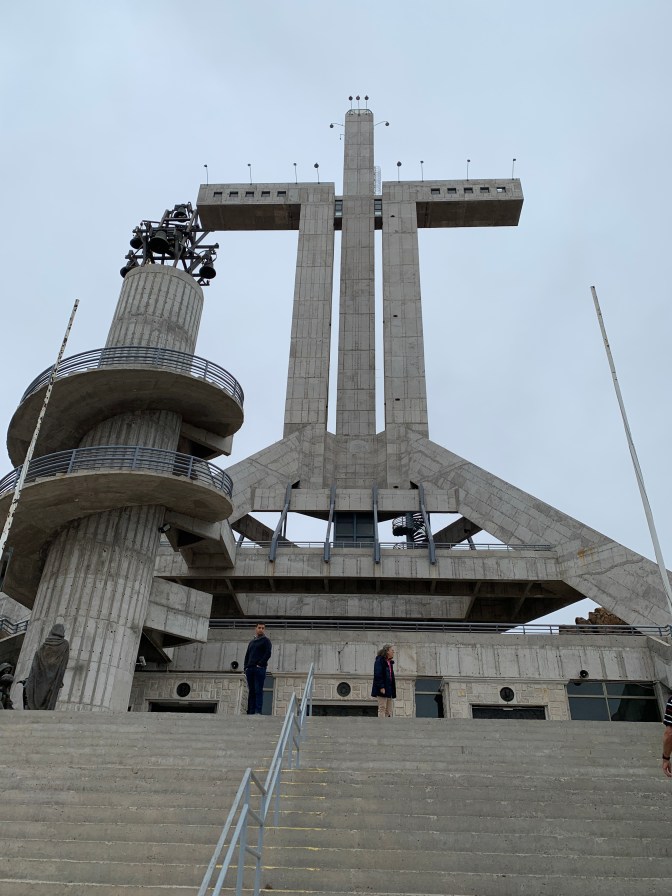
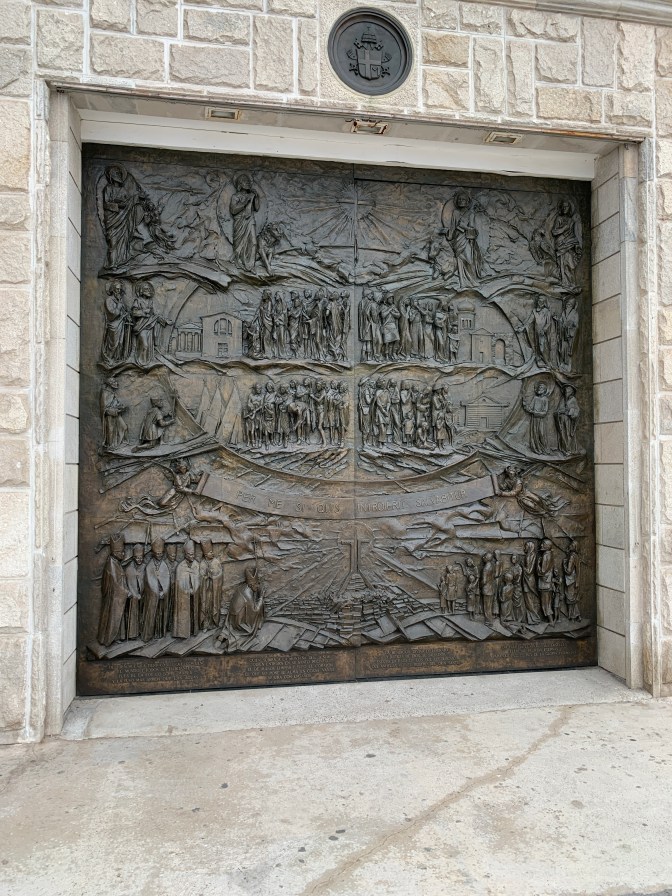
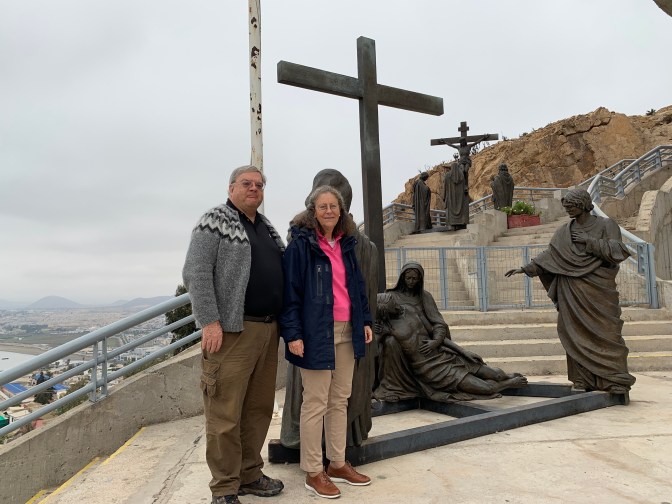
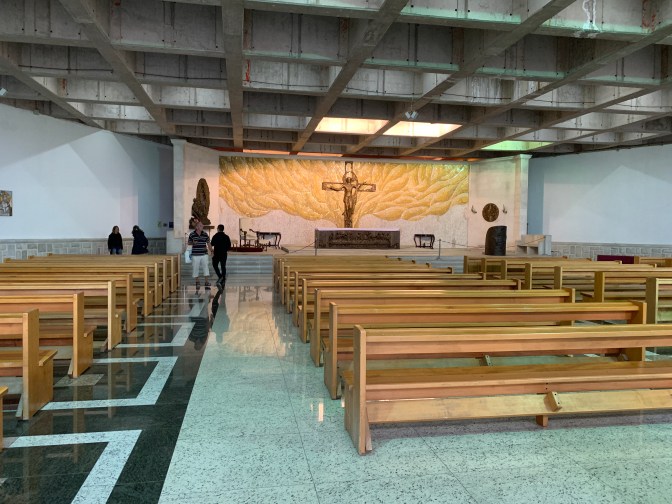
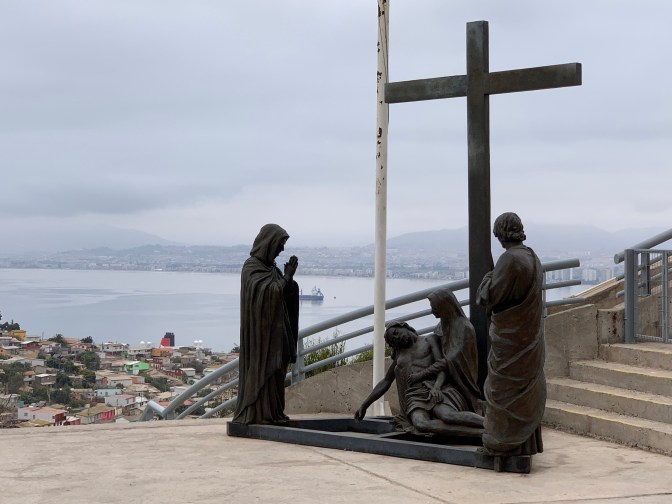
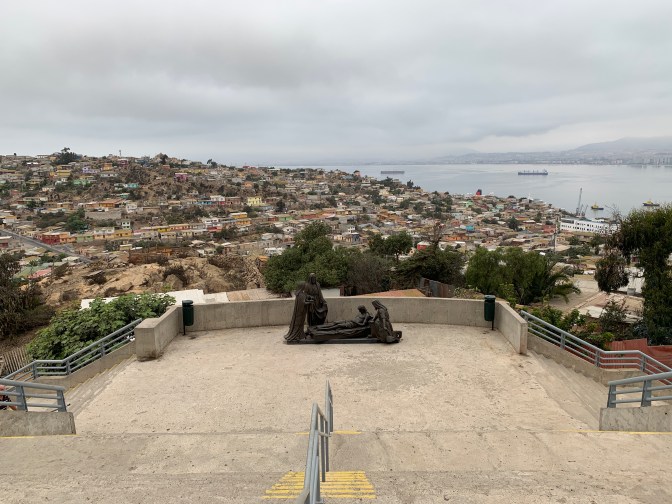
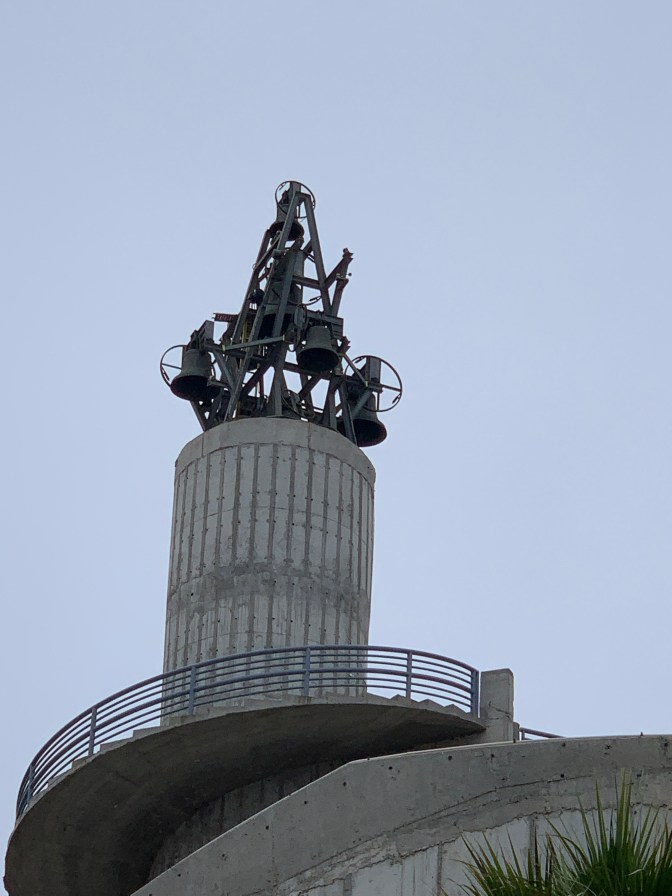
Our first stop was at the Third Millennium Cross (we saw from the ship) that was erected in 2000 to mark the start of the third millennium after the birth of Christ. Once we climbed the 40-50 steps we had a panoramic view from the church under the cross, over the whole city and bay. Surrounding the church and cross (www.cruzdeltercermilenio.cl) were life sized bronze sculptures of the way of the cross, which were exceptionally well done. We opted not to pay the entry fee to see the museum and go to the top by lift (elevator) to get a 360° view of the city but we did look into the church with it’s relatively simple Nave. The doors had spectacular carved in bronze, doors. Apart from the altar decor, there was a “pieta” type sculpture and a life size sculpture of Pope JOHN PAUL II who visited Chile on two occasions. The Campanella consisted of various bronze bells in an open bronze structure on top of a concrete pillar. Indeed all the church and cross was made of concrete.
As we drove to the next stop we passed an imposing and large mosque, interesting, considering that Roman Catholicism is alive and well and the predominant religion in the country is Catholicism. Many high rise apartment buildings line the Avenida Del Mar – Coastal Road.
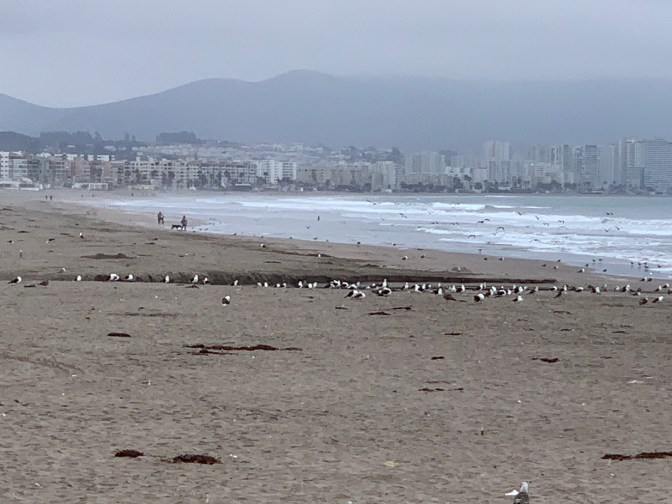
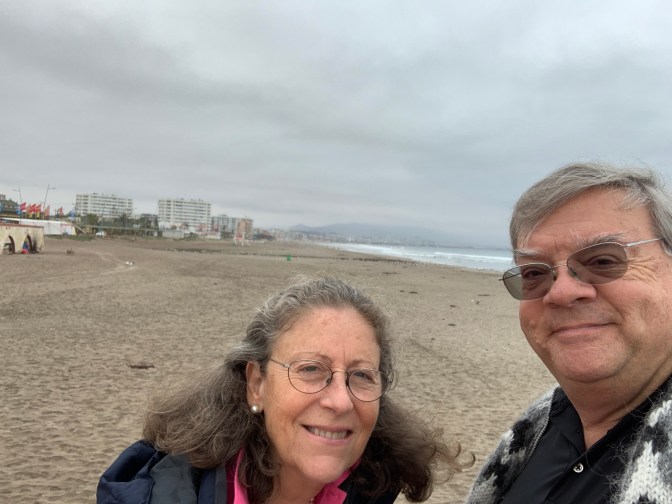
As we passed the miles of beaches in the early foggy day we were aware that later in the day these beaches would be full of families enjoying the last day of summer holidays. La Serena is a “twin town” as there is barely a way to identify whether you are in one or the other. A small creek differentiates one from the other.
The cross is the symbol of Coquimbo, but the 1950 Faro Monumental de la Serena – red and white Lighthouse is the iconic symbol of La Serena. It is currently under renovation but a great view of the beaches which at one time in history was full of pirates like Sir Francis Drake, is now a beautiful stretch of holiday-maker enjoyment.
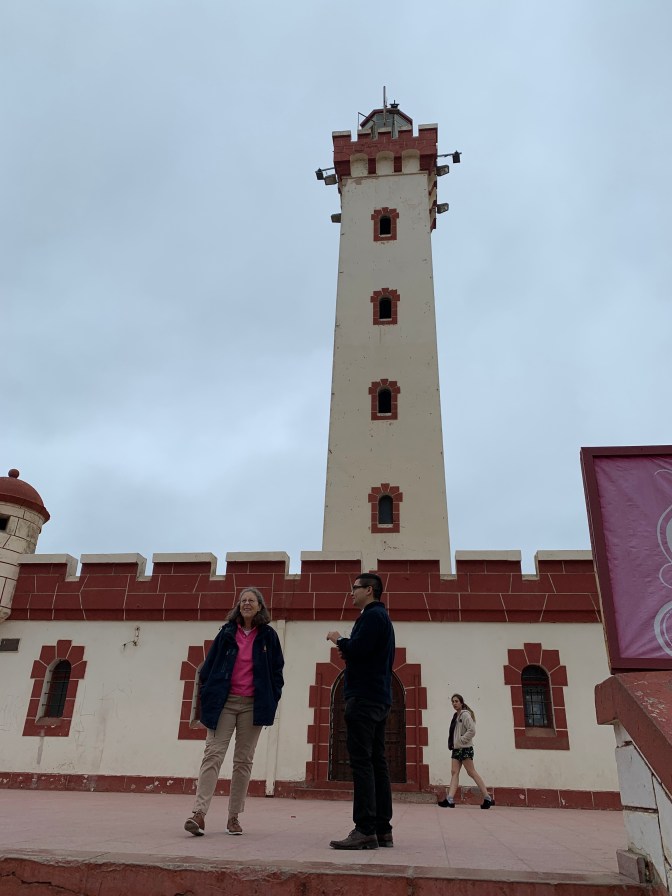
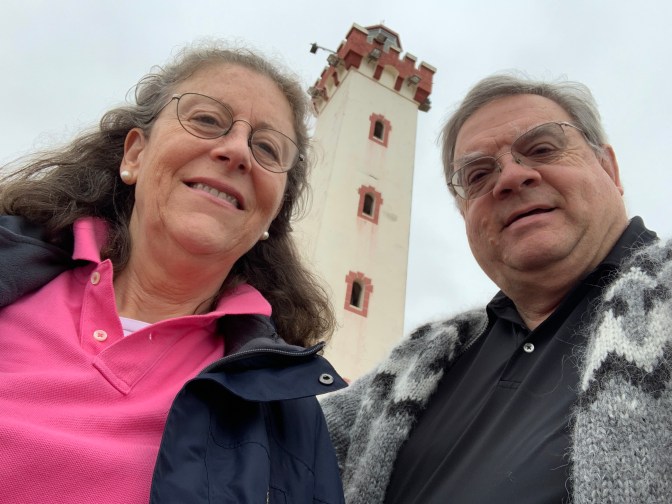
This lighthouse is located at the point where the Avenida Francisco de Aguirre meets the ocean. This Avenue is reminiscent of the Paseo de la Reforma in Mexico City or the Champs Élise in Paris. It was built as an open air museum to house the many (perhaps 40 on each side) statues lining the row of trees in the central median. When kept up, it must be an avenue that the local people would be proud of having. However it is the parade route of most of the protestors, so the statues are spray painted, the walkway dirty and unkept and is a symbol of what a few can do to an otherwise beautiful part of town. We also passed what was Wal-mart. Apparently a superstore that provided credit cards with a Chilean Peso 100,000 (US$125) limit. Many of the locals loved the “free cash” and spent it up to the limit. However they did not have the funds to repay and at the existing interest rates, the amount due can easily reach CLP500,000 (US$625). So the activists burned the entire place down, leaving only the concrete parking area. This is of great detriment to the locals that enjoyed the large shopping capabilities.
Driving around La Serena we were able to experience the various squares markets and colorful homes unfortunately filled with graffiti from the rebel elements of society.
We then headed out past the airport to the Elqui Valley heading towards Vicuña the home of the Nobel Laureate – Gabriela Mistral where we were to attend church, but time got away from us so we headed back to the Craft market – La Recova which is next to the Templo San Agustin for the 11:30AM service. (Mon – Sat 11AM and 8PM & Sunday 10, 11:30 AM and 8pm). An excellent priest with a terrific sermon.
We then returned to Coquimbo to the seaside restaurant “Donde Elbita” (“where Elbita hangs out”) and as time was of the essence, we ordered some empanadas to go.
Driving out of Coquimbo with it’s 29 churches (thus called the city of Bell Towers), past the Main Square, Arturo Platt (1850), 1626 San Francisco Church and the key football (soccer) stadium, home of the local “Pirates” team, to the highway.
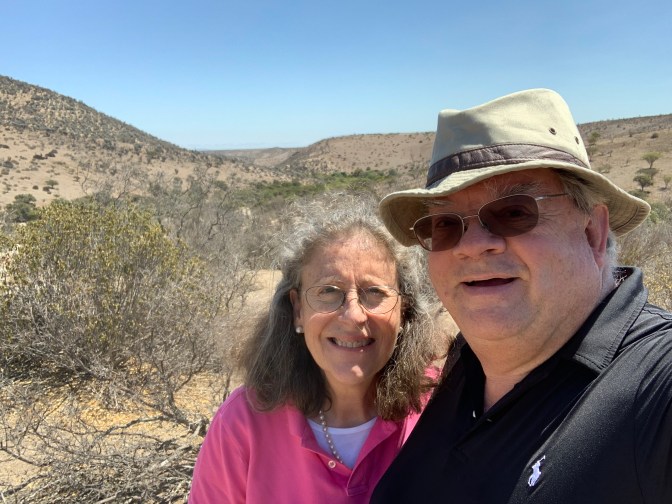
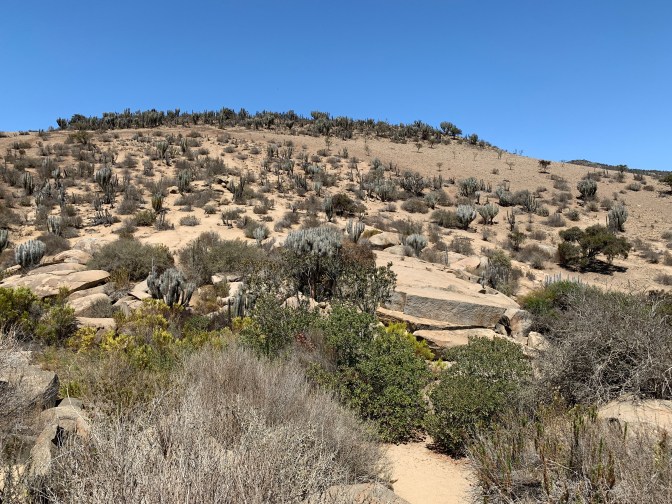
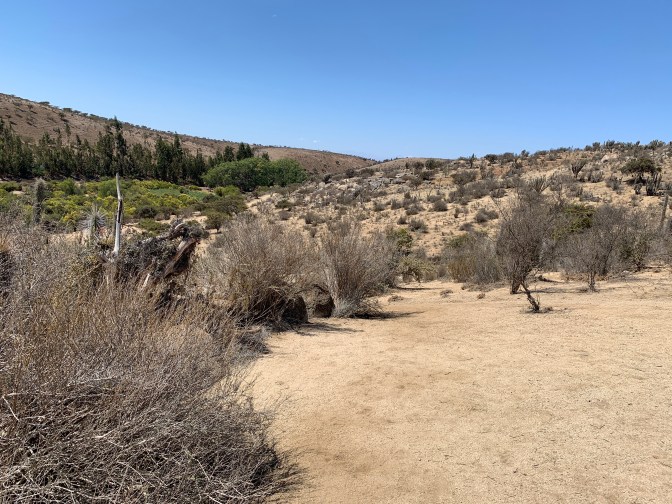
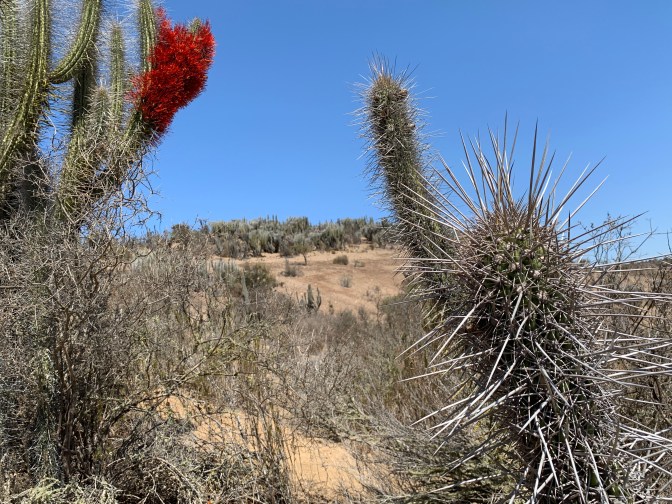
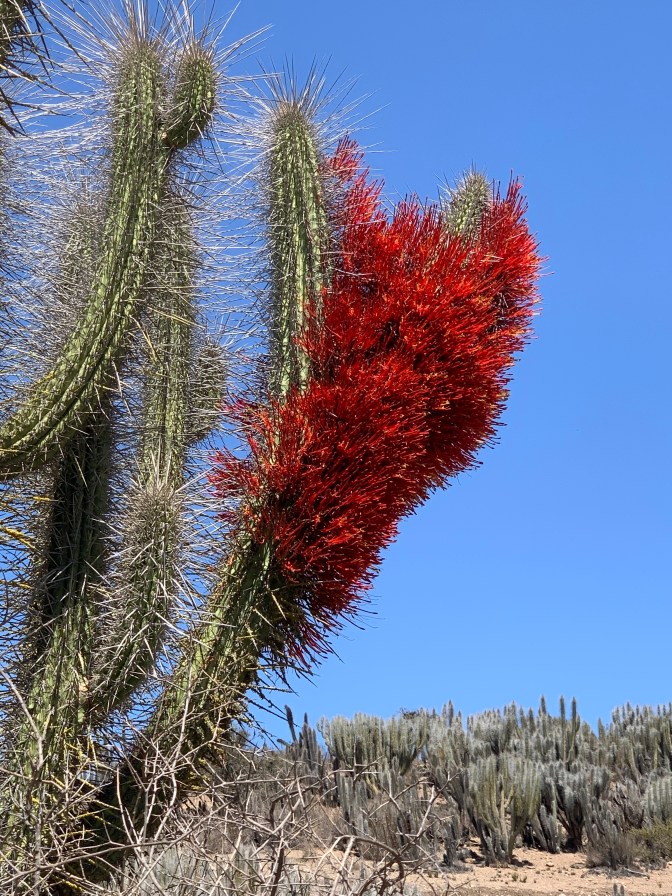
for 1 1/2 hours on the PanAmerican Highway, we passed the La Heradura and Las Tacas beaches some of the luxury resorts to the Tabali winery and Valle del Encanto (Enchanted Valley). Las Tacas is one of these exclusive resorts and has a private airfield, golf course, private beach etc. Unfortunately no time for the Winery but the National Archaeological site of the Valley was spectacular. It was declared a national monument in 1973 and is approximately 20 km from the city of Ovalle in the Coquimbo region. It consists of about 3 hectares 7 1/2 Acres) where there are vestiges of three archaeological cultures – The Molle, The Animas and the Diaguitas. Over the past 4000 years these tribes left on the large rocks a sign of their rituals for the guide deity or Shaman. Petroglyphs, pictographs and hundreds of mortar and pestle type “Tacitas” structures are present. After passing the entrance, where the guard collects the CLP800 (US$1) entry fee one drives down the hill and an immediate dichotomy is apparent. As an aside, since we were speaking Spanish, the gate keeper amused us when he heard we came from Mexico, saying that when he was bored he would have a tequila or two and put on a music cassette! The central part of the valley consists of green trees, shrubs, bushes and a small rivulet is apparent (10-15 feed wide). Whereas the area to either side of this green area is a semi-desert area with sand, rocks and cacti.
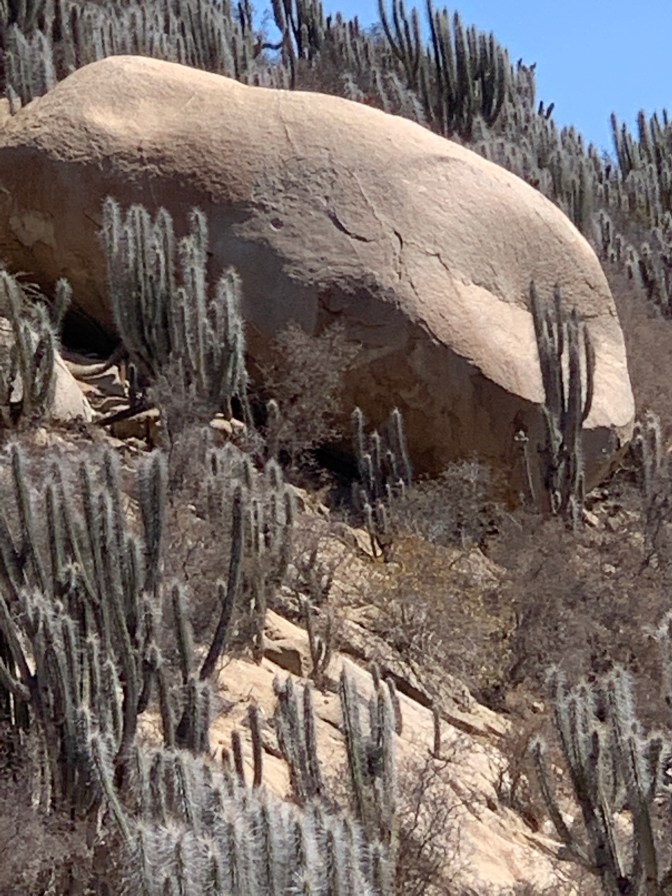
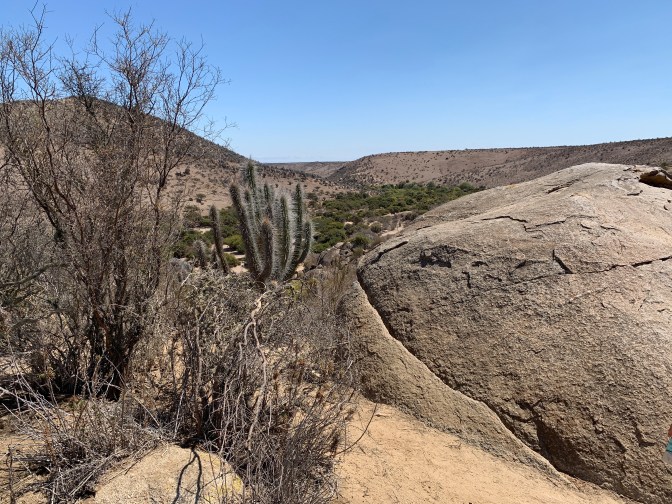
There are several areas with in the valley identified by the types of petroglyphs that appear to dominate.
From left to right as one is descending into the valley there are three zones of sites which are the Talinay, the Tawaya and Tabalí zones. In the Talinay zone are:
A. The Family – Characters intertwined associated with the Diguita and Diguita Inka cultures. (Note whereas many use Inca, the modern representation of this culture is Inka).
B. The Superior – Figures that better reflect the society of greater complexity thus of a later period and the scraped petroglyphs predominate.
C. The Culepo Fox – Showing a representation of this, the largest of the canine family.
In the Tawaya zone are:
A. The Sanctuary – Area where ritual ceremonies were held and where we spent the majority of our time at the site. Extensive Petroglyphs of both types as well as Tacitas, were present.
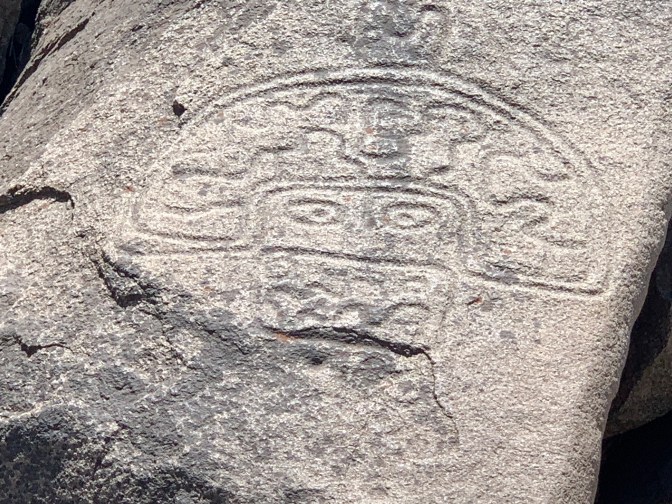
B. The Socos Head Area – where many of the iconic human heads with headdresses are found.
C. The parking area for autos after descending from the terraced entrance area.
In the Tabalí zone are:
A. A picnic area under the widest “green” (Vs desert) area where tables, chairs and out-houses are available for visitors.
B. The Forester or Visitor, anthropomorphic representations defined as the late “Encanto” style (900-1536 CE / AD) where we spent the rest of our time in the site.
C. The Añañuva endemic herbaceous plant and the Gran Peñón or large rock with a panoramic view of the valley.
The three main representations referred to above and present at the site are:-
1. Pictographs are paintings on the rock using vegetable and mineral dyes. These are probably the oldest in the valley and are usually have red paint applied to the surface of the rock with some sort of binder. Altogether there are nine blocks that have been found at the site and the paint has faded over time, so difficult to see.
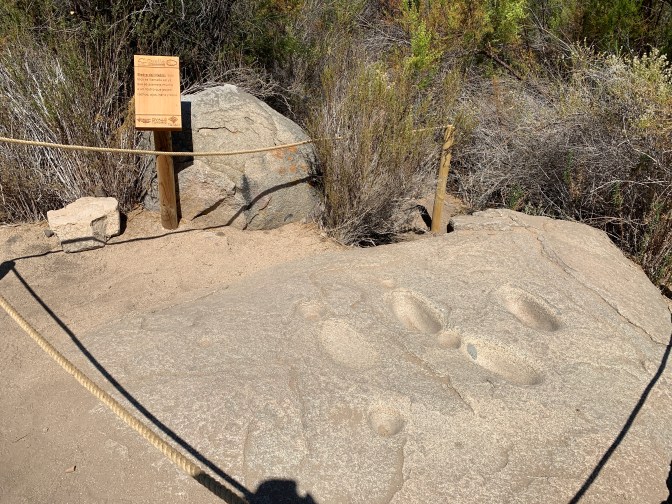
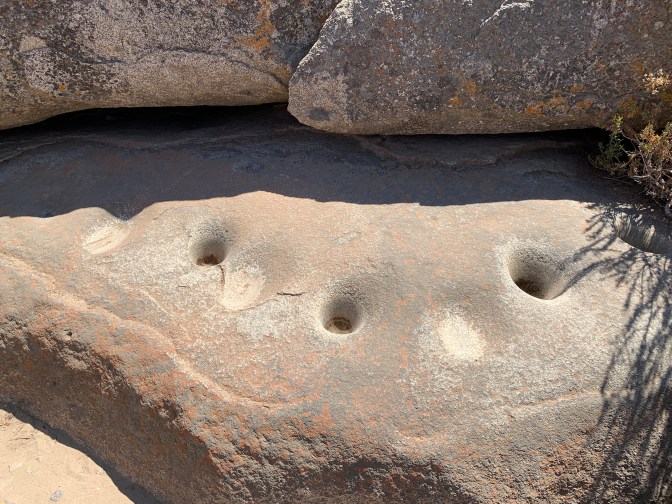
2. The “Tacitas” Stones probably date to the late archaic period (3000 to 500 BCE) and may well have had paintings in addition to the holes. These cosmos associated holes, in general about the size of a coffee cup, are ubiquitous and obviously were made over an extended period of time as the tools the only tools they appear to have had, were just other stones. These appear as holes in rocks, with each hole being used to grind grains, but placed in such a way that, when filled with water, reflect the constellations above and each hole reflects the corresponding star of the constellation. They vary, based on use, from 1/2 inch to 8 inches in depth and usually not more that 6 inches in diameter.
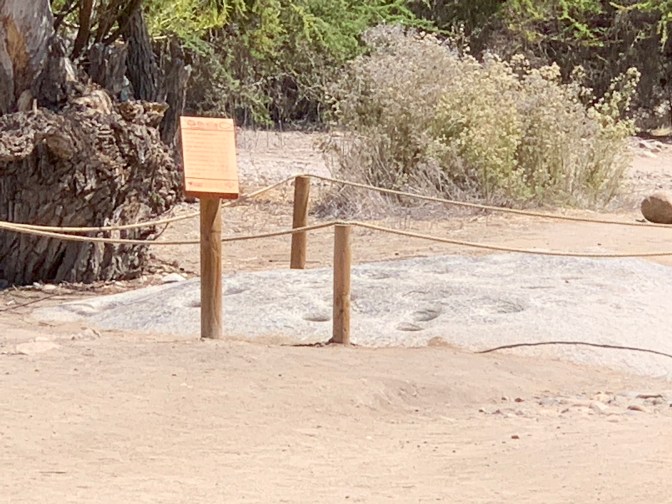
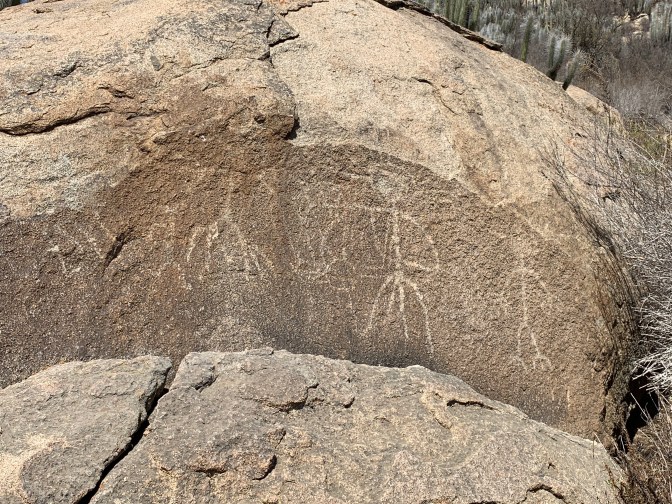
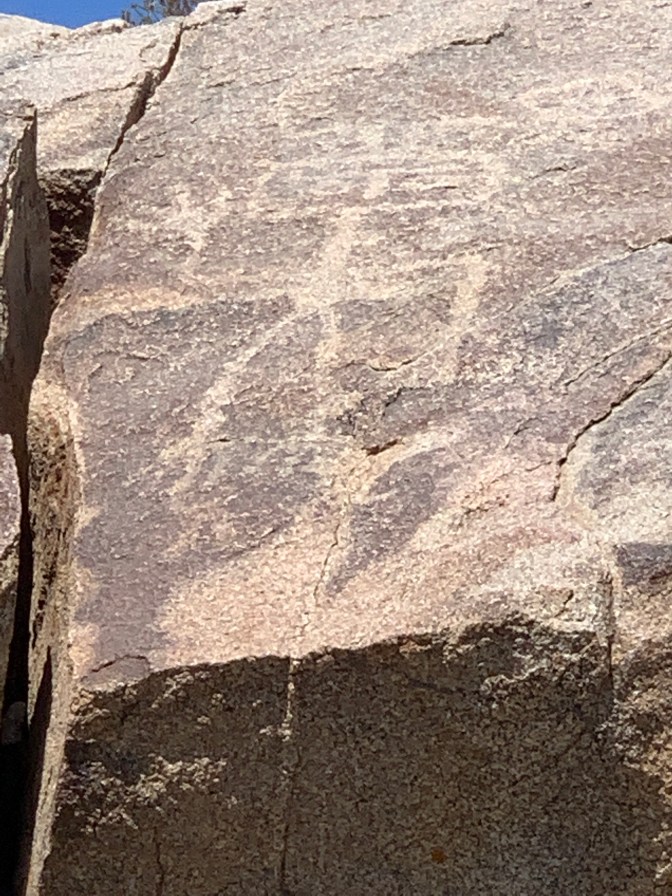
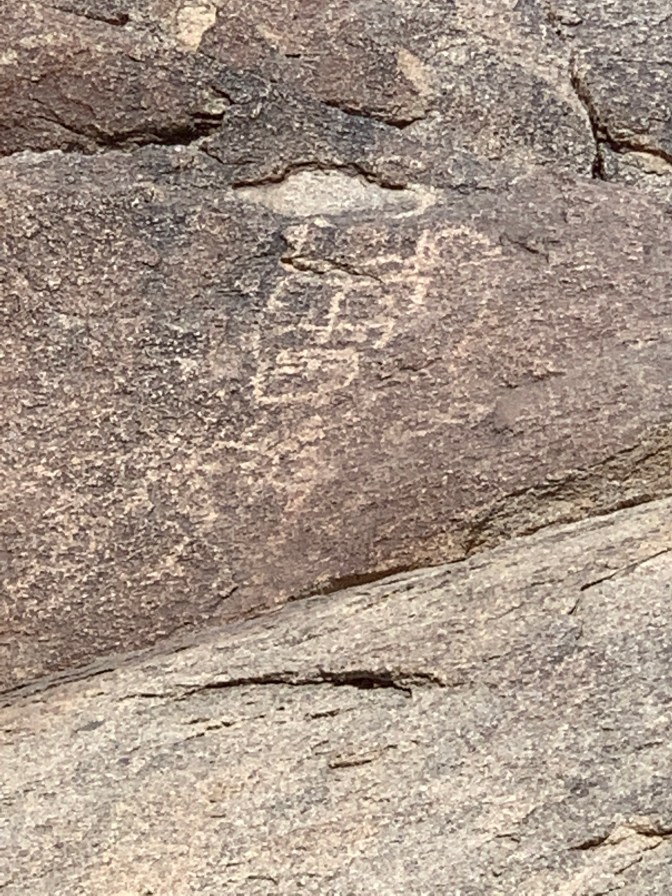
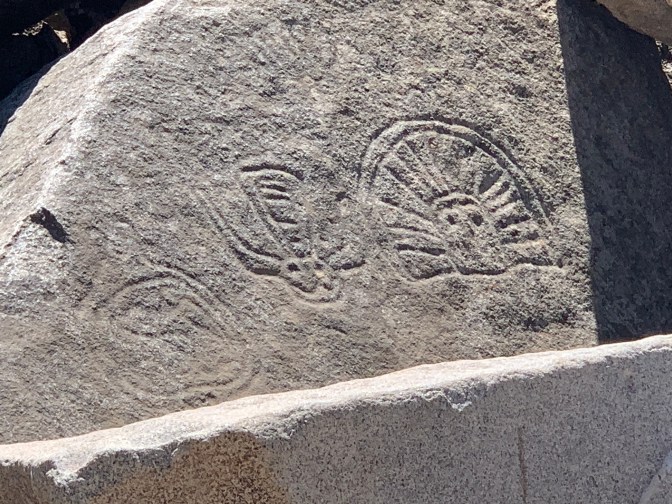
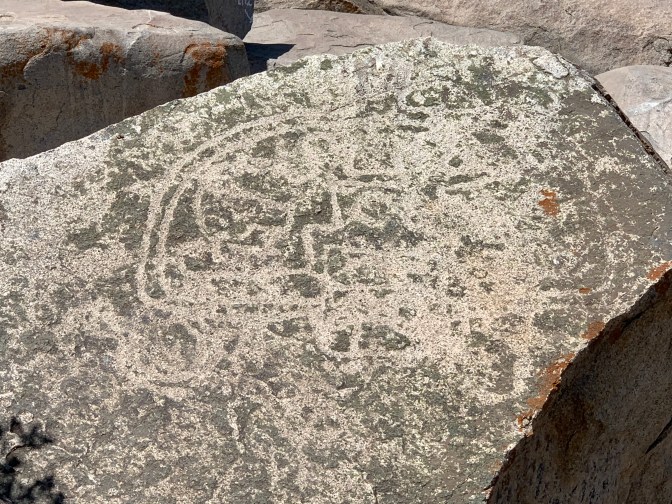
3. The Third important element in the valley is the presence of numerous petroglyphs which can be of two different types. 3A. One involves chopping away at the stone causing a 3 to 7 mm engraving in the rock and depending on the sun and shadows they can appear to vary in their appearance. The iconic images are the so-called “Tiara Heads” (human heads with large headdress) since they define as the type of site settled during the Limarí Style which is in the Early Pottery Period from 300 BCE or BC to 900 CE or AD. [Note I use both the archaeological notation – Before the current era BCE / Current era CE or the common notation of before Christ (BC) / after Christ [Anno Dominae] (AD).] However many other images were present. 3B. The other type of petroglyph involves scraping. These types of images are scraped on the stones, some of which were placed on top of the prior carved images. This is representative of the Late Intermediate or Inka Period (from 900 to 1536 A.D. / CE) and the figures are anthropomorphic zoomorphic and / or mask and face type.
As we returned to the ship the guide reminded us that this area is where there are three major telescopes as the sky’s are so clear and there is no City light. The Cerro Tololo astronomy center is operational, one is due to come on line in 2023 and the third consisting of various dishes in a circle which is scheduled to come on-line in 2030. Much information is presently on-line at the Astronomical Survey web site as various terabytes of data are received per minute of operation.
When we got back to the ship and safely aboard, we drank lots of water and called Robin as it wailed be his birthday tomorrow and we would be at sea and not be able to call. There was a local band playing at the quayside wishing us well on our way. Just as we got hold of Robin, the Happy Birthday song was played by the band. So Robin had Happy Birthday sing to him from Coquimbo, Chile!!!
The evening entertainment was the superb four young lady opera trained group – IDA – singing popular music.

 Roger & Anne Travels