Thursday January 19, 2023
Starboard to Dock – Container Port, no shops, Right hand Drive, Bus 75, Tour 1, Excellent Guide Urania, Driver Andonis.
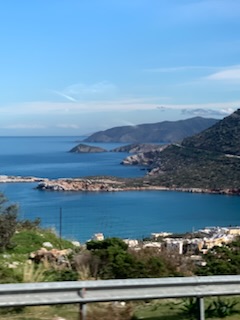
The Island of Crete is the largest Greek Island and the fifth largest in the Mediterranean. It measures 160 Miles from East to West and between 7 1/2 and 20 miles North to South. Heraklion on the North Coast is the principal town and has a population of 200,000, and Crete 600,000. Crete has flourished for more than 4,000 years as part of the Egyptian, Minoan, Greek and Aegean civilizations but during it’s history it has been conquered and ruled by various civilizations. It’s location in the middle of the Eastern Mediterranean between Europe, Africa and Asia, has made it very attractive to the powers in the region. Amongst which are the Dorians (11th Century BCE); the Romans (67 BCE to 395 CE); the Saracens (923 to 961); the Venetians (1204 to 1669); the Ottoman Turks (1669 to 1898) whereupon it became independent and then in 1913 became part of the Greek State until the air battle of 21 May 1 941 when it became occupied by the Germans from 1941 to 1944. After the war it became part of Greece.
The main occupation is farming (millions of olive trees) and tourism (25% of population), which occurs mainly between April and November with some 6 million people visiting each year. For olive oil to be considered Extra Virgin it must have between 0.2 and 0.8% acidity. Approximately 4-5 Kilograms of small olives are used to produce 1 liter of olive oil. Greece is the third largest producer of olive oil after Spain and Italy. Other crops are fruits and vegetables. 98% of people on the island are Greek Orthodox which broke with the Roman Catholic Church some 1,000 years ago. Village priests have to be married and undertake a specialized education before becoming priests. However, to rise in the hierarchy of the church celibacy is demanded. All priests are civil servants and paid by the State.
One of the main attractions that most people visit is the Minoan Palace of Knossos (inhabited from about 1900 BCE to between 1380 and 1100 BCE) the “Home of the Minotaur” – a mythical creature half man half animal (bull) that lived in the labarynth of Knossos Palace. The Deity – Zeus was born on Crete since his jealous father would devour the first five children. His wife, in a ruse to “require different rest and air, went to Crete, had Zeus and was left to be raised by goats and bees in a cave. When she returned to her husband, Zeus’s mother presented him with a stone (instead of the baby) which he devoured, thus seemingly arguing no line of succession. However Zeus grew up and destroyed his father becoming the all powerful and transformative deity. It was he, transformed into an animal, who impregnated a princess giving rise to the Minotaur. The mountain to the South of Heraklion is shaped like a face of a person in profile and is said to be the final resting place of Zeus. It is interesting that there are some 2,000 species of plants on the island of which some 200 can only be found on Crete.
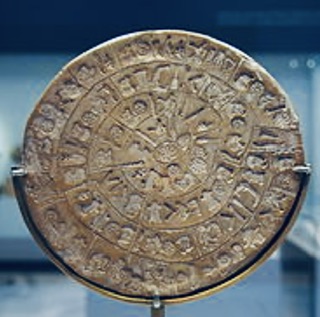
Most of the ancient Mycenaean Greek writing in Knossos, has been deciphered and is in the principally syllabic Linear B (87 syllabic and some 100 ideographic signs), pre-dating the Greek alphabet and dating to 1400 – 1200 BCE. Thanks in great part to the efforts of Michael Ventris and John Chadwick (between 1951 and 1953) it is the only Bronze Age Aegean writing system to be deciphered, as there is a significant body of text. However, Linear A, used to write the earlier Minoan civilization language (1800 to 1450 BCE), and one that is best known to be in a spiral configuration on both sides of the Phaistos Disk from Knossos remains undeciphered. Various people (including myself) have attempted to “decipher” the script, but none are fully accepted amongst scholars, due to the very limited texts thus far discovered. The term Linear refers to the fact that the script was written to cut lines into a clay tablet vs cuneiform which used wedges into clay tablets.
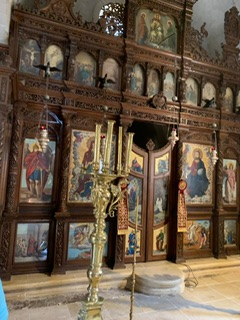
Since we had both been to Knossos on prior visits to Crete we opted to travel some 1.5 hours over the mountainous terrain to one of the 35 monasteries on the island – the Ecumenical Patriarchate Holy Metropolis of Rethymno and the Avlopotamos The Holy Monastery of Arkadi OR the Arkadi Monastery for short! It is located on Mount Ida at an altitude of 500 Meters (about 1,00 feet) above sea level and consists of a fortified complex with a 2 aisle central church. It was a 13th Century Monk – Arkadios who founded the monastery. On November 9th, 1866 during the Cretan revolution against the Ottoman Turks that the complex was attacked by the Ottomans. The local monks under Abbot Gabriel Mannakis, gave safe haven to some locals (the Revolutionary Commission of Rethymnon) that the Turks wanted. Rather than give up after 2 days of fierce fighting, they all congregated in the room with the gunpowder and set fire to it, killing not only themselves but a large number of Turks. This was the beginning of the end of Ottoman domination of the island. It is interesting to note that last century the remaining 700,000 Ottoman Turks were banished from Greece at the same time as 1.2 million Greeks were banished from Asia Minor. Arkadi Monastery Phone 0030 28310 83135and 86; email info@arkadimonastery.gr; Web – www.arkadimonastery.gr. It is still a monastery with half a dozen monks and receives many pilgrims and visitors. Many of the rooms in the old fortification are set out as they were during it’s heyday and an interesting museum with many of the original iconographic representations are visible.
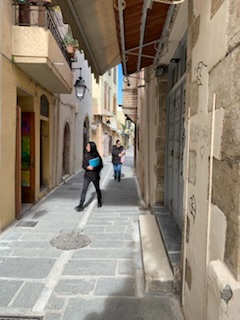
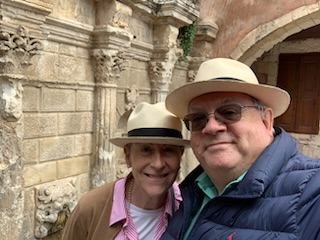
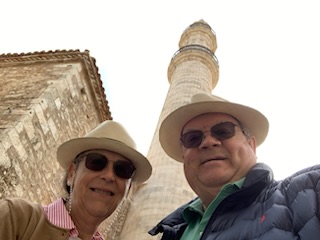
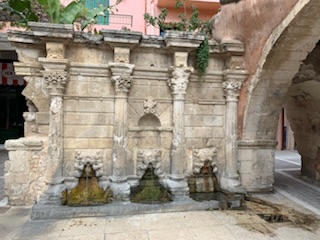
Our next stop some 20 minutes away was the old town of Rethymnon with it’s venetian era harbor and narrow winding streets including vestiges of a Minaret when the church was converted into a Mosque during the Ottoman occupation and is now a conservatory of music. After wandering around the town and getting a bit lost, we ended up in a local taverna for a Greek Coffee and a baguette with olive paste, eggplant and feta cheese.
We returned to to the ship and enjoyed some tea before watching the sail away and attending the hysterically funny performer (juggler, comedian, circus performer Goronwy Thom.

 Roger & Anne Travels