Sunday January 22, 2023
An early start for a very exciting day – Transit of the Suez Canal from North to South. At 3:30 AMwe lifted the anchor and started the entry into the canal at the Port Said entry. There was one container ship in front of us so we were the second ship to enter the Canal at 4:00 AM. It was still dark but we could see lights and buildings on the shore. We specifically opted for a cabin on the starboard side as the western side of the canal has a lot more life, towns, green area and activity vs the Sinai desert side which is all desert. If you plan on going from the Red Sea to the Mediterranean then choose a port side cabin. It is interesting to see the Sinai (East) side but lots more to see on the other side.
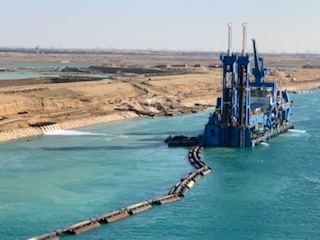
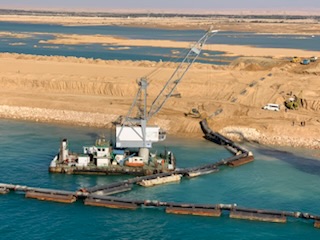
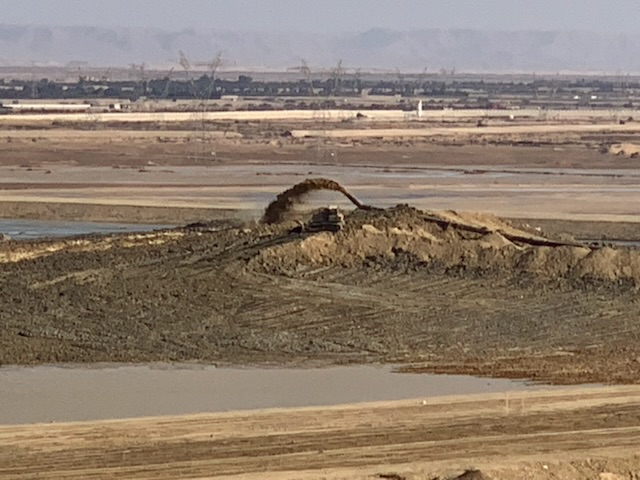
The day started chilly (in the 50’sF) and very misty / foggy. We were out in the front of the ship on the 11th floor as we approached the (Japanese) Friendship bridge (Al Salam) and all of a sudden it completely disappeared in the mist. Even being directly under the bridge it was barely visible. As the day wore on the mist lifted and the heat started up. We spent some time in the Commodore Club hoping it would be like the Panama Canal Transit we experienced nearly 3 years ago, namely that the expert commentator would be in that room and could be availed to answer questions. Indeed Vivian Rowen, the Egyptologist lecturer was there, and gave some general discussions but not in the detail that the chap did transiting the Panama Canal as he had run that canal and his father ran it before him. As the day wore on we moved from one place to another around the ship until we exited into the Red Sea by the City of Suez (Population 1 million) over the Ahmed Hamdi Tunnel at about 4:30PM. When the canal was built it was 164 Kilometers (102 miles) long and has not been enlarged and is 193.30 Kilometers (120 1/8 miles) long, 24 meters (79 feet) deep and 205 meters (673 feet) wide or more. Some places the canal allows for 2 way traffic, but the Great Bitter Lake is where the ships traveling in opposite directions wait for the ability to pass through the narrower sections. It was in 2015 that the 35 Kilometer (22 mile) parallel channeling the center part for this 2 way traffic was added. The plan is to have the entire Suez Canal a “dual carriage way” with ships going in both directions. In 2021 they stared the widening of the Southern entry by an additional 40 Meters (130 feet) and a depth of 22 meters (72 feet) for the 30 Kilometers (19 Miles) from Suez to Great Bitter Lake.
Some interesting facts about the Suez Canal.
The earliest attempts at a canal was the Canal of the Pharaohs joining the Nile to the Red Sea – 1897-1839 BCE. Other attempts by Darius and Sesostris and Pliny the Elder (23/24 AD/CE), the Ottomans and many others. In 1854 the French obtained the first license to construct a canal and after forming a private company in 1858 work started on 25 April 1859. The official opening was on 17 November 1869, but work continued for another couple of years. Although the French ship L’agile (The Eagle) was supposed to be the first to transit the canal, the British Naval Survey ship secretly overnight navigated through the waiting ship to the front on the queue, making it impossible for the French ship to pass it, so the Royal Navy ship The Newport was actually the first to use the canal. The English fearing French control, purchased 44% of the stock for US$4 Million in 1875 but left the French the overall control. So in 1882 the British invaded Egypt. In 1936 the British pulled out of Egypt but the Canal was still under it’s control. In 1956 the Canal came under Egyptian control following nationalization by president Nasser prompting “The Suez Crisis”. It was at this time that my Aunt, Uncle and Cousins who had been living in Cairo for a couple of decades were forced to escape with barely more than the clothes on their back! Since that time the canal has only been closed during the Israel Egypt conflicts. The new canal extensions (deepening and side canals) were opened. Recently the Evergreen Container Ship, Ever Given, blocked the canal from 23 to 29 March 2021 causing some $10 billion of disruptions.
The cost today of transiting the canal is US$7 per ton. So Queen Mary II paid $500,000 to cross today. The average price paid for all ships is about $250K. However that saves a great deal over having to go all around Africa.
Some of the monuments and structures visible from the ship along the canal are (going from North so South):- 1) The Suez Canal of Japanese Friendship Bridge (1995) joins the African side to the Asian side of the Canal. 60% was financed by the Japanese and the towers are built in the shape of Pharaonic Obelisks. It is 70 Meters above the waterline.
2) The AK47 (shaped like that type of weapon) on the West Bank commemorates the battle of Ismailia between Israel and Egypt in 1973. 3) The Defense Monument at Ismailia designed by the French – 50 Meters high, 240 meters long, using 4,700 toms of granite) was erected to commemorate the efforts of Egypt to defend the Canal against the Turkish army during the World War.
In the evening, Suzanne Godfrey from Liverpool a Flutist, whom we have seen before, performed using various flutes.
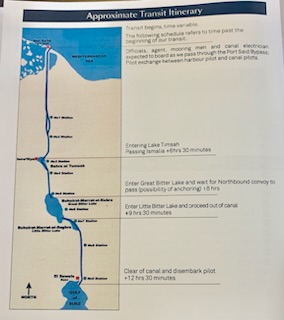
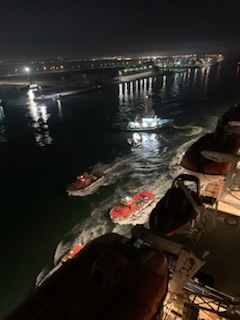
The Northern entrance to the canal from the Mediterranean near Port Said, Egypt.
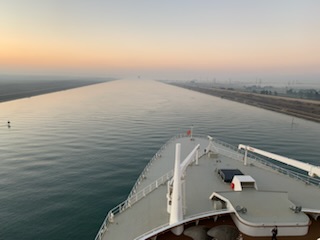
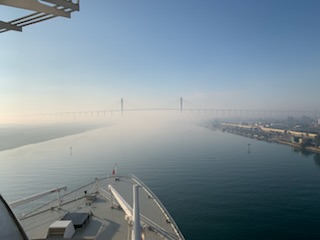
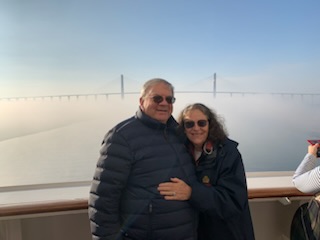
Going under (the very foggy) Japanese Friendship bridge.
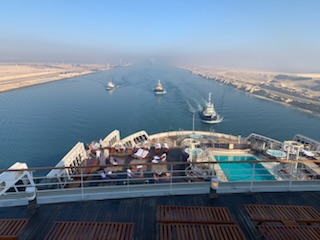
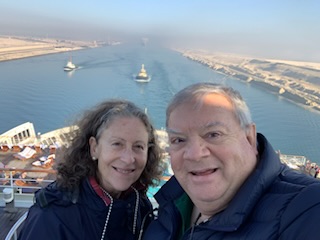
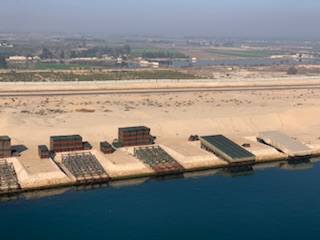
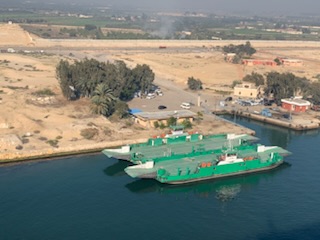
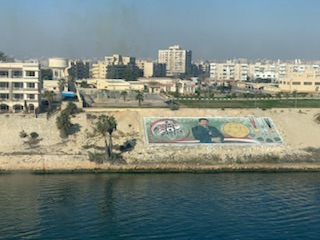
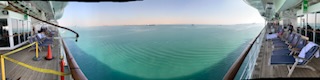
Of interest as we pass through the canal, mostly on the Starboard side of the ship. The Port side is mostly the Sinai Desert.
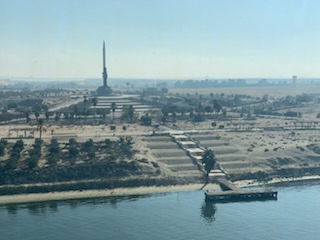
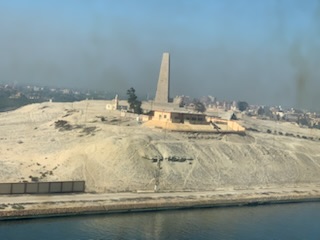
The AK 45 and other monuments referenced in the text above.
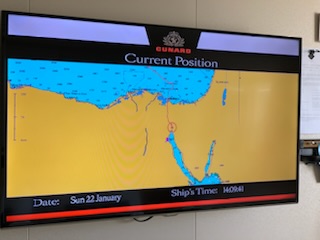
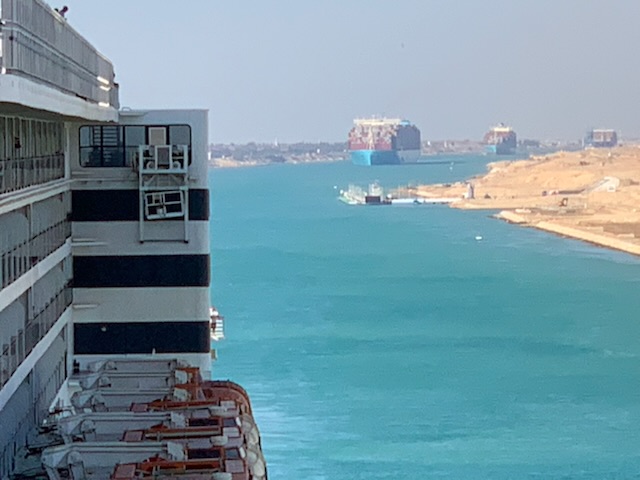
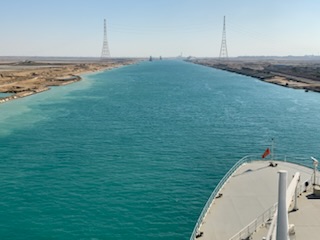
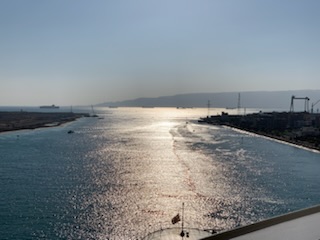
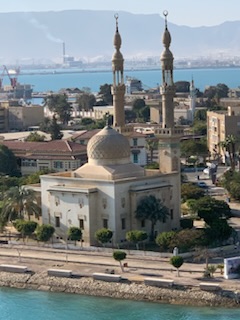
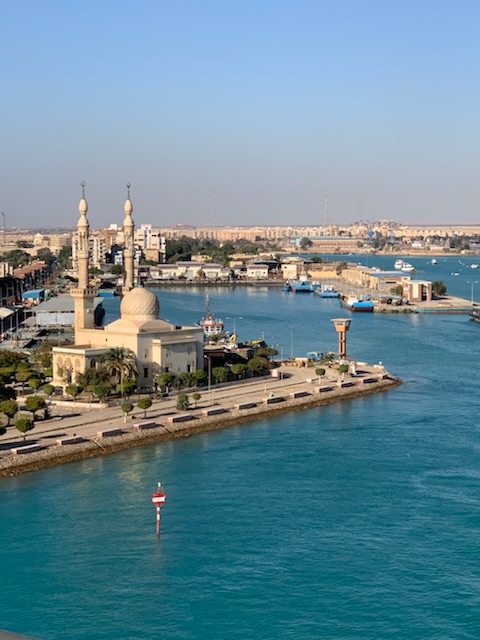
Exiting the canal at the town of Suez and entering the Red Sea.
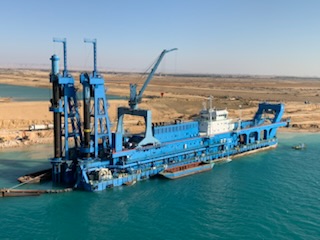
However, the next few pictures show the dredging efforts, sucking up the sand and moving it through large tubes which is part of the widening of the canal at the Suez / Red Sea end.

 Roger & Anne Travels