Monday January 23, 2023
One of the most spectacular, albeit tiring, days of any trip. Even though Anne and Roger had both visited Lower Egypt – Cairo, Giza and Alexandria (Anne having lived in Cairo), neither of us had ever been to Upper Egypt. So Luxor (population 100K) was the first trip to be booked, when we decided to take this trip and we were not disappointed!
It was an early start as we had to depart at 6 AM soon after docking at the Port of Safaga (population 40K) on the Red Sea (Starboard to Dock, RHS Drive). We together with the other 1,000 people on this tour, were in for a 3 1/2 hour coach ride through the Western Sahara to the town of Luxor. On the way our excellent guide – Hossam Ragab Email:- hossamr723@gmail.com; Facebook:- Hossam-Ragab-1257. I mention this as he does private tours and we would definitely book him when we return for a 2 week tour of Egypt to get a more in depth view of the fabulous civilization from 4-5 thousand years ago.
Luxor (or Thebes as it was called) was the second Capital of Egypt after Memphis. Alexandria and Cairo followed as the capital cities.The 5 principal eras are the Pharaonic 3200 BCE then Persians 525 BCE followed by Greeks 332 BCE, Romans 31 AD (CE) and finally the Arabs from 641 AD (CE). Today there are still 4 major Bedouin groups amounting to about 1 Million (of Egypt’s 100+ Million) people. Since there is a great deal of sand, the men and women tend to wear long loose fitting clothes and depending on the marital status, wear hijabs (face coverings) black if married; colorful if widowed or divorced etc. It is a defense against the sand in the face, and apparently not a religious expression matter.
Our first stop was at the Karnak Temple Complex, which was built by various pharaohs, but one of the principal ones was Ramses II who ruled for several decades during the heyday of the Egyptian civilization. The immediate impression of the location was the enormity of the place. The sheer size of the entry bastions / walls or pylons resemble 40 story high, 20 feet thick and 60 feet long, solid stone skyscrapers. Entry to this “outer Courtyard” is passing the ram head series of some 50 sphinx statues. There was a 2 mile roadway lined by sphinxes form the Temple of Luxor to Karnak. Passing through the entry or 1st Pylon into the Great Forecourt or enclosed courtyard one sees the “work in progress” of the pylon (front wall) as the ramp from antiquity used to haul the stone to the top of the wall is plainly visible. Also the first column on the right hand side, upon entering, consists of square blocks placed on top of each other, the second column shows that these square blocks underwent some rounding off of the square and the final columns showed the polished column with hieroglyphs and images in color, still visible today several millennia later. A 40 foot high carved statue of Ramses III and his main wife (at his feet) is in the center as well as several other structures like the alabaster Seti III altar and the Ramses III temple. This courtyard was a relatively late addition to the complex as it was added between the 14th and 11th centuries BCE. The second pylon was built 1333-1306 BCE and other monuments added in 1200 BCE.
The “inner sanctum” between the second and third sets of pylons, was dedicated to the father of fathers, the mother of mother’s, the God of Gods – Amon. His wife Mut and son Khons form the holy trinity. Of note is that the cult of following Amon as principal deity and thus the power of the priests, was temporarily suspended as Tutankhamen’s father Akhenaton (mother Kiya) attempted to move the capital and the religion away from Amon to the God – Aton. This worked during his lifetime but Tutankhamen moved it back to the cult of Amon as soon as he became Pharaoh. This area of the complex was the “Holy of Holies” and only priests, pharaohs and other elite were allowed to enter this area. The columned Hypostyle Chamber as it is known, was constructed during the reign of Seti I and was completed by Ramses II. Ramses II was one of the most powerful of rulers as he ruled for 67 years and had 92 sons and 106 daughters, four of these daughters became his wives of which he had some 90! The enormous 134 columns make humans look like ants and all are carved with figures and hieroglyphs which still maintain their color. The central colonnade forms a cross while the lateral colonnades fill the rest of the space evoking the reeds that grow in the River Nile. This section had a roof, which was partly stone and partly wood so was dark, but rays of light were permitted to enter the area by allowing some space between the top of the columns and the roof. The largest third section past the third lot of Pylons has not been restored to the same extent and other than two obelisks (one to Thutmosis I and the other to Hatshepsut), we did not see, but instead turned to visit the sacred lake which had two underground water tubes to the Nile so water could flow in and out of the lake maintaining it fresh. On the way we stopped at the long wall of inscriptions where we learned that the hieroglyphs can be read left to right, top to bottom or right to left. The key is the animal and which way it is facing. You always read toward the Duck or other animal. Pharaohs had two names, their birth name and the name they took when they became Pharaoh. If you see a duck with the circle behind (the sun) it’s head, the it is the birth name that follows in the cartouche. Of interest, but not relevant to this is that license plates of vehicles are written with the 3 letters facing one way and the 3 numbers are read in the opposite direction. Also there was a statue on a pedestal of a sacred beetle. This was a deity relating to death as the observers noted that this beetle buried in the ground at night and then became alive the next day. This was similar to the belief of death where the body had to be preserved as they would return to give new life to the body. However, the 4 key organs – lungs, liver, intestines and stomach had to be removed as the jackel God Anubis would devour these if left in place. The organs were placed in Canopic jars prior to mummification (with natron and linen cloths).
We then walked the final 200 yards (of 2 Kilometers) of the transverse path leading from Luxor Temple Complex of Ramses II to the Hypostyle Hall with it’s four pylons and numerous hieroglyphic texts and statues. It may be appropriate to remind oneself that Egyptian Hieroglyphs are alphabetic with some logographs, It was due to the finding of the Rosetta Stone in Rosetta Egypt, that Jean Francois Champollion following the earlier work of a British man, that we can read all these texts. On the Rosetta Stone are written praises by the people of Memphis to Ptolomy V in Greek (which could be read) at the bottom; Demotic which was the language of the commoners in the center, which was known and the Hieroglyphs in the upper part which could not be read, but as the other two scripts referred to the same actions, it allowed Champollion and others to decipher the upper script, assuming, correctly that it said the same thing.

The entrance Pylons and Sphinx’s
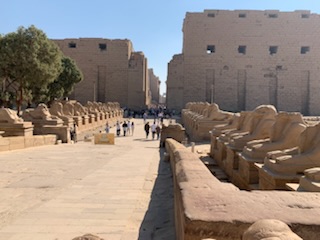
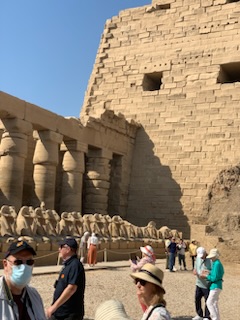
Note the first three columns on the right. The closest to the pylon shows the square blocks of Granite, the second shows the rough rounding off and the third etc show the finished columns all in the fore-court between pylons 1 and 2. This is in the fore-court or entrance courtyard. On the far right if the picture you can see some of the remnants of the ramp used to move the stones to the top of the pylon.
Below are images of the courtyard.
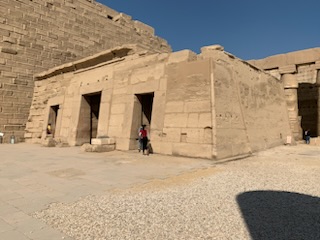
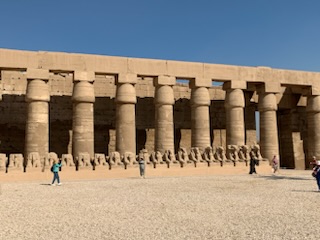
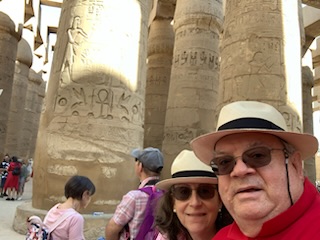

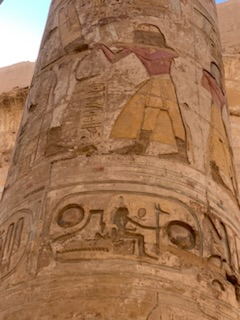
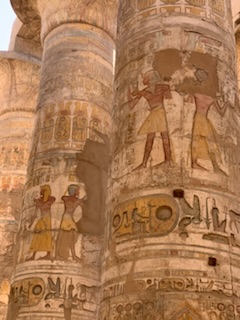

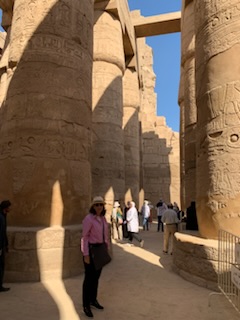
The columned Hypostyle Chamber With the enormous columns filled with colorful images and hieroglyphs.
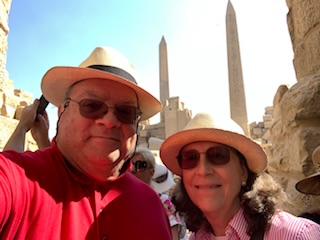
the third section with the obelisks, which we did not visit.
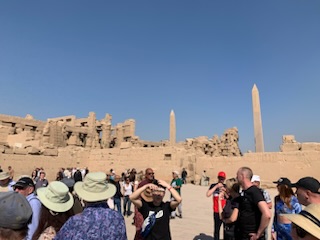
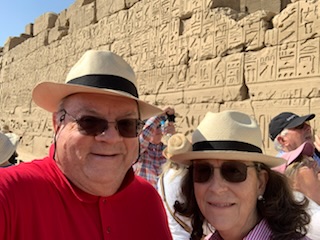
The hieroglyph wall leading to the sacred lake
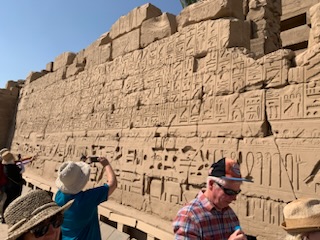
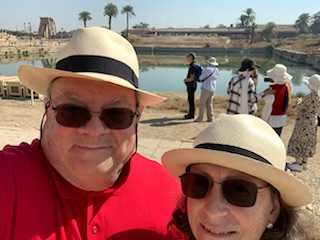
One of the pylons from the Temple of Luxor along the 2 Km Sphinx lined road to the center of Karnak temple.
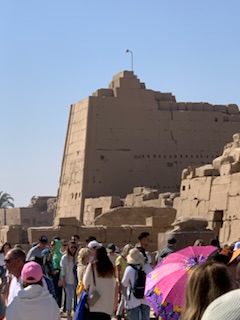
The text on the interior of the transverse pylon.
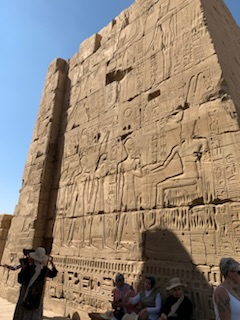
The next stop, at it was now midday was lunch in the Karnak dining room of the exclusive Steigenberger Hotel and Resort on the Nile in the town of Luxor. A good place to stay if one is visiting the area for any length of time.
We then travelled the 3/4 hour drive to the other side of the Nile to the Valley of the Kings. There are actually 4 necropolis valleys – The Kings, The Queens, The Nobles, and the Workers. All contain tombs befitting their status in the hierarchy of the times. The Queens tombs are less visited and less richly carved than the Kings and the nobles and workers are carved caves into the sides of the valley, currently under a major archaeological project. Arriving at the parking area we were given our tickets (Rhapsody Travel, 1 day entry Egyptian pounds 260 = US$9) and entered into the hall where there is a scale model of the Valley with the names of the Pharaohs, the location of their tombs, the order in which they were discovered and under the Perspex model one can see the structure of each of the tombs. They open different tombs to visitors on a rotational basis to minimize the deterioration. We were to visit the tombs of Ramses III, then Ramses the IX and finally Ramses IV. Some of the tombs can be visited only by paying an additional fee such as Tutankhamen’s, which was overcrowded and not as lavish as the rest as all the artifacts that Howard Carter found in the tomb in 1922 are now in the Cairo Museum. However, he is the only Pharaoh thus far found, whose body remains in the sarcophagus in the tomb. Extensive work continues searching for tombs yet to be discovered.
Having passed the entry building there are 12 passenger “golf cart” like vehicles, that take you from the bottom of he valley, up the hill to the area where most of the tombs start. The first two are KV1 – Rameses VII and KV2 – Rameses IV. KV and number indicate the Valley of the Kings and the number is in the order in which it was discovered with the last one being KV62 – Tutankhamen.
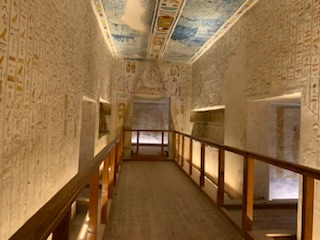
We walked to KV11 which is that of Rameses III, the second king of the 20th Dynasty – 1187-1151 BCE and ruled after Ramses II during the sponge of the 20th Dynasty. As you enter the tomb, your ticket is punched so you can only visit 3 tombs. You enter through metal gates which can be chained shut, into an 8 feet wide and 10 feet high, 60 feet long corridor, flanked by two animal (Hathor)-headed columns. As you descend the corridor you marvel at the sight of the walls and ceiling being filled, top to bottom, with a myriad of hieroglyphic inscriptions and pictures all carved into the stone for posterity. Most are still well preserved and readable. It is one of the longest tombs in the valley measuring some 125 meters (about 410 feet) long. The first two openings, left and right show secular scenes. A little further down are 8 (4 on each side) side rooms with scenes and vessels / jars of food for the afterlife. A “dead end” corridor during construction, was stopped as it hit KV 10 the tomb of Amenmes. This first section to the blockage was built by Set-Nakht, father of Ramses III. The pharaoh then took over the building of the tomb moving the corridor to the right. This continued on with side chambers. One of which is gated off, however, there was a man who (for a fee) allowed you to jump over the fence and enter the chamber. Anne kindly recommended that I jump the gate and visit the spectacular room with its colorful images of Ramses III meeting Osiris, Isis and the other gods related to death and the afterlife, together with numerous inscriptions. The final corridor leading to the burial chamber was equally magnificent, but the burial chamber is in a bad state of preservation and entry is prohibited. The mummy is in the Cairo Museum and the sarcophagus is in Paris.

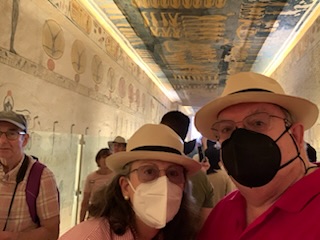
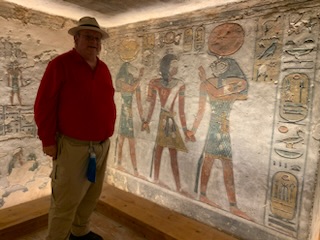
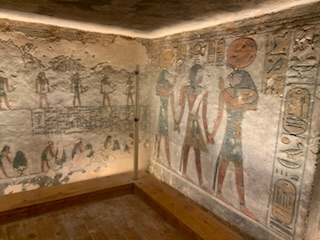
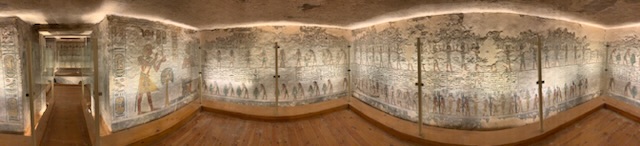
We then retraced our steps down the valley past the tomb of the 90 sons of Rameses II to the tomb of Rameses IX (KV6) of the 20th Dynasty. This was of a similar entrance and passing along three long corridors and chambers easy with pictures and hieroglyphs before arriving at the burial chamber. They depict scenes from – The Book of Caverns, The Opening of the Mouth Ritual, The Book of the Earth, The Book of the Day, The Book of Night. The Imy-dwat, The Litany of Ra and The Book of the Dead. The burial chamber is empty and has a large open pit in the floor.
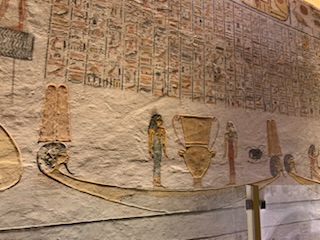
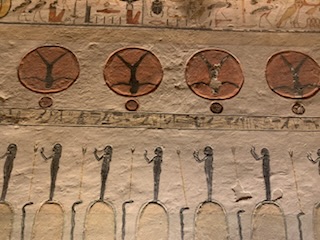

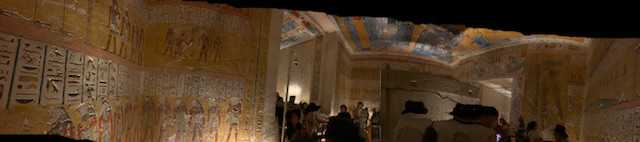
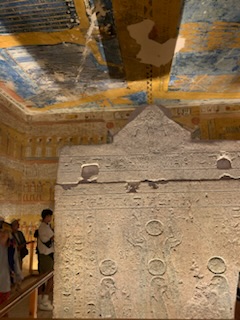
The final Tomb was KV2, that of Ramses IV also of the 20th Dynasty. It should be noted that the earlier Dynasties were buried in pyramids (like Chofu in Giza) and those, starting with the 18th Dynasty started to be buried underground in tombs like in the Valley of the Kings. This tomb was particularly impressive with the vibrant colors on the walls and the fact that the enormous stone sarcophagus lay in it’s original resting place in the burial chamber itself. It was visited and measured by the explorer Richard Pocoke in 1737, it served as the lodging place for Champollion in 1828 while working on the decipherment and early Coptic Christians used it as a church and left graffiti on the walls. The ceiling is decorated with colorful cartouches of kings names as well as birds, vultures etc. It has many beautiful scenes of the king being taken by boat to heaven to be judged. If his heart was heavier than a feather it was eaten by the vulture god and disappeared forever, however if lighter it went on to the God of Final Judgement Osiris to be Judged. Many scenes were observed that are similar to the prior tombs with excerpts from the Book of Caverns, Dead and Gates and the ceiling above the sarcophagus depicted the Book of Heaven.
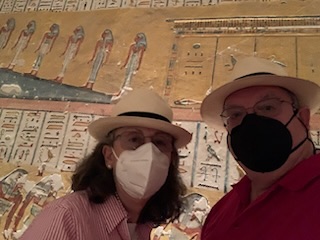

After this exhilarating day, we returned to the coach for the 4 hour trip back to the ship. We were greeted with champagne on the dock and proceeded to diner and the folkloric presentation by the musical and dance troupe from the local town of Safaga.
Below is a picture of the valley of the kings and of the final Ramses II area under research


 Roger & Anne Travels