Saturday January 28, 2023
Port to quay; RHS drive; dock in container port with no facilities and no shuttle bus into town (only to port entrance). Guide Rashid (excellent) bus 5 – Salalah Contrasts. No landing card required as stay was less than 24 hours – “Quick Trip”.
A warm day in the Arabian desert town of Salalah (population 400,000) in the Dhofar region of Oman. It is Oman’s second largest city after Muscat and was an independent fiefdom with no rule of law. The Omani Sultan, with the aid initially of British Gurkha forces, then Iranian special forces sent by the Shah brought Salalah – the “Frankincense Capital of the World” into the kingdom of Oman.
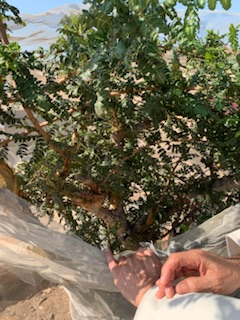
Only Yemen and Dhofar in the Arabian peninsula, experience a monsoon season from July to September (called Khareef meaning “Autumn”) and during this season all is very green. A major producer of natural gas, some oil (900,000 barrels a day), fruit and vegetable farming and fishing are the key economic factors of the area. Tourism is still in its infancy, but our coach and guide were excellent. From ancient times 2000 BCE, Salalah and it’s neighboring settlements – Al Balid, Sumharam, Shisr and Wadi Dawkah are the main producers of frankincense, which in it’s heyday 13th Century, one kilo of Frankincense brought 1 kilo of gold. It was a major port of the region and trading from all the neighboring seafaring nations took place bringing goods in exchange for frankincense. The frankincense tree (Boswellia Sacra) which is everywhere and self seeds itself. It is tapped (like maple syrup from maple trees) and that sap is the frankincense that comes in three qualities. The highest quality is white and used for medicinal purposes (eaten directly or placed in water and dissolved, drinking it daily) going for Omani Real 30-40 / kilo; the second quality is yellow and the lowest quality is brown which is used in incense burners and runs at about a cost of 5 Omani Reals a kilo (UD$1 = 0.395 Omani Reales).
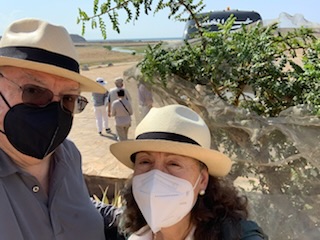
The Frankincense Tree whose sap produces the incense and other medicinal uses.
The Country of Oman is ruled by a Sultan. Ahmad bin Said (1694 – 1783) was the early ruler from 1749 to 1783 and the family of Busaid continued to rule until the Al Said family took over last century. Said bin Taimur, (1910-1972) ruled from 1932 until he was deposed by his son Qaboos bin Said on July 23, 1970. Qaboos (1940-2020) then took over and ran the country until his death on January 10, 2020. At which point the Royal family had three days (men and women) to decide on a new ruler, and if they couldn’t, Qaboos had left a letter naming his successor in a sealed envelope to be opened in front of the ruling counsel. His cousin Haitham bin Tariq (1968- present) assumed the Sultan-ship three years ago, on January 11, 2020. On January 12, 2021, the current Sultan changed the law of succession to primogeniture, with back-up alternatives and only in the male line. Thus, Theyazin bin Haitham Al Said (1990- present) is the crown prince and the heir apparent.
Said bin Taimur was very restrictive such as allowing only 4 schools in the country (2 in Muscat, 1 in Salalah and one in the interior) to exist. Women were not permitted to be educated etc.
Qaboos was born in Salalah and educated at Sandhurst in the UK, then in the German Air Force where he became a pilot and finally back in England where he learned about how to rule a country and organizational matters. When he returned after his European education in 1968, his father held him under house arrest, but with the help of the Gurkhas etc as previously stated, he deposed his father. He made major changes from the start, changing the flag colors and name of currency from his father’s name to that of the Country. Women were empowered and indeed were permitted to vote on the new ruler and today there are more women college graduates than men. Crime is almost non-existent and there is no presence of military or police. All schooling and medical services are free for all citizens. Foreigners are permitted to buy land anywhere and immediately receive permanent residency status for them and all their extended family. All Omani citizens are given a 600 square meter plot of land, once in their lives, to build their homes. It appears that many of these homes are major palaces. However, we were told that this is because it is the custom for the sons of the family to remain in their parent’s house after marriage and live there with their children. Thus what appear to be very large homes are actually 2,3 or more family homes in one. Polygamy is permitted and our guide indicated that he had 2 wives, but now only one, and it is the custom currently to only have one wife.
Overlooking the large container port and Salalah city.
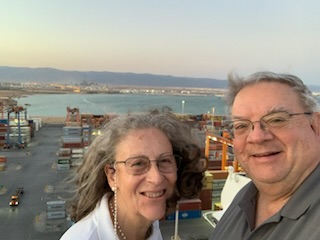
Salalah was a small fishing village until 1970 when a major building effort started to take place. Today many buildings very spread out can be seen together with a Mosque in each neighborhood. As almost 99% of the population are Muslim. Wide dual carriage way streets transverse the city and lead to the outlying areas. One of these, which we did not go to, is to Job’s Tomb (nn Nabi Ayoub Mausoleum), but may be worth visiting if we return some day. Another is the “Anti Gravity Point” OR “Magnetic Point” OR “Gravity Hill”. Here a car can go uphill in neutral and without use of an accelerator and can get up to speeds of 46 – 60 Kilometers per hour!
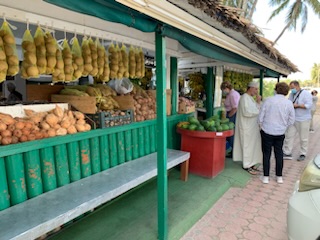
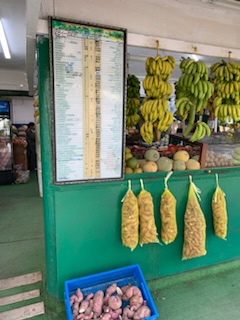
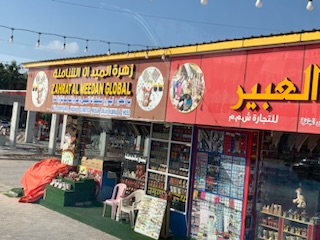
Our first stop was at the ceremonial palace of the Sultan Hosn which could only be seen from the outside and has beautiful gardens outside and one could see a minaret / mosque inside the compound. This is used as a ceremonial location for meeting signatories as his home palace is towards the hills in the East. A short photo-stop was followed by a brief drive to the Al-Qawf Market with many shops all selling either frankincense in it’s various forms, or clothing. We also stopped at one of the many fruit selling stalls along the road with the usual tropical fruits and vegetables. The farms seem to be situated between the shoreline and the residences of the farmers, right in what seemed to be the center of town. As this is such a modern and spread out city the planners can afford to have farms and palaces together.
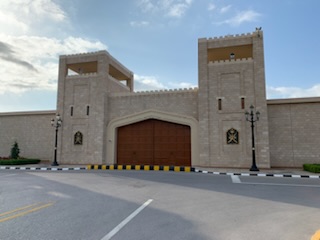
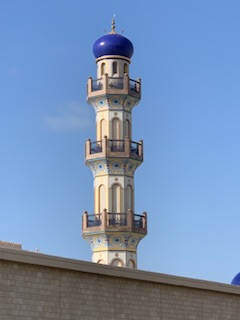
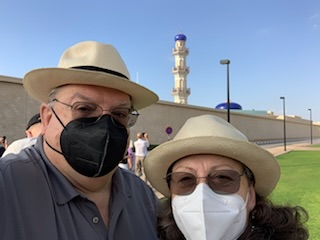
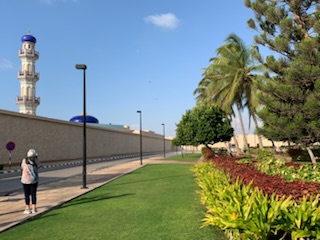
The Sultan’s ceremonial palace above. Below the Suq (Suk) / Market and vegetable stand by the road.
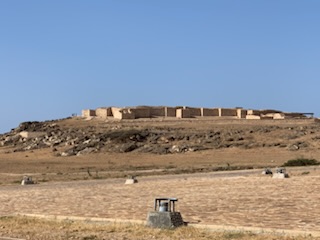
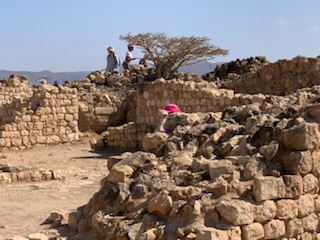
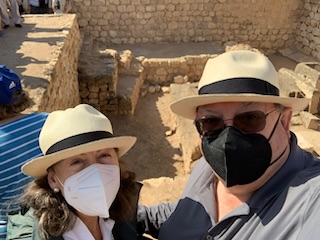
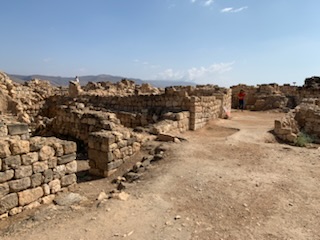
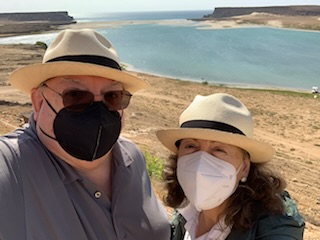
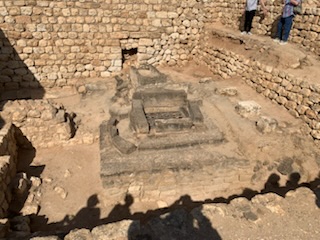
Next, some 25 minutes on the highway, after passing the Wadi Darbat waterfall , brought us to Sumhuram or Khor Rori – a seaport (4-5 century BCE), archaeological site which is a fortified town that dates back to the Hadramawt empire of the first century CE / AD. It is the old port where frankincense was traded. It is also associated with the Queen of Sheba. Here, being Saturday, a day of rest, the museum was closed. However, our guide, since we were way ahead of the other coaches, persuaded the guardian of the site to open up the small but interesting museum and we saw a short documentary that explained all about the location which was very insightful. We then went to the archaeological site, currently being worked on by a group of Italian Archaeologists from the University of Pizza. A fantastic view of the harbor can be gleaned from the promontory that is the fort. The ground is very uneven and easy to trip and fall. The entrance is through a double zig-zag corridor with doors, to stop any unwanted guests, although there was a rear entrance for the merchants to bring their wares for trading .
Along the way, we saw many camels and at one point had to stop to allow the large camel herd to cross the motorway! The Camel herd owner, once they were all safely across the road, left them to their own devices with no enclosure, only to return in the evening to bring them home. We were told that if you walk in front of a camel, it will follow you, but if you allow the camel to take the lead, it will always head towards an oasis, where there is water or back home. They have an uncanny way of knowing which way to find water. All the camels in the UAE, where we are headed next amount to about 25% of the Omani population. Camels are milked and their milk is low fat, low cholesterol and made into yogurt, ice cream or drunk alone.
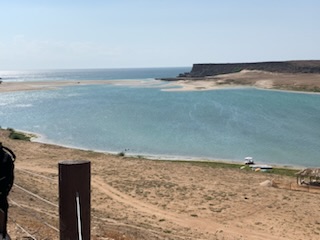
We then retraced our steps past the waterfall to the fishing town of Taqah. This is the fishing port where the sardines are plentiful as are other fish. However, instead of learning about fishing, we stopped at a beautiful sandy desolate beach. Beautiful, but not overly educational. Next we went to the Castle Taqah which was being restored, so one could only see it from the outside. As we continued in the coach we passed one mosque where there was a funeral taking place and three tents where weddings were underway. In the case of weddings, the imam announces to all at the local mosque that XX and YY are to be married, giving the date, time and location and all are invited to attend, whether they know the individuals getting married or not.
The beach at Taqah (the fishing village)
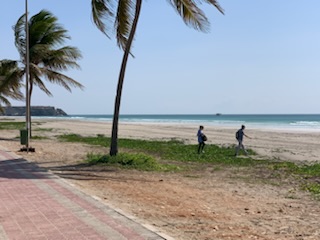
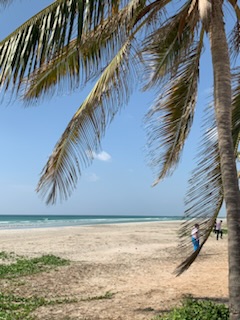
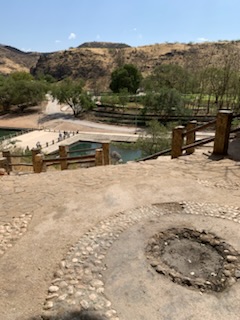
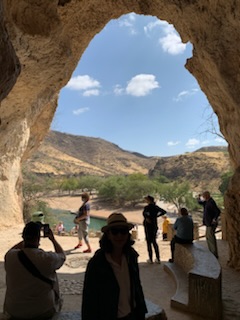
Our final stop before retuning to the port, was the private garden of the Queen Mother, which is open to all at the weekend and public holidays for picnics or recreation. The guide, although excellent, telling us all about the life of the average Omani and some history / politics, never really told us much about the places we were actually seeing. So when we arrived at the gardens, we could see beautiful verdant and colorful flower areas behind fences, but were taken to a river where there was a spring feeding the river, which we walked along and eventually got to a point where we could climb up into a cave and get a nice view of the area. One assumes it was once the “residence” of a family, but no explanation was forthcoming. Nevertheless, we enjoyed the area. Our exit was briefly detained by a heard of cattle that was crossing the road, but we were soon passing the groups of some 50 palaces with their mosque, then a desert area and another similar grouping of homes.
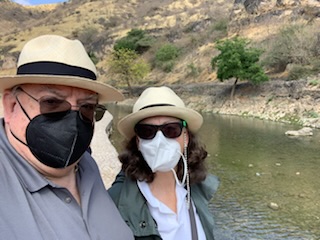
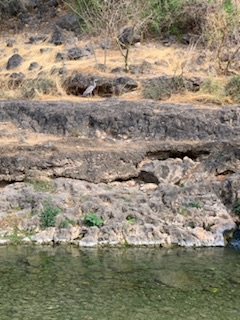
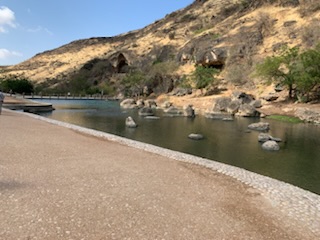
The Queen Mother Gardens and the cave we climbed up the hill to visit.
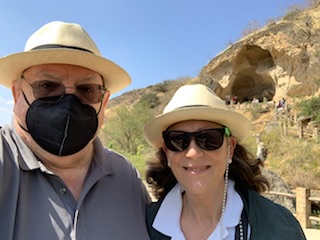
We were back at the ship by 1:15 PM and headed for lunch and lots of water! Overall, we got a very good impression of this modern, spread out city, clean, roundabouts and rules respected, no traffic and friendly people.
We are now out of the piracy area so we will resume normal conditions and the extra precautions will be dropped. So after watching the sail away and dinner we went to the terrific show of Worley & Farrell, two British individuals that play the same piano together, crossing hands and playing extremely fast, some classical pieces. Amazing how they are able to work the keys at lightening fast hand speed.

(Thanks Javier for this FBI image)

 Roger & Anne Travels