Friday February 10, 2023
Today was our last day at sea before getting to Penang, Malaysia. The morning was taken up with the usual set of lectures, but the afternoon took a different turn.
Dr. Bob Donaldson spoke about why “Nation Building” has not worked. He gave examples of the great success of Germany and Japan after WW2, but these were already functioning nations. Whereas the disastrous efforts in Iran, Iraq, Afghanistan etc are due to the competing sects, tribes etc (like Kurds, Shi’a and Sunni in Afghanistan) that were almost at war prior to the US intervention and continue to disagree despite the best efforts of the US and coalition forces.
Next was the conversation / interview of the BBC journalist Jane Corbin. It;s always interesting when the Entertainment Director Neil, interviews these guest speakers as it gives you an insight as to who is the real person as opposed to the person you see on TV. She is married with 2 children (boy & girl) and even though she was born in England (her mother went thee to have her daughter) they lived in various places in Africa and so from an early age she became interested in the world and the issues that she found in these different places. She does teach younger journalists but never knows what her schedule will be like as she always has a “Go Bag” ready to go off to the next story and hot spot. I can fully empathize with this as when I was working for the Bank, I had a bag packed and in the car or at the office at all times as I knew where I would start the day, which office and which country, but never knew until the end of the day, in which country I would sleep, if not in the air! She has worked and continues to work in some of the world’s hottest of hot spots and always tries to keep a neutral tone to the reporting. Some 3-5 weeks of shooting and 5-7 weeks of editing produces 1 hour of programming. Asked about PTSD, she said often it was not the cameramen that would suffer PTSD, as they observed the world through the lenses, but the presenter / reporter and editor who saw the hours of raw tape and experienced the action with the people that would have PTSD. She spoke about several interviews like Indira Ghandi and Ms Bhutto who were assassinated soon after their interviews with her, as well as Yasser Arafat who would have lunch at 2 AMand only eat yogurt!! Many other leaders she has interviewed and told stories about them.
The third lecture was by the British diplomat – Andrew Barber who spoke of the intelligence war during the WW3 and specifically about the “Red” and “Purple” cypher machines that the Japanese used which the Americans were able to get hold of early in the war and were able to use to decipher communications about plans before the Japanese acted on them. This greatly helped in bringing the war to an earlier end than would otherwise not have been possible and saved many Allied lives. It was interesting to note that the Germans and the Japanese had little to do with each other even though they were allies, but the Japanese ambassador to Germany would be in regular contact with Hitler and would then report back to Japan. These communications were all intercepted and deciphered, giving the Allies great advantage. The old WW2 adage “Loose Lips Sink Ships” comes to mind!!
The afternoon, Anne went to the Gulliver’s Workshop where the Actors / Owners of the Box Tale Soup explained the philosophy of how they put together a show. From the initial concept to the initial drawings to the execution of the props that all fit in a suitcase or trunk, so that it is very moveable, to the development of the script and music. A very interesting demonstration. Roger would have liked to have gone but had signed up for the Shiraz Fine Wine seminar. Anne after the theatre talk was over, went to see the Queen Mary 2 guest choir that had been practicing under the auspices of the Cunard Singers. The choir comprised of 40 women and 12 men and sang different songs – from Mama Mia to Les Miserables and more. A fun way to spend the afternoon.
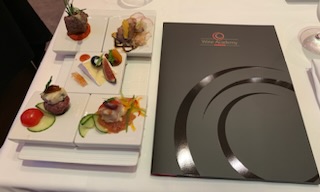
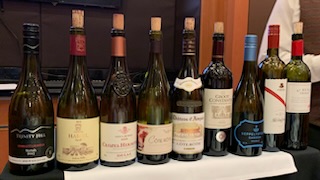
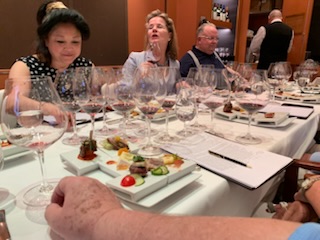
Roger was going through a very interesting talk and wine tasting with 8 other guests seated around a table, on Shiraz or Syrah. Both are from the same grape and the word Syrah originates in Persia (Iran today). Today in South Africa and Australia the word Shiraz is mainly used whereas elsewhere it is Syrah. The grape itself after DNA analysis at University of California at Davis in 1998 comes from the Rhône with the “father” being a now extinct grape called Dureza and a “Mother” still in existence but in very minor amounts – Mondeuse Blanc. One often thinks of it coming from Australia / New Zealand as in 1836 James Busby took it to Australia. We started off with a very light Syrah Gimblett Gravels, Trinity Hill, Hawkes Bay, New Zealand 2017 founded by John Hancock, funded by Robert & Robyn Wilson in 1993. The second was a much bolder and one I greatly enjoyed – Syrah Clos de Gat Har’el, Judean Hills, Israel 2014. This wine is 90% Syrah and 10% Cabernet Sauvignon. Of interest is that most vineyards around the world are between 30 and 50 Latitude North and South and the best are ones with a larger temperature difference between day and night and those on more rocky and poor soil with poorer ones growing in more sandy soils. Obviously this is a generality and there are many exceptions. The third wine was Crowe’s-Hermitage Les Launes, Delia’s, Rhône, France which like most is 100% Shiraz. The next wine was another French one – Côte-Rosie, Domaine Pierre Galliard, Northern Rhône, France 2020. It is situated on the slopes and the vines grow in various soils. Up to 10% are co-fermented with Viognier which adds to the complexity and they do practice micro-oxygenation. The next wine from the same region was Château d’Ampuis, Côte-Rhône, E. Guigal, Northern Rhône, France 2014. It was founded in 1946 by Etienne Guigal in Ampuisin and in 1961, Marcel, the son took over as his father became blind. The grandson Philippe now runs the business. We then moved way from France to South Africa to taste the Shiraz made the the oldest and best known winery in South Africa, founded 338 years ago (1685) – Constantia. Shiraz Groot Constantia, South Africa -2018 which is situated near Table Top Mountain outside Cape Town. Of interest here is that when Napoleon Bonaparte was in exile from 1815 to 1821, the only wine he was allowed was that coming from this winery. Next we went to the Adelaide area in South Australia for the last three. If you have lost count by now, there were 9 wines we drank!!! Shiraz Seppeltsfield, Barossa Valley, Australia. In 1850 Joseph Seppelt purchased 158 acres for £1 an acre and produced wines and fortified wines for “medicinal purposes” for the Australian Hospitals as doctors believed that those in hospital needed Brandy to help patients recover from their ailment. A practice sadly is no longer maintained! The last two I felt were the best together with the Israel wine and this next one come with a red stripe across the bottle. Shiraz The Dead Arm, d’Arenberg, McLaren Vale, South Australia. Many Shiraz wines have interesting names, but this one comes from the fact that vines all over the world can be affected by a fungus Eutypa Lata that renders one branch / side / arm dead. It has to be cut off of the fungus arrested, however the other side of the plant produces good, albeit low volume, fruit with intense flavor. The final wine, which is probably the best of all comes from the famous Penfolds vineyard in Australia. Shiraz St. Henri, Penfolds, South Africa. It was founded by an English doctor – Christopher Rawson Penfold born 1911, graduating with his MD. In 1938, he and his wife Mary went to Australia in 1945 and produced fortified wines for his medical practice. The wine making took off particularly after his death in 1970 when is wife took over. In continued on with their children and grandchildren and today produces some of the best wine in the region. One barrel may be worth AUS$ 250,000! All in all a very enlightening 2 hours although after 9 glasses of wine with just some small but excellent “amuse bouche” type food, we had difficulty making it back to our cabins!!!
The evening show was the magician, Philip Hitchcock, the magician, who tried hard to entertain, but with little success and the Cunard Singers and Dancers doing a tribute to Dream Girls followed.

 Roger & Anne Travels