Saturday February 11, 2023
We docked Starboard to dock (should have been Port) in Penang, Malaysia where, based on the British influence in the area, driving is on the left. Both of us thought we had been here before so opted not to do a city tour but instead go and visit the Orangutans. However, the port we were thinking of in Malaysia that we visited 4 years ago was Malacca! We realized this as we saw the city full of skyscrapers and looking very prosperous. Nevertheless, we were glad to see the Orangutans.
Penang (Pulau Pinang) is an island, just off the coast of Malaysia connected by two long bridges (Penang built in 1985 and Sultan Abdul Hali’s Muadzam Shah Bukit in 2014) and ferries and has been an important shipping town for many years given it’s position at the mouth of the Malacca Strait. A key waterway between Malaysia and Sumatra, Indonesia that is the quickest way to get from the Indian Ocean / Andaman Sea into the Eastern part of Asia – Philippines, Indonesia, Borneo, Bangkok Thailand, Cambodia, Vietnam, Korea, and on to China, Japan, etc. It is almost like a naturally occurring “Suez Canal” between Western and Eastern Asia. The Capital is Georgetown and Penang is a World Heritage Site. Penang covers some 1,050 Sq Km (400 Sq Miles) and a population of 2.2 million. Malaysia’s history dates back many thousands of years to the neolithic period (5000 to 6000 years ago) based on archaeological findings in Seberang Perai.
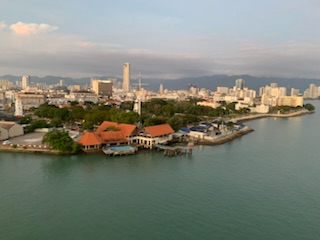
Penang Harbor today
Modern history dates to 1786 by Francis Light of the East India Company, even though the first British vessel arrives in June 1592 captained by James Lancaster. At the time it was under the rule of Siam (Thailand).
Francis Light promised British Military help to Sultan Muhammad Jawa Zainadine Adeline II who ruled that area as a vassal lord of Siam, and was given Penang Island in return for the protection. Light took possession of the Island on August 11 of that year in the name of King George III and the East India Company. He called the town Georgetown in honor of the Monarch and the Island was called The Price of Wales Island. Gradually and after several treaties, the British had full control over the current territory (including Singapore) by 1784. From 1826 – 1843 Georgetown was the capital of Penang, Malacca and Singapore, until Singapore became more important and became the capital, but Georgetown remained the Financial Center. This continued (other that a couple of years during WW2 when it was ruled by the Japanese) until 1957 when it became independent. Penang was established and remained a free port until it was revoked by the Malaysian government in 1969, which adversely affected the economy until the free industrial zone was soon thereafter established, making Penang the “Silicon Valley” of the East, reviving the economy through the 1990’s. We passed this zone on our tour seeing IBM, Microsoft and other high Tech companies and this is why there are many national and international companies there now.
Our excellent guide – Harold Anthony is of Indian descent, but a Malaysian. There are three dominant groups that live together in harmony – the Chinese form 43% of the Island population, followed by Malay natives 42%, about 7 % Indian and the rest of mixed ethnicity. However all seem to get along happily even though there are various religions and practices. In the South of the island most of the land is covered with some 300 factories, mostly foreign; the west is mostly countryside and the north is where all the beautiful beaches and fancy resorts are located. Georgetown is a modern city with skyscrapers and shops and many people have a second home here.
It is interesting that the flag of Malaysia was designed with help from the USA so it has a similar design, namely there are 14 stripes each indicating a state and the corner in the US flag has stars, in Malaysia it has a crescent as the “official religion is Islam, but it is not an Islamic country. The Chinese Malaysians are predominantly Buddhist, the Indian are predominantly Hindu and the “Other” are Christian. All religions are accepted and practiced. In fact there is one street in Penang that has several houses of worship each one of a different religion and it is known as Harmony Street! This is not the only disparity, as the flag has 14 stripes / States, but there are only 13 as Singapore was originally one of the states until it decided to become independent of Malaysia. The country has 9 states that are ruled by Sulttans and each 5 years one of these is named “King” of the Country. British education, legal / law and order and politics remain under the British system and all are educated in English, Tamil (Malaya) and their native language, depending on their origin – India, China etc. The economy is mainly now based on palm oil and all along the highway one could see acres and acres of palm trees that the fruit is harvested and two types of oil are produced: the white oil being used for cosmetics and the reddish one for cooking. Rubber used to be a major export until synthetic rubber took over. However there are still some rubber plantations on the island. Harvesting the Palms can be dangerous as there are 121 types of snakes and 75% of these are poisonous. The worst is the King Cobra which can rise up to 6 feet in the air and if you are bitten, death comes within 10 minutes. The guide suggested that if you come across a Cobra you should just remain motionless until it “gets bored” and goes away. Any movement can be interpreted as aggressive and thus it will attack. Pythons if they bite you allow a slower death – 40 minutes!!! Neither sounds like it is a lot of fun.
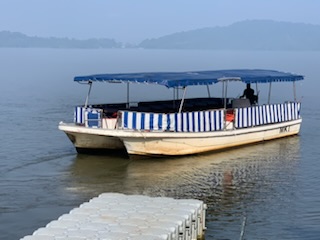
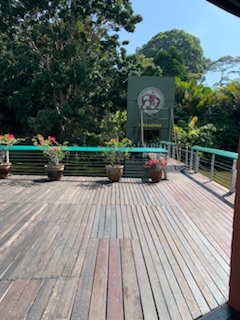
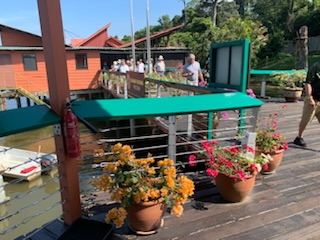
After a little over an hour with the guide providing us with all the above and more information, we reached the artificial lake made by the British. Water from the lake is used to feed the rice paddies in the area. We arrived at the Burkett’s Merah Lake-town Resort with hotel, shops and entertainment. We then were to board a small motor driven catamaran, to the 35 acre island where the Orangoutangs are living and referred to as Bukit Merah Orang Utahn Island, run by a scientific foundation of the same name. (Japan Bukit Merah, 34400 Semanggol, Preakness Daryl Ridzuan, Malaysia; email – salemarketing_oui@yahoo.com; Web orandutanisland.org.my; Phone +605-8908-110 OR +6019-578-3025). The name Orang Utahn stands for Orang = man and Utahn = forest so Orangutan is “man of the forest”. This is because they share 97% of human DNA. They have similar gestation, menstruation to humans and start reproduction when they are 7-8 in captivity and 12-13 in the wild. The majority of the Malaysian Orangutans exist in the wild in the two Malaysian states on the island of Borneo. This island has three countries on it – the north consists of the Malaysian States of Sabah and Sarawak and in between the Sultan of Brunei has a small piece of land and is the country of Brunei. The Sultan is one of the wealthiest individuals in the world. The Southern part of the island is Borneo which is a part of Indonesia.
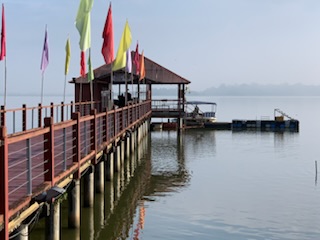
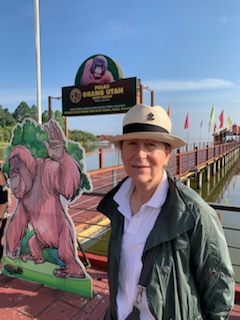
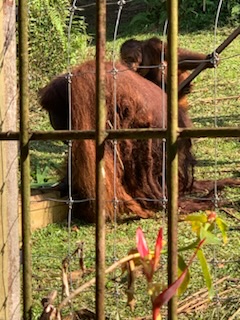
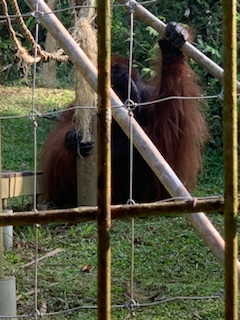
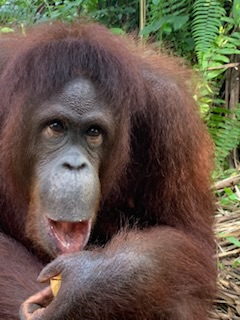
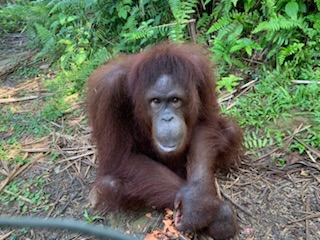
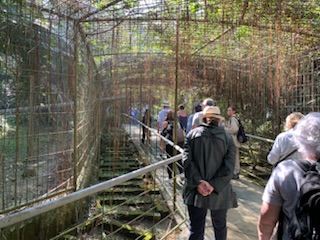
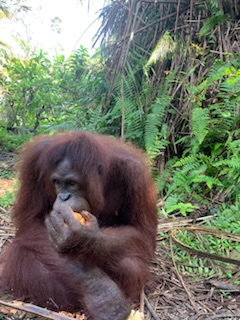
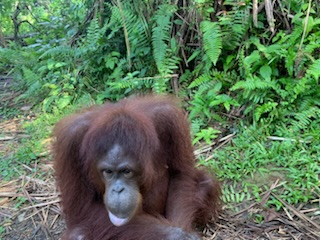
When one of the “Borneo” Orangutans are injured or are found abandoned and brought to the Bukit Merah Orang Utahn Island, they are allowed to roam free and as they cannot swim, they cannot leave the island. There is a caged walkway that permits humans to walk through and see the Orangutans in their native habitat. There is a group of professionals that take care of the animals and there have been children born on the island, So conservation, rehabilitation and research are the prime factors funded in part by visitors to the island. When all has been done and they are nursed back to full health they are released into the wild in Sarawak. Orangutans live for an average of 50 years in captivity and a few years less in the wild. They have opposing thumbs, long arms, each one having a distinct personality and hierarchical family structure. They mostly live in trees and males are typically alone unless in reproduction mode. There is a common ancestor to the Great Apes – Chimpanzee, Orangutans, Gorilla and the smallest – the Bonobo. There are three species of Orangutans – Borneo (Pongo pygmoeus) found on that island; the Sumatran (Pongo obelii) and finally the Tapanuli (Pongo tapanulensis) both found on the island of Sumatra. Males grow to 200 lbs (90 Kg) and 4 1/2 feet (1.4 Meters) high whereas females are smaller and grow to about 110 lbs and 3 1/2 feet high. A young lady who had been working in the sanctuary for 15 years took us through the caged walkway through the jungle and she pointed out each one by name, called them and there was a male colleague of hers feeding the Orangutans inside the enclosure bringing the animals closer to the viewing area by throwing food in the direction of the viewing public. This also brings education to the general public the dwindling numbers in the wild which could led to extinction.
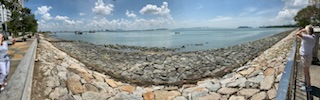
We drove back to Georgetown, where, as we were back earlier than expected, the guide took the coach through the town pointing out the various buildings. A really enjoyable day. And as we have three more “port days” coming up we were ready for a good rest. However, in the evening we enjoyed the comedian Jeff Stevenson.

 Roger & Anne Travels