Friday February 17, 2023
Port to dock, large cruise terminal, container port area, left hand drive.
Today we were up early as we were doing the “Bangkok in A Day” Tour, but chose the “Small Group” version which meant that instead of being in a large 40-50 passenger coach, we were only 4 couples in a small van. Fortunately we all got on well. One was an English couple that live in the Channel Islands, another Australian couple from Tasmania and the third couple was an English man from Derbyshire and a woman, apparently not his wife, but a traveling companion, from the North of England. He kept referring though to his wife. At first they were the ones that complained and did not participate in conversation, but eventually were ok.
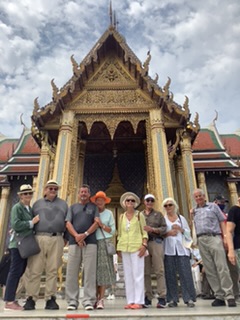
We were the last to board, took our seats and the driver and guide – Sasa – sat in the front seat. She was enthusiastic but her English left a lot to be desired and even though she said ask me any questions, there were few she could or did answer. Some she looked up on the internet and then ran through google translate to tell us. Some she ignored and others she answered something totally different from the question asked. Nevertheless, she had a nice personality, tried hard and was very pleasant and most importantly, took us to the sights we were supposed to visit and did not loose anyone!
As we drove the 2+ hours on the 6 lane (3 in each direction) highway from the port Laem Chabang, she gave us some information.
There have been 4 capitals in Thailand (previous to 1939 – Siam). 1) Sukhothai (1238-1583); 2) Ayutthaya (1351-1767); 3) Thonburi (1767-1782) and in 1782, it expanded to the Eastern side of the Chao Phraya river which is today Bangkok or Krung Thep Maha Nakhon or Krung Thep. The full name is actually 168 letters long and is listed in the Guinness Book of Records as the longest place name in the world. The guide gave us the full name which nobody could repeat, but loosely translates to – “City of angels, great city of immortals, magnificent city of the nine gems, seat of the king, city of Royal Palaces, home of Gods incarnate, erected by Vishvakarman at Indra’s behest”.
The country, which had never been ruled by an outside country, has a population of 68 million, of which 12 million live in Bangkok. Of the 12MM, 10 million are Thai and the other 2 million foreigners. The country is principally Buddhist (she indicated 50% but others have said up to 95%) with Christian and Muslim coming in equally and then a few of other religions. She also indicated that many young people were born Buddhist, but are converting to Christianity. We saw many Buddhist temples, the odd mosque but did not see any churches. Laem Chabang is the town that has grown up around the port and has a population of 90,000. Most goods entering Thailand go through this container port and it is the 20th busiest port in the world. Thousands of cars assembled here, are waiting at the dock to be transported overseas. Apparently monks, dressed in yellow or orange can be “life” monks or “temporary” monks. If a married man decides to be a monk for a month or more, he can do so, but during that time, he has to live in a monastery, beg for food daily and most importantly cannot even touch a woman even by mistake. So if a woman is walking anywhere near a monk, they have to leave plenty of room for him to pass so they won’t touch. After completing the “Temporary” monk period, he can return to his wife and family and continue his life. Only men can be Buddhist monks, women cannot be nuns. This was contradicted by the guide tomorrow saying that novices and nuns do exist! I’m glad all agree on the same set of facts! There are about 30,000 Buddhist temples in Thailand of which there are 300 in Bangkok. The prior king Rama 9th, was beloved by all and almost worshiped as a god. He ruled for some 70 years and after his death in 2016, his son Rama 10th took over. It is illegal to speak bad of the king, but we know that this king was a playboy living more in Europe than Thailand and was criticized as Crown Prince. We asked the guide who acknowledged that there were stories about his prior behavior, but that he is a very good king and people like him and he is doing good things for the people. He, like Prince / King Charles in England follows in the footsteps of a long reigning, very popular monarch and both are about the same age.
On the road we passed some rice fields which is to be expected since rice is the mainstay of every meal, but what was a bit more surprising, we also saw large fields each of several acres (some a lot smaller), each field with raised sides, about 2-3 feet deep (as we saw in adjacent ones that were dry) filled with water. We were told that there were shrimp farms.
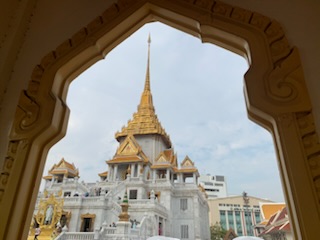
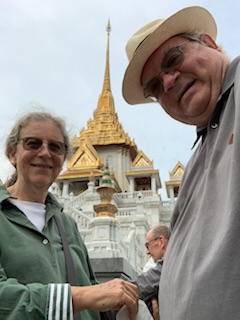
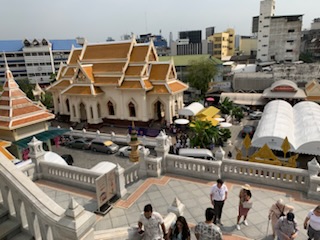
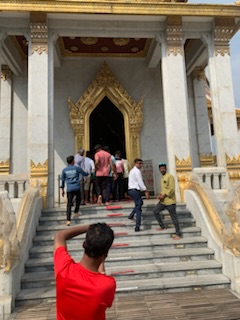
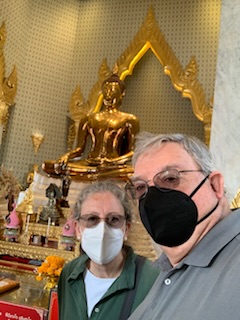
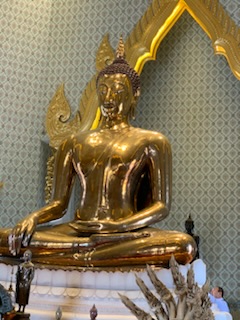
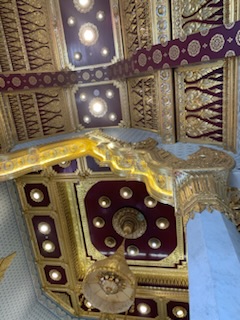
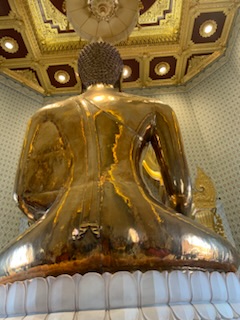
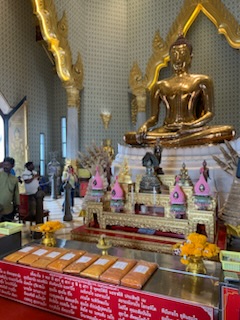
Our first stop was in Chinatown on Charlene Krung Road, Samphanthawong District, Bangkok 10100 at Traimit Witthayaram Temple or “Temple of the Golden Buddha” (Sukhothai Traimit). It is the largest Golden Buddha in the world and appears in the “Mara Conquering Attitude” which is the typical style when Sukhothai was the capital of the country. It is made of pure gold and measures 12 feet 5 inches in diameter and 15 Feet 9 inches from the base to the crown. It weighs 5 1/2 tons and is some 700 years old. This image has been displayed in various temples most recently in the Choti-Nara Temple or Wat Phrayakrai in the Yannawa District. This temple was deserted and the Buddha image was covered in plaster many years before to prevent warring factions from ceiling the gold. When destruction of the temple was to be undertaken for giving way to more modern construction purposes, it was moved in 1931 to a building in the Traimit Witthayaram, a compound of it’s current location. A new shrine was built in 1955 and when the Buddha image was moved a piece of the plaster covering the image broke off and it was only then that it was discovered to be made of pure gold. We entered the basement, removed our shoes and took the lift up to the base of the entrance to the shrine. After dropping our shoes (you cannot enter the holy area with shoes on or even carrying them). We climbed the few steps and entered the holy place. There are 4 entrances, one on each side of the square pedestal, giving way to the high (estimated at 30 feet) ceiling with a raised platform (some 15 feet high), on top of which sat the spectacular golden Buddha. In front of the Buddha was an altar with offerings and two, 2 foot high intricately woven reeds forming a king cobra image. Often the Buddha images are shown with a king cobra forming a parasol-like image protecting it. Snake iconography represents the soul going from the land into the heavens. After admiring the room, doors, image and other items in the room, we descended the 90 steps and briefly saw a “Secondary” temple with a Buddha statue and other buildings, before heading back to the van and continuing our journey through China town and the flower market to the next and principal stop of the tour – The palace of the king.
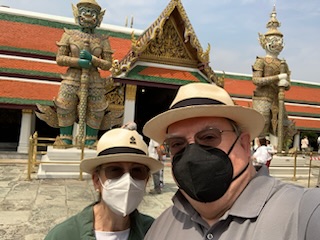
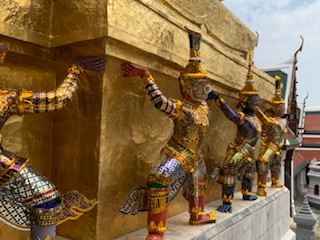
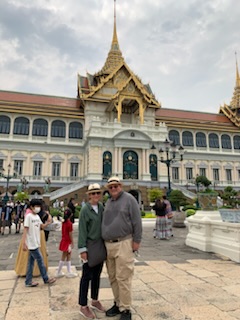
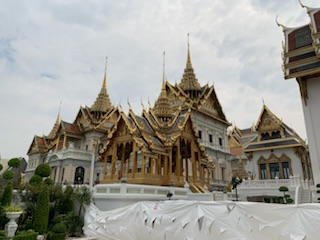
The Grand Palace complex was established in 1782 to serve not only as the residence of the king Rama I, but also as the area for administrative office: Throne Room and other structures. The two earliest buildings were the Dusit Maha Prasat Throne Hall and the Hor Phra Maha Monthian Dharma (the auxiliary library built by the prince – younger brother of King Rama I) to house Buddhist scriptures. Entering the complex, (at least the part open to the public as it is still used for ceremonial occasions, even though the King now lives in another palace), we were amazed at the entire place with the camera clicking everywhere as rounding each corner things seemed to be more magical that the prior corner. The first sector was the great lawn, but one could see in the distance many buildings and gold seemed to be everywhere. Entering the section where many of the “religious” buildings are located, the first thing one sees is the gallery with the roof held up by columns on one side and a solid wall on the other which has many images of the story of Ramakien. The story is that Tosakanth (the king of demons) kidnaps King Rama I wife – Sida. Tasakanath asks his numerous relatives to help him beat the king who has come to fight with an army of monkeys to get his wife back. He succeeds and returns her to his capital. Thus many stupa’s and other structures have demons and monkeys apparently holding up the structure. There are many buildings, Stupa’s and temples in this complex.
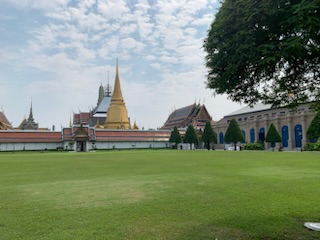
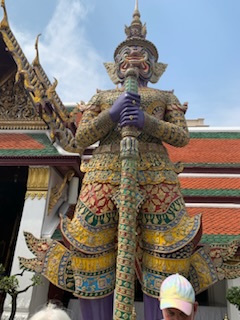
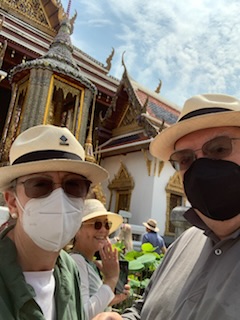
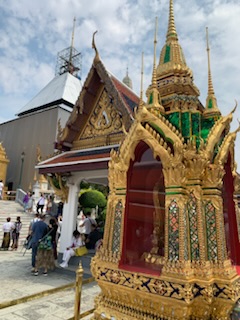
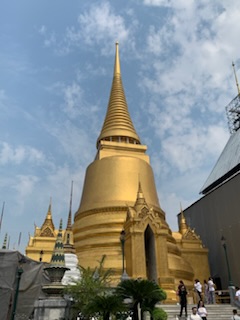
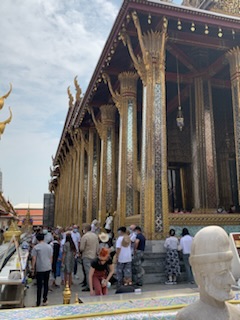
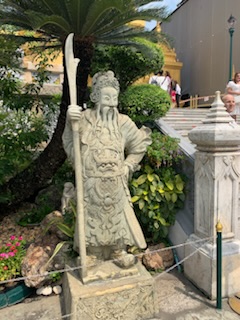
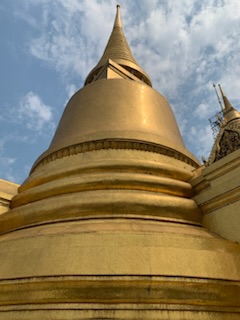
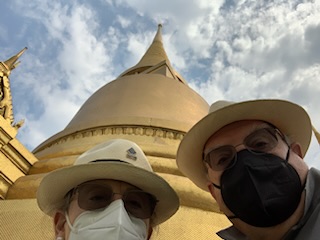
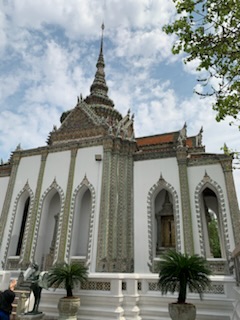
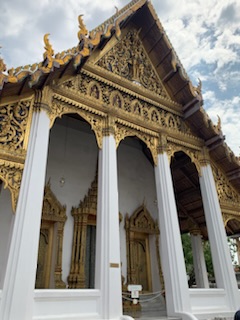
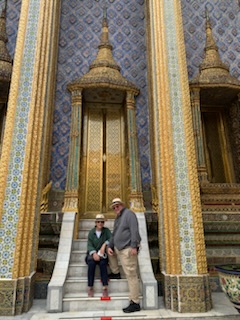
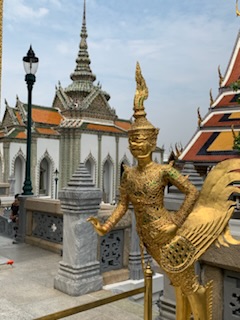
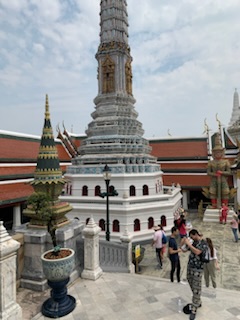
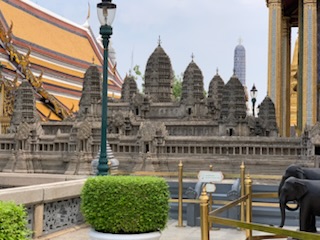
To name but a few – Hor Phra Naga was built by Rama I (1782-1809) to house a standing copper Buddha image but this was later pulled down by Rama III and the statue transferred to Phra Withan Yod. He then rebuilt the building to house the ashes of the princes. (Phra is similar to a Stupa, but the former is shaped like a tower and the latter has a bell shaped lower part and a steeple). An interesting structure is a scale model of the Khmer temple in Cambodia – Angkor Wat. This was built by Rama IV to show his subjects what the place looked like as Cambodia was a vassal state of Siam. King Suriname Varnan II built the amazing Angkor Wat near today’s town of Siem Reap. The size of the Angkor complex is amazing and the many structures show the power of the Khmer empire.
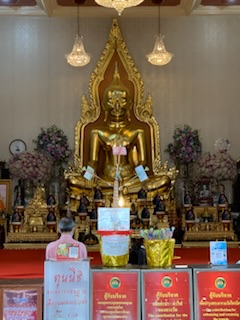
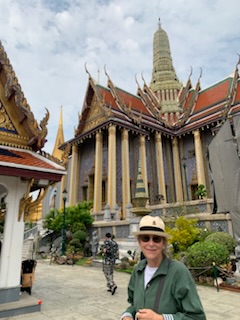
Perhaps though, the most “Holy of Holy’s” is the Temple of the Emerald Buddha (actually carved of Jade, not emeralds, but is green), built by King Rama I in 1782. It is 66 centimeters high and 48.3 centimeters wide at its widest point. This image is considered the most important one in all of Thailand. It is dressed in different clothing depending on the season. There are three seasons in Thailand: the winter (now as it is only about 32C / 90F), the rainy season and the summer. At the change of season, Buddha’s clothes are changed, and it is only the King who can change the clothing in a special ceremony. The origin of the jade statue was that it was discovered in 1466 in Chang Rai, a province in the north of Thailand. In the reign of King Tilokaraj (1441-1487) it was taken to Chang Mai in 1481. In 1552 King Chaichetta, of Laos took it to Luang Phrbang in Laos. When Vientiane City became the capital of Laos it was moved there in 1564 where it remained in “The Temple of Dawn” until 1778 when King Rama I took it to the Siam capital Thonburi. On March 5, 1784 it was transferred to the existing location.
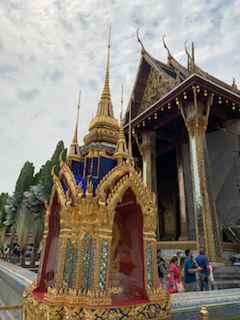
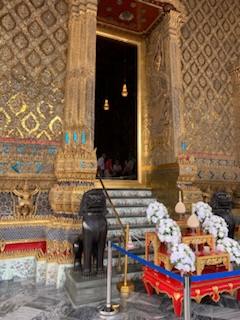
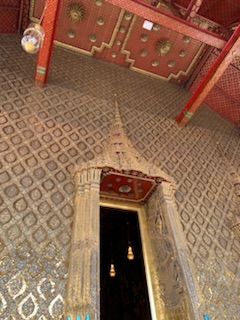
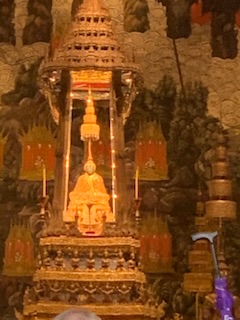
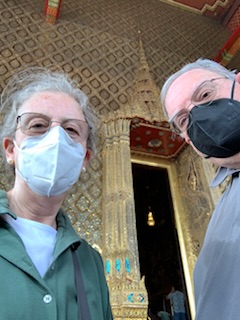
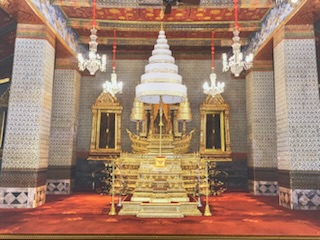
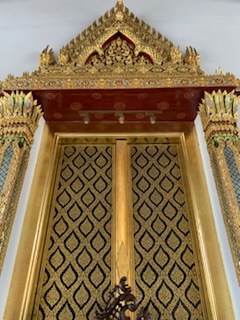
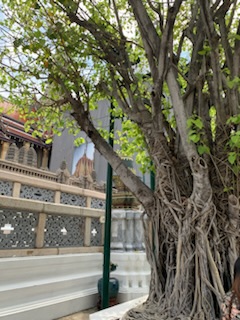
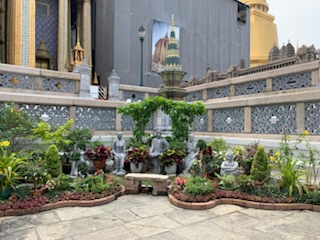
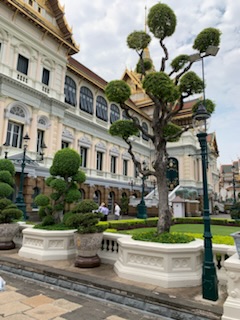
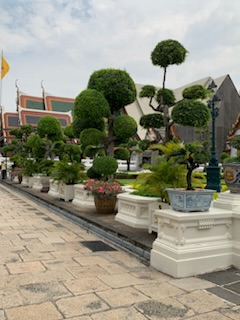
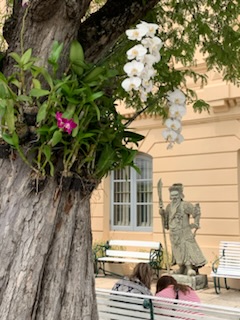
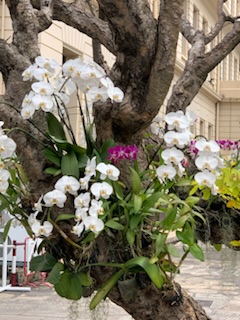
One final point was as we were exiting we walked past an amazing topiary / giant Bonzai garden and spectacular orchids. There are many other stories and temples, but this should suffice to wet your appetite to learn more of this amazing place.
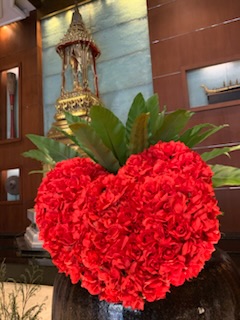
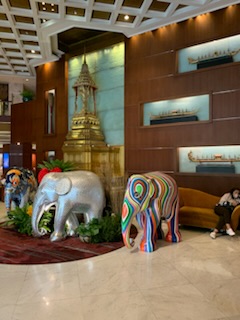
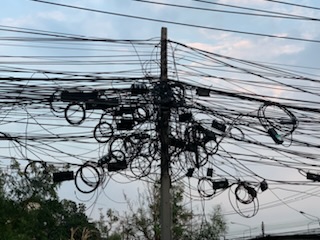
Our next stop was lunch at the Royal Orchid Sheraton hotel, passing the “Buddha Selling Street” where shop after shop sold Buddha images / sculptures of all sizes and types. Of note also was the “spaghetti” of electrical, internet and telephone wires at each post, seemingly haphazardly places on poles. Some hanging down to strangle an unobservant passer-by! A scene reminiscent of Buenos Aires, Argentina and many other cities. Lunch was inside the restaurant with a lavish buffet of Thai and other food, which we greatly enjoyed.
Back on the vehicle we transferred to a shop selling high end jewelry on the ground floor and Thai souvenirs on the upper floor. We purchased a few items as we only were given a few minutes before we took to the motorway and returned to the sip. The Cruise terminal was filled with some 20 shops, so Anne went back to the cabin and Roger purchased a couple of items. Our day ended with a salad and the show on the ship which was 3 of the 4 male English singers calling themselves The Jack Pack, who apparently are quite famous in Britain and have played for the King. My personal opinion, being a bit picky, was that the songs they chose (many Sinatra Hits) were terrific, but even though 2 of the three had good voices when singing alone, as a trio their singing was a bit out of synch. Also they altered the tempo and phrasing of some of the songs which did nothing and actually detracted from the original. The other point was that they tried interjecting comments during their singing, which was difficult to hear and broke the mood of the song. However, it is always enjoyable to listen to live productions.

 Roger & Anne Travels