Saturday February 18, 2023
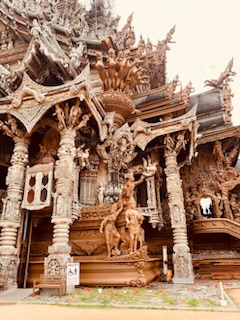
As we remained overnight in Laem Chabang, we booked another half day tour which from what we remember, was the “best of the rest”, so we set off on Coach 6 with Guide Yai, who similar to yesterday had difficulty with English, so it was difficult to understand what she was saying and did not say too much. However, she had a good personality and tried very hard. What we discovered was that we were off to a Sanctuary under construction then to spend time at the beach and neighboring shops, and back to the ship, so we were apprehensive about the day to come. However, what we saw was well worth the day and it was a great big WOW! If you are ever in the area, it is a definite to see. I am talking about the “Sanctuary Of Truth” Museum just outside Pattaya, which is only 45-60 minutes by road from Laem Chabang. (206/2 Moo 5 Soi Naklua 12, Naklua, Banglamung, Chonburi 2015, Thailand www.sanctuaryoftruthmuseum.com. Phone +66(0)81-350-8709; OR +66(0)38-110-625.
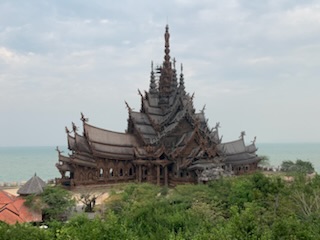
It was designed by a Thai businessman – Lek Viriyaphan, (sometimes called Kuhn Lek – 1914 – 2000) who funded the effort. His family were Chinese and he was sent to Shanghai for University. He picked up an extensive knowledge of various cultures before returning to Thailand when his father fell ill. He took over the family business and in 1941 bought the Thonburi Panich, which had the representation of Mercedes Benz. In 1942, he established the Morton Bank which merged with Kaset Bankand in 1966 and it became Krungthai Bank. In 1947, he established Viriya Insurance Company. In 1961, he established the Thonburi Automotive Assembly Plant (TAAP). He left a thriving group of companies to his family and was a great philanthropist and a Patron of the Arts. One example was the establishment of The Sanctuary of Truth, others include the Ancient Siam open-air museum park in Samut Prakhan, Thailand.
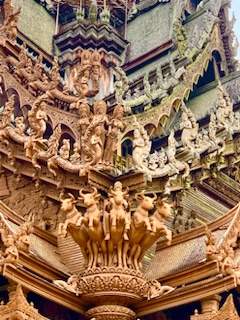
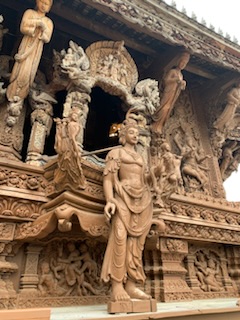
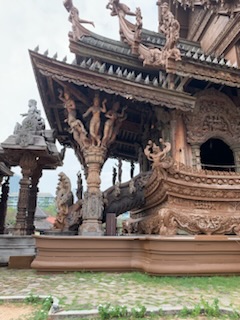
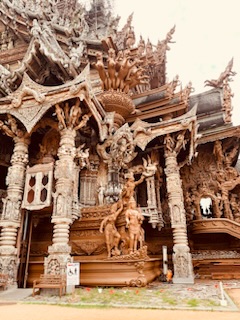
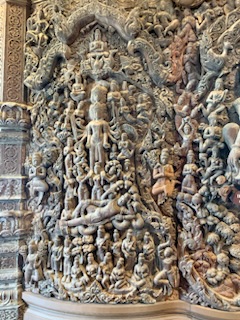
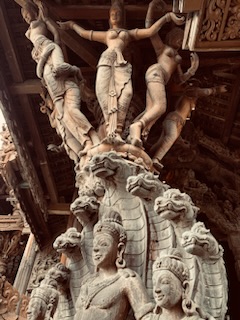
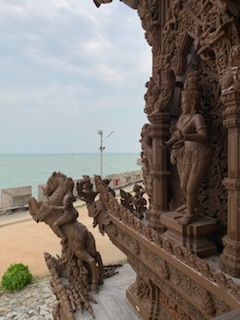
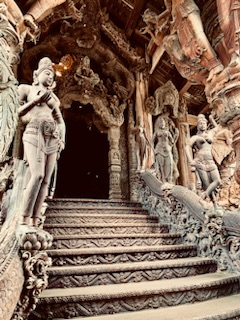
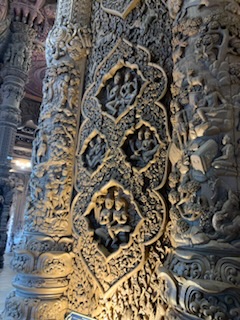
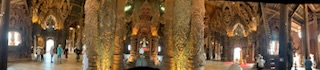
Various hardwoods are used in the construction af the building and the main post is “Takien” wood and expected to last 600 years. It is located on the shores of the Gulf of Thailand. All carving is done by hand, mostly Cambodian workers, and no screw, nail or glue is used in the construction. The overall sanctuary is over 100 meters high, a spire that is 40 metes high and has an internal space of 2,115 Square Meters overlooking the water. Construction started in 1981 and continues to date with the hope that it will be completed by 2025. There is focus on Hinduism and has on it’s roof top the Hindu creator God Brahma. The main structure consists of various Halls. The northern hall features Buddhist Guanyin and features wisdom and emancipation. The southern hall has astronomical themes (sun, moon & other planets) that affect human well-being. The western hall represents the classical elements – earth, wind, fire and wind, The eastern wall represents family and familial affairs. Overall it visually portrays important eastern religions concepts and the cycle of life.
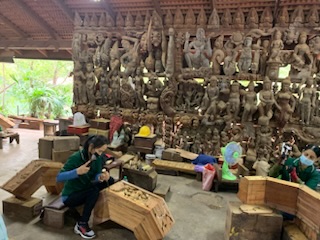
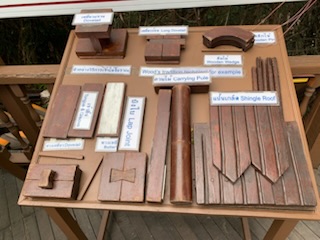
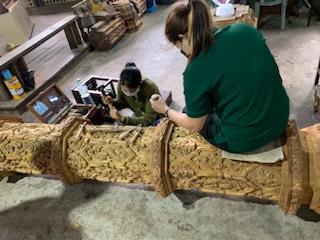
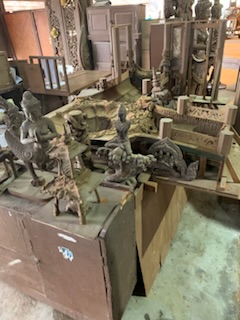
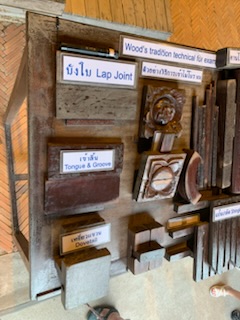
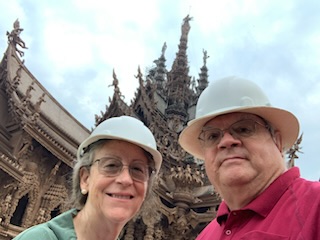
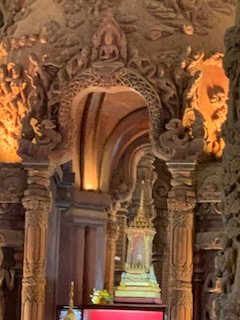
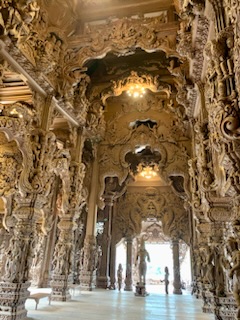
The structure seeks to portray the “Seven Truths” answering the eternal questions – Who are we? Where are we from? How do we survive? What is our life’s purpose? The entrance stairway which is on the ocean side, up to the museum has carvings of aquatic creatures, swimming against the tide up to the main platform. This is a representation of life where we are “swimming upstream” to achieve goals in order to find the truth of life. We were intrigued by the lift / elevator all carved in wood and using no nails or screws. It, like the entire structure has open spaces for windows allowing the sea breeze to filter through the entire building. The ornateness of the carving that covers every surface (except those parts yet to be completed) is staggering.
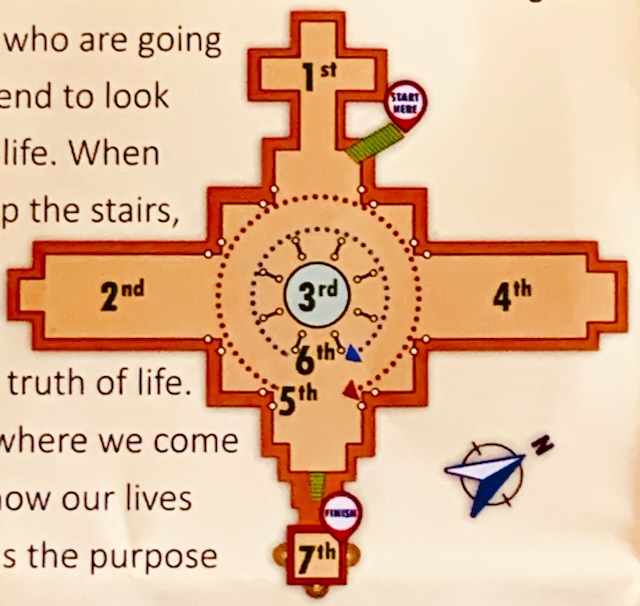
Entering the main floor, we turned to the right into the upper part of the cross shaped building. This was the depictions of the First Truth– Who are we? Where do we come from? This represents human equality. No matter how rich or poor, what you believe in, what religion you practice, we are all made from the four elements: 1) Earth – symbolized by carvings of soil, land, various animals and forest; 2) Water – representations of water and aquatic animals and plants; 3) Wind – symbolized by movement of plants by the wind; and 4) Fire – represented by a dragon and fire breathing animal.
Proceeding anti-clockwise, one enters the second chamber of the Second Truth– How do we survive? Our life cycle from birth to death depends on nature. This is depicted through carvings of Mother Earth, the Sun, the Moon, Gods of the week and parents. The local guide of the building showed us a table whereby your day and date of birth refer you to a particular day of the week. Around the end of the “wing” are the different deities and activities relating to the 7 days of the week, which tell you of your truths. A balcony, overlooking the parking lot give you views of the sides of the building as seen from the inside.
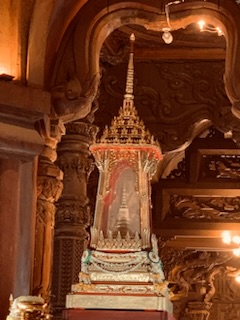
Now going to the center of the cross is the “holy of holies” with a raised platform and where the Buddha’s relics are enshrined. This Third Truthis – the End of Life. We are all born to die and you can never escape that. However, the only thing we can leave is our good and bad actions towards others. Understanding this, helps us develop our own consciousness. Proceeding across the hall to the wing opposite the 2nd truth is the Fourth Truthwhich illustrates the examples of the great individuals who have left a major mark on the world. Even after they are dead, their philosophy lives on. Carvings of suppression of or overcoming evil by goodness, living in harmony with nature, Adhering to a good moral code and ethical principals, mercy, self-sacrifice for the benefit of others, perseverance to achieve positive goals are all shown in this area. The Fifth Truth– What is the Purpose of Life? This is depicted on the outside corners / columns of the central area that form the corners of the cross. The guidelines to follow are a) never become a friend to those who are rogues; b) good people will lead to more good people; c) practice self-sufficiency; d) always seeking knowledge and abilities that lead to good outcomes; e) speak politely and be pleasant when you listen; f) respect your parents; g) provide assistance to those in need and h) give up procrastination, repay the benefactor. The Sixth Truth– Society is a “Two Sided Coin” – can be found depicted on the inner columns around the central 3rd Truth. The two opposite sides of society are depicted on the inner part of each column – what society would look like if we follow the truths and the outside depicts society if we don’t. Specifically 1) generosity vs selfishness; 2) politeness and humility vs arrogance; 3) respect vs disrespect; 4)understanding and accepting differences vs discrimination; 5)justice vs inequity; 6) apology & forgiveness vs blame; 7) gratitude vs lack of appreciation and 8) harmony vs dissidence. Finally the Seventh Truth– located in the “base of the cross” / the final hallway opposite the 1st Truth – the Beginning of Society. Here we end the journey and the importance of family is stressed. Family in the broadest since, those who we care for, be they blood family, friends or others.Here the 8 carvings indicate – 1) giving birth; 2) raising the child; 3) providing education; 4) teaching them to be a good person; 5) guarding their safety; 6) providing a career suitable to the qualities and preferences; 7) supporting a good spouse and 8) providing assets to assure future stability.
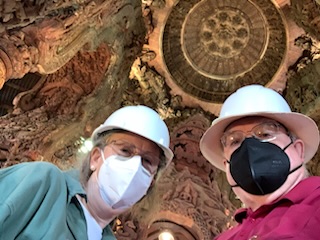
As we left the building, the guide gave us the philosophy of the founder, which makes a lot of sense.
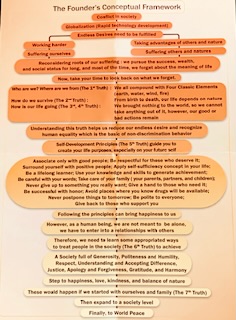
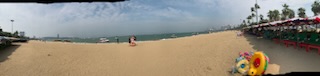
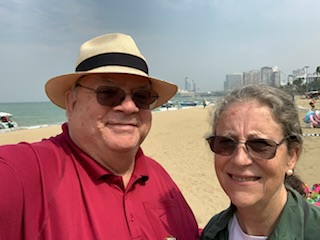
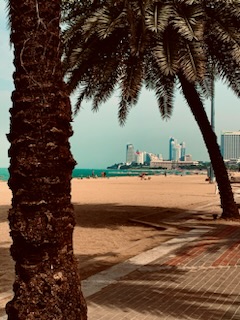
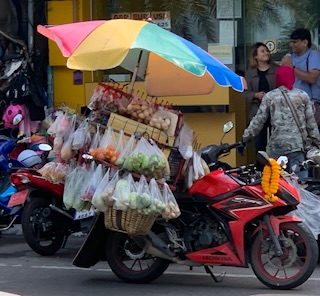
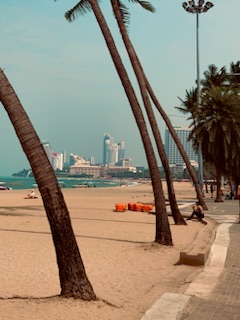
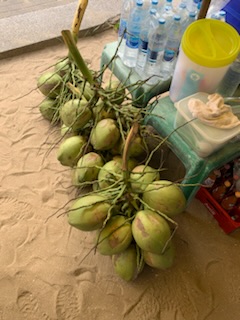
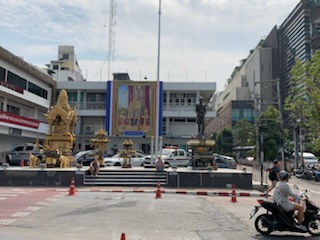
The building is not alone in the park. There are other attractions that make it a destination for families as there are elephant rides, a small zoo, boats for rent to paddle on the water and many other such activities. After leaving this spectacular place, we were taken to the town of Pattaya beach which is a long sandy beach with many western hotels, Hilton, Holiday Inn etc and food, drink and shops for some free time. We walked on the beach and enjoyed a fresh coconut before walking along the seafront, eventually ending up drinking a local beer at one of the many, somewhat seedy, bars.
A good day, returning to the ship for a late lunch, afternoon activities and the show tonight was the outstanding cellist from Romania, Greece and other origins, living in Tokyo – Andrea Cavassi.

 Roger & Anne Travels