Friday March 03, 2023
A nice day at sea, after two busy, tiring but really fun days in Darwin. The first lecture by Dr. Robert Derricourt, the Anglo Australian Professor talking about certain people past and present that make Australia the great country that it is. It seemed to be a more or less advertisement for the great people of Australia in all different fields of endeavor. Not very inspiring, and other than some of the sports stars, like golfer Greg Norman and movie stars like Cate Blanchett, most of the other people he spoke about were unknown to us.
The second one by Captain Glenn Robinson, a Great Barrier Reef Pilot, spoke to a full house about the biodiversity of the flora and fauna of the Great Barrier Reef. He will be on board basically until we reach Sydney as there has to be a Pilot to guide you through the tricky waters of the Reef. We will pass the Torres Strait, that narrow body of water between the Northern tip of Queensland and Papua New Guinea Island. Once we pass that, we will be going through a very distinctive route so as to avoid the Great Barrier Reef on the inner passage, closest to Australia land mass. The reef is the only living organism visible from space. A fascinating insight as to what to expect.
The third lecture was highly entertaining and Rod Preston spoke about Australia – Convicts, Poms and Flashers. Poms are the local term for British people but actually has the original meaning of Prisoners Of Mother England Ships. Prisoners (some 60,000 although some estimates go as low as 50K and high of 120K) from England and other undesirables were sent to the USA when it was a colony but after the revolution, they had to find somewhere else, so these people were sent to Australia. In total between 1788 and 1868 a total of about 162,000 prisoners were sent to various penal colonies in Australia. The first fleet of 11 convict ships arrived in Botany Bay on the 20th of January 1788 having left Portsmouth on May 13, 1787 with 775 convicts, plus crew, families etc of 645, to found what is today the city of Sydney in New South Wales. It was called Sydney after Lord Sydney the UK PM. Later other colonies were established in Tasmania (1803) and Queensland (1824). 1 in every 7 were women and many, once they had served their sentence, decided to remain in Australia. At first it was a stigma to be a “freed” convict, but now it is a sign of merit to be related to a convict, with many rising to prominence and 2 are actually portrayed on the Australian currency. It was the Transport Act of 1717 passed by UK parliament, that regulated which convict and which offenses could be punished by transporting the convict to the USA or Australia. Most of these were more minor crimes and the UK still had capital punishment for major offenses. By 1770, there were 222 crimes that were punishable by death (The Bloody Code) for offenses mainly against property. A very interesting lecture punctuated by amusing slides like the first voyage by Captain Cook exploring where to set up a penal colony and indeed looking for New Holland (Australia’s name prior to the British) passing the Queen Mary 2 due to favorable winds, while enjoying a vegemite sandwich. !! Vegemite is Australia’s version of Bovril or Marmite.!!
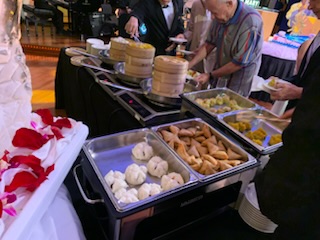
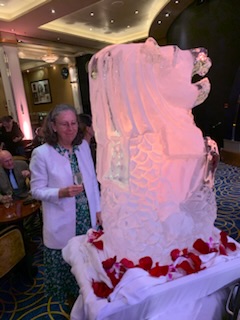
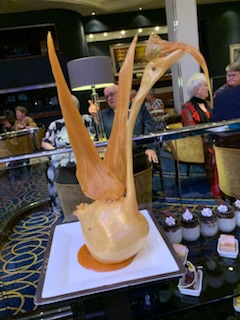
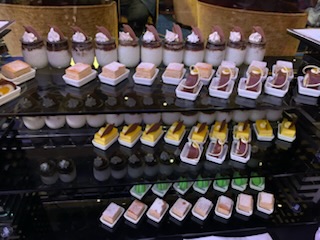
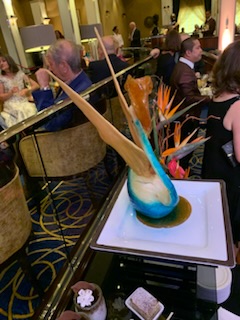
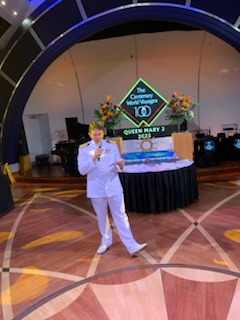
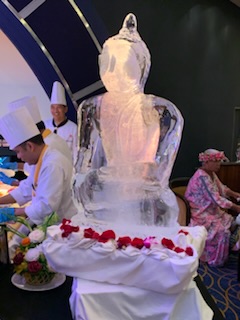
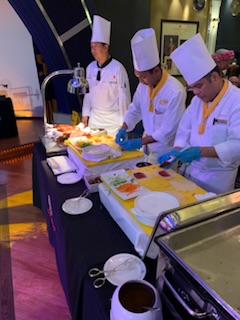
The evening saw another party by the captain and senior officers for all of us on the World Cruise. This time back in the Queens Ballroom with a beautifully carved Buddha and Merlion (Singapore) and spectacular food – dumplings, duck crepes and more. We had a nice chat with a couple of the dancers from the Cunard Singers and Dancers, which was fun. The show was a very talented Australian violinist Suzie G. Who came out in a white sequin dress and a white violin.

 Roger & Anne Travels