Saturday March 04, 2023
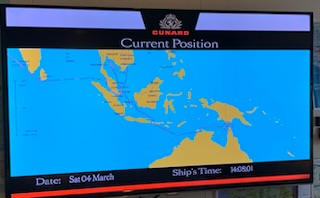
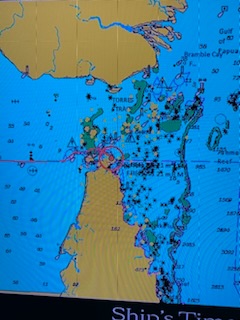
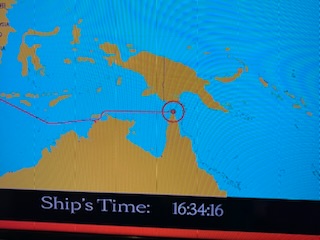
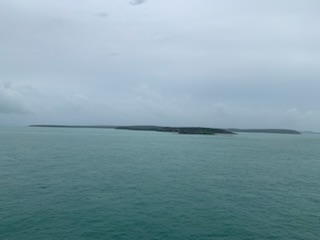
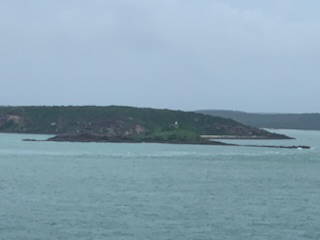
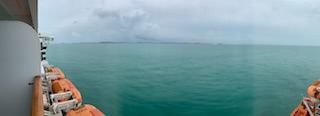
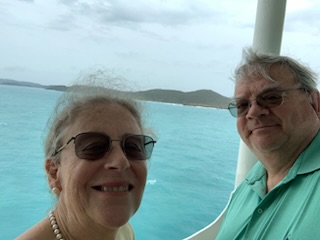
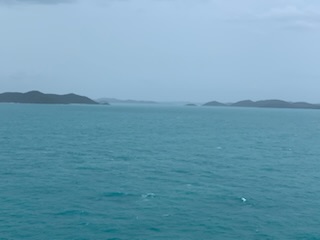
The second day at sea before we get to the Great Barrier Reef (GBR). The big excitement was passing the Northernmost tip of Australia – Cape York which is just a few miles across the Torres Strait from Papua New Guinea Island. It is a point / promontory that is almost inaccessible by land other than 4X4’s over rough terrain, and so by sea is the best way to get there or see it. The GBR Pilot advised us when we were near and what we were seeing. What we saw was a series of some 60+ islands of which only a handful are inhabited and it seemed difficult to wend our way through the various islands like the Prince of Wales and Thursday Island, as we saw many buoys and rocks coming out of the water, so very shallow. It was good to know that the experienced pilot was helping us to get through these waters. It was a bit overcast, it rained and then bright so a bit of all kinds of weather conditions, but what was particularly noticeable was the color of the waters and the various shades of blue and green all over. In a way it was reminiscent of passing Cape Horn / Tierra de Fuego between the South of Argentina / Chile and Antarctica. A really spectacular sight.

Before this occurred about 2:30PM we had a full day of lectures. Rod Preston started the day telling some amusing stories about Secrets, Spies and James Bond Kilt. While he seemed to jump around without a clear path from start to end, he gave us lots of information while at the same time telling amusing stories. One about Ian Fleming who had been in the spy business and then petitioned to tell the stories of one of the more famous of the spies he worked with and got Sean Connery to play the part of the spy using the 007 which was the code for the group he worked with and the ladies man aspect came from a friend of his with a James Bond name, so put it all together a combination of people into one character in the 007 series of James Bond.
The second lecture was by the head of the Wildlife Australia organization and a naturalist – Suzanne Medway. She spoke of the flora and fauna of the Great Barrier Reef as for the next few days we will be traveling the full length of the Reef. 1/3 of the reef is protected and called the Great Barrier Reef Marine Park (www.gbrmpa.gov.au). Some key points about this are – 2,300 kilometers (1,400 miles) long and 60 – 250 Kilometers wide and an average depth of 35 meters; Area – 344,400 Square kilometers or 70 million football fields; made up of 3,000 separate reefs in one area; billions of tiny organisms known as coral polyps; there are 900 islands; 1,625 types of fish; 133 types of sharks, manta rays; 30 species of wales and dolphins, 3,000 varieties of mollusks, 500 species of worms, 100 species of jellyfish, etc; and 6 of the 7 known marine turtles – Common Green, Hawksbill, Loggerhead, Olive Ridley, Leatherback, Flat-back. It can be seen from Space by the naked eye and is one of the 7 wonders of the Natural World. Officially it starts in the North from the Torres Strait to Lady Elliot and Fraser Islands in the South. While the reef is some 600,000 years old, due to the change in water levels the current GBR is considered to be have started growing on the older structure some 20,000 years ago. As the waters continued to rise the present reef can be considered about 6,000 – 8,000 years old. Because of the need for sunlight coral reefs cannot grow any deeper than 150 meters (490 feet) and increase in diameter 1-3 centimeters a year and can grow vertically 1-25 centimeters per year. The second largest reef is off the cost of Belize (290 Kilometers) and the third largest is off Western Australia known as – Ningaloo Reef (280 kilometers long).
We will be stopping at the Airlie Beach (on Queensland mainland / Whitsunday Islands), of which there are 74, located in the heart of the Great Barrier Reef with only a handful inhabited with a population under 2,000. One of the main issues facing the reef is global warming, pollution etc. that creates coral bleaching, where the algae and organisms die off and the brightly colored coral becomes white and dies. During the reproduction season, the coral let go of billions of eggs and sperm, appearing like a snowstorm with the hopes that new coral will be formed and settle on the old dead coral or ocean substrate, thrive and continue the propagation of the species. In Africa when going on a safari one attempts to see the “big 5” – Lions, Leopards, Buffalo, Rhinoceros and Elephant. In the GBR there are “the big 8” – Clownfish, Giant Clams, Manta Rays, Maori Wrasse, Potato Cod, Sharks, Turtles and Whales. Clownfish were made famous by the movie “Finding Nemo” but actually are a critical part of the ecosystem as they are symbiotic with the anemone. The fish hides in it’s tentacles, cleaning them by feeding on the parasites that cling to the tentacles and yet looking attractive to predators while the anemone shoots out poison killing anything that comes too close providing food for for it. Finally, My Octopus Teacher is a documentary talking about the octopus as an animal and was recommended at the end of her talk, available on Netflix.
The third lecture was on the history of Brisbane, which we will visit after the Great Barrier Reef. The afternoon saw the top of the eastern tip of Australia and the evening performance was probably the best show of the trip. The brilliant Australian Song and Dance man, performing based on his hero – Sammy Davis Jr. – Wayne Scott Kermond. He sang, he danced, did acrobatics, fabulous tap dancing and ended with a duet: sung and danced with his wife. A truly sensational show. If you know he is in your area, he does a show well worth seeing.

 Roger & Anne Travels