Saturday March 11, 2023
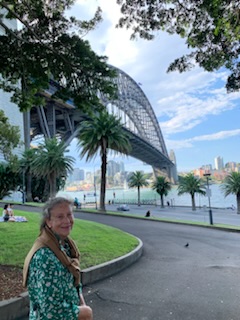
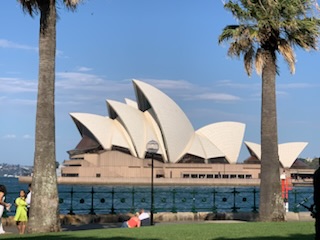
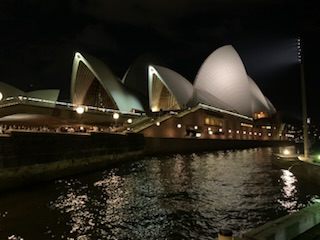
The day started early as we wanted to watch the sail into Sydney Harbor. Sydney, is one of a handful of harbors that is spectacular, Hong Kong and Rio de Janeiro being the other two. There is truly something magical about this location, the size being not too big and the two icons of Australia – The Sydney Harbor Bridge (known locally as “The Coat-Hanger”, with 160,00 vehicles crossing it per day) and the Sydney Opera House with now the backdrop of a very modern sky-scraper city of 6 million people.

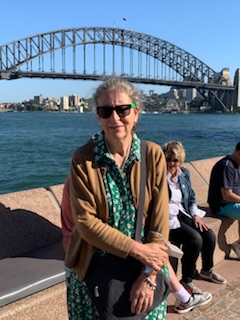
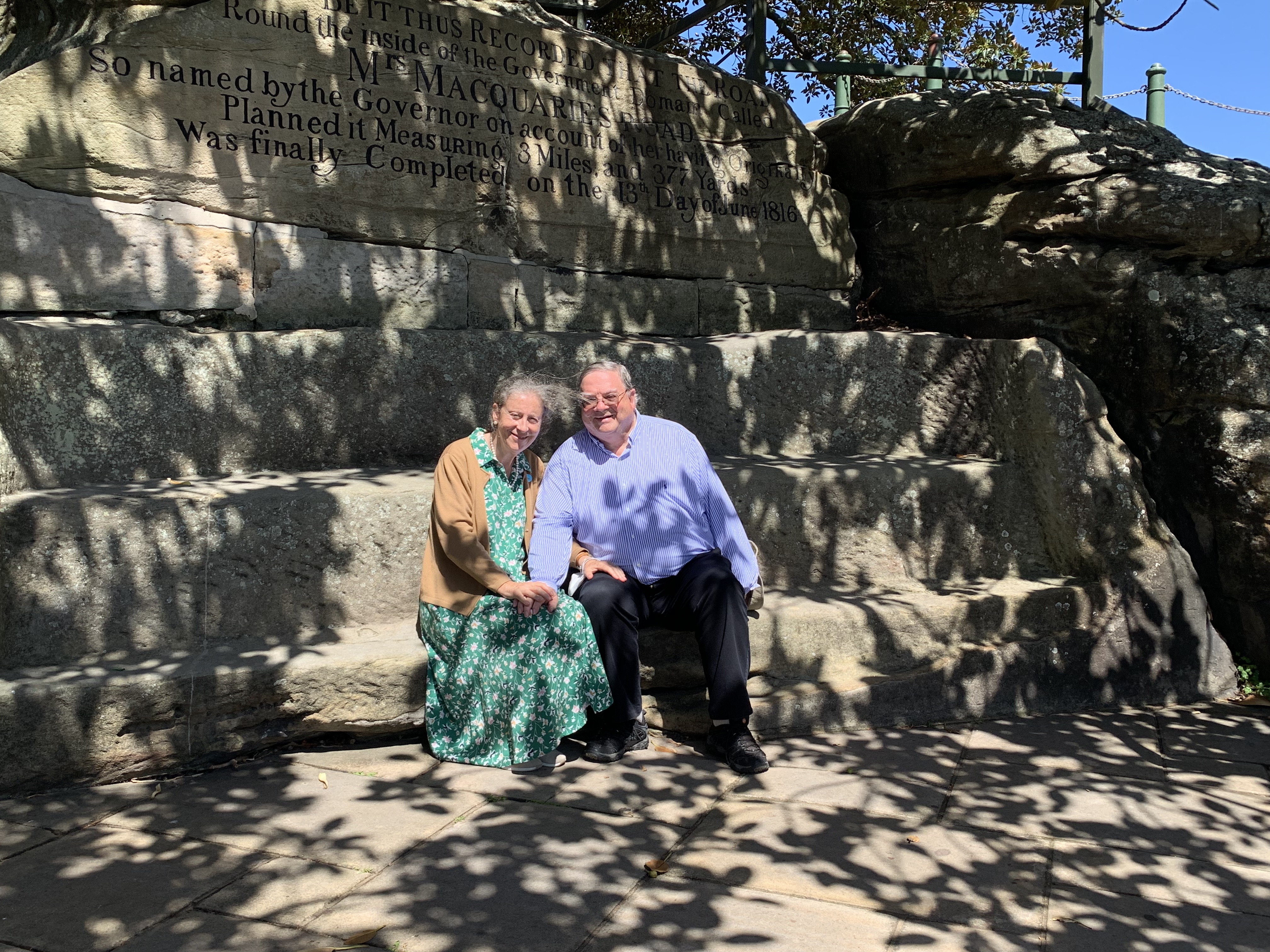
Sydney , established January 26, 1788, is the largest city in Australia, although Melbourne is likely to have a larger population in the next few years. It is the capital of the State of New South Wales and has close to 70% of the population of the state. It is made up of 658 suburbs spread across 33 local government areas. The aboriginal population that have inhabited the Sydney area for at least 30,000 years (radiocarbon dating), now represent at most 3% of the population, but every effort is being made to respect and acknowledge the ancient cultures of the area – The Darug, Dharawal and Eora peoples. It is clearly stated that the Opera house for example sits on aboriginal land. In 1770, James Cook made his first voyage of mapping Australia making landfall in Botany Bay, interacting with the Gwaegal peoples, with the area now forming part of Greater Sydney. On January 26, 1788, the first fleet of 11 ships including 736 convicts and some 350 free men, from Britain under Captain Arthur Phillip landed in Sydney making it the first penal colony in what is now the area called The Rocks, close to the Cruise Ship Quay. This is now commemorated as Australia Day. Convicts and free people, continued to arrive in Sydney until 1840. Many of these convicts were used to chip away at the stones that line the harbor and the chip marks on the stone can still be seen from these early days. The second fleet followed in the mid 1790s and the third in 1791. In April 1789 a smallpox epidemic killed about half of the aboriginal population. From 1810 to 1821 Governor Lachlan Macquarie led the efforts to establish Sydney with a bank, hospital planned road system etc. Mrs. Macquarie never liked living there and there is an area on the promontory with a ledge where she would sit waiting for her husband to arrive back from his travels and to await ships arrivals bringing news from home. We visited that as the first stop once we were on the coach as it provides a spectacular view of the bridge and opera house together. By 1851 there was gold found in New South Wales and Victoria (Melbourne is the Capital) and the gold rush began with Melbourne growing to a larger population than Sydney as the gold mines were closer.
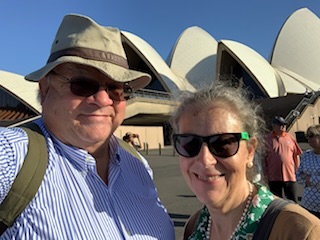
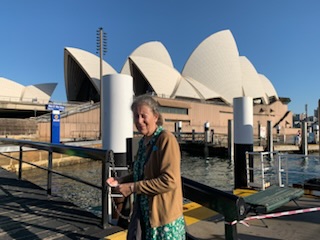
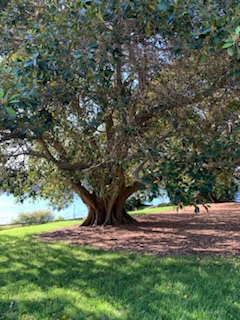
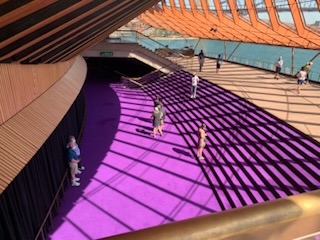
The usual dock for larger ships like ours is nestled between these two icons, but the one dock was full so we had to anchor in the bay and go ashore by tender. Smaller ships can go under the bridge and dock on the other side, in an area known as the Rocks. As it turns out, this was terrific. We got off the tender right at the Opera House, which was where our tour was to start. It was to be a tour of the building followed by a coach ride around town including Bondi Beach. We arrived and the excellent guide Frankie, quickly thinking on her feet, said we have 3/4 hour before our opera guide was to be there, so took us for a very interesting walk through the Botanical Garden which is next to the Opera House. We got back to the Opera House in time to meet Michael the local Opera guide, who is majoring in Opera at the University, take us on a guided tour. He took us from the main Foyer, through the newly built tunnels to ease handicapped access (finished last year) to the various areas and to the Opera House. This is the smaller of the two halves of the overall complex and is the one furthest from the Bridge. Then we went through the connecting outside area admiring the ceramic tiles and entering the larger space which is the Philarmonic / Music side. Luckily there was no rehearsal going on so we were able to see it all. There are also other stages, which we did not visit, for smaller theatrical / music performances. He gave us the sad history of the Danish designer and how it came to be built, taking a lot longer than planned and way over budget.
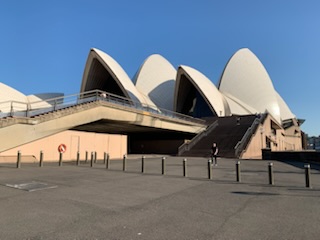
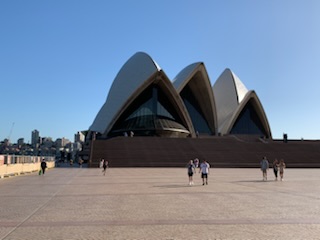


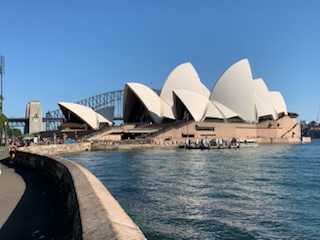
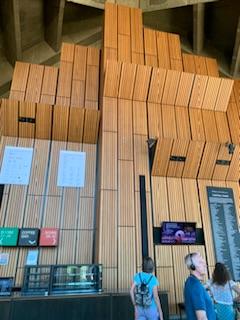
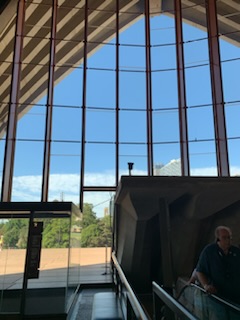

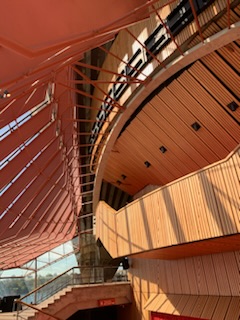
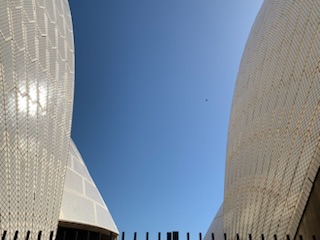
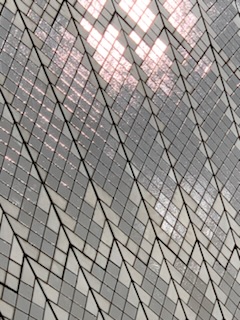
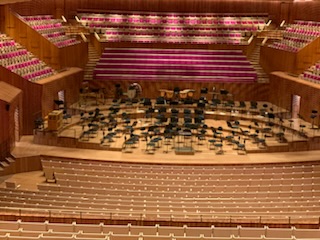
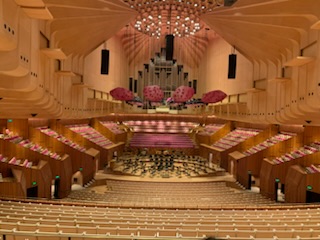
After extensive lobbying by Eugene Goossens, the Director of the New South Wales Conservatorium of Music following the Second World War, for a larger location for the performing arts and music, as the existing location of the Sydney Town Hall was too small, the government acceeded. The site chosen for the opera house was Bennelong Point (named after the leader of the aboriginal tribe of the area). It was originally an island, but with land reclaimed, it was made part of the mainland. On September 13, 1955, an International Design Competition was orchestrated by the Government of New South Wales, led by Premier Joseph Cahill. Of the 233 entries, representing architects from 32 countries, the one that was selected in 1957 was number 216 by the Danish Architect Jørn Utzon. The first phase – 1957-1959 was planning the building. The second -1959-1963 was building the upper podium with groundbreaking and construction starting on March 1, 1959. Phase 3 – 1963-1967 was the construction of the outer shells and phase 4 -1967-1973 was the interior design and construction. One of the biggest problems was how to build the shells until Utzon came up with the idea of creating the shells as sections of a sphere. This allowed arches of differing lengths to be cast in a common mould. The Architect, construction firm Civic and Civic, monitored by the Engineers Ove Arup and Partners (Ronald Jenkins) worked together to resolve the various issues. Utzon’s contract called for him being paid a per-diem as living expenses and his payment upon completion of the project. Due to the political forces at hand the project was to take 3 years for a shceduled opening on Australia Day (January 26) 1957, at a cost of some UK£3.5 million (A$7MM)! Hornibrook Group Pty Ltd were resononsible for the making of 2,400 pre-cast ribs and 4,000 roof panels. The special tiles took 3 years of development at the Swedish Company Höganäs Keramik each 120mm square as Utzon wanted to achieve various objectives. First to be resistant to the weather, then to change color to reflect the light and third that they be “self-washing” meaning that rainfall cleans the tiles and the water runs through crevices between the tiles. In 1963 a new government was in power led by Robert Askin, who put the project under the jurisdiction of the Ministry of Public Works and they gradually cut back and made life miserable for Utzon which led to his resignation on February 26, 1966. At this point the project had cost A$23 Million. His position was taken over by Peter Hall who was principally responsible for designing the interiors as Utzon, who had not been paid as the project was not competed, left with all his architectural plans and drawings. He refused to even accept a phone call for many years after his termination, but eventually did and (after 1999) agreed to send his son with 2 conditions: issuing a public apology and he was to be paid. His son, also an Architect, was sent to work on the remodeling including the Utzon room named in his honor. Utzon died on November 29, 2008, was eventually paid, with accrued interest, a total of $27 million and a public apology was issued. The project was completed 10 years late and at a cost over budget of 1,357% of A$102 million. It was completed in 1973 and opened on October 20, 1973 by Queen Elizabeth II with Utzon not being invited. He never saw the finished building. However, he received the Pritzker Architecture Prize in 2003 (Architects major prize) for his work on the Opera House. Over the past 10 years it has been going through a major refurbishment to be ready for this it’s 50th anniversary. Some dimensions are: – height 62 meters (213 ft); length 183 meters (600 ft) and width 120 meters (394 Ft) covering 1.8 hectares (4.4 Acres). It consists of the Concert hall with 2,679 seats and the world’s largest mechanical tracker organ with more than 10,000 pipes; The Opera (Joan Sutherland) with 1,507 seats, used for opera, ballet and theatre; and the smaller production spaces – Drama Theatre with 544; Playhouse 398; The Studio – a flexible space with 280 permanent seats but can be expanded to hold up to 400; The Utzon Room is a small multi-purpose venue with a capacity of 210 and finally a recording studio.
After the Opera house complex tour we wandered up the hill to a waiting coach and went first to Mrs. Macquarie’s point then on to the Bondi Beach (native translation of – “noise made by waves breaking on a beach” or “surf”).

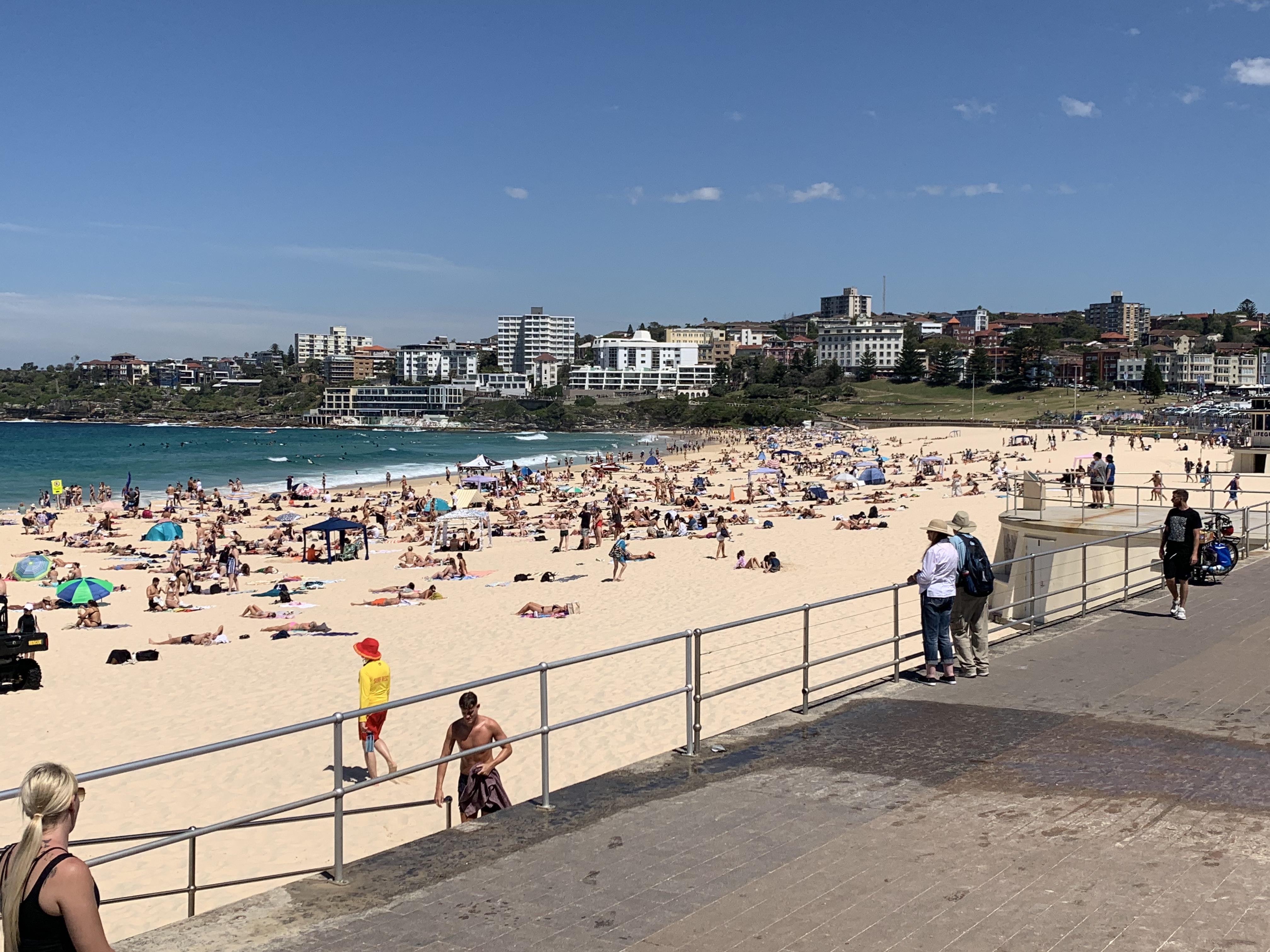
We passed various neighborhoods and buildings before returning to the Opera House and the end of the tour. We then decided to return to the Opera to get our tickets and find out where the dinner was to be held, as we had booked pre-opera dinner in the complex. As the ship was a tender ride away, we decided to dress for the opera in the evening, from the time we got up so as not to have the 1 hour delay in going back to the ship and returning. We had been told of the oldest pub in the city – The Fortune of War, established in 1828, where we sat at a high top table in the corner of the bar, had some “tapas” and beer as we were having dinner in 3 hours at the Opera House. Two older gentlemen turned around from their perches on the bar and started a conversation which went on for 3/4 hour. There were originally 16 men that would meet there once a week to have a pint (20 fluid ounces) or a mini (10 fluid Oz) or a schooner (15 Fluid Oz) and resolve the problems of the world. All but 6 are deceased, but most were publicans, owning various pubs in the area. One of the 2 was from Dublin but had been in Sydney and owned an Irish Pub for some 30+ years. The other man, Alan we were told after he left was in his day, one of the most powerful politicians in Australia representing the country in negotiations with all the major powers in the world! A really nice surprise lunch. We covered topics as wide as derivatives, the bankruptcy of Silicone Valley Bank in the US, world politics and everything in between.
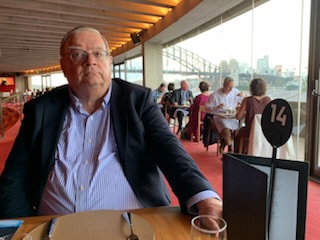
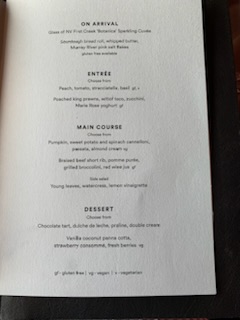
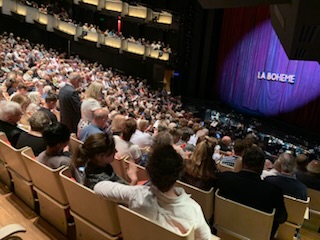
After leaving the pub, we wandered around The Rocks area, through the Saturday Street Market, under the Harbor bridge and back to the Opera House in time for 6 PM dinner in an area near our seats overlooking the harbor. There were 30 tables, mostly 2 to a table but a few 4, in what is best described as a foyer which we had visited earlier on our tour. We were welcomed with Champagne, enjoyed prawns, cannelloni and chocolate tart washed down with a nice Pims. Ten minutes before curtain we took our seat a few rows from the orchestra pit and greatly enjoyed a terrific production of La Bohème. This was the last opera performance of the season and brought extensive curtain calls and a standing ovation. We hurried out of the theatre as it was about the time for the last tender to take us back to the ship. Otherwise we would have had to wait until 1 AMwhen the ship was to dock in the port and allow passengers to board directly from the Quay. A long but exciting day having walked 20,692 steps or 13.5 kilometers in the day!




 Roger & Anne Travels