Thursday March 16, 2023
Today we anchored near Kangaroo Island, which is the third largest Australian Island after Tasmania and Melville and is located 112 kilometers (70 miles) southwest of Adelaide. The day long tour we took was “The Best of Kangaroo Island”, tour coach 4, guide & driver Gary, who was outstanding, amusing and kept chatting while driving, giving us lots of information. There were 44 passengers and we were lucky to be on one of the early tenders as rough seas, apparently had to curtail tender operations during the day and many guests could not go ashore. We were fortunate as in retrospect it is definitely one of the big highlights of the entire trip. We arrived in Pennington Town on the eastern end of the island on the Dudley Penninsula. There are some 4,700 permanent residents lots of hotels and holiday homes as it is just a ferry ride from Cape Jarvis on the Fleurieu Peninsula and thus a short drive to Adelaide. Specifically the closest point on the mainland is Snapper Point 13.5 kilometers (8.4 miles) across the Blackfriars Passage. The island has no diseases, no viruses, no snakes and lots of animals. There was a very large population of Koalas as there was a large gum tree (eucalyptus) plantation but a major fire in 2019 / 2020, killed a tremendous amount of Koalas and other animals as well as destroying the plantation, 73 houses and killing a handful of people. We could see even today, many burned trees, some are starting to come back.
In 1802 Matthew Flinders was circumnavigating Australia, mapping the coast when he came upon Kangaroo Island. Starving and without water, they landed, killed 31 kangaroos and found fresh water so called it Kangaroo Island (KI). There are still many kangaroo, but darker, softer fur and smaller than those on the mainland. We did see a couple of large groups in the distance, but as they mainly come out at dusk and dawn, we did not see as many as we might have done. Soon after leaving KI he encountered a Frenchman Nicholas Baudin on a vessel and told him about it even though the British and French were at war. He came to KI and named one of the bays after him – Baudin Bay. Later an American came and named another bay and town the American River. There is an aboriginal population living on the island starting some 10,000 to 40,000 years ago. Most fresh water is derived from rainfall and all homes have large reservoirs. The island does have a reservoir and truck loads of water can be delivered to fill your storage tanks at $550 for 22,000 liters. The island is 155 kilometers long, has 550 kilometers of shoreline, the narrowest point is 1 kilometer wide, there are 1,600 kilometers of roads on the island, of which 500 are tar / bitumen / paved, the others are made from crumbled ironstone and limestone. Because of the ironstone roads, there are many lightening strikes and these lightening strikes were the cause of the 2019 fire. There are only 4 towns on the island with the main one being Kingscoate and the others are Penneshaw, where the tender left us, Parndana and American River. A handful of smaller villages – Island Beach, Emmy Bay, Brownlow and Baudin Beach that have a smattering of houses. In order to populate the island, 174 WW2 veteran soldiers and their families were helped to get and work farms on the island, through low interest loans.
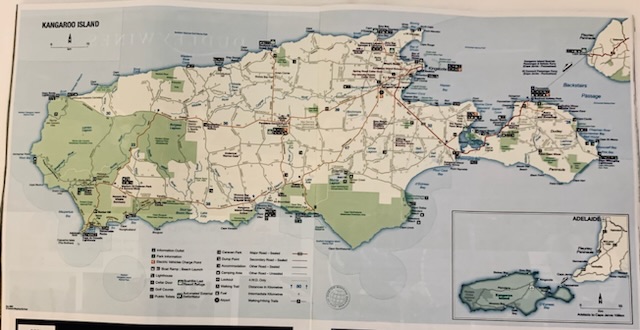
We travelled to the bottom end (South West) of the island stopping to pick up a picnic lunch at Emu Ridge Eucalyptus Distillery, which we visited later. It is owned and run by Larry & Bev Turner and family since 1991. (PO Box 299, Kingscote, SA 5223 Phone +61 (0)8-8553-8228; info@emuridge.com.au; Web – www.emuridge.com.au). Initially, the eucalyptus leaves (Narrow Leaf Mallee – Eucalyptus Cneorifolia) were harvested by hand but now they are using mechanical harvesting. The leaves are stripped and boiled with the fumes of the oil and water evaporating and condensing. As the Eucalyptus oil is lighter than water it floats and siphoned off. It is the only distillery left on Kangaroo Island although there were 60 at one time. They only sell locally or over the internet. The spent leaves are used for fertilizer. This Distillery is near the Clifford Honey Farm. Apparently there were some rather aggressive bees on the island until a more docile variety was imported from Italy called the Ligurian bees in the 1880’s and the population is vibrant producing the special 100% Ligurian bee honey.
Along the way we passed Murray Lagoon, Vivonne Bay where there is a general store that recently started selling King George Whiting fish burgers which have become very popular. We continued along the South Coast Road, past the Western KI Caravan Park where we returned for lunch and on to the Flinders Chase National Park eventually getting to the Remarkable Rocks, Admirals Arch and the Cape du Couedic Lighthouse. This was where we were to spend the rest of the morning.
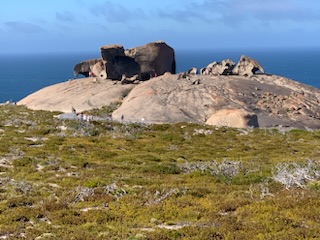
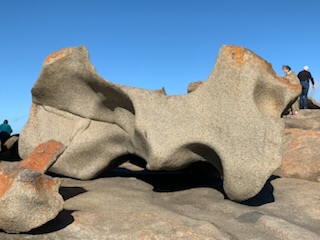
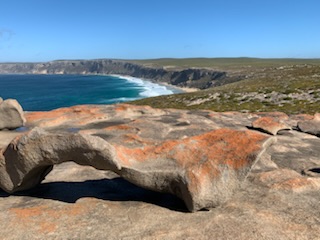
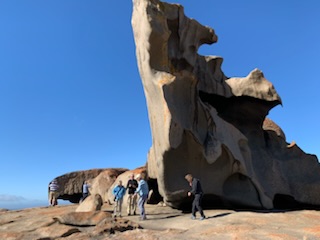
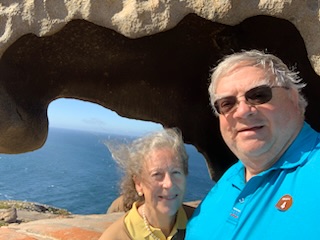
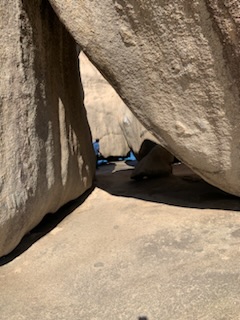
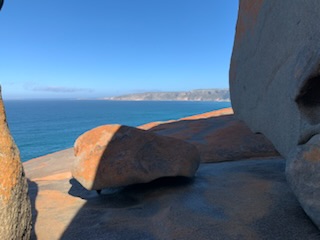
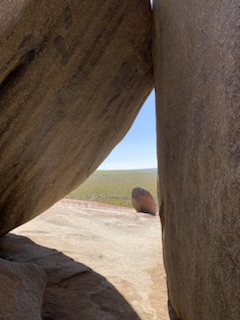
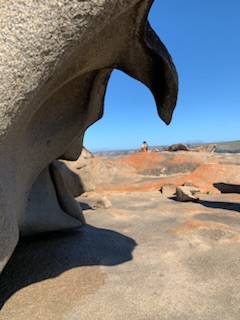
First we visited the Remarkable Rocks, which is an area at the tip of the west end between Weirs Cove and Sanderson bay. These giant rocks from a distance appear to resemble a camel lying on top of the hill, but on closer inspection they are massive, extremely hard rocks that over the past 500 million years, have been pushed up from several miles below the surface to the surface and battered by waves and the elements. The size dwarf human beings and the shapes are spectacular. One actually Anne was able to get fully inside the rock and her face and torso were all that was visible. Others appeared to be bird beaks, while others had a steel of a modern abstract sculpture. Whichever one you look at, it becomes a paradise for photography while being amazed by the enormity of the place. There is a walkway / boardwalk leading you to the rocks which are covered with an orange lichen and can be very slippery in wet weather. There are no barriers and the Southern Ocean batters against the rocks, so if you fall in you die and several (9 and counting) people have slipped in and died from being bashed against the rocks by the sea. However, if one is cautious and not a dare devil, one can safely enjoy the rocks and feel the granite under your feet and all around you.




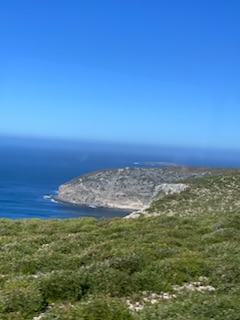
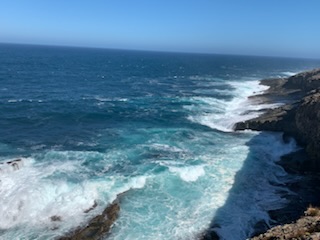
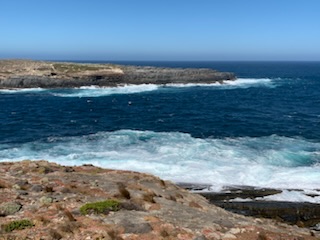
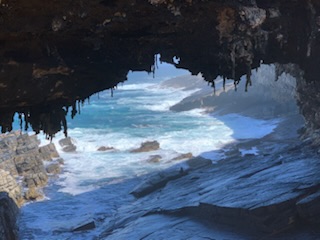
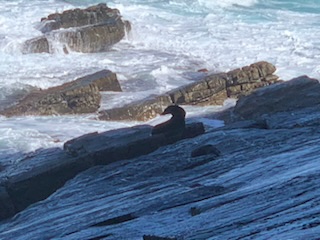
A few miles away, we once again stopped at the other end of Weirs Cove where there is a stone lighthouse (Cape du Couedlc) built in 1906, at the southwestern most point of the Island. There are two other lighthouses one on the northwest tip (Cape Bordeaux Lighthouse) and one on the easternmost tip (Cape Willoughby Lighthouse). We drove past the lighthouse to the tip, overlooking the Southern Ocean and then walked the long way down the boardwalk to some 40 odd steps where after descending and continuing along a boardwalk, one sees The Admirals Arch. This is a natural stone formation forming a sort or bridge with stalagmites framing the shoreline and the Long nosed fur seals basking on this rocky shore.
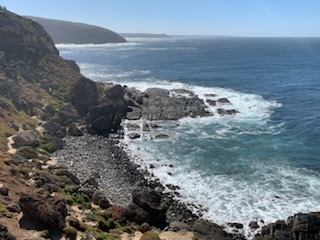
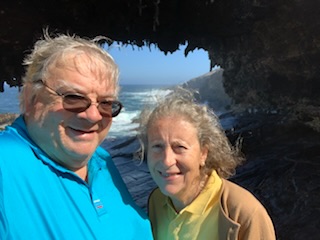
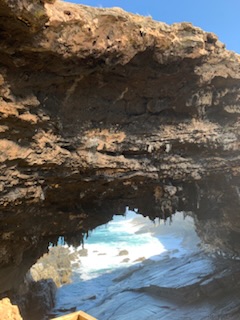
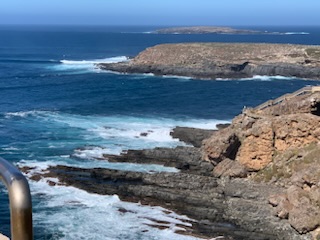
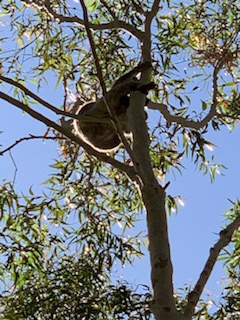
After photos and admiring nature, it was time to climb up the steps and the long uphill boardwalk to get back to the coach and proceed to the Western Campsite where we had our picnic lunch. There were a few tables outside, some other ones in a large concrete room and toilet facilities and a small shop that mostly had basic tinned food, but a couple of postcards and magnets. We purchased a couple of bottles of Coopers Beer which is a local brew and delicious. Our guide mentioned that it was his “go to” beer. The exciting thing was that after lunch, wandering around the campsite, we saw a Koala up in a gum tree with a little joey (baby) in its pouch. How they don’t fall and hurt themselves is a mystery as it was asleep holding on to branches, but it’s backside was hanging with no support. All very exciting.


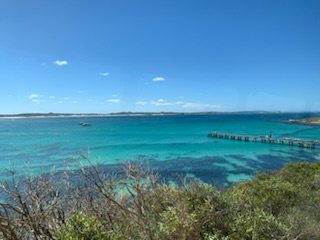
As if this was not enough excitement for one day, we were off to our next stop – Seal Bay passing the “exclusive 9-hole Samedi Golf Links” – some reasonably flat areas of land between hoarse bushes with the green fees having just been raised from $2 to $3 for a day!! The seal bay is home to a conservation center that monitors and oversees the area assuring that nature is given it’s place, but at the same time a place for educating visitors. The general buildings have a small area of explanation including pelts showing that these are hairy seals, not fur seals and you can touch both and feel the difference. Also skeleton and other interesting facts are displayed. There are facilities and a very small gift shop. Most people who visit can walk along a boardwalk to a promontory where one can see the seals on the beach. This is a relatively easy, wheel chair accessible walk. However, for a few visitors a day, a knowledgeable guide will take you down to the beach to get “up close and personal” with the seals. The closest one can get to the seals is 10 meters, but that was amazing. You are their in their natural habitat, no zoo, no fences nothing, just you in the sand, the seals and the ocean. They lie in the sun to get warm, as they get cold when out fishing. The males reach some 400 kilos (850 lbs), 2-2.5 meters in length; they go out to sea for 3 days, not sleeping and can go up to 60- 100 kilometers out to sea and dive up to 275 meters deep as they can hold their breath for 12 minutes. Females weigh about 100 Kilos (220 lbs), are about 1.75 meters long; swim out some 30-60 kilometers from the shore and can dive up to 80 meters deep, holding their breath for 4-5 minutes. Pups weigh 6-7 kilos at birth, are 65-70 centimeters long, spend 17 months suckling, are introduced into water at 4-8 weeks can dive to 7 meters at 6 month, 40 at 15 moths, 44 at 23 months and 57 at 3 years. They start going out hunting for their food after 4-6 months. The main predators are sharks and another leading cause of death is rope, plastics, nets and other such human debris. After their 3 days hunting, feeding mainly on squid, octopus, rock lobster and other such shellfish, which they swallow whole, they return and lie around, getting warm and processing their food. When the females are “in heat” the males are aggressive and territorial, however what we saw, was males and females together not bothering with each other. In Seal Bay at the conservation center the Australian Sea Lion, which is on the endangered species list, produce about 240 pups a year, one of the largest number anywhere. In 2022, the first pup was born on May 8th and a total of 256 pups were born with 49 mortalities. They always return to the same place for reproduction and child care. During the colder months, they may form burrows / nests in the sand and under the vegetation to protect themselves from the cold and rain. When pups are born they will be taken care of by both parents, but while they are out hunting, the pups have been known to be curious and come up to humans on the beach to check out this “other animal” in their territory. If that should happen, stay completely stationary and after a while the pup will get bored and go away. One of the key things to note is that if you have mobility issues, do not try and go down to the beach. It is a fairly steep incline down and then back and many steps at the bottom to get to / from the beach and the sand is deep and difficult for one to move around.

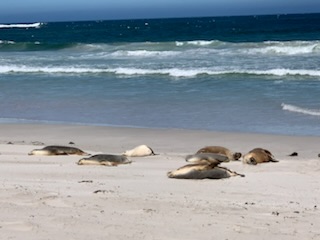

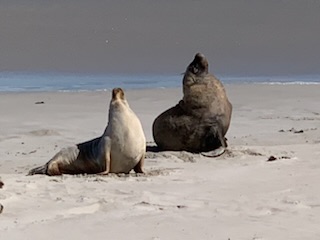
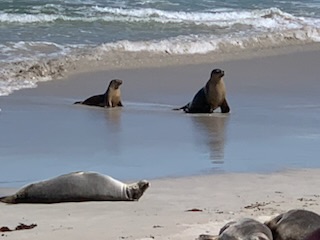
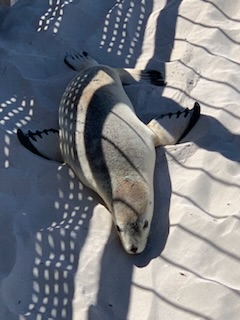
We also visited a couple of other bays, Pennington Bay being one, for a photo stop which is located at the narrowest part of the island, all gorgeous, with spectacular beaches.

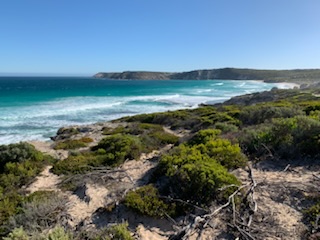
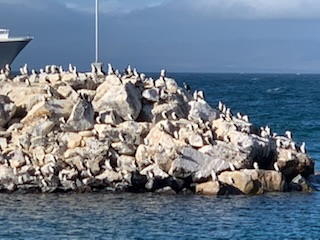
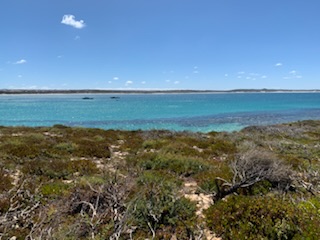
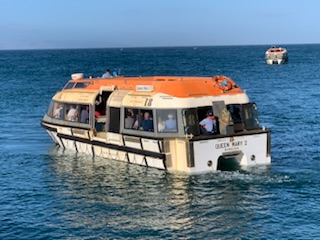
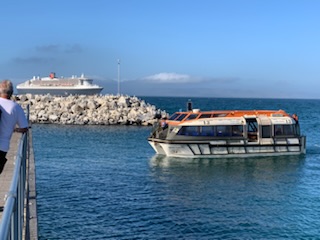
We got back to the tender location in Pennington after a truly spectacular and enthralling day. The tender ride back to the ship was a bit bumpy and it was only after we returned, that we found that the captain had to stop the tender operations, so many could not get off. If you ever find yourself in the Adelaide area and have a couple of extra days, we strongly recommend going to Kangaroo Island and visiting. There are hotels of all categories, although the 5 star resort was burned down in the fires and should be rebuilt by 2024. Back on the ship we had a nice dinner and went to the show – Amber Jade, a terrific Australian singer as well as master of the clarinet and saxophone playing Big Band Tunes. All in all a really fabulous day and we were lucky with the weather as it was sunny but not too hot.

 Roger & Anne Travels