Monday March 20, 2023
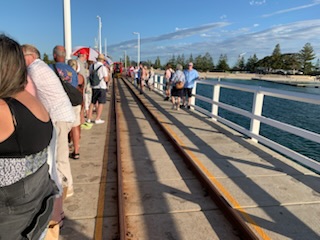
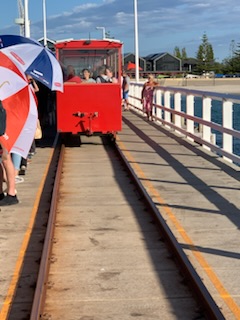
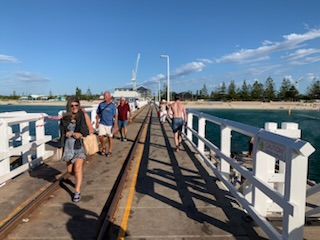
The ship dropped anchor in the very shallow Geographe Bay, a long way from shore, as it is very shallow. Tenders took 40 minutes to get from the ship to the end of a very long jetty / pier. It is the longest jetty in the Southern Hemisphere at 1,841 meters (6,040 ft) long and was built of wood, however it has been destroyed a couple of times, most recently in 1970 where it was reconstructed using some of the original hard wooden pylons with a cement cover. The town is known for its jetty and is a key feature of the town. there is a train that takes people from the shore to the end of the pier where there is a concrete and glass underwater viewing area. This has been so popular that they are in the planning process of extending it and expanding the viewing area underwater while putting a restaurant underwater as there are a lot of tourists, being only 2 hours drive from Perth. A couple of shops, some facilities and some very friendly local residents greeted us warmly. The town of Busselton is an easy walk from the pier, but there is not much to see.
The key reason for coming to this area is the Margaret River Wine growing region that produces about 3% of the total wine that is produced in Australia, but about 20% of the premium wine that is made in the country. There are 190 Vineyards in this area of which 95 produce 5-star wines. The best grapes of the area are the Chardonnay and Cabernet given the climate, winds off the Indian / Southern Oceans and the limestone base in the area. However Shiraz and other varieties also grow well. Most harvesting is done at the end of summer in February and March, with some of the Muscat and sweeter wines typically being picked in April where the Brix (sugar concentration) lever is higher.
This area is the ancestral home of the Noongar aboriginal people from the Wardandi and Bibulman language groups. The area was colonized by the Europeans in 1829 and there was a major massacre by the European settlers in 1841. Early exploration in 1801 by the French – Nicholas Baudin, with his ships Géographe and Naturaliste gave rise to the names bing used today for the bay and cape in the area. It was first settled by George Garrett Busselton in 1831 and was granted land in the area a year later and this led to other settlers moving to the area in Western Australia. By 1842 the town had a Post Office and 1845 St. Mary’s Church, with the first school opening in 1848. By the 1850’s the local hardwood and whaling led to it becoming a major trading port. Soon thereafter convicts were brought in to help with the public works. It steadily grew over the next 100 years as a trading port. However, by the 1970’s, tourism and the wine making of the Margaret River area took over as the predominant economic engine of the area. By the late 20th century it was one of the fastest growing areas in the country and officially became a city in 2012.
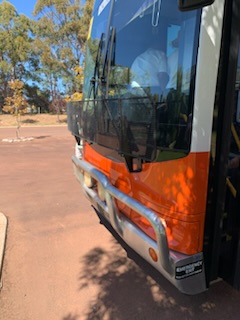
We had booked the day tour “The Essence of Margaret River”. So once ashore we walked to the end of the pier where it seemed like many of the local town people all greeted us and made us feel very welcome. We proceeded to the coach 6 to greet the guide Brian, the Driver Dennis and the ship’s escort Leona, who actually works on Queen Elizabeth but had some time off, so joined the Queen Mary 2 for a short holiday. We were in Busselton, our first town in the State of Western Australia with a population of 42,000 but doubling at week-ends, public holidays and summer holidays. On average about 1/2 million people visit Busselton each year. As we headed west and then south west we passed the towns of Vasse, Carbunup River on the Busselton Highway we arrived at our first stop – The Cheeky Monkey Brewery, located near Cowaramup on the westernmost side of Australia on the Indian Ocean. Bussleton area is the ancestral home of the aboriginal people known as the Wadandi Boodja (Saltwater People’s Country) and Busselton still goes by the aboriginal name of Undulup. What we noticed throughout Australia was that there is a true interest in acknowledging and respecting the aboriginal people of the country. Constant reference is made that we are on the lands of the aboriginal peoples and please respect the land.
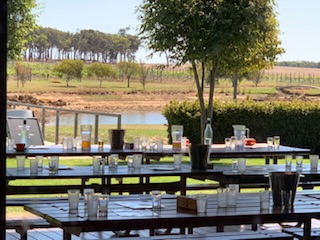
The Cheeky Monkey Brewery (4259 Caves Road, Wilyabrup, WA 6280 +08-9755-5555; http://www.cheekymonkey.com.au) provided us with a tasting of four of their beers, all were delicious but our favorite was the 4th one which is the alcoholic Ginger Beer. The first was a 4.2% Draught which was light and crispy and uses Noble Hops. The second was 4.2% Hazy Pale Ale which had a bit of a citrus taste although containing no citrus. The third was the 4.8% XPA which has won awards as the best pale ale. Finally, the Ginger Beer which was delicious. In the same facility Burton Creek winery has a tasting and retail shop.
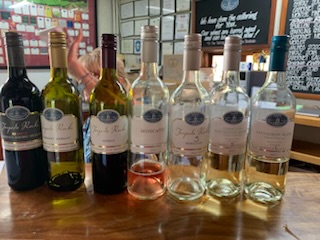
We then proceeded north on Caves Road until we reached the Cape Naturaliste Vineyard (1 Coley Road, Yallingup, WA 6282; +08-9755-2538; http://www.capenaturalistvineyard.com.au) near the town of Yallingup on the north west peninsula where the point and lighthouse are called Cape Naturraliste. It is located behind Smith’s Beach and the 19th century Stone Inn overlooking the valley was once a staging post for coaches on the Perth to Margaret River route. It then became a dairy farm and the milking shed is now part of the wine cellar. The grapes benefit from a sea breeze and the absence of pesticides and herbicides and “best wine” prizes have been won. The knowledgeable vineyard manager gave a very good talk explaining the different wines and the story behind each. We were to try 7 very good wines produced at the vineyard. The 2022 Sauvignon Blanc was light and good, next the 2022 Semillon Sauvignon Blanc had a similar asteroid but much more body, The third white 2021 Torpedo Rocks was followed by the 2022 Moscato, the 2018 Torpedo Rocks Shiraz and Torpedo Rocks Cabernet Merlot and finally the 2019 Reserve Cabernet Malbec Merlot which was excellent, although many passed on the last one or two as they were generous with their tasting samples.
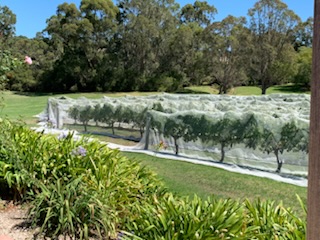
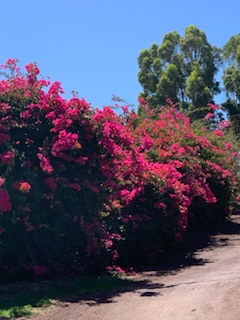
Our next stop was Aravina Estate (established in 1968 – 61 Thornton Road (corner of Wildwood Road in Yallingup, WA – info@aravinaestate.com; +08-9750-1111; http://www.aravinaestate.com). A spectacular winery, restaurant, as well as, a car and surfing private collection. While the collections are small, they add an additional interest. We were here to have a nice lunch overlooking the vineyards. We exited the coach and were immediately overcome by the spectacular gardens that contained a large number of hydrangeas, “Black Boys” (aka Grass Trees) and many other local plants. This is a private estate and these were the gardens of the estate. This winery is set on 180 acres of rolling vineyards. Here we had lunch consisting of a cheese and charcuterie board and a series of half a dozen Pizza’s, all delicious, with sparkling white wine upon arrival and different wines during the lunch.
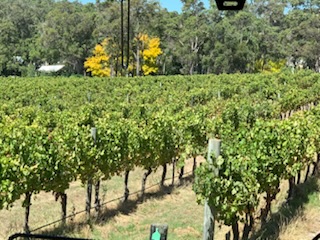
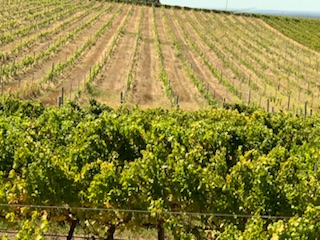
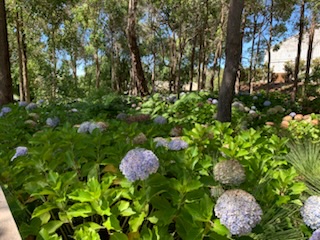
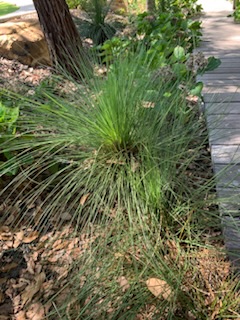
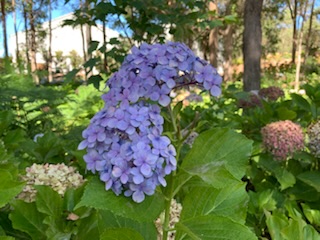
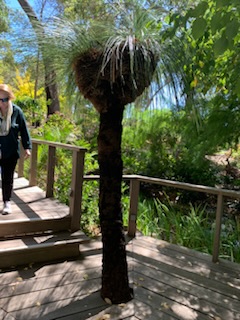
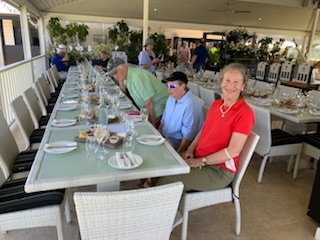
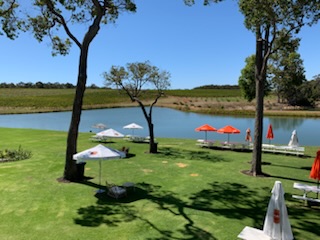

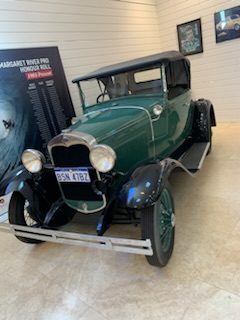
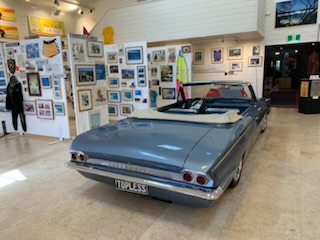
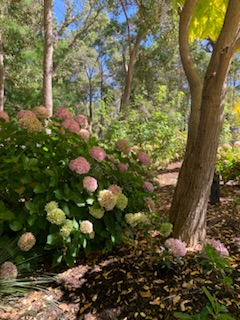
It seems like all we did today was drink wine and beer, well that is not too far from the reality. We figured we had drunk about a bottle and a half of wine per person, so all were very happy and enjoying the day completely.
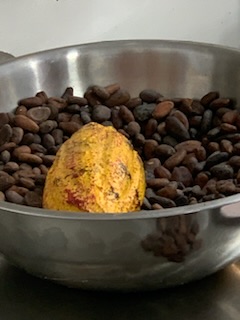
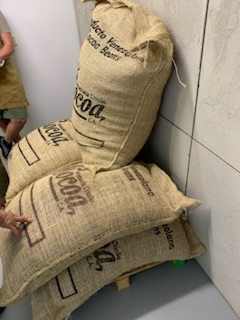
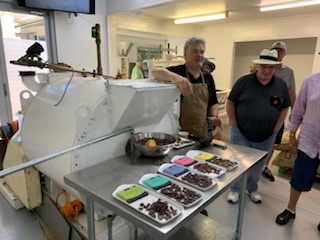
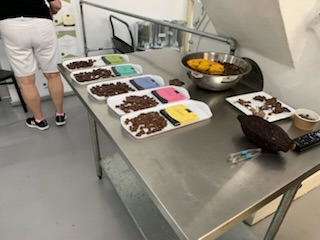
As if that was not enough of a day, our next stop was at the Gabriel Chocolate factory. While no cocoa or sugar exist in this area, which are the two principal ingredients of chocolate, the owner, Gabriel, gave us an excellent presentation on the different types of cocoa beans, where they grow, how they are dried and how they produce different tasting chocolate. The cocoa bean is a large 6” by long 3-4” wide bean shaped somewhat like a rugby or American football. Inside this pod, which grows on trees and is hand harvested, are a number of “seeds” like large beans surrounded by a gelatinous substance. The beans are removed and dried typically on the concrete floor or netting, then once dry, packed into large sacks and sent to manufacturers. One particular bean that is extremely expensive (thousands of dollars per sack) are dried on concrete slabs outside the town church (in Venezuela) but have to be brought in and laid out again each time it rains. Once in the factory, the beans are crushed and depending on the % of cocoa in the finished product, it can be either just cocoa or mixed with milk, sugar etc. He explained that cocoa originally came from Mesoamerica where the beans were used as currency, drunk by the rulers and (I add here and mentioned to him privately) were the origin of the concept of “0” in the Maya Culture allowing the Maya numerology to have positional notation, unlike the Roman System. By having the concept of zero or null value it allows numbers to be places in the certain location to indicate a value, easing mathematical computation. In the decimal system we commonly use the number 1 with one “0” indicates ten, with two zeros – hundred, with 3 zeros – thousand etc. In Maya, being vigesimal (base 20 not 10) the first position marked by a zero after the initial digit marks the value of 20, with two zeros 400 and with 3 zeros 8,000 etc. I digress, but it seemed appropriate when talking about chocolate that came from Southern Mexico and having a bit of knowledge of the culture of origin. Back to the presentation. In general, commercial chocolate in the USA may have 15-20% cocoa; in Europe the major producer and consumer being Switzerland and Belgium the chocolate may have 25-30%, but a lot of chocolate that has a much more bitter taste, which is better for you, has 90+% and less than 10% sugar and or milk. We tasted various pieces of chocolate from different sources – Madagascar, Venezuela, El Salvador, etc and with different cocoa content and the taste is totally different. In tasting, one should not bite the chocolate but allow it to melt in your mouth as it melts at body temperature.
We drove a bit more around and eventually got back to the ship, but with the amount of wine and beer, the warm climate, the walking and enjoyment of the day, we opted to forego dinner but did go to the show which was the Cunard Singers an Dancers doing “A Tale of Two Cities” (Broadway, NY and West End London), followed by the outstanding singer Belinda Adams that portrayed some of Barbara Streisand songs and others.

 Roger & Anne Travels