Monday March 27, 2023
Another day at sea crossing the Indian Ocean filled with interesting lectures. The sea was still a bit “bumpy” but not too bad at all.
Stuart Usher – Military Historian – Challenge of a Nation, The Battle for Australia – Coral Sea, Kokoda, and Milne Bay and the fight for Australia in WW2. Another fascinating talk about how the Australian forces were able to work with the allies to push back the Japanese as they captured island after island towards Australia and actually bombed and sunk ships / killed people in Darwin and Northern Territory. The key point when Australia became concerned was with the fall of Singapore as that is where there were many British troops and so it was hoped, that is where the Japanese would stop their pursuit for the control of the eastern island nations. There were several naval battles with the Coral Sea, being a determinative one and after that, the battle of Midway was the beginning of the end. However, it was not until the dropping of the two Atomic Bombs on Hiroshima and Nagasaki, that the war in the Pacific, finally came to an end.
Robin Craig – Futurist – Reach for the Stars – Reaching Past Earth – an interesting talk about the key issue of exploring the universe and getting off the earth. The rockets that propel capsules and people into space have to be so big, not because of the payload, but because of the weight of the fuel it has to carry to get out of the earth’s atmosphere. The issue of time travel becomes interesting when one considers that the closer you get to the speed of light the more time stands still. So if you could travel at the speed of light and go to the closest solar system on our own, you could do that during a normal human lifetime, however upon your return to earth, 200,000 years would have passed. He also discussed the possibility of worm holes for traveling at warp speed. All this is theory today but when you consider that it was only 100 years ago that a human being was able to take flight for a couple of minutes, and now we can fly to the moon, what will the next 100 years bring?
While Roger attended this presentation, Anne went to the port presentation by Ruth on Port Elizabeth, South Africa and heard that most of the things to do here were the safaris as the game reserves were close.
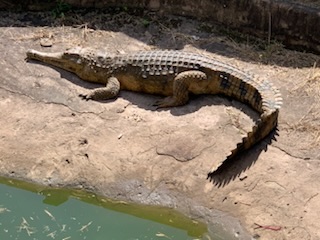
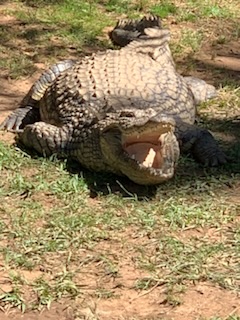
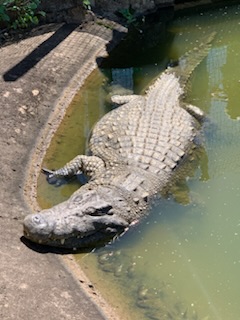
Gavin Robinson – African Wildlife – Crocodiles- The Secret Behind the Myth spoke of the reason for working with and conserving crocodiles. First there are various types of crocodiles and alligators. Alligators cannot take sea water and their jaws are such that their mouths close completely; whereas Crocodiles can take sea water and their mouths always show teeth and have an open jaw. Alligators can live in cold water even in ice provided that their snout comes up to breath air above the ice. Crocodiles would not survive in cold weather. Several years ago, crocodiles were being killed, almost to extinction for their meat and for the leather goods buisness. Now through careful conservation and the management of farm raised crocs for the show, handbag etc buisness, crocodiles will survive. A crocodile always lays eggs in the same place and then the mother can sit on the nest for 3 months without food and then 2 months taking care of their young before having to feed. This is when they are most dangerous and they will eat anything that comes into view. Only about 3% of the babies reach adulthood. A lot of very interesting information about his life’s work, and it is his specialization, doing conservation, tracking, educating and dealing with Crocodiles throughout Africa.
Kate Schroeder – Forensics, Archaeology – Making Faces from the past come to life – A really interesting way in which she gets skulls not only of archaeological record, but of police cases that are current. The methodology is the same. Today there are reasonably good computer programs that can create a likeness of a person from the skull, but the old tried and true method of clay modeling is still the most widely used and it is her specialty. She gets as much information as possible about the person and has a good look at the skull, then usually makes a 3D model of the skull in great detail which is what she uses for building the clay model. There are certain fairly standard ratios like 3/5th being the ratio of the nose at the top bones to that of the width of the end of the nose. As it is all cartilage, it all disappears over time and skulls are only left with a big hole where the nose was. Also there are 52 different points on the skull where pegs are installed and the thickness of the skin is a defined depth in these area, so the clay can be built up to just cover those pegs. She talked of one very old – pre-neanderthal skull that she worked on which took 11 days full time. It shows a much larger mouth, thus accommodating all the teeth as opposed to most humans today that have a much more closed mandible thus leading to impacted wisdom teeth. A very well delivered and informative chat.
There was a time change tonight where we moved back an hour. We decided not go to the show as it was Rhythm of the Night with Cunard Singers and Dancers which we have seen many times, and also, we had zoom calls being Monday.

 Roger & Anne Travels