Tuesday March 28, 2023
The last day at sea crossing the Indian Ocean before we get to Mauritius and Reunion Islands. The first lecture was by Andrew Jarrett the tennis pro, coach and referee who spoke on “Coaching on the Professional Tennis Tour”. Anyone who wants to be irrespective of capabilities or age can be a coach, and there are different types of coaches. In 1968, as previously discussed, there was the “Big Bang” when Tennis became open to all. In the 1950’s and early 1960’s very little, if any, money was available in tournaments but tennis was very popular attracting great crowds. It was then that the prize money started to grow exponentially. For example, the US Open Winner received the following amounts in USD – In 1968 – $14,000 for winning men and $6,000 for winning women. By 1973 the shift to equal prize money for men and women was started. By 2000 the US Open winner (male or female) won $800,000; by 2010 it was up to $1.7 million and by 2020 the winners each got $3 million. When it came to coaching in the early years 1 person helped Bjorn Borg – a traveling coach, the first one, organized everything from practice, to entries to travel arrangements. There are different types of coaches: –
- Individual coach – Here the top player makes a private deal with a coach and pays for that work. It is not very stable for the coach as they can be replaced at the whim of the player, but usually the income is higher than others. For example – Andy Murray’s Coach received £750,000 UK pounds a year. However the usual fee is closer to US500 a day plus expenses.
- Federation Coach – Here a country pays a salary to coach all players of that country. This is much more stable for the coach.
- Sponsor Coach – In this case a sponsor like Adidas, Nike, Wilson etc pay the coach to help all those players under contract with the sponsor.
- Academy coaches – Those are paid by the particular organization or a particular club where one or a group of players call “home” and practice during their time when not in tournaments.
Next he described the various different types of coaches giving examples of each such as: –
- Super Coaches – People who have at one time been at the top of the game and thus became “household names”, such as – Jimmy Conners, Boris Becker, Ivan Lendl
- Extrovert Coaches – Richard Williams with his daughters, the Williams Sisters; Jim Pierce, John Macenro , Nick Politierri with Andre Agossi, Agassi coached Jockovitch, Leon Smith UK Davis Cup Coach
- Seasoned Coaches – These are ones that fly under the radar, that are not generally known by the pulic, but are very well known and respected inside the world of Tennis. They are able to help their players as they know well all the people in the tournaments and can call on friends to help out as well as have a tremendous knowledge of what works and what does not in the field of coaching.
Job Description – Basically when there is only one person in the “entourage”, the coach has to monitor who gets in on the list of players to play in the tournamet, when you are on the waiting list and judging whether to take on the expenses of travel hoping that some will cancel and your player gets the nod above the “Cut Line”; analysis of opponents and statistics, like where does a player serve on big shots etc; look to slight advantages. The coach must have the qualities of having a great relationship with player, understanding when to say something and when to shut up; organize things like – practice time, what player from another group to warm up with; contacts with other coaches and sometimes just be a friend. One of the key to a coach’s success is knowing other people in the industry so one can help the player you are coaching.
Entourages can often create friction amongst each other that have different opinions and thus need to be managed, like Andy Murray who has 12 people in his entourage that help him in various ways.
Wimbledon and French Open are now allowing in 2023 on-court coaching; US and Australia are considering it. David Lloyd was a UK Davis Cup Captain and one of the early “on-court” coaches who now has a very successful series of tennis venues / academies in the UK.
The second lecture was an interview by Neil Kelly of the Australian Comedian – Ian McFadyen – The Comedy Company creator and producer, which was a family show. He was trained by ABC (Australian Broadcasting Corp) so he could produce as he knew it all on how to produce TV shows. He stopped as he suffered “burn out” after 60 comedy shows in 2 years – writing each week. Part of the way through 3rd year of The Comedy Company, the network went into receivership. This means that he and the cast were Not paid for the last 4 shows. In receivership, the bank gets money and only if there is some left over, does anyone else get any pay. As the Accountant had to be present at each meeting to assure proper use of funds, they got into the spirit and made joke suggestions. All the networks were taken over by accountants and lawyers in Australia by mid 90’s and reality TV took over as they did not have to pay the actors and scripted shows were out. At it’s height there were 100 comedians on TV, however, now there are only about 5. The advantage of reality TV is that you can get ordinary people to do things that they do in real life or are willing to do to get onto TV. In many ways, it is “fake” as shots and reactions and actions are like that of filming a war movie but it is now related to cooking for example. Big Brother had 16,000 people lined up to do the show. In reality, “Survivor” for example have a field hospital as well as food etc. Game shows are a good way of improvising. It was interesting to hear that he could not sell the “Comedy Company” overseas as it would need sub titles in the USA, although, now many of the people on US TV are Australian. Class runs through comedy in UK whereas American situation comedies tend to be more about guilt and redemption some actually have specific lessons. No British sitcom resulted in a lesson. “All In The Family” uses class and race with a daughter and no good son-in-law, to create the comedy; while the Australian version is a bit cruder but similar. Mostly comedy was a male activity, but females are now starring in comedy and women are doing jokes about themselves, which men would not touch. Finally, in the 1950’s there was much more British comedy and influence, while the American (Preachy) comedy came in much later, but still most Australians prefer British humor to USA humor.
The third lecture was by the Archaeological CSI – Kate Schroder, who has training in Archaeology, Medicine, Biomedical having studied at Sheffield University then Reading. Forensic Archaeologists now in 16 countries have developed a protocol on the boundaries as to what can be done in testifying. It is much more of a science with a scientific lab and the CSI TV programs have little to do with reality. One of the first aspects when the CSI gets to the scene where human remains are found is to determine if a crime scene is an archaelogical site or a crime scene. Some of the crime scenes she has worked:- 1) One find in Cambridgeshire had 52 bodies, some had arms tied behind their backs, of which 17 are found with feet and head placed together. These 17 were found to be from the Roman periods. 2) With new work on the railways they are finding more graves. All these findings are recorded and include 3D measurements and drawings. 3) With drought and since the 1970’s they are finding bodies as the water in lakes are coming to light even though they were supposedly thrown to the bottom of the body of water, never to come to see the light of day. 4) Near Easton station they found 50 crania of young men all in a line, 3 feet away from each other killed in execution style.
She mentioned that she had a full DNA work up so as to eliminate any possibility of contamination when dealing with human remains. Another area that they have started exploring is the testing of dust, like at the 911 World Trade Center site – checking the dust that has some sort of human remain as it was “contaminated” with bits of DNA from the victims.
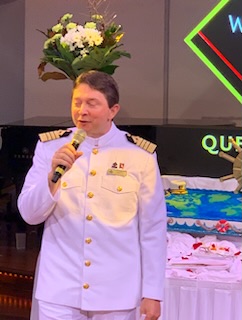
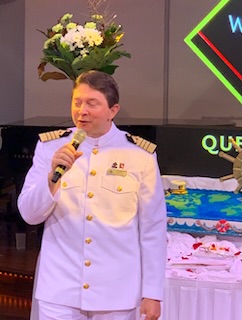
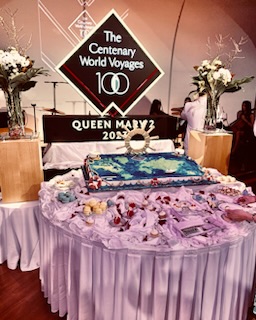
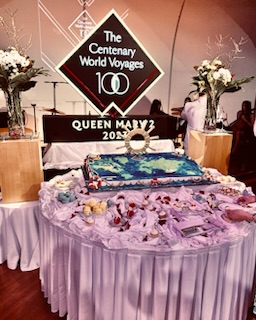
We enjoyed the Captain’s party for those of us on the World Cruise for this segment. The evening’s performance was one of the best of the cruise and played to a completely full house. It was a two part show, with the first being the extremely funny Northern Irish comedian – William Caulfield followed by the brilliant singer “big man” from New Zealand – Russell Harrison who was able to get the audience really singing. Others have tried and it results in a feeble effort, but he greatly succeeded. A fun evening.


 Roger & Anne Travels