Thursday March 30, 2023
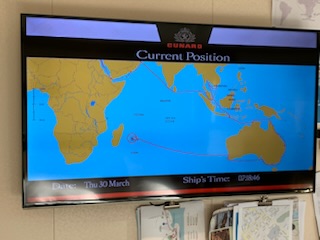
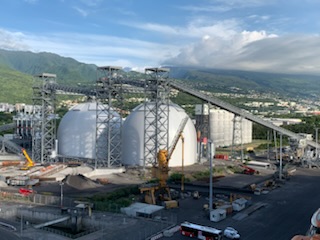
The early arrival after traveling 130nm from Mauritius saw us going bow first, into the eastern dock at La Possession (named as it was the place where the French arrived and named it a possession of the King of France) in the NorthWestern part of the island, and then swinging the stern 90 degrees to dock in the commercial port starboard side to dock. The original western dock is at Le Port, being a commercial dock, there are absolutely no facilities. A couple of tents were placed on the dock for the immigration and customs officials to shade from the sun as they had to examine one’s passport, one at a time, before being let out of the restricted dock area. Furthermore, upon our return, we all had to get off the coach for an inspector to review the ship key card and perhaps question anything that you might carry. The coach then went through an inspection before being allowed through the gates to pick up all the passengers who had just got off and walked through the port authority building. One is not permitted to walk anywhere in the restricted area so there is a 5 minute shuttle bus from the ship to the door of the restricted port area and another coach shuttle to take anyone who wanted to into the nearby St Gilles Les Bains town which was some 25 minutes away. We boarded our coach number 2 to take the “Scenes of Reunion” tour with outstanding guide Joel and the excellent coach driver Ryan. As it is a department (territory) of France, driving is on the right, mobile phones operate as if in Europe, the Euro is the currency, French is the official language and Roman Catholicism is the predominant religion. A little bit of France in the Indian Ocean! The first things that became apparent were two huge “factories” right by the ship. The one along side with two sets of 6 chimneys, is the old coal driven electric plant and the other that looked like two giant balls, is the newer biomass electrical generation plant. However, even though it would seem good for the environment and to reduce carbon footprint, the fuel for this biomass is wood chips coming from Canada!!!
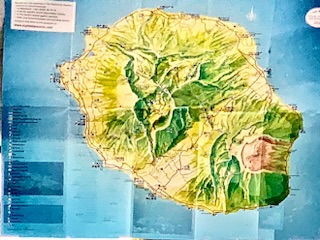
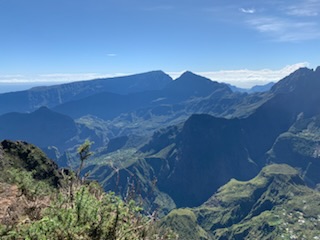
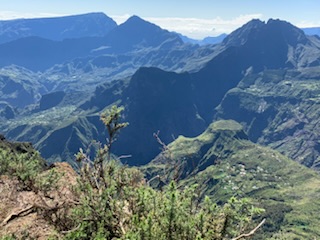
The history of Reunion (previously called île Bourbon after the Bourbon French dynasty) dates back 3 million years ago when a volcano appeared on top of the ocean, this formed what is now the northwest half of the island. About 1 to 1.5 million years ago a second volcano appeared to the southeast forming a separate island. Over the years the two land masses were joined into one island that is Reunion. A diagonal line from north east to south west is evident in the geological structure of the island. It occupies an area of 2,500 sq km (980 sq miles) with a length of 63 kilometers (39 miles) and a width of 45 kilometers (28 miles). Around the outside of the island are a number of towns all named after saints, with St. Denis on the northern tip, being the largest town with 152,000 people of a total of 880,000 on the island. The center of the island is what provides the amazing sights, tracks and spectacular part of the island. 3 major Calderas, (collapsed volcano craters) give rise to jugged peaks. These are Cirque de Mafate, Cirque de Salazie and Cirque de Cilaos which are arranged in such a way that the three come together at the point – Piton de Nieges at 3,071 meters (10,076 feet) above sea level, which was the first stop on the agenda of the day. In the south eastern part of the island, there is a very active volcano – Piton de Fournaise at 2,631 meters (8,632 feet) above sea level. It erupts 2 1/2 times each year and lasts usually for a day or so, but some 12 years ago the eruption lasted 10 months adding shoreline and thus extending the size of the island. It covered the circular road that goes all around the island. There is only one road that crosses the island from St. Pierre to St. Benoit, it is in the valley between the two volcanos that eventually joined to form one island. Much of the center of the island is only accessible on foot, and thus a haven for hikers or by helicopter. People who live in this central part go shopping once every couple of months and take home a maximum of 1 ton of food and supplies as that is the maximum permissible in the helicopter. They like the solitary life away from the noise and hustle of cars, roads and other such urban noise.
Early history of the island is not really known, but Arab traders knew of it as well as Indonesian and Malaysian on the way to the east and Madagascar. Around 1507 the Portuguese explorer Diego Fernandez Pereira discovered the island at which point it was uninhabited. The Portuguese basically left the island untouched and used it as a stopover to get fresh water on their voyages. The first French claims to the island date to 1638 and officially claimed by Jacques Pronis in 1642 when French mutineers were deported to the island from Madagascar. In 1665 the French East India company sent the first settlers. Slaves were imported to work on the plantations and on February 4, 1794 France abolished slavery but Reunion kept the practice. It briefly came under British Rule from 1810 to 1814 when the Treaty of Paris stated that it be returned to French Rule. During the French Revolution all that had to do with the King was to be changed. So at the National Convention on March 23, 1793 the name was changed to Reunion in homage to the meeting (reunion) of the Fédérés of Marseilles and the Paris National Guards before the insurrection of August 10, 1792. In 1806, it briefly changed it’s name to île Bonaparte (after Napoleon) but was changed back on March 7, 1848. On December 20, 1848, the abolition of slavery was official and the 60,000 slaves were free. Prior to that there were many “runaway slaves” who tried to live in the higher part of the island, but were soon caught and punishment included whipping for the first offense, cutting achilles tendon for the second offense and ultimately death. If the slave was killed in the mountains, the left ear or left hand, which had been branded, were brought back to claim the compensation. These were displayed to show what would happen if slaves tried to escape. By this point coffee, then sugar, cotton, indigo (but never grapes to avoid competition with French winemakers) and other crops needed labor, so indentured servants were brought in from India, Zanzibar, China and other countries. However, they had to convert to Roman Catholicism which they recented. When the workers became fewer and fewer, the landowners repented and allowed them to practice Hinduism on the property, but had to maintain the Catholic front when off the property. Other nationals were brought in as well, so Reunion is today a multi-ethnic, multi-religious culture, living in harmony particularly with extensive intermarriage. One of the issues was that the inhabitants were mainly men, so a few ladies tried to be brought in, but eventually prostitutes were brought in to start growing the population. Rainfall on the older NE side is about 2-3,000 mm a year and there is only one river, however on the active volcano side, due to the prevailing winds, rainfall is 5-7,000 mm a year and there are 16 rivers, also making that part of the island much greener. When the Suez Canal was opened in 1869 there were fewer ships calling into the port as they no longer had to come past southern Africa to get to the eastern spice islands.
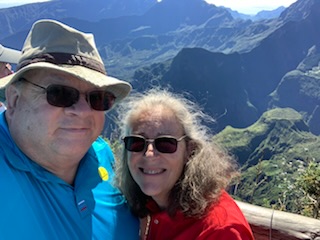
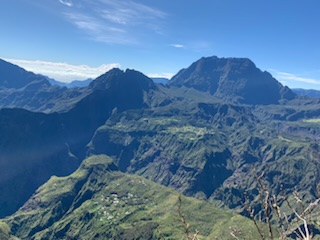
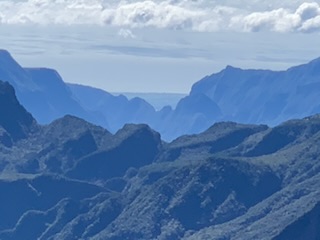
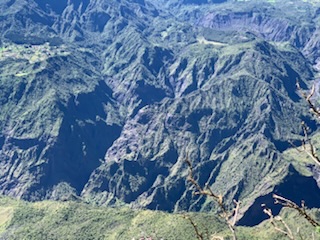
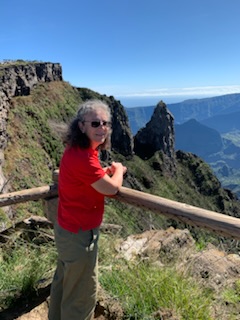
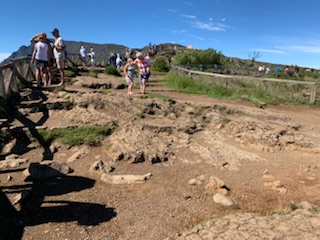
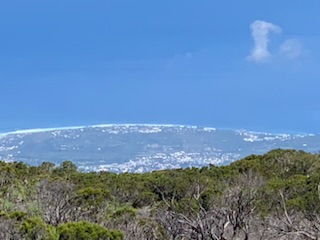
As mentioned, our first part of the day was ascending the mountains on a 2 lane, one in each direction, road that had a large number of “blind” hairpin bends to reach the top after a bit over an hour. Often, the guide indicated that the view was not great as the clouds cover the area. However, we were exceptionally fortunate and the day was absolutely perfect. The guide indicated that of the many times he has come up here there have only been 4 that the view and weather were as spectacular as today. Indeed, the sheen volcanos and calderas, with rugged outcropping and virgin forest, with the ability to see to the eastern side of the island and the southern active volcano was crystal clear. We were truly in awe of the beauty of nature. We were given 1/2 hour to walk over the area that has a wooden railing and the very uneven lava walking surface. Absolutely spectacular.
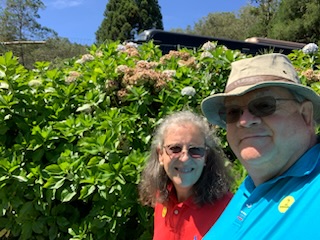
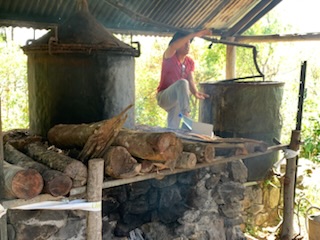
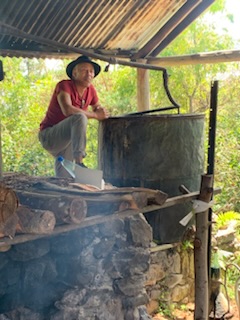
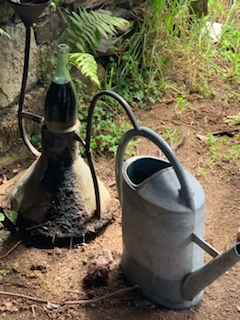
Boarding the coach, we started our way back down the mountain and stopped at the “La Destillerie du Maïdo” – the geranium and other perfume oil distillery. The owner gave us a tour of his garden and showed us how to make geranium oil. The buisness has been in the family for three generations, but the amount of hectares under cultivation have gone from 50 down to 4. Two of these are aromatic geraniums and the other two have different flowers. He gets a ton of geranium flowers and packs them into a copper kettle filled with water with a mesh on top of which he places the geraniums. He sets up a smoldering fire under the 6 ft high kettle which boils the water, extracting the essential oils that go up as steam into the retort and the steam then flows into a circular water cooled drum. At the bottom of this appears a tin can with a bottle without a bottom on top of the can. The geranium water is sold like rose water, that has a bit of the geranium perfume and the geranium oil which is lighter than water, is captured and sold locally. From the 1 ton of geraniums, one obtains about 1 liter of oil. A very interesting process and wild but attractive garden.


It was now time to wend our way through the hairpin curves and back to the ship. A truly spectacular morning, thanks in great part to the perfect weather and an excellent guide. One final message that the guide left us with was that around Easter time, the big delicacy that is served on the island is wasps, which at a cost of E350 euros a kilo, are very expensive. Some like them raw while others fry the wasps or bake them and serve with salads or in a curry. We decided not to taste them, however, we were not sure exactly what we were eating at lunch so who knows!!!
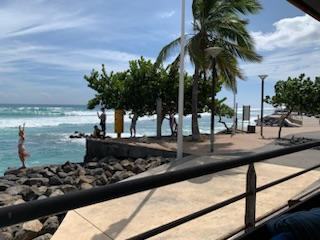
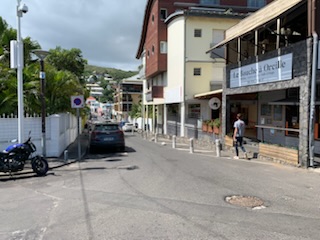
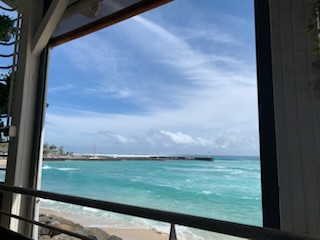
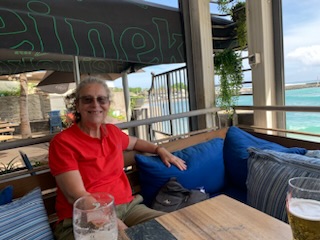
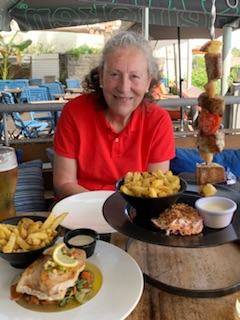
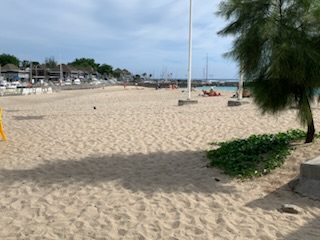
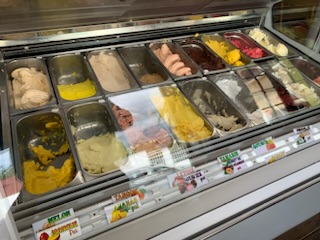
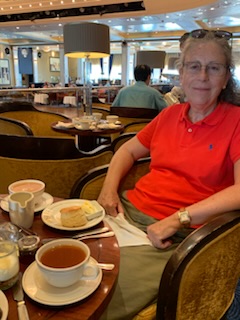
Since we had various hours before we set sail, we took the 30 minute shuttle into the small town of St. Gilles Les Baines and asked the local tourist office where we could get a good meal. They pointed us to the Esplanade des Roches Noires, which is an area along the beach with various restaurants. We chose “La Plage” (2 Rue du Port, St. Gilles-les-Baines, Reunion, 0262-33-2677 – http://www.laplage.re) which seemed appropriate and sat overlooking the turquoise ocean, on the verandah enjoying local “dodo” beer and other local delicacies as the waves lapped against the mottled (white and black due to lava) sand. An idiilic way to enjoy the island. On our wander back through the town, we stopped and enjoyed the gelato at one of the ice cream shops as the temperature was 32C (90F) before arriving just as the shuttle bus was about to leave with a full load of passengers back to the ship. Upon arrival we enjoyed a nice tea and scones in the Queens Room as we had done the day before, before returning to our cabin. We skipped dinner but enjoyed the Swedish comedian / magician – Michael Halvarson.




 Roger & Anne Travels