Monday April 3, 2023
Our first day in South Africa, which is one of the places we were looking forward to visit because of it’s rich history and aboriginal culture. However, we realize that this is the last few days before we spend many days at sea getting back to New York and the realities of completing this amazing world voyage and getting back to daily living ashore.
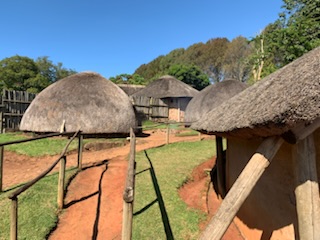
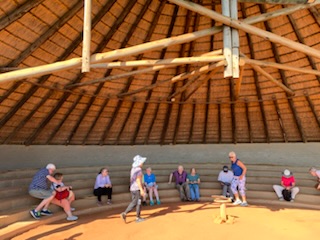
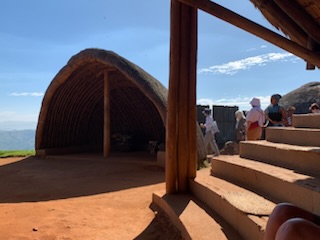
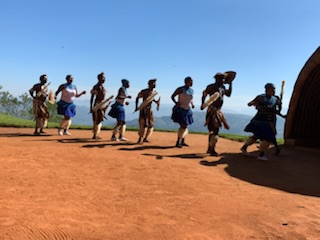
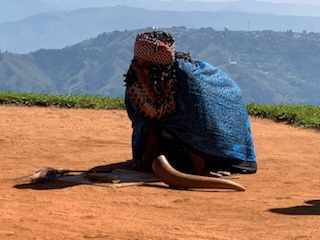
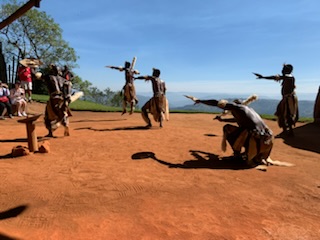
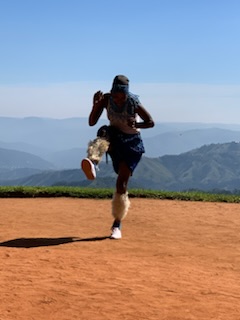
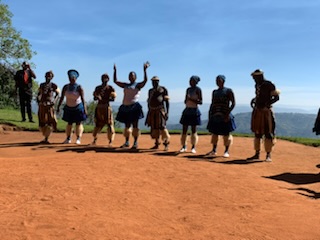
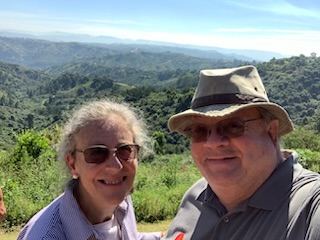
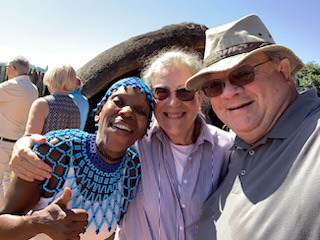
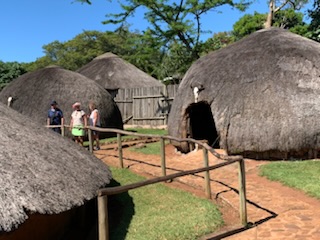
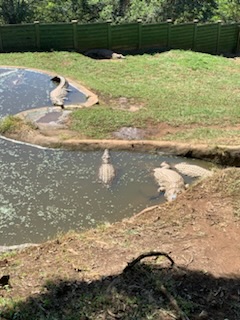
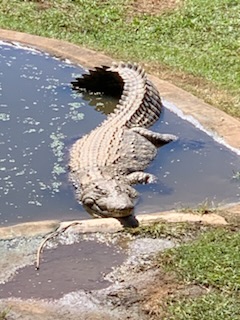
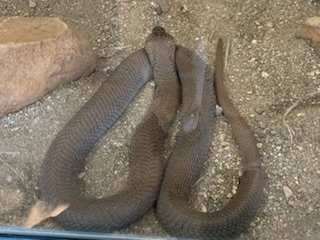
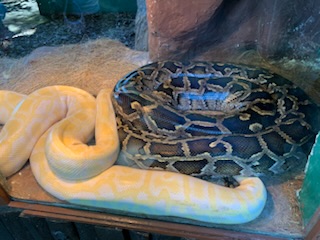
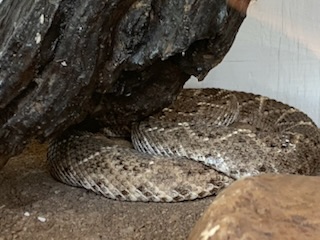
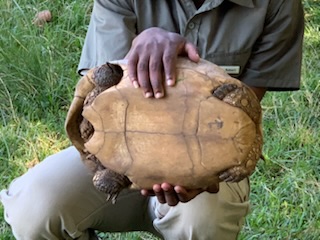
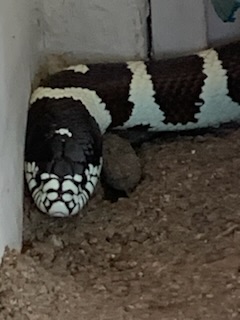
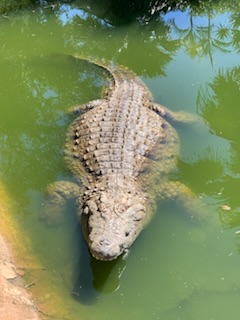
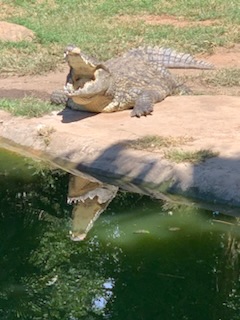
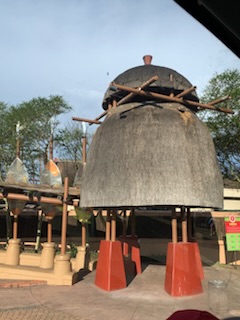
We docked in the commercial port, the largest in South Africa and according to the guide, the largest in all of Africa. The ship docked starboard to dock, however both sides had a view of the town. We gathered in the Theatre for the tours as each person had to go one by one through South African immigration, just outside the theatre, with landing card and passport. Once that formality was completed, we proceeded ashore. What we found was a tight passage between the ship and the buildings, where one coach at a time had to back up to collect the passengers for that coach trip, then drive off so the next coach could pick up the passengers for the next tour. We were on coach 8, and it is left hand drive, due to the British influence, for the tour of 1,000 Hills. There was an excellent Cunard representative, Veronica, who had been with us on another tour in Australia and the worst tour guide one could hope to have – Irene. She did not know how to use the microphone, despite being shown by Veronica. She never explained anything about South Africa, Durban or anything, but in her thick German accent would say – that’s a tree, those are cars, that’s a building I have no idea what type, these colonial buildings of Post Office and City hall have no use, those statues are of people who I don’t know and nobody cares about etc. Incompetent and negative about everything. At first, people complained that they could not hear and finally resigned themselves to tuning her out, as she was not saying anything of interest or importance, and just enjoying the scenery and what the tour had to offer. At the end, usually the people on the coach clap, by way of appreciation, and many give a tip to the guide and sometimes the driver. In this case when we got back to the ship, no-one clapped and no-one gave her a tip and indeed most did not even bother to say good bye. All this being said and despite that inconvenience, we thoroughly enjoyed the tour and it was a highlight of the entire trip. The reason being that we wended our way up into the hills, past various wealthy and poor areas and the views were very nice. When we finally arrived at the 1,000 hills, we found a Zulu village – pheZulu Safari Park. It is a tourist attraction / private enterprise however, it seems that a Zulu family does actually live there. It is a typical Zulu village with various thatched huts located on the top of a hill, 1,000 meters (3K+ feet) above sea level, with a beautiful view over the valley of many hills and peaks. We did not try and count the 1000 peaks!! We were ushered into an amphitheater / shell structured building made of wooden poles and thatching, overlooking the 1,000 hills. After being seated we were treated to an excellent series of Zulu dances telling the story of man, wooing a female into marriage. The Zulu practice polygamy and a man can have as many wives and he wants and can afford. In the exchange a man must give a minimum of 11 cows to the family of the bride in exchange for their daughter marrying the man. Another condition is that the first wife must accept the other wives, and third, the man must treat them all the same and “put up” with all the mother-in-laws and their family!! The dances showed off the agility and almost frightening warrior spirit that the Zulu’s are famous for, while at the same time showing the wooing of the woman. In South Africa which has a population of about 56 million, the Zulus number about 10 million. The dancing lasted about half an hour and the five young women (who all wore sneakers) and 5 young men (barefoot) as well as the drummer and older “Mother / fortune teller / witch doctor / herbalist” were happy to interact with us and have pictures taken with them at the conclusion of the dancing. We then enjoyed a special cake with cream and jam and coffee or tea in an area with tables, again with a spectacular view of the valley of 1000 peaks. The excitement continued as we were then taken in groups to visit the live animal park. Here we were up close and personal with a series of some 25-30 large alligators and 50 odd baby alligators as well as some 30 snakes, some are highly toxic like the black mamba, spitting cobra etc as well as the snakes that squeeze you to death. The leader of the group, offered to put a snake around the neck of anyone who wanted, we declined!! There were also turtles and tortoises and other animals. A great introduction to African animals that in the bush are the ones that share the land with humans. The entire 2 hour experience was really fabulous and we greatly enjoyed the tour.


We got back to the ship, just in time to head to the afternoon tour. However, before discussing that tour, let’s find out a bit about Durban, some of which was provided by the Zulu and much better young female guide we had in the afternoon.
Durban (eThekwini in Zulu) and, nicknamed Durbs, has the third largest population (3.4MM) in South Africa after after Johannesburg and Cape Town. It hosted the FIFA World Cup in 2010. It is in one of the 9 provinces of the Republic of South Africa (RSA) called KwaZulu-Natal and had the original name Natal, after Bay of Natal, which was named by Vasco de Gama, as he found it while sailing in 1497 to the Far East at Christmastime (Natal = Christmas in Portuguese). Durban and the Bay of Natal are on the Indian Ocean. Archaeological evidence shows that hunter gatherers populated this area since 100,000 BC. In 1686, a Dutch East India Company vessel Stavenisse capsized and was wrecked just off the eastern South African coast. Some of the crew made their way ashore, learned the local language and integrated into the friendly community. On October 28, 1689 the Noord Ship came tp “rescue” the crew. Soon thereafter the Dutch Cape Colony purchased Durban from the Abambo people for UK£1,650. In 1822, the British ship Salisbury arrived with 2 Royal Navy Officers (James King and Francis George Farewell)engaging in trade. They returned in 1823 taking shelter from a storm in the Bay of Natal and in 1924, Farewell opened trade relations with the Zulu King Shaka and established a trading station. Together with Henry Francis Fynn, another trader they had 26 possible settlers of which 18 stayed. On a visit to see King Shaka, Fynn helped him recover from a stab wound and as a thank you he was granted a 25 mile strip of coast 100 miles in depth. On August 7, 1824 an agreement was reached with King Shaka for the Bay of Natal including 16 miles South of the Bay and the British Flag was raised becoming the start of the British in what is now Durban. Only 6 of the settlers remained, but more arrived. On June 23, 1835 it was decided to call the place D’Urban after the governor of the Cape Colony Sir Benjamin D’Urban.
It is today ethnically diverse with Zulu, white and Indian / Asian populations being the predominant and the languages spoken in order of number of speakers are – English, Zulu, Xhosa and Afrikaans.
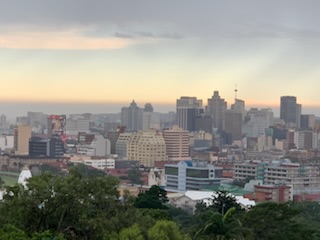
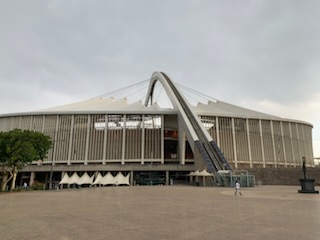
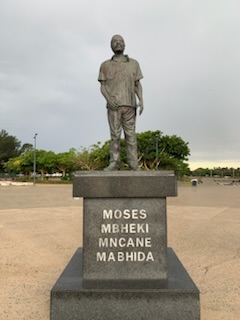
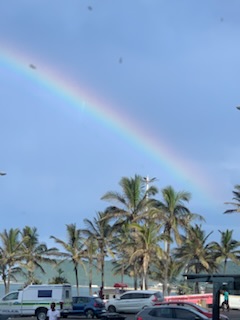
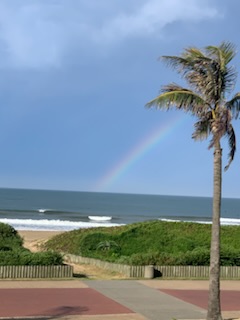
The afternoon tour – Sights of Durban (coach 19 – guide Cindy) gave us an overview of the city. It was mainly driving around seeing the two colonial buildings: Post office and City Hall; and seeing both the affluent as well as poor sections. The local market with it’s food stalls and basic clothing, was reminiscent of typical markets in third world countries with rubbish on the floor and yet there was a buzz of excitement as people scurried from one to another stall to get ingredients for the family meals. We always enjoy these markets as they give a flavor of how the local everyday people live. We also were taken to the top of a hill to get a panoramic view of the city. One of the stops was at the very impressive Football (soccer) stadium dedicated to Moses Meheki Mncane Mabhida (1923 to 1986). He became a communist and community organizer then was active in the trade unions serving as the first Vice President of the South African Congress of Trade Unions (SACTU) . He was active in the ANC becoming a local leader before going international. He then started the military branch of the ANC and was active in the intelligence arm. He died of a heart attach in Maputo and was buried there for 20 years before being returned to Kwazulu Natal to be buried in 2006 in the Herro’s Acre of the cemetery in Pietermaritzburg, a suburb of Durban. Opposite this stadium is the Rugby stadium and the athletics track keeping all these sporting venues in the same area. We also drove along the golden mile due to the color of the sand, where there was a fabulous rainbow over the Indian Ocean, with local vendors selling beach related clothing and drinks, food etc. A children’s park with games and a cable car was shut down as a recent major storm brought the ocean waves over the park, destroying the mechanisms, electric motors and rides, which are yet to be repaired. We passed the Suncoast Casino and hotel complex which covered the equivalent of several city blocks.The guide was somewhat disparaging of the place and obviously had some sort of bias against the place as she repeated in different ways – “Don’t go in there as you loose all your money and everything”. A sign outside which was interesting was: “Black Cardholders” with a white arrow on a black background pointing to the left; and another arrow pointing to the right on a yellow background saying “General”. Reminiscent of Apartheid! The guide who we estimate in her 20s was quite explicit and talked a lot about marriage practices in the Zulu people. Again we assumed she was of marrying age and either looking or recently married. She spoke of the rituals performed at puberty of a girl moving from child to womanhood where the female elders of the family would take her off for a week, bathing her in a sacred river and telling her the “facts of life”. Further explaining the 3 day marriage ritual, the polygamy rules, as explained above, all very interesting.
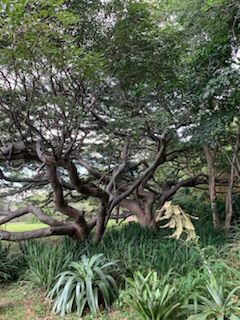
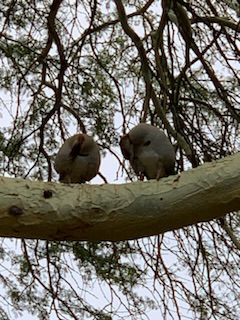
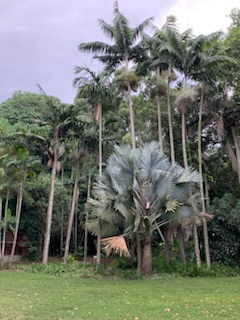
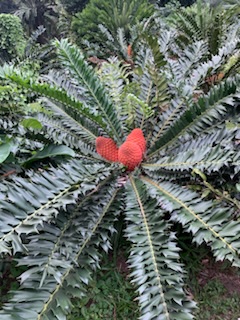
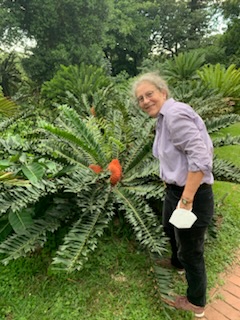
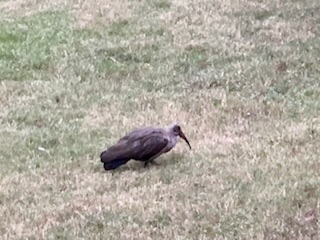
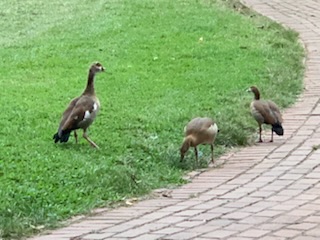
The main stop on the tour was the Botanical Gardens (founded in 1849) which were fascinating. Initially planted with different species of crops from around the world, to see which would grow in the country and then subsequently many other species were brought in to show the local people what are the plants of the world. A statue of the Founder – John Medley Wood (1827 to 1915) was in the gardens. He was curator from 1882 to 1893 and Director from 1903 to 1913. The size of the trees: Banyan, Giant bamboo, Palms, Elephant Trunk Tree, and others was enormous. Other interesting plants were the Osaka Birds Nest Fern that has 3 large (18” long X 6” wide) cone-like structures at it’s center, and the pony tail plant that comes from Mexico and has branches off a palm tree like base with leaves that form into “Pony-Tails”. There were also birds, one of which is the uThekwane (Hammerhead Stork) in the Zulu culture is believed to have “Burning Power”. If one disturbs their nest your home will burn within a day which has happened often. Also the Lightening Bird and the belief is that if you touch the nest you will be hit by lightening.

We returned to the ship and as we had not had time for lunch, we headed straight to the food court and enjoyed Lunch / Dinner. The captain came on to tell us that we were delayed in our departure due to the rainfall with lightening and the complexity of passing a Chinese Spy Ship docked in front of us. He was sure that it was a surveillance ship as it had a very large communication ”ball” with high powered equipment on the deck. We did go to the show which was three black, English singers: Queens of Rhythm that sang some Motown and other songs. We are sure that they were good, but we were both tired and were asleep in our seats during the show.

 Roger & Anne Travels