Wednesday April 5, 2023
A day we were looking forward to greatly as it was Safari Day. We were not disappointed and indeed found it to be spectacular. We docked in Alcoa Bay at 4AM port to dock, but as we backed into the berth in the container port, both sides got a view of the town of Port Elizabeth (P.E.), whose name changed to Gqeberha (in local Xhosa language) on February 23, 2021 and is in what is called the Nelson Mandela Bay Metropolitan Area, the main city in the province of Eastern Cape. As mentioned before South Africa drives on the left, indeed most of the countries we have visited drive on the left, because of the British influence around the world when cars were invented and commercialized. Canada and the USA are two of the few colonies that drive on the right. Being a commercial port, there are no facilities and no buildings, so the coaches (ours was tour 17) drive right up to the ship and take you out of the port area. No walking to the port gate, even though the town is relatively close by, perhaps 10-15 minutes walk into town. The local Mayor Retief Odendaal and a group of Xhosa dancers were on the dock to greet us as we got off the ship.
The Khoikhoi (formerly know as the Hottentots) people were traditionally nomadic people of South Western Africa going back to 65,000 years ago. By 800 AD (CE) the isiXhosa speaking people were the dominant residents. In February 1488 the Portuguese explorer Bartolomeu Diaz entered the “Baja da Roca” (now Alcoa Bay) after rounding the “Cabo da Roca “ (now Cape Recife). In 1497, Vasco da Gama entered Alcoa Bay on his voyage to India. By 1820, there were 4,000 British settlers that landed and set up residence. On June 6, 1820 the British acting Governor General of the Cape Colony Sir Rufane Donkin named the seaport in memory of his wife Elizabeth Frances née Markham. This became the major port for the wool, mohair and ostrich feather exports. It is still a major port with Volkswagen being the principal employer, and car carrying ships are one of the main vessels in the harbor. Apartheid segregation was the law until May 1985 when a black boycott of white businesses started. By September 1985, the white business owners were desperate and a “cease fire” was established until March 31. 1986, to work things out. As nothing material resulted, the boycott started again on April 1 until a state of emergency was reached on June 12, 1986 with the arrest of many of the leaders of the boycott. Apartheid was ended in 1993 with the Interim constitution and the Constitution of 1996 after the first non-racial elections in 1994 won by the African National Congress (ANC).
The town itself has no tourist attractions, although beaches, natural beauty and some 5 star resorts are there for enjoyment. The main reason for docking here on the cruise is to go on Safari to one of the nearby game reserves. We had chosen Lalibela, which we found out is a private game reserve on 10,500 hectares (26,000 acres) owned by the Heinz (baked beans etc.) family. They do have accommodation as well as day trips and it seems very well run.
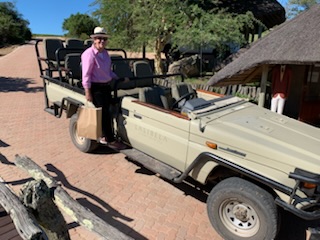
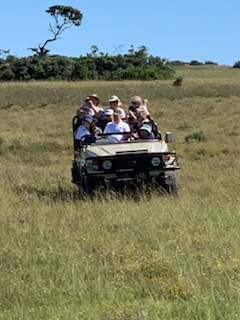
We boarded the luxurious coach and a young vivacious married girl – Lidelia was our very good guide and Conrad the Driver. She told us she was married as her dowry consisted of 20 cows. When she got married 3 years ago each cow cost RND 2K-3K each whereas now they are RND10K-15K (FX 1 US# = RND18.50). As we passed through the town she explained that there was a viewing tower, that this province of eastern Cape is the poorest in South Africa, but she claimed the most beautiful with extensive beaches and natural countryside. We passed Townships (Black African suburbs) as well as more affluent suburbs. There is an issue with electricity so there is a rolling 6 hours on and 2 hours without electricity each day. As we drove through town all the traffic lights were off as there was no electricity at that time, but there was when we returned. We did see a couple of windmills for electric production. An impressive stadium – The Nelson Mandela stadium is a 44,000 seat football stadium built for the 2010 FIFA World Cup. We passed the Addo Elephant National Park near Colchester which was established in 1931 and is the home of “The Big Seven” – Some 900 Elephants, Buffalo, Leopard, Rhinoceros, Lions (these being the classic “big 5”), plus Sharks and Whales in the marine area This together with birds, eland, hyena, kudu, zebra, hart best, antelope and others make it a big tourist destination. There are a lot of other Game Parks in the area such as – Amakhala, Barefoot Addo Elephant, Baviaanskloof, Bellevue, Daniell Cheetah, Groendal, Kriega, Kragga Kama, Kuzuko, Kwantu, Pemba, Schotia, Shamwari and the one we went to Lalibela (off Route N2 after Bushman’s River – Phone +27(0) 41-581-8170OR +27(0) 71-852-1009 (WhatsApp) – www.lalibela.net). We arrived and after completing the necessary waivers (“if an animal eats you it’s not our fault” type of paper) to see thatched roofed buildings, very well kept, and were led down a relatively steep stone pathway to a seating / bar area overlooking the property then up a rather rickety wooden slatted raised walkway to a “Round House” also thatched with the roof inclined to the center. The central 12 foot circle was open and graded towards a central drain. This was divided into an area with tables for eating a kitchen / serving area. A salad bar and a raised area that had a bar, and rest room facilities. A complete restaurant. After a few minutes we were directed to enter the open Range Rover vehicles that had three rows of three seats abreast and the driver and one passenger in the front. So 11 people in total. We climbed into the middle seats and soon the driver guide introduced himself, gave us a few rules: Never stand up; Never get out of the vehicle; All phones must be off as the ringing could cause the animals to charge etc. Animals in the wild see a large vehicle as another large animal, but if you are walking they see a smaller person and can more easily attack. Excitement heightened and we were off on our first adventure into the wild. We first went towards a water hole where there were a lot of aquatic birds, ducks and four Hippopotamus, that were almost completely submerged, with just the snout and eyes visible above the water. They apparently get “sunburned” so spend a lot of the day in the water. The guide indicated that they are the one animal that causes more deaths to humans than any other animal in Africa, so keep them at a good distance as they can run fast and with their weight, cause a great deal of damage to humans. On the ridge there were several ostriches and we could make out a few Zebras in the distance. The driver / guide would follow the same pattern at each stop. He would get as close as he felt was safe, turn off the engine, explain what we were seeing, tell us about the animals and give us plenty of time to take pictures. When all were finished with the pictures, he would then drive to the next area where there were animals we had not seen. Although there were some gravel paths criss crossing the land, which he would use at times, he felt just as comfortable going across land to get close to animals. Again if we had seen a lot of a particular animal, he would just drive past them or wait until they were off the trail. We were definitely in the animal’s territory, not in a place where humans rule! Certainly tele-photo lenses, binoculars, zoom lenses helped, but a simple phone camera certainly permitted you to get photos to remember.
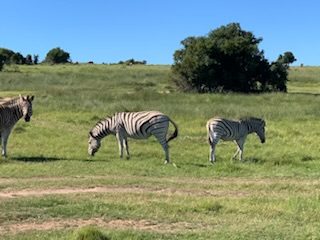
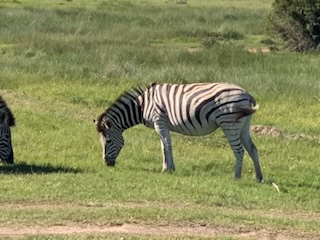
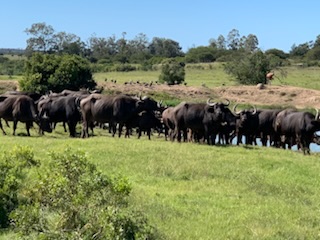
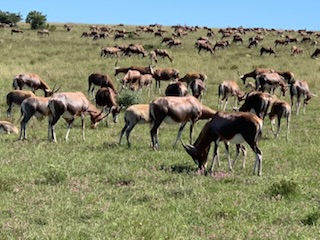
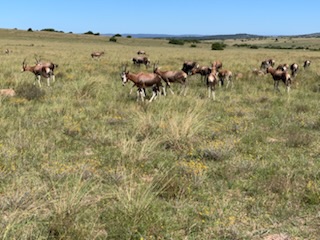
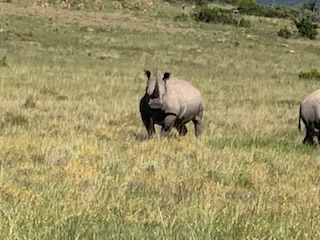
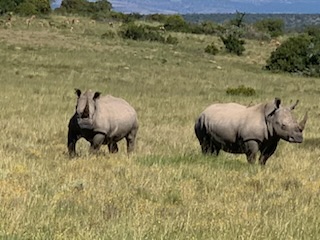
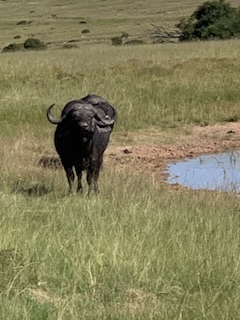
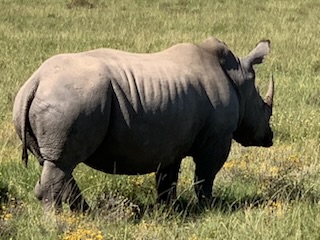
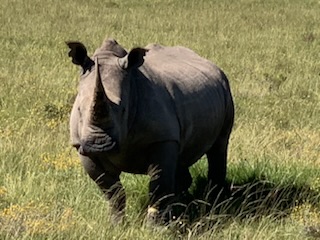
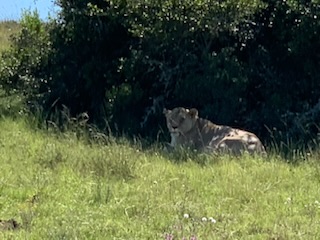
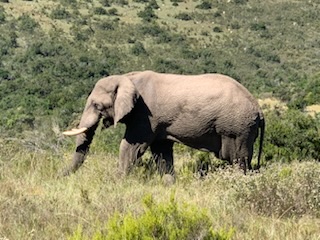
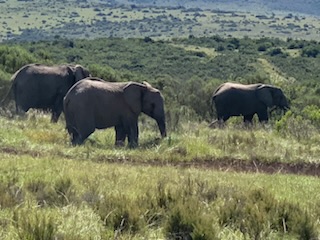
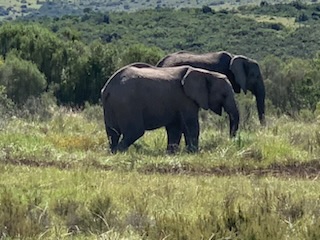
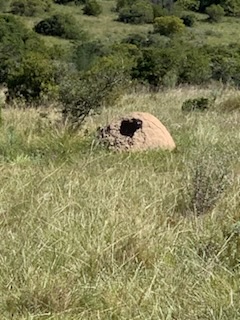
We climbed a hill and stopped to admire some zebras, some of probably 200 that we saw on the travels around the reserve. Some warthogs / wilder beasts approached and the zebra moved on. Virtually all the animals we saw are herbivores, they all eat the grass and shrubs, the exception being the lions. At another water hole we saw some 50 Water Buffalo with major sets of horns, a head that is stronger than concrete and even one baby that had been born yesterday with the mother’s umbilical cord still hanging. The speaker on the ship had told us that when you go onto a game reserve, always look at the babies. If they are healthy looking, the reserve is doing things right. All the babies we saw were doing well and looked very healthy. All over the property we saw impala, eland, ibex and deer type animals, several hundred of these. We ran across a hundred or more ant hills, some that were 3 foot high. Some had a hole in the top where the nocturnal feeding Aardvark (ant eaters) had “dined” last night. Over the hill there were mode Ostriches: black the males, and brown the smaller females. However, the next of the “big five” we saw were two White Rhinoceros initially resting on the ground, but then got up as we approached. Whether it was just one of those things or whether there was a pattern, we are not sure, but most of the time one faced one way and the other in the opposite direction either side by side or rear to rear, looking out for possible predators. Their “armor plated type skin” is so thick that it is difficult for a predator to bring them down, however soon after seeing them we turned a corner and under a tree, by he bushes were a set of bones, picked completely clean of what appeared to be a Rhinoceros. Here we really got the full understanding that we were in the wild and their territory. They are not fed or taken care of by the game keepers, it is “Nature Rules”, Darwinism at it’s raw state. Another of the “big five” we saw was first a male lion, resting under a bush out of the hot sun, as they hunt at night. The take a big chunk of meat and swallow it so the digestion process takes some time as they don’t have to eat again for a week. This lion was quite happy for us to observe him and rest in the shade. In another area of the park there was a female lion who at least raised her head to see what this strange thing (us) was doing near her, but she also was quite happy to rest in the shade. We were told that they keep the lion population to a handful, they currently have 8 as if there are too many, being meat eaters, they can kill off some of the other animals creating an imbalance. The guides all communicate with each other as two other similar vehicles were driving over the reserve with other guests from the ship telling each other where the animals were located. At one point our guide said, ok let’s go an see if we can find an elephant, I saw them over here earlier today. Just at that point another vehicle came in saying the elephants are … in a totally different quadrant. So we drove for some 15 minutes past a lot of other animals and eventually caught up with initially two elephants who ambled along while we drove beside them. After which the driver decided to go over a hill and there we found another 10 elephants and a couple of babies. So very exciting.


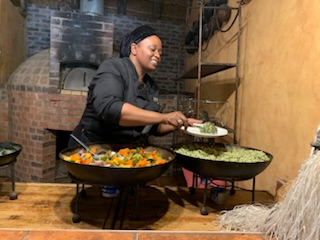
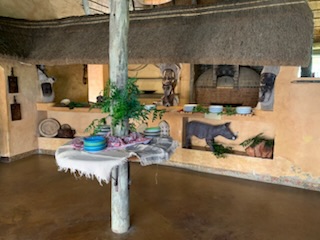
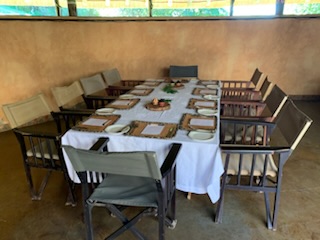
After 3 hours driving around the bush, it was time to get back to the food hut. We were so turned around that we had no idea in which direction to start to travel to get back to the main huts. Fortunately after some 15 minutes driving across the bush and some paths we got back to the “restaurant”, where they had prepared a very tasty meal with some good South African beer and wine. A really remarkable day and a truly exciting first venture into the world of Safaris. Lots more animals to see, giraffes, leopards etc, but those will have to wait for another time! After lunch we drove back the 1 1/2 hours to the ship to enjoy tea and the evening show which was the musical / comedian Foggie Flax. A good impersonation of sketches but not as funny as his first show.

 Roger & Anne Travels