Friday April 7, 2023
Good Friday, rain and poor visibility were unfortunately the conditions of the day where we had booked a full day tour all around Cape Town (Kaapstad in Afrikaans; iKapa in Xhosa) and the neighboring areas. The morning started with a great view of Table mountain as the iconic backdrop to Cape Town, but soon it was covered in clouds and remained so all day. It is the legislative capital, being the seat of Parliament of the country although Johannesburg (commonly called “Jo-berg”) is the largest city and the official capital. The greater Cape Town area has a population of about 5 million of which 40% are Colored; 43% are Black and 17 % are White. The most common language is Afrikaans (35%), followed by Xhosa (30%) and English slightly less, however the official language is English. The modern town (as aboriginal remains go back 12,000 to 15,000 years ago) was founded by the Dutch East India Company as a supply station for Dutch ships sailing to the Far East, in 1652. Although Portuguese explorers were here in 1488 calling it the Cape of Storms. In the 16th century French, Dutch, Portuguese and English ships stopped in Table Bay and traded with the local Khoikhoi tribes. In 1652, the Dutch settled the area and imported people from Madagascar and Indonesia that are the first colored people in the area and are the lineage of those living here today. The United Kingdom captured Cape Town in 1795, returned it to the Dutch in 1803 and then recaptured in 1806. By 1814, in the Anglo – Dutch Treaty of 1814, Cape Town became British. By the turn of the century (1900) the population of Cape Town had grown to more than 170,000. In 1910, Britain had established the Union of South Africa uniting the Cape Colony with the other areas. In 1950, the Apartheid law saw that Blacks could only live in certain areas (Townships) and others were for Whites only with the Blacks (Bantu) being evicted. On February 11, 1990, Nelson Mandela having just been released from Robben Island prison, gave a speech from the (White only) Cape Town City hall and was elected the first Black president four years later.
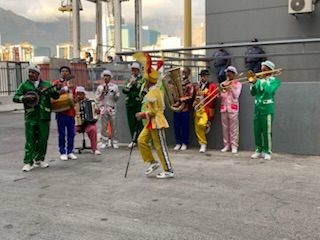
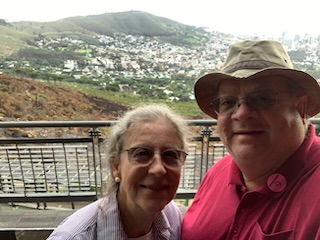
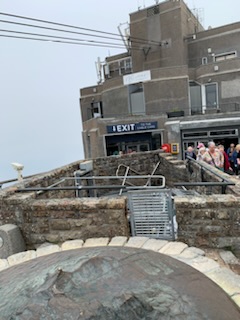
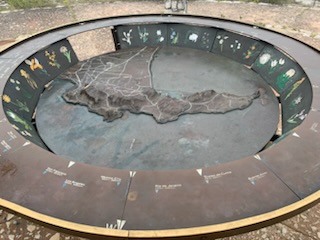
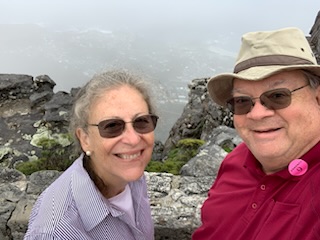
We docked port to dock driving on the left hand side and were greeted by a local band and singers from the area and boarded Coach 6 with our good guide Carol and driver Martin for a day visiting the sights of the Cape Town area. – “Complete Cape Town” is the name of the tour. After driving through town and climbing to 363 meters above sea level to the bottom of Table Mountain, we were at our first stop – the cable car that was to take us to the top of Table Mountain. It is a steep climb and the two cable cars manufactured in Switzerland, are a pair of only three in the world, the other being in the USA and Switzerland. The unique feature was that even though the center remained stationary, the outside revolved 360 degrees during the 4 minute ride up the mountain allowing all to see every vista without having to move around the car. The upper cable station is at 1,067 meters and the highest point on Table Mountain is 1,085 meters. The view through the mist of Cape Town below, the Table Bay / ocean and Robben Island in the distance, was spectacular albeit cloudy. When we reached the top, we had 25 minutes to walk all around the top and admire the views. Unfortunately by this point the clouds were so thick that one could not see from one side to of the mountain top to the other, let alone anything below. There is a cafe (Ten 67) and a shop (Shop at the Top), so after wandering around trying to see whether one could see anything, we stopped in the buildings to get out of the wet climate.
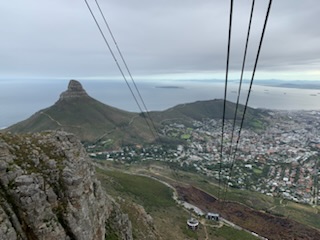
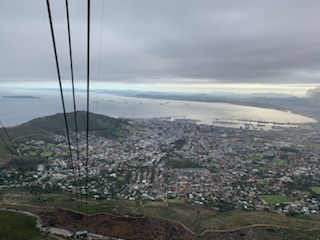
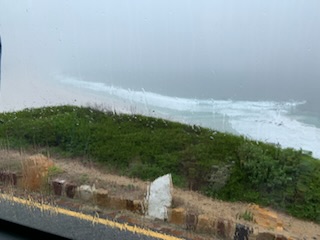
We got back on the rotating cable car and back to the bottom to return to the coach and set off along Chapman’s road past Scarborough towards the Cape Point and Cape of Good Hope. The drive along Chapman’s Peak Drive toll road is a testament to engineering as it is a cut in the mountain, with steep ravine-like passages to the sea while at other times, the half-tunnel, half-mountain being held up by columns and a roof over the road, make it a challenge to those with vertigo. However, as we could barely see the bottom of the cliff and water due to clouds and rain, we were semi-oblivious.
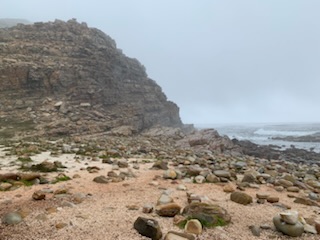
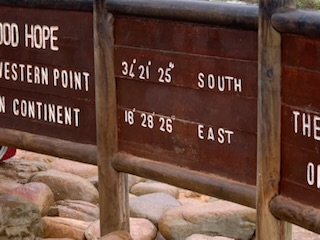
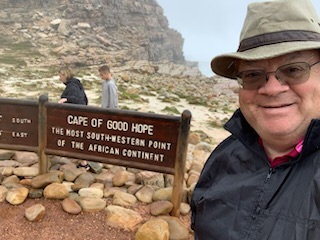
We eventually reached the Cape Point National Park, an area all around the point that is the home to 3,000 plant species of which 80% cannot be found anywhere else in the world. We briefly stopped to see ostriches roaming in the wild in the park, but made our way to the Cape Of Good Hope. Even though it was raining, Roger did get off the coach to have a picture of the sign that says – “Cape Of Good Hope – The most South West Point of the African Continent – 34 Degrees 21’ minutes and 25” seconds South and 18-28’-26” East”. This is a rocky outcrop around which sailing vessels must pass to go from the Atlantic to the Indian Oceans and on to the East. Fierce storms and rocks have made it the graveyard of many ships and sailers on their way to India and the East. As it was raining and foggy with limited visibility, the stop was brief. We then drove just a few miles to Cape Point, another point at the southernmost point in Africa. Here a funicular would take you up to a fantastic viewpoint overlooking the National Park and oceans. However the rain and clouds were so thick, we never even saw the bottom of the funicular, so there was no point in even trying to ride it and get further into the clouds to see nothing. A cafe and shop offered shelter from the rain for the 20 minute stop.
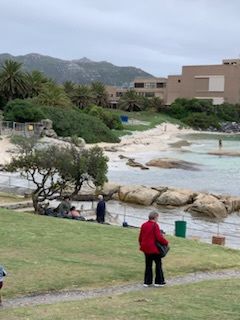
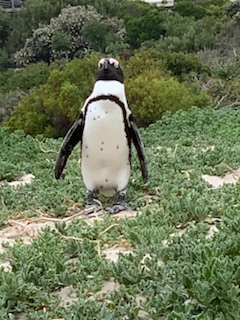
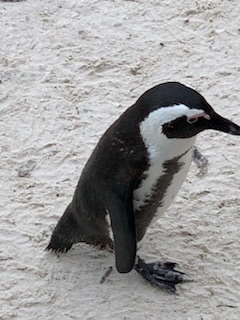
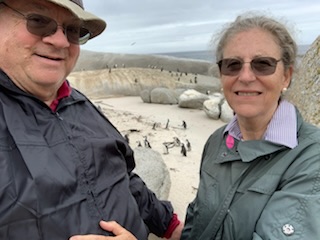
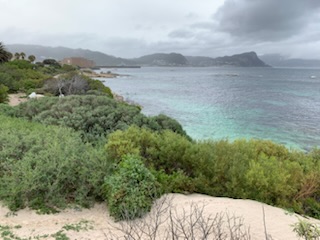
Boarding the coach, we were off to Simon’s Town for lunch. The coach dropped us near the Seaforth restaurant and we walked along the beach seeing some penguins and as we were reaching close to the restaurant we found that the water had created a sort of river, cascading over the stairs and the beach. So we waded through that and found another way into the very nice restaurant overlooking the bay, where we were served the catch of the day, veggies, beer and pudding / desert. Thus nourished, we wandered some 15 minutes along Kleintun Weg to Boulders – a penguin colony where from a board walk, we found hundreds of African Penguins: some sitting on their nests; others frolicking in the water; while others stood sentry; and others pecking / cleaning each other’s necks. As we were wandering back up the boardwalk, we ran across a Dassie – a small hedge-hock like animal whose closest relative is the elephant! This tiny animal that could fit in one hand is related to the enormous elephant!!! It was now time to wend our way back on the other side of Table Mountain back to Cape Town and the ship.

Even though the weather did not cooperate, we were glad to have had the adventure. If you are doing this tour, a couple of words of warning – It does require a lot of walking on uneven surfaces and it is not recommended if you have any fear of heights as the cable car, funicular and road all can give you unpleasant sensations. The evening entertainment aboard the ship was the excellent singer Andy Abraham who focused on the music of Nat King Cole.

 Roger & Anne Travels