Saturday April 8, 2023
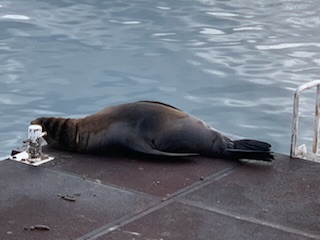
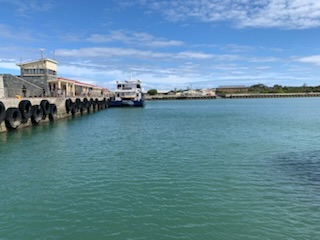
Today started early as we were to meet our tour on shore by 7:30AM. We were off to Robben Island. The name in Afrikaans is Robbeneiland and is 4.3 miles (6.9 kilometers) off the coast. It comes from the Dutch Robben – Seal, thus the “Island of the Seals”. We boarded the coach, which was very cramped as there were three seats on one side and two on the other (as opposed to the usual 2 and 2) with a center aisle that was 12 inches wide at most and the seats were smaller than usual. Two tour guides came on: Laverne and Molly; addressing the 63 passengers, calling names one by one. As hands were raised, Molly made her way, with difficulty up and down this very narrow aisle giving each name a unique, named paper with QR Code that was the entry ticket to the Ferry and Robben Island. After all had received their tickets and the group divided into two, half with Laverne and the rest with Molly, the coach drove off driving 10 minutes away (it was only a 5 minute walk) to the Victoria and Albert (V & A) Harbor-front. This is a very nice area along the bay with many shops, restaurants and upscale flats. We then queued to get onto the ferry to take us the 35-40 minute ride to Robben Island. A catamaran, yet still somewhat of a choppy ride, with excellent TV documentary / explanation of what the island is all about. The big excitement however was that as we boarded the vessel we could see in the bay a large number 20-30 dolphins, jumping out of the water and “putting on quite a show”. A great send off to the Island. For those who come on their own, one can easily walk from the cruise terminal to the Waterfront and get a ticket to go on the ferry to the island, without a tour. The only issue is that once on the island we believe that all you will see is the prison and that occupies a very small part of the island. We boarded Coach 10 together with the local guide Craig. A young “Colored” (not black nor white) man as he called himself. He was absolutely one of the most brilliant, eloquent, moving, erudite guide / speaker we have found anywhere. He immediately stopped the coach a few hundred feet from where we started and without a microphone, set the stage for the visit. He said: I will say many controversial things, but because of the importance of what I have to say, I want you to hear my voice directly not through the speakers. He then laid out the tour which was to consist of two parts: the first, under his guidance was seeing the various parts of the island that was not the prison; and the second, the prison itself, with a different person, the Maximum Security Prison, for political prisoners. The island is oval measuring 2 miles log north to south and 1 1/8 mile wide and covers an area of 2 sq miles (5.2 sq km) and has some 700 buildings. You could hear a pin drop. He spoke from the heart not only telling us about the prison, but more importantly the meaning behind what it has meant to the country. Most tours stop at the various places and end up at the end before returning to the prison itself. He, very wisely as there were 4 coaches, always prefers to go to the end and then work his way back to avoid the stopping and waiting for the others. He spoke of the three things the government focused on in 1948 to make a change: Education, Media and The Mind of a Child. If you control the education so only “Your Side” of reality is told, you control the thoughts of your people. The mind of the child is controlled by the knowledge it is fed by parents, educators and the media. If you control the media to only tell your side of the story, that is what becomes a reality. If you divide a nation into two halves say white and black (like Apartheid) you get the majority (Black) to revolt eventually against the white. However if you differentiate different parts of the population – While, Black and Colored and you reinforce that, like on Robben Island where Blacks on arrival were given shorts, short sleeve shirts and no shoes, while concurrently Coloreds were given long trousers, long sleeve shirts and shoes, you create antagonism between those two groups and not as much against the whites. The old adage – “let you and him fight” comes to mind.
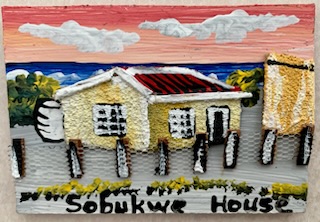
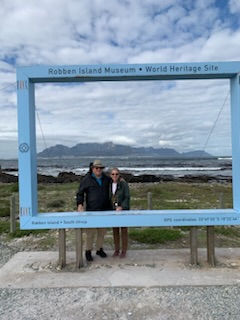
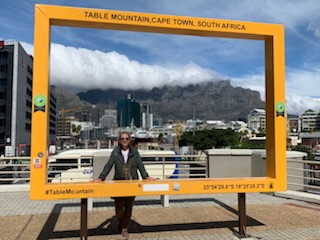
We got to the southern end of the island by the Commissioner’s House / Ladies Rock / Minto Hill, where the Lighthouse is located and were allowed a few minutes off the coach. Apart from rest rooms, there was a small shop, a place to take a picture looking at Cape Town / Table Mountain and in many ways most importantly, a small tent, where prisoners who had spent time on the island and their families can sell whatever they want to help them economically. A few items were there and wanting to help, we did buy a refrigerator magnet of a small yellow house with a saying “Sobukwe House”. We had no idea at the time what that was all about, but if they were selling it, we understood it had to be important. We soon found out why.
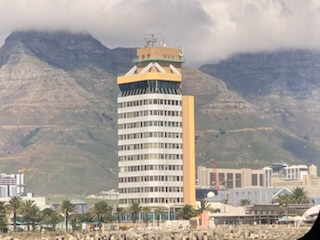
We were able to observe a few penguins in the wild and a great view of Cape Town and Table Mountain. The weather was a perfect sunny day, unlike yesterday.
Once back on the coach we retraced our steps back to the prison, first going through the “town”. When this was a prison there were guards and officers who lived on the island and a small town, with clinic, school, church etc was built. Today there are some 100-150 people living on the island, all working for the “Museum” / UNESCO Heritage Site that is the Island. They have desalinated water, electricity from solar panels and internet. To keep up the school they need to have 15 students (total at all levels), but currently only have 11, so they have to take one of the three ferries to the mainland each day to school. During COVID, or bad weather, they were able to take classes on-line. The small white church with a plaque “Erected in the Year of Our Lord 1841 – Captain Richard Wolfe Commandant of the Island” appears just above the door. Every February 14th couples are allowed to get married in the church or renew their vows. As Craig said – “not for me” – marriage and prison don’t go well together. Another custom is that whenever there is a child born on the island to one of the families a pink or blue flag is flown from the church steeple. The island has not always been used as a prison. It was a “lunatic asylum”, a “leper colony” and a “military fortress” as it lays at the entrance to the harbor. Thus, there are vestiges of the small criminal prison, the barracks, the male and female & children leper houses etc. One of the stops was at the cemetery of the leper colony, which had a number of gravestones, although the numbers were probably much more than that.
The island was discovered by Bartolomeu Dias in 1488 and was used as refueling station. In 1654, the Dutch placed all their ewes on the island and a large shed and shelter were built. Since the 17th century it has been used for the incarceration of prisoners (mainly political). In 1806, the Scottish John Murray opened a whaling station, now known as Murray Bay next to present day harbor. As mentioned from 1845, it was used as a leper colony, initially on a voluntary basis, until May 1892 with the passage of the Leprosy Repression Act, after which it was not voluntary. Prior to this about 25 lepers were admitted annually but in 1892 there were 338 and 250 the following year. The military used it in WW2 and the political prisoners returned in 1961. In 1969, the Moturu Krakatoa to commemorate the Prince of Madura – Sayed Abdurahman – a sacred Muslim site was built. He was one of the first Imam’s in Cape Town and sent to the island in 1740 only to die there in 1754. It was closed as a prison when Apartheid ended in the 1990’s and since then has been a pilgrimage site / tourist destination / museum.
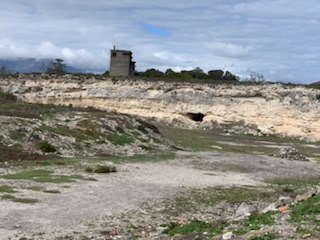
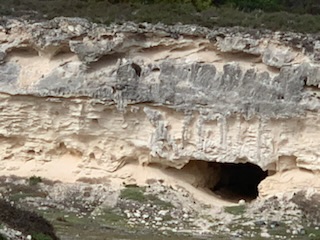
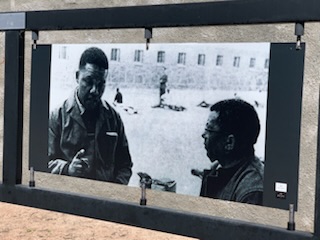
Craig prefaced our next stops by saying please silence your phones, make no noise and just take in the enormity of the place and it’s meaning. The first was the Limestone Quarry where Mandela and 32 high ranking political prisoners were put to hard labor every day. Mandela spent 13 1/2 years working in the limestone quarry 5 days a week. The philosophy was to exhaust the prisoners, as if they were physically exhausted by the end of the day, all they wanted to do was sleep and rest, thus requiring less guards. There was a cave in the limestone quarry where the prisoners were allowed to take their meal and to use as a toilet. However, over time they trained their minds to only use the toilet bucket in the morning and at night so as to not have to eat and undertake ablutions in the same place. An interesting phenomena occurred there, namely the 32 prisoners were from different walks of life, different countries and different philosophies. so under other circumstances they would never interact. Since they were all together in the “same boat” they talked and realized that they had a lot in common. The guards, who were there to stop the talking, opted to listen as they were learning a great deal and indeed “turned a blind eye” to the talking, never reporting it to the prison officers. The Ubuntu Philosophy – “I am because you are” – was born, meaning you and I can only exist together, if we help and respect each other. The chatter helped to keep them alive and helped the mental attitude. There is a bluestone quarry and other quarrels that were mined for the construction of the buildings on the islands, but he Limestone quarry was only for the most important prisoners. The prisoners noticed that the guards were changing their attitude which helped them understand that with peaceful discussions that are coherent and erudite, anyone can change their outlook. An important lesson for what was the African National Congress (ANC) and the future of the country. A very sobering and emotional time, imagining what it was like for those who during our lifetime were subjected to these inhumanities and the road to lead the massive change in the country. On February 11, 1995 the surviving prisoners came to Robben Island and placed stones at the entrance to the quarry in remembrance of the hard times they spent there.
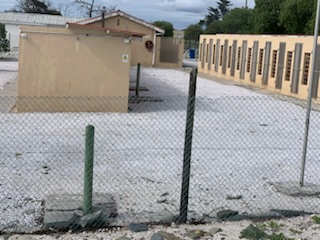
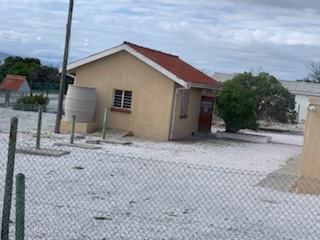
Our next stop was at a little yellow house inside a chain fence as well as two other buildings. We found out that the two other buildings were added later and were dog kennels, and that the little yellow house was where Sobukwe was held in solitary confinement always with two guards present. We now understood what the magnet was all about. Robert Mangaliso Sobukwe born December 5, 1924 and died February 27, 1978 was an Anti-Apartheid Activist and first president of the Pan Africanist Congress (PAC) from 1959-1963. He was married to Veronica and had 3 sons and a daughter. He was broken on Robben Island, after 6 years (1963-1969) of solitary confinement, and then sent home to Kimberly with his family under house arrest (1969-1978) until his death in 1978 from Lung Cancer. On Robben Island he was given certain privileges and was permitted books, magazines etc and studied and received a degree in economics from the University of London, while on Robben Island. He was a teacher and a lawyer and advocated for Africa for Africans (anyone that lives and pledges allegiance to Africa). He and Nelson Mandela were “colleagues” and whereas Mandela took to politics, Robert had always focused on the minds of children, focusing on education of the next generation. Although he is not well known his impact on the end of Apartheid was just as important.
Craig then took us and stopped outside the prison itself. Various buildings / blocks where these political prisoners were held, some in single cells and others, 60 to a cell. We were introduced to the guide and told about his story. The guides going around the prison, were themselves political prisoners that did time on Robben Island. He indicated that this is a “time restricted” experience as the prisoners are dying off so once the last one that can do the tours, dies or is incapacitated, that connection will be all over. In our case the prisoner guide – Delio Ntroel Bngoe from Soweto – introduced himself, he has been doing tours since 2003. Until he was 12 he thought Soweto was the greatest place to live as that was all he knew. However, his grandmother asked him to go into another area to get something. He suddenly saw for the first time what life was like outside the township. This discrepancy in the way people lived drew him to being an activist to try and achieve equality. He was imprisoned as a political prisoner at Robben Island (RI) for 5 years, beaten and treated badly, having to work on stone quarries and when in 1989 after the “day of amnesty” when all RI prisoners were released, he on April 27th 1991 and his cohort, were taken by ferry back to Cape Town and the first thing they wanted to do was to go to the top of Table Mountain and see RI from the top. A scene that the had seen daily from the island. Then they decided they wanted Kentucky Fried Chicken, so they went to the KFC. He was an activist with the youth ANC and got into trouble so had to live in exile in Angola, Botswana, Zambia and Swaziland. He continued his activism from abroad and one day they had been working on the extradition of a couple of people whose cover as activists had been compromised. All was going to plan when they found that one of their number had told the authorities all the details of the plans. They were caught and in 1984 at the age of 21 he and his 4 co-conspirators were tried, found guilty and sentenced to 25 years and sent to RI where he lived in Cell Block F – the first we were to visit. We entered his cell, which was for 60 prisoners, although seldom had more than 40, he closed the bars and closed the metal door. We were there with no way out, just sitting on wooden benches. When he was a prisoner there, they had to sleep on the concrete floor, there were no toilets and a communal bucket was only emptied once a week! It must have stunk! He told us that the prison was built to handle 1,250 prisoners, but at it’s height there were only 900, it was never filled. All prisoners were always referred to only by the number that was allocated to them when they got to the island, so as to further humiliate the prisoners. However, they were able to form 11 football teams and play games against the other prisoner teams. Sunday, they were locked in their cells. There were a few signs around the cell, showing prisoner cards and other documents. One, which was of interest was entitled – Differences between B and C diets –
B = Coloureds / Asiatics = mealie meal 6 oz breakfast; bread 4 oz lunch, 4 oz dinner; fat 1 oz daily per person / mealie rice or soup; meat 6 oz per person; jam/syrup – 1 oz per person daily; sugar 2 oz; coffee – 1/8 oz breakfast and 1/8 oz supper.
C = Bantus – mealie meal – 12 oz, breakfast 6 oz, supper 6 oz; Puzamandla Lunch; fat 1/2 oz per person per day; mealies; meat 5 oz per person; no jam / syrup; sugar 1 1/2 oz per day; coffee 1 1/2 oz breakfast.
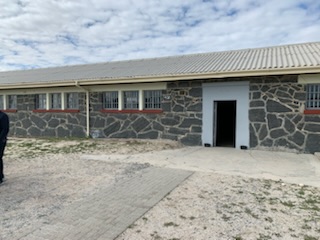
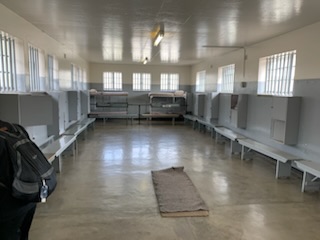
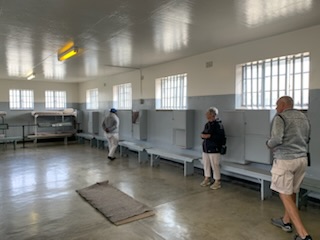
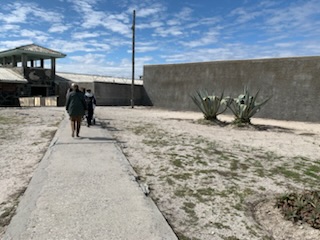
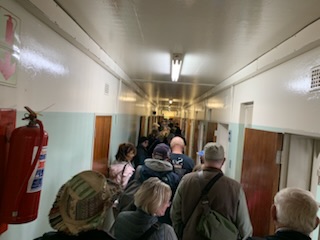
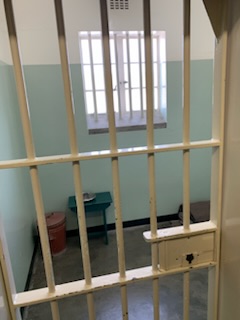
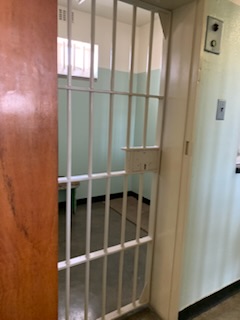
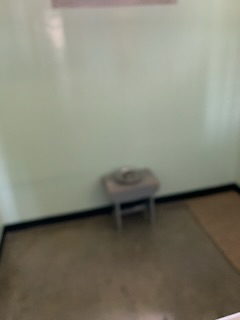

We were then ushered through the corridors and into Cell Block B. This is where the leaders were kept in single, solitary cells. The one with the red bucket was Mandela’s, said the prisoner guide, otherwise everything is the same in each cell. We quietly walked down the hallway looking at the various cells, pausing briefly at Mandela’s cell, the 4th one in from the small yard where they were allowed to walk around for 1 hour a day. We then bid farewell to the guide, thanking him and I asked one final question – Are you not resentful for all that was done to you? He replied, “No, I don’t have time for that, there is still too much work to be done to truly gain full equality”. We wandered back to the awaiting catamaran and returned to Cape Town.
A couple more points to mention: – 1) Some of the key prisoners were Mandela who became the first Black President of South Africa (1994 – 1999) as well as 2 other inmates of Robben Island – Kgalema Motlanthe (2008 – 2009) and Jacob Zumba (2009 – 2018) have also served as Presidents of the country as well as the father of president Thabo Mbeki who succeeded Mandela in 1999.
Many other important people spent time in Robben Island – Anti Apartheid Activists, Imams, Namibian, South African and other politicians, Mayors of Port Elizabeth, Johannesburg and Cape Town, Kings and Prophets of local indigenous tribes, Archbishop of Cape Town, Congressional Leaders and Politicians, Deputy Chief Justice of South Africa, Premier of the Eastern Cape province, but most were ANC Activists against Apartheid. The second point is to give a brief summary of Mandela – 2) Rolihiahla Mandela, a member of the Xhosa people was born on July 18, 1918 in Mvezo in Umtata, Cape Province South Africa and died in Johannesburg at the age of 95 on December 3, 2013 and is buried in Mandela Cemetery in Qunu in the Eastern Cape. The name Rolihlahla in the Xhosa language means “troublemaker”. He was born a Xhosa, with his father’s grandfather being the King of the Thembu Royal Family.
On the first day at school, the teacher would give all the students that had African names, English names and he was given the name Nelson for no apparent reason. Thus he was always known by his English name Nelson. His father had 4 wives and Nelson was from his third wife. Both his parents were illiterate, but his mother a devout Christian sent him to a Methodist School. Here he not only got the name of Nelson, but he was baptized a Methodist. His father died of lung disease when Mandela was 9. His mother also disappeared and it was the Chief of the Thembu and wife that raised him. He was a devout Methodist and at 16 he undertook the ulwaluko circumcision ritual and was given the name Dalibunga. At Law University (Witwatersrand) he was the only black student and suffered racism. He befriended several activists, including Robert Mangaliso Sobukwe, which is where his desire to correct the wrongs of apartheid started. In March 1943, he marched against a rise in bus prices. He joined the ANC and was instrumental in the formation of the ANC Youth League on Easter Sunday 1944. It was here that he met his first wife and they were married the same year. He was married three times a) Evelyn Ntoko Mase (1944-58); Winnie Madikizela (1958-1996) and Graça Michel (1998 to his death). He had 7 children. He rose through the ranks of the ANC maintaining the focus on breaking apartheid. By 1950, he was head of the ANC Youth and an executive of the ANC. It was in 1951 that he turned from a pure racial activist to studying communism and a “classless society” and receiving aid from the Soviet Union. He was first arrested in 1952 following a speech in Durban calling for protests and in all spent 27 years in prison. F.W de Klerk, the last “white” president released him from Robben Island in 1990 and then they worked together until Mandela, as head of the ANC, became the first black President in 1994 following elections that for the first time included not just whites, but all colors. He wisely opted for “Truth and Reconciliation” rather than “Revenge” as the general philosophy to bring the country together. After turning over the presidency at the end of his term to Mbeki, he faded out of politics assuming the role of elder statesman. He received numerous notable prizes such as the US Presidential Medal of Freedom. The Lenin Peace Prize, but perhaps the most famous was the Nobel Peace Prize in 1993. He died in 2013 at the age of 95.
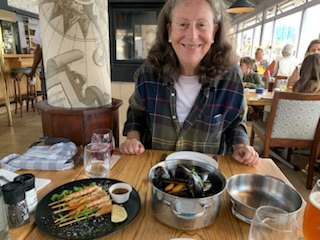
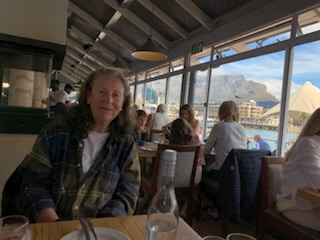
Once back in Cape Town, as we were in a very nice area – the waterfront – we decided to find a nice place for lunch – Den Anker – and enjoyed a nice meal with local beer, overlooking the harbor. We were interested to see that the restaurant was full and all were white patrons, served by white people (mostly young attractive girls), yet behind the counter there were a few Black people. While this is obviously a microscopic sample of a tourist area, it just seemed very interesting, particularly after all we had seen and heard this morning, on Robben Island. We wandered back to the ship, passed through Departure Immigration and once we were on the ship we could not set foot back on South African soil as we had been processed out of the country. That evening we went to the show which featured – Max Fulham – a very good, young and funny Ventriloquist. A true day of reflection, emotion and better understanding of the actions that took place in South Africa during our adult lifetime.


 Roger & Anne Travels