Monday April 10, 2023
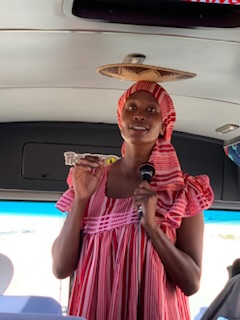
We arrived 2 hours late having recovered 3 of the 5 hours lost when we departed Cape Town due to bad weather. We docked port to dock at the commercial port of Walvis Bay in Namibia where there are no facilities. This country like South Africa drives on the left and indeed was a part of South Africa until March 21, 1990 when it became independent. We had not really done our homework beforehand, so we were not sure what to expect. However, as we write this having spent a day there, it is a really interesting place. We boarded Coach 16 after meeting in the theatre and going through face to face, one by one, immigration. We had to complete two identical forms, one we handed in as an arrival card and the other when we returned to the ship where we also had to go through immigration face to face, as the departure form. We were greeted by the attractive, erudite young lady guide who spoke perfect English – Dijie and the driver Andre. The coach had an interesting narrow spiral entry steps, but was comfortable.
Namibia is an independent country in South West Africa bordering South Africa to it’s south, Angola and Zambia to it’s north and Botswana to it’s east. However, it also has a long thin neck of land that goes between Angola and Botswana reaching Kane which is at the crossroads of Zambia, Namibia, Botswana and Zimbabwe. While English is the official language, Afrikaans (Dutch base) is the most commonly spoken languages, followed by German and 11 tribal dialects. The largest ethnic group is the Ovambo people making up nearly 50% of the population. Nearly 90% identify themselves as Christian (half being Lutheran). It is one of the lowest population density countries in the world with about 8 people per square mile. In early times it was home to the San, Damara and Nama people, but by the 14th century the Bantu peoples started populating the area. Agriculture, Tourism and Mining are the key economic drivers. In 1884, the German Empire became the ruling colonial power calling the area German South West Africa, until 1915. Between 1904 and 1907 the German occupiers massacred 10,000 Nama (50% of their population) peoples as well as 65,000 (80%) of the Herero peoples in what was the first “genocide” of the 20th Century. The country is called after the Namib desert from the local word meaning vast land. In 1878, the British – Cape of Good Hope – annexed Walvis Bay and the Penguin Islands which became part of South Africa in 1910.
Walvis Bay is both the name of the second most populous city in Namibia as well as the name of the bay on which it stands at the delta of the Kaiser River. It is the only protected deep water port in the country and attracted many whalers due to the abundance of plankton and other sea life. It has always been a key harbor for ships rounding the Cape of Good Hope which we visited and sailed past a couple of days ago. The Dutch called it Walvisch Baye, the English as Whale Bay then it became known as Walwisch, Walvis and finally Walvis Bay. The aboriginal Herero people called it Ezorongondo. The first of the colonial powers to stop, but not settle the area in 1485-87 were the Portuguese. The Dutch East India Company by the 18th century controlled it as a stopping point for ships going and returning from the East. In the 19th Century with the “Cape Colony” being British it was annexed and run by the Cape Colony (British South Africa). Conflict with the Germans who controlled the rest of what is now Namibia continued. And during the First World War 1910-1915 period the Germans briefly had control of the city and bay before being returned to the (British) Cape Colony rule. This is why there is a lot of Dutch style architecture and Afrikaans a Dutch based language, as well as a large German settlement and community with German being the 3rd most spoken language (after English and Afrikaans) and English being the Official language, political and educational system and driving on the left side of the road. A very interesting mixture of European cultures in this county known as “The Smile of Africa”. If one considers Africa as a face, Namibia is where the mouth of the head is located!! By 1930 the League of Nations made it a part of South Africa who imposed their rule, regulations, customs and Apartheid until Nelson Mandela as South African President officially in 1994 handed Walvis Bay over to become part of Namibia. The Capital of Namibia – Windhoek is 389 kilometers from Walvis Bay and the country has an estimated 2.6 million population.
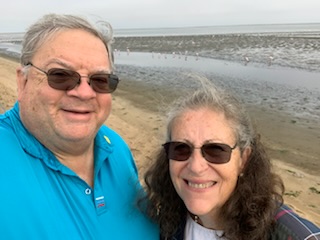
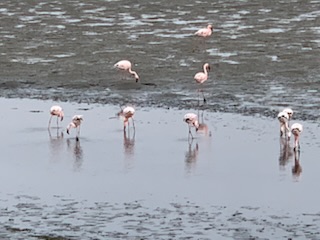
Walvis Bay has an estimated population of 65,000 although there has never been a formal census in the country. Our first stop was the Walvis lagoon which is known for it’s abundance of flamingos. It was great to see them. The guide who, at first was interested in mainly pointing out costs and economics, indicated that around the lagoon were the very wealthy people as they had to pay up to US$100,000 per house. This indeed is a princely sum when one considers that minimum wage is officially US$1 per hour. However, as there is 40+% unemployment in the country employers can offer US$0.50 an hour and have a line of people looking to get the job. Private education following the Cambridge System is costly, but public education is available for all. Medical treatment likewise is available free to all, however as the government doesn’t pay the doctors, they may or many not show up. Thus one needs to have private pay for medical and hospitalization. A private hospital costs US$1,000 per day. As we passed middle and lower class housing she explained that as many as could, would get municipal mortgages as banks charge up to 75% interest. We passed a prison, where she said 80% of the inmates are women. The minimum sentence for minor crimes like stealing carry 8 years in prison whereas the worst crimes can carry up to 35 years. As we passed a cemetery, she indicated that most are buried, full body as there are no crematoriums so bodies are sent to South Africa for cremation and it can take up to 6 months to take place and then 30 bodies are cremated at a time. We passed a platform that is out in the ocean which is used to collect bird guano for fertilizer and cosmetics. An oil extraction platform could be seen offshore, but it was left there on it’s way further north up the coast and has been there for several years so at some point they will come and pick it up and take it to where oil can be drilled.
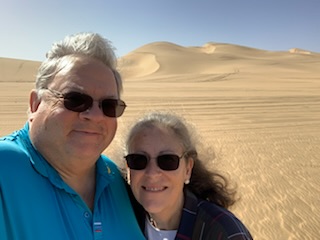
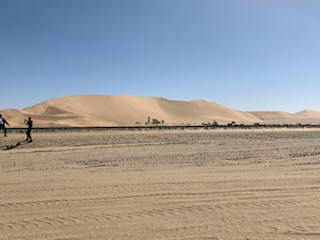
We got to our second stop – Sand Dune 7. By this time we were well out of Walvis Bay and headed north across the desert to the next city we will visit – Swakopmund (literally, The Mouth of The Swamp) , where we were to spend the rest of the day. At this stop there was a Quad Motorcycle rental place where one could take vehicles and ride over the sand and up the dunes. We just wandered in the sand to the base of the dune. We were truly in the desert, which constitutes something like 95% of the country. Only 5% is towns, the rest is sand. Rainfall happens some 5 days a year in this desert region.
Swakopmund has bout 45,000 inhabitants and is a beach resort town at the edge of the Namib desert. It was founded on August 8, 1892 as the German South West Africa harbor, since Walvis Bay was owned by the British. The Herero people called it Otjozondjii, derived from the Nama word -Tsoakhaub meaning “Excrement Opening” as the Swakopmund river brought everything including dead animals into the area as it entered the Atlantic Ocean. Another interpretation is that it is based on the San language where “Xwaka” means Rhinoceros and “ob” – River.
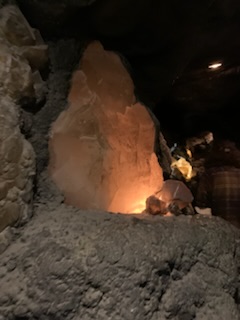
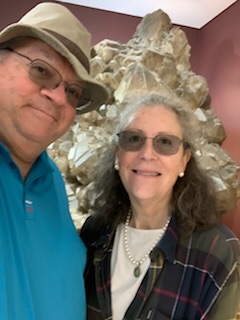
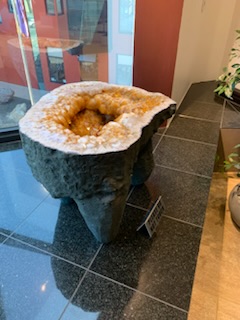
As we drove around town, the guide pointed out various buildings or areas. One area – Germantown – was predominantly where the German speaking people live. Otherwise nothing over remarkable. However, when we stopped at the Museum, wow, things became unique. It was a mineral museum / shops, displaying various types of minerals that are mined in Namibia. (Kristall Galerie phone +264-64-406080; web – www.kristallgalerie.com; email gems@kristallgalerie.com) As we entered to the left we found ourselves in a sinuous cave, only wide enough for one person at a time to pass, simulating the Othman Tourmaline Mine. In 1985 while drilling, the mining equipment fell into a black hole 45 meters deep, exposing a cave system that allowed the crystals to grow. Within the rocky walls of the museum cave, quartz and other minerals were lit up in different colors as if that’s where they were found and ready for extraction. A very impressive, albeit a bit claustrophobic exhibit that was some 100 feet in length. Exiting, one was in a gallery that exhibited some of the giant crystals, including the largest one in the world which stands some 12 feet high. A person standing by the crystal cluster reaches about half way up the crystal. A very good display of all the minerals of Namibia, an area where jewelry is made on view and giant mineral bunches. One shop had the ultra expensive jewelry, another the expensive jewelry and a third with more affordable items. However, our attention was mostly on the two floors of all the raw minerals and explanations we found very interesting. One disturbing fact is that there are 4 Uranium Mines in the country and through a typical finance for resources deal, the Chinese own these Uranium Mines in perpetuity. Apparently a large US$400+ Million loan was made to enhance the overall infrastructure of the country, but when it came time to pay, they defaulted and as a consequence of the negotiations, the Chinese ended up with the Uranium Mines. Canada has been given the rights to a fifth mine that has just opened. A few diamond mines are all owned by DeBeers.
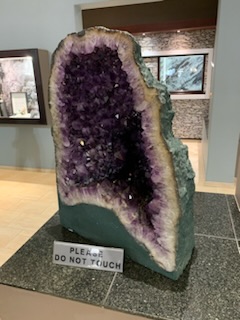
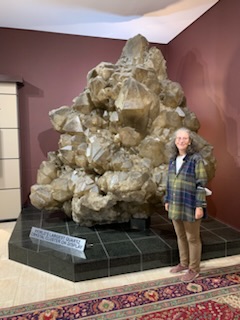
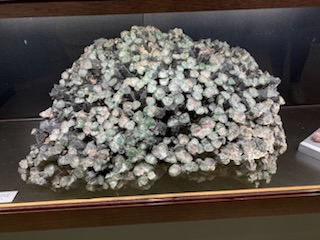
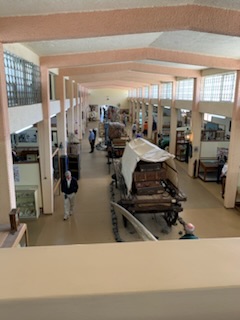
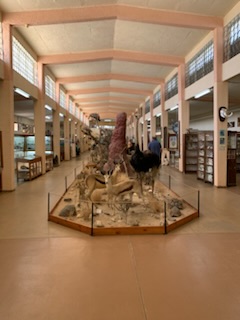
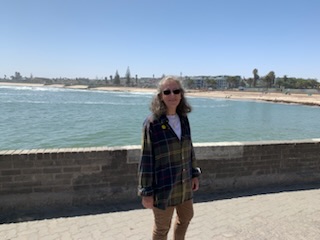
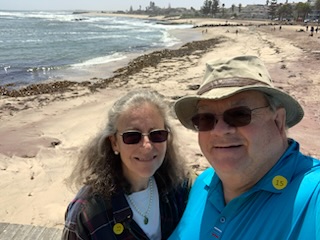
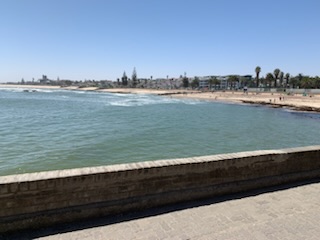
We were back on the coach and off past the main elegant shopping area to a stop, for a couple of hours, where we had free time to visit another general history, artifacts, taxidermy animals and archaeological items. All again small but very interesting. We then wandered along the beach until we found a nice restaurant with umbrellas shading the tables, overlooking the beach and decided to have some lunch and try the local brew overlooking the bay. Satisfied, we did look at a local street vendor area where locals were selling their wares. Returning through the Namibian desert, we had a brief stop overlooking Dune 7 before returning to the ship, passing through immigration and in time for tea, dinner and the show – Chris Hamilton – a brilliant pianist and likeable banter. His “piece de resistance” as he ended the show, was to solicit from the audience the names of what ended up being some 20 songs. Liberace used to do this as well. Then he went on to play excerpts from each of the songs that had been requested, to an amazed and very appreciative audience.

 Roger & Anne Travels