Wednesday June 14, 2023
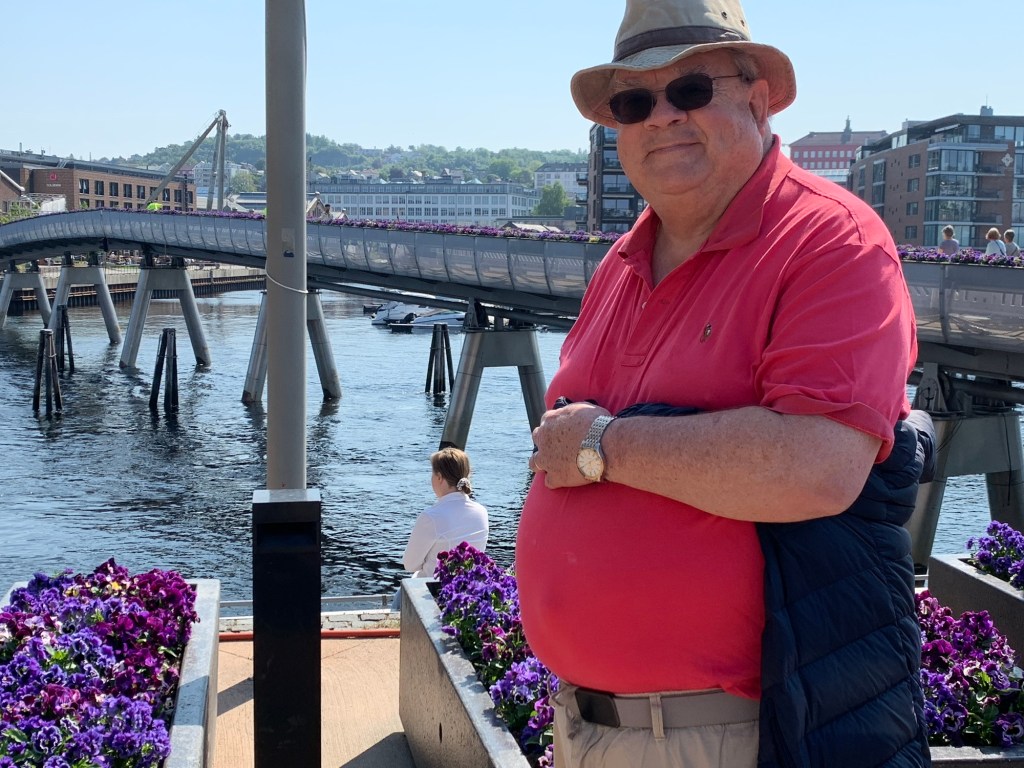
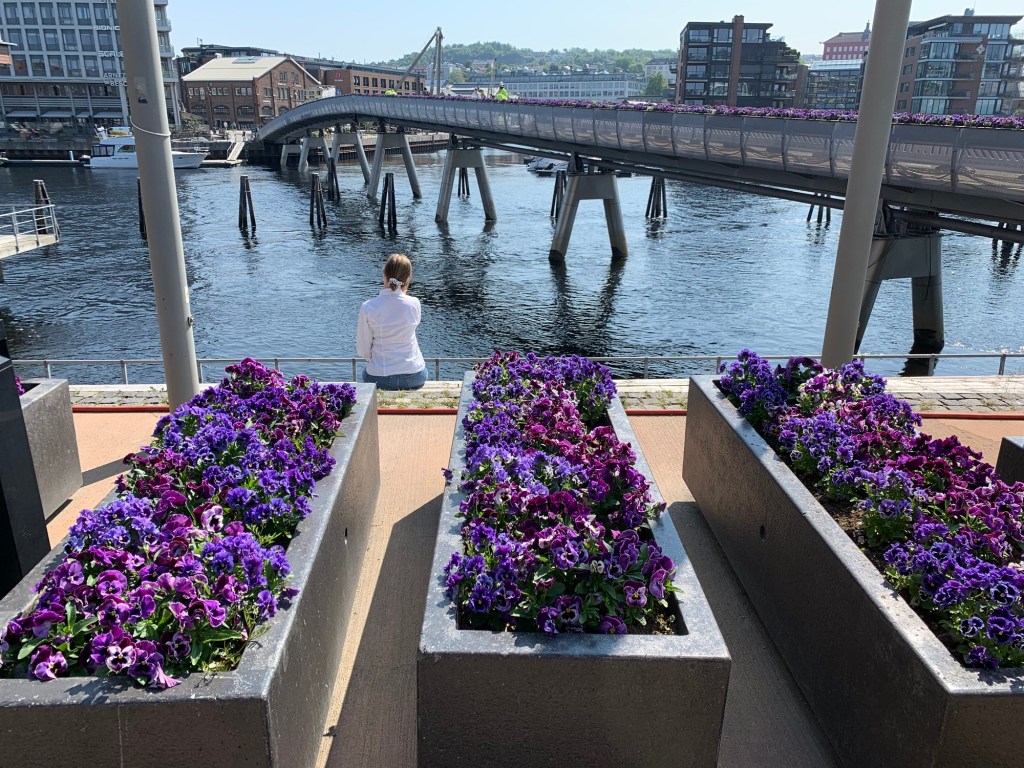
A truly wonderful day in Trondheim on the very large Trondheimsfjord. The weather was spectacular, bright sunshine and warm enough to go all day in a short sleeved shirt. We docked Port to dock in front of the Pirbadet (Norway’s largest inside water Park) and after breakfast, Anne & Roger went walking through the town for a couple of hours finding charming plazas, lots of young people enjoying the sun. We even aw three young girls in bikinis swimming in the fjord a few meters from the ship. It’s amazing how clean they keep the water and all the city. We never saw anyone smoking, no litter and lots of bicycles and scooters. All the coaches are electric so the air is clean and free from pollution despite it being the 3rd largest city in Norway with a population of 200,000.
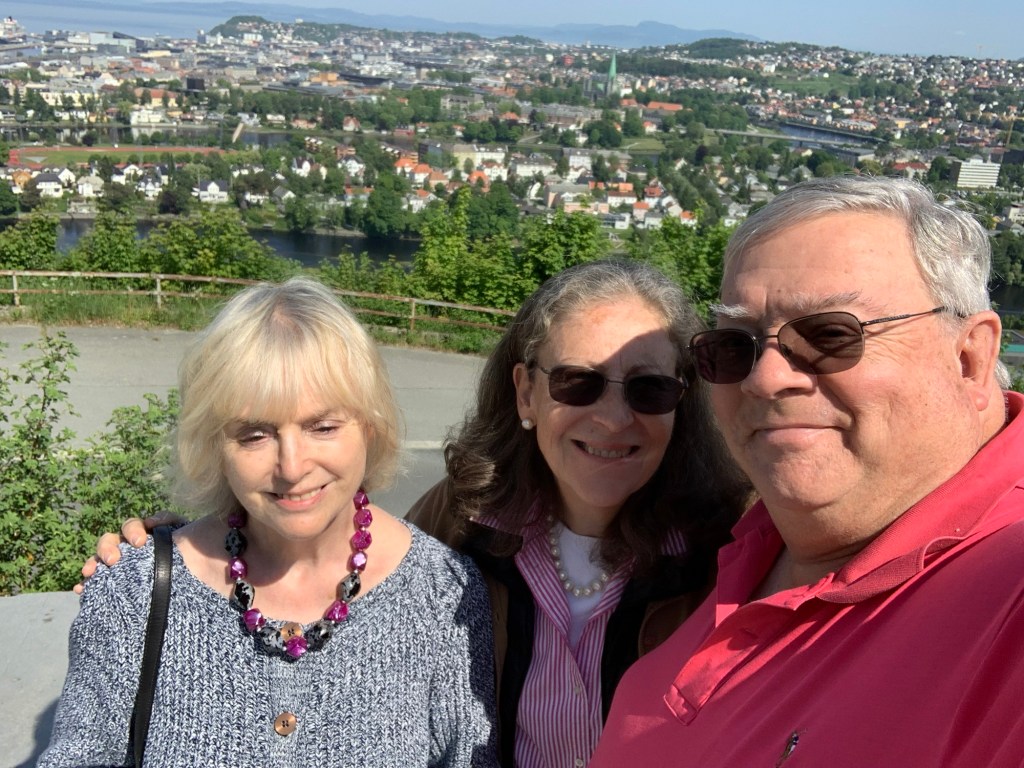
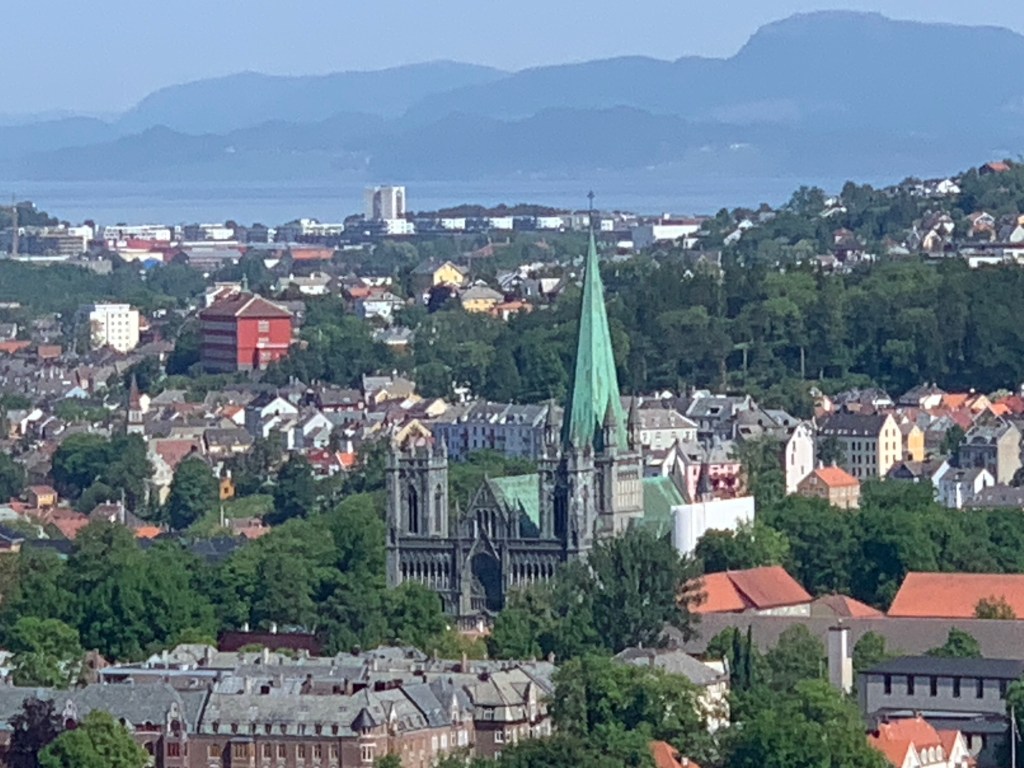
We got back to the ship in time to meet up with the Dweck’s for our afternoon tour – Trondheim Heritage Trail. We boarded the coach 14, RHS drive, and met the excellent young girl who was the guide and driver. We toured the different parts of town mostly wooden structures. There was a fire here which almost destroyed everything in the city. So a famous city planner was brought in and insisted on factories being on one side of the river and residential on the other. Also the streets are wide all to prevent a major fire disaster again. This has now changed and mixed up, but it was a good plan. We did have a photo-stop at the top of a hill overlooking the city which was really spectacular. We were intrigued and were informed by a small island just off the coast. This Munkholmen island was a notorious prison where convicts were badly treated and then many had death sentences carried out on the island. Then the prison was closed down and converted to a monastery where various monks lived happily and peacefully. During the reformation when Catholicism was banned and all clearly removed in favor of Lutherism, still the predominant religion practiced in Norway, the island reverted to a brutal prison, nicknamed – The Norwegian Alcatraz. During World War 2 it was a look out and storage place for ammunition. Today it is a tourist attraction where you can take a boat and visit the structures and purchase various handicrafts. We did not have time to visit.
The two main stops were the Cathedral of Nidaros / Archbishop Palace Museum and the Outdoor living museum – Sverres Borg Trøndelag Folkemuseum. However before getting to those, a little bit about the history of Trondheim. The website that covers all the tourist information is http://www.visittrondheim.no.
The settlement of Trondheim was founded as a trading post in 997 CE and was the capital of Norway from the Viking age until 1217. From 1152 to 1537 it was the seat of the Roman Catholic Archdiocese of Nidaros (the original name of the city) and the home of the Archbishop was next to the Cathedral. That is now a museum of much of the history of the church including some of the original statues. After the reformation, the Catholics were replaced by the Protestant Lutheran religion and ever since 1837 it has been the seat of the Lutheran Diocese of Nidaros. The City was incorporated in 1838 and the Municipality was formalized in 1964 when Trondheim merged with Byneset, Leinstrand, Strindberg and Tiller areas. It was expanded on January 1, 2020 with the addition of Klæbu. From the 16th to 19th centuries the city suffered many fires as most of the buildings were made of wood. One of the worst was in 1651 when 90% of the city was destroyed and after 1681 there was an almost total reconstruction of the city with wider streets.From February 26th, 1658 to May 27th 1660 the city was under Swedish rule. Also it was occupied by Germany during WW2 from April 9, 1940 to May 8, 1945 during which time the area was a major base for German submarines.
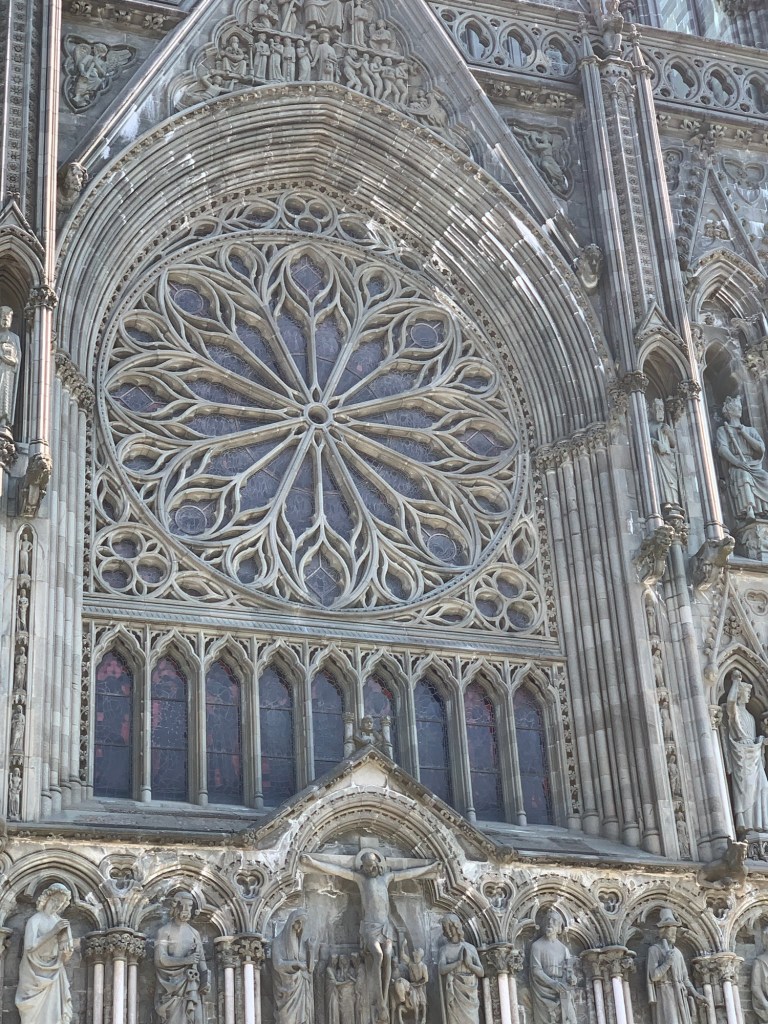
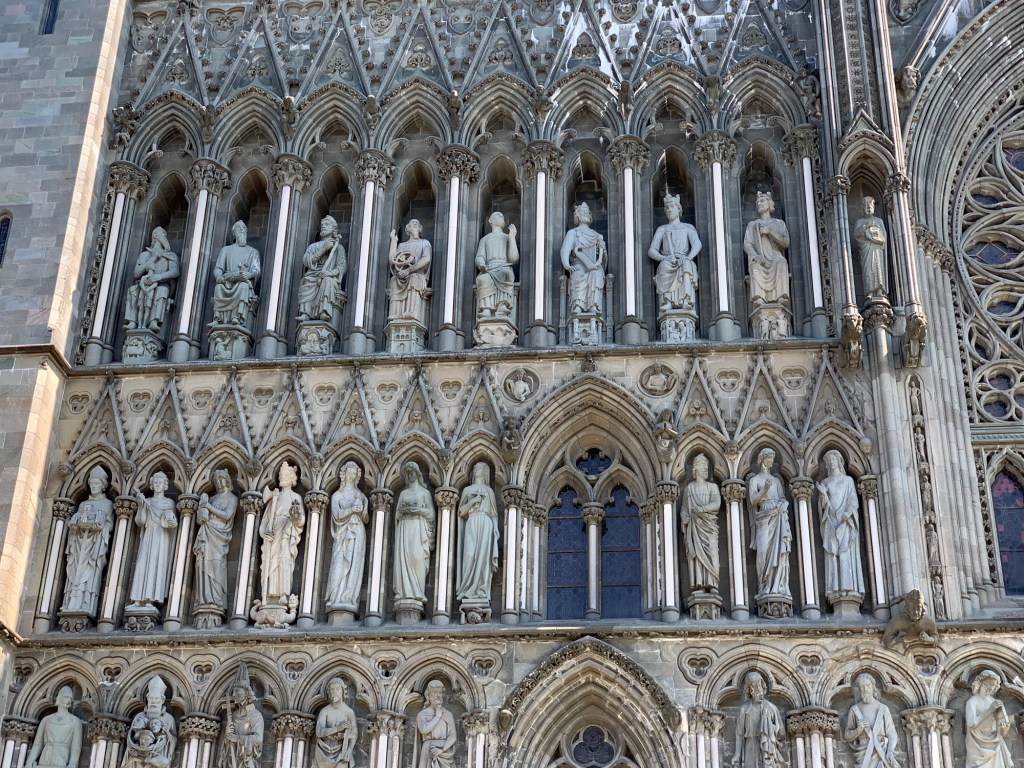
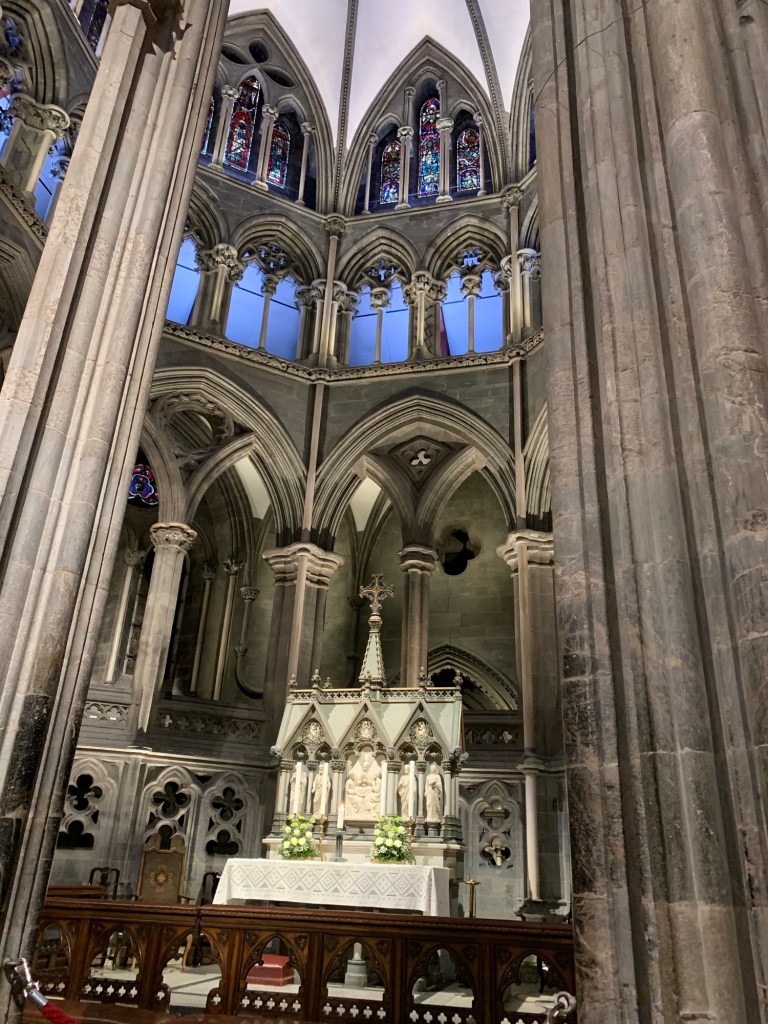
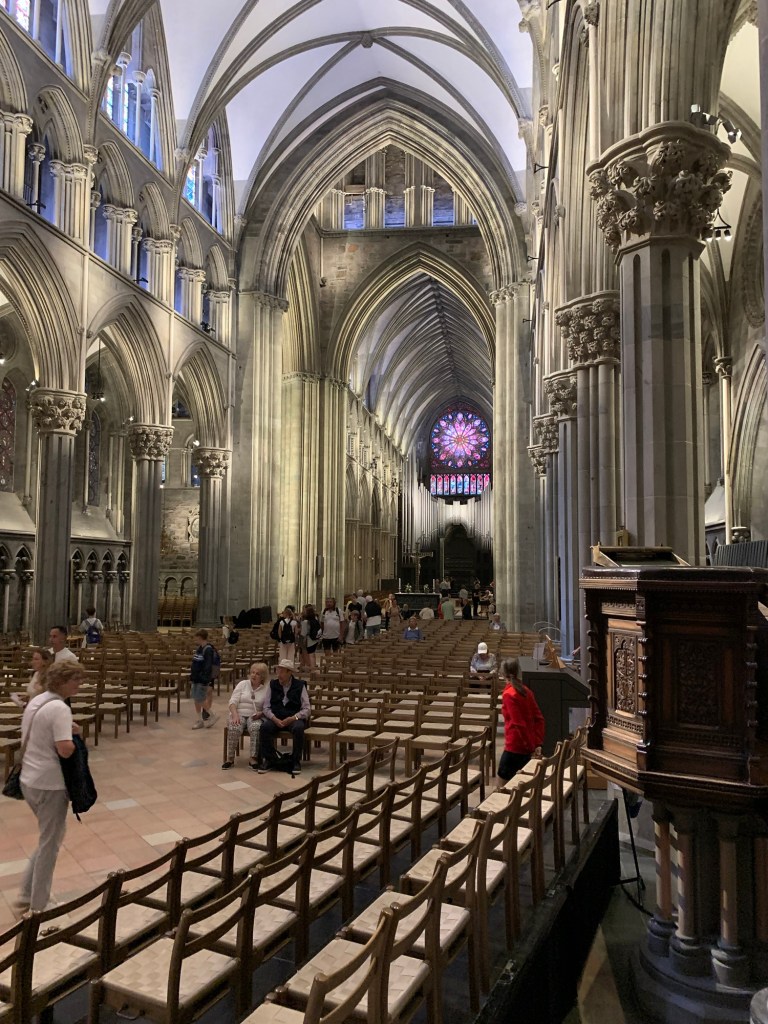
The first stop was at the amazing (reminiscent of Nôtre Damme Cathedral in Paris) Cathedral of Nidaros. The Western Façade has a series of sculptures in three rows. The top row is made up of Christ’s spiritual and physical ancestors – Left to Right – Abraham, Samuel, Isaiah, Ezekiel, Jonah, King David, King Jehoshaphat of Judah, King Hezekiah of Judah, John the Baptist, Moses, King Josiah of Judah, King Azariah of Judah, King Solomon, Zechariah, Daniel, Jeremiah, Elijah, and Jacob. The middle row shows the Expulsion from Paradise and Annunciation as well as Norwegian Saints and their Virtues – Left to Right – Archbishop Øystein (cathedral construction), Saint Hallvard (patron of Oslo), Saint Sunniva (first Norwegian saint), Saint Olaf, Virtues – Charity, Hope and Faith, Isaiah, Angel Gabriel, Virgin Mary, Angel guarding the gate to paradise, Adam, Eve, Virtues – Truth, Compassion, Peace, Justice, Bishop Torlak (Thorlákr Thorhallson – national saint of Iceland), Saint Magnus, and Bishop Erlend (of the Faroe Islands). The bottom row shows the Apostles together with Saints and Kings that spread Christianity throughout Europe – Left to Right – Olaf Tryggvason (King Olaf I), Bishop Sigurd (with the heads of his 3 slain nephews), Saint Clement, Saint Philip, Saint Thomas, Saint Bartholomew, Saint Andrew, Saint John, Saint Peter, Crucifixion with Mary and John, Saint Paul, Saint James the Greater, Apostle Simon, Saint Matthew, Saint James the Lesser, Saint Jude, Saint Nicasius (Archbishop of Reims), Saint Denis (Patron of France), and finally Saint Francis of Assisi. The Western façade also has gargoyles,masks, angels,and a collection of animals = bears, donkeys, elephants, cocks and bees.
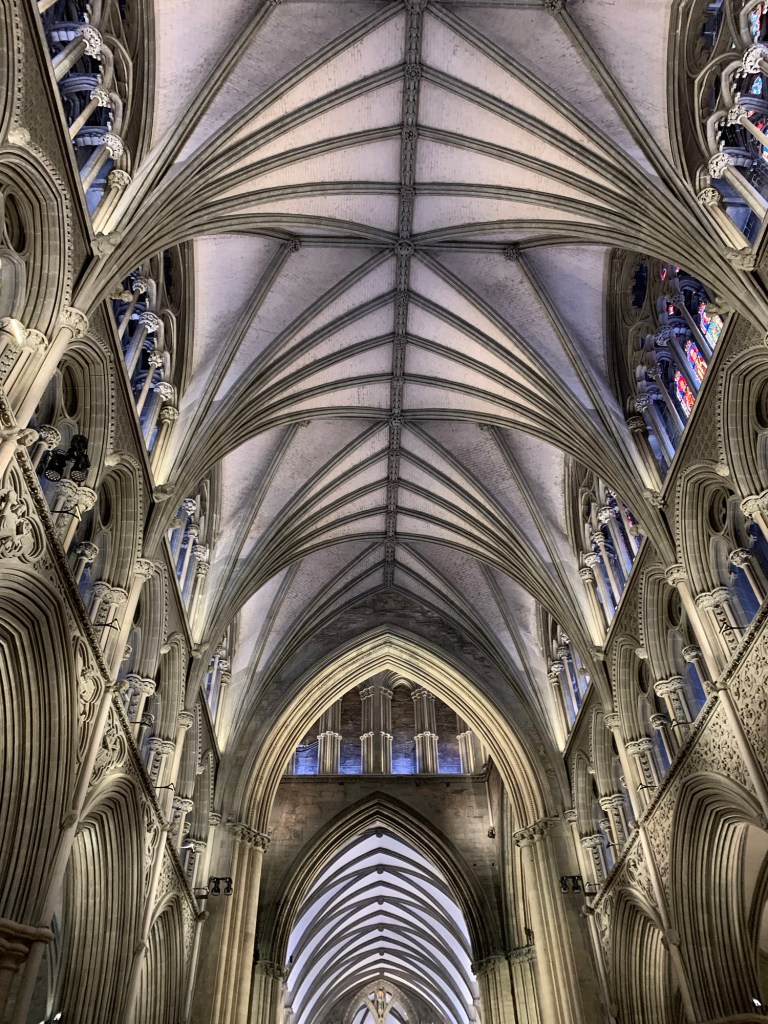
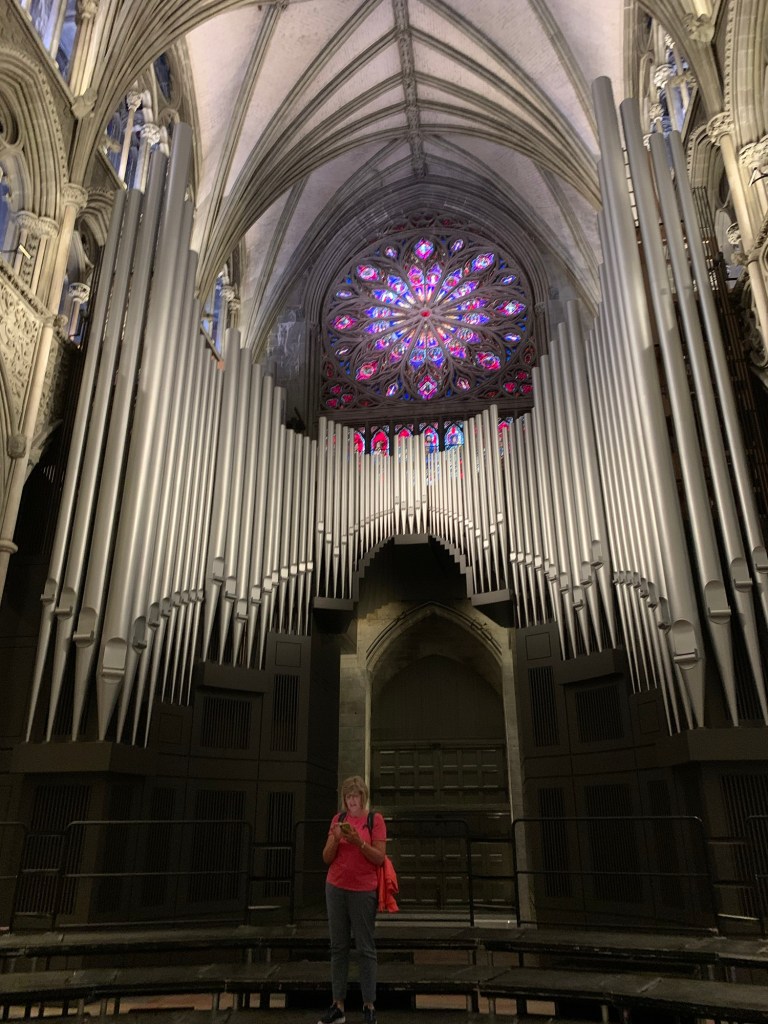
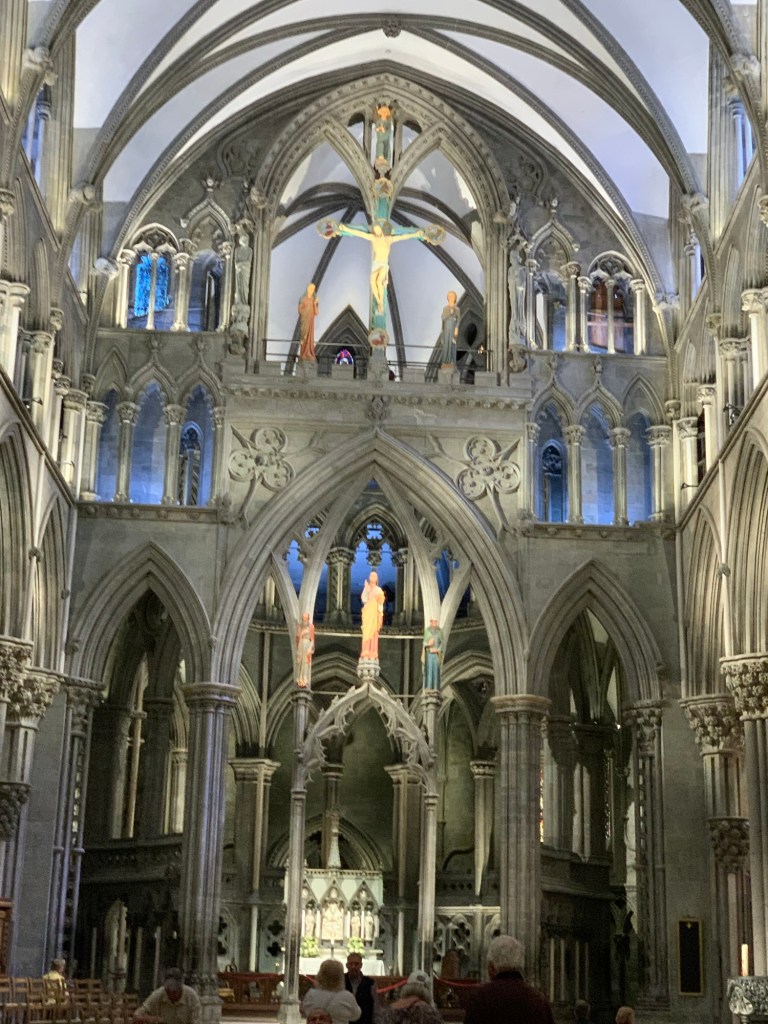
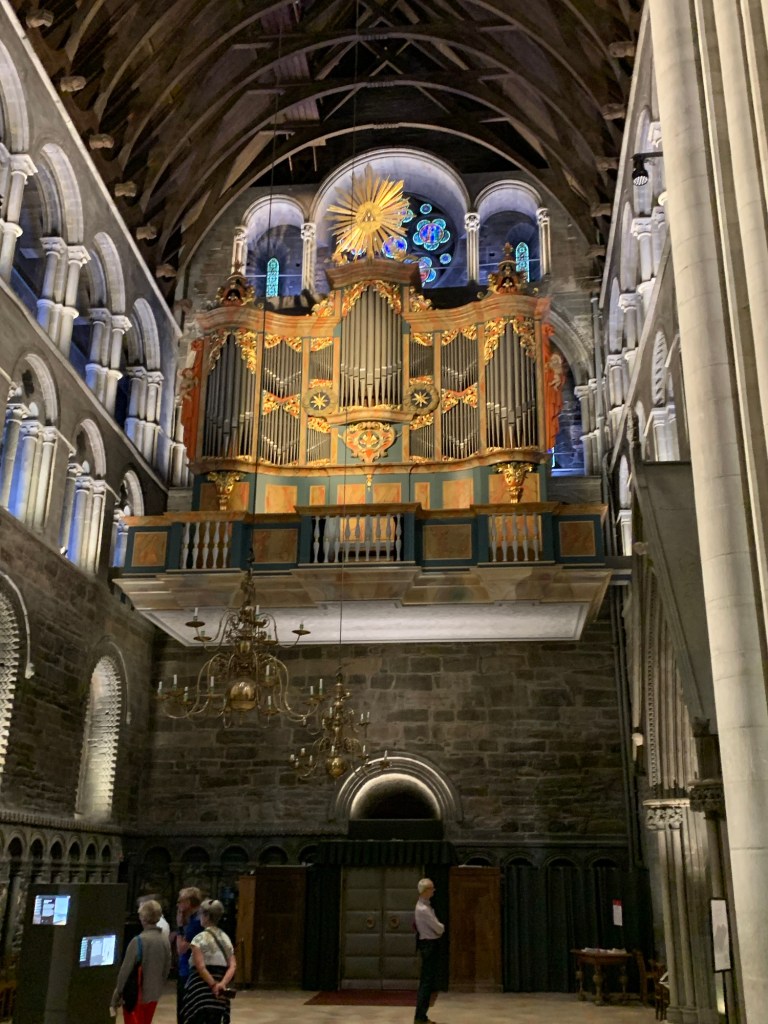
The church is also the burial site of King and later Saint Olaf II (995-1030 CE) and the traditional church for the coronation of the Norwegian Kings. It was built in Romanesque / Gothic style over 250 years (1070-1300) with additional work continued thereafter and is dedicated to the Holy Trinity. Inside the church is ornate with a spectacular rosette stained glass window and the windows on the sides all date to the 19th and 20th centuries (after one of the fires) with those on the North side depict Old Testament scenes against a blue background and the South side represent the New Testament scenes against a red background. There are 2 altars one at he intersection of the Transept and Nave and is more modern dating to the early 20th century. The main Altar is in a typical octagonal end and was the resting place of St. Olaf in a reliquary silver casket in the shape of a church with dragon heads. King Christian II melted it down for coinage and the remains of St Olaf remain a mystery but somewhere under the church with the only relic to survive is a femur in a silver / gold reliquary.


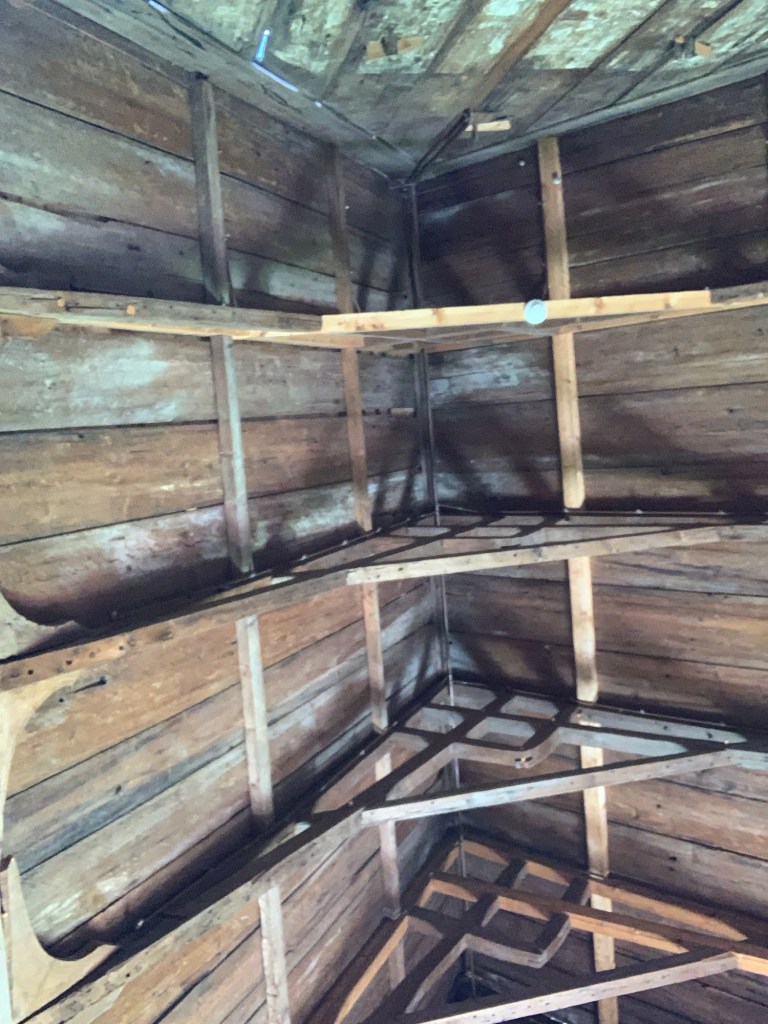
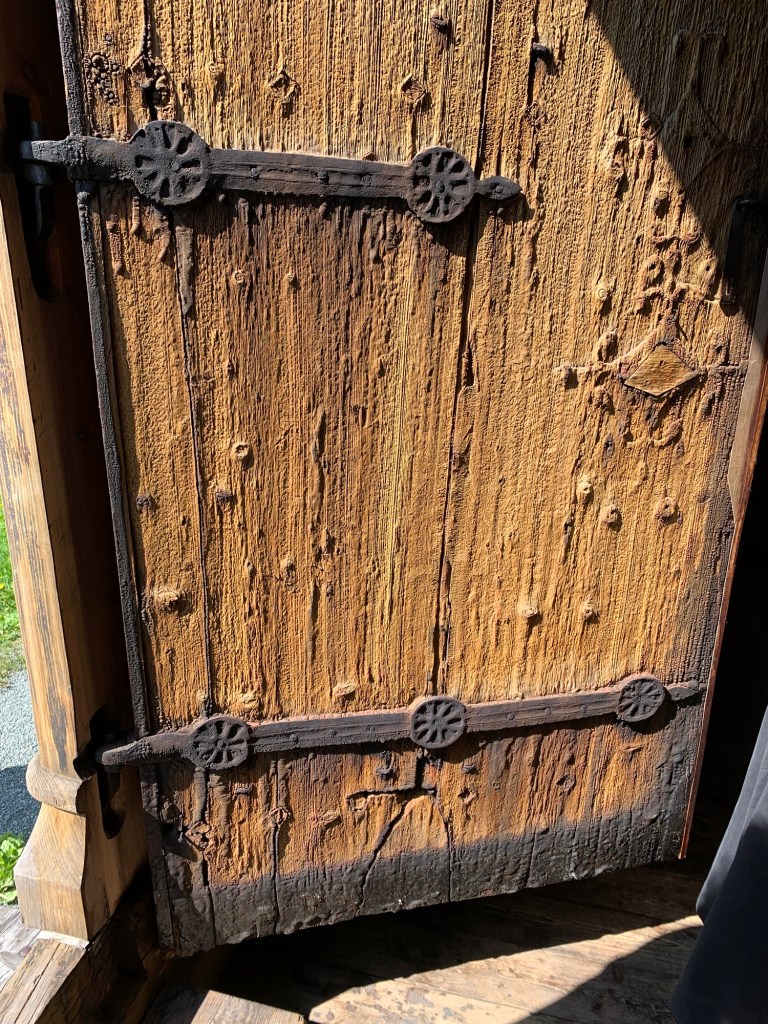
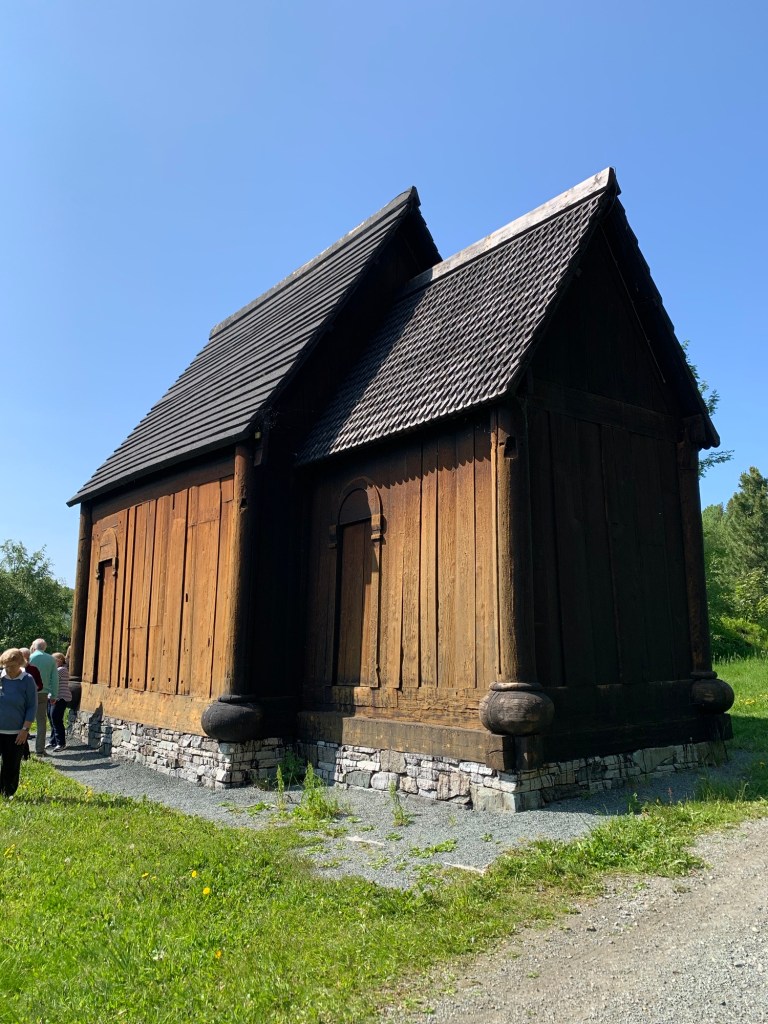
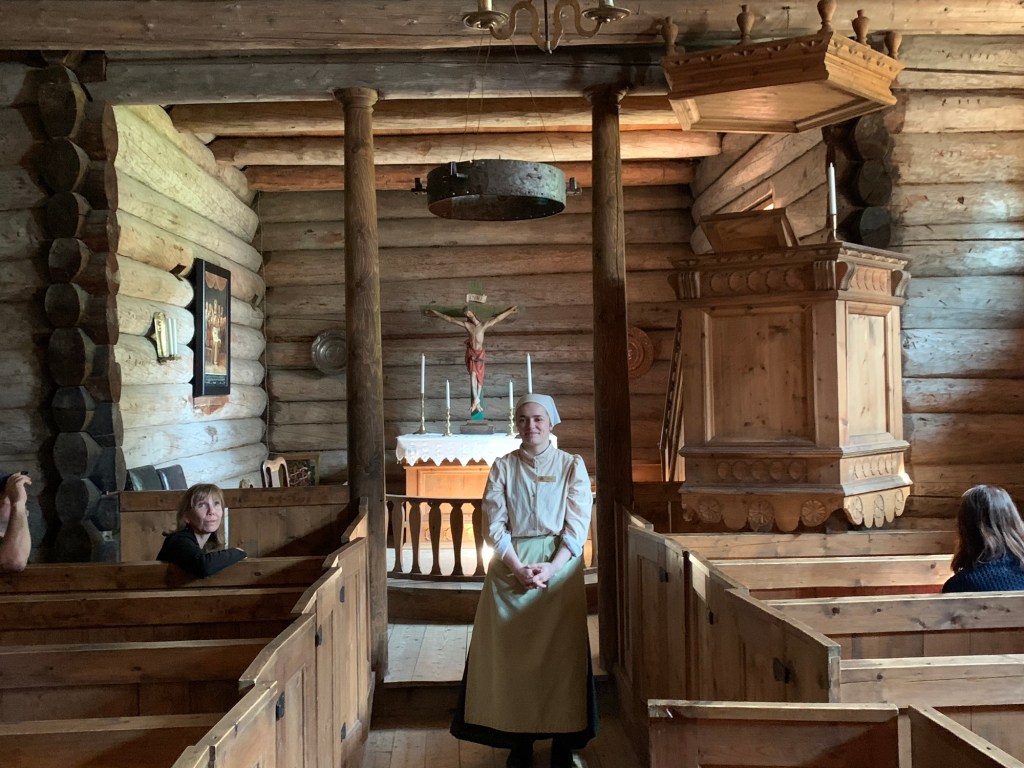
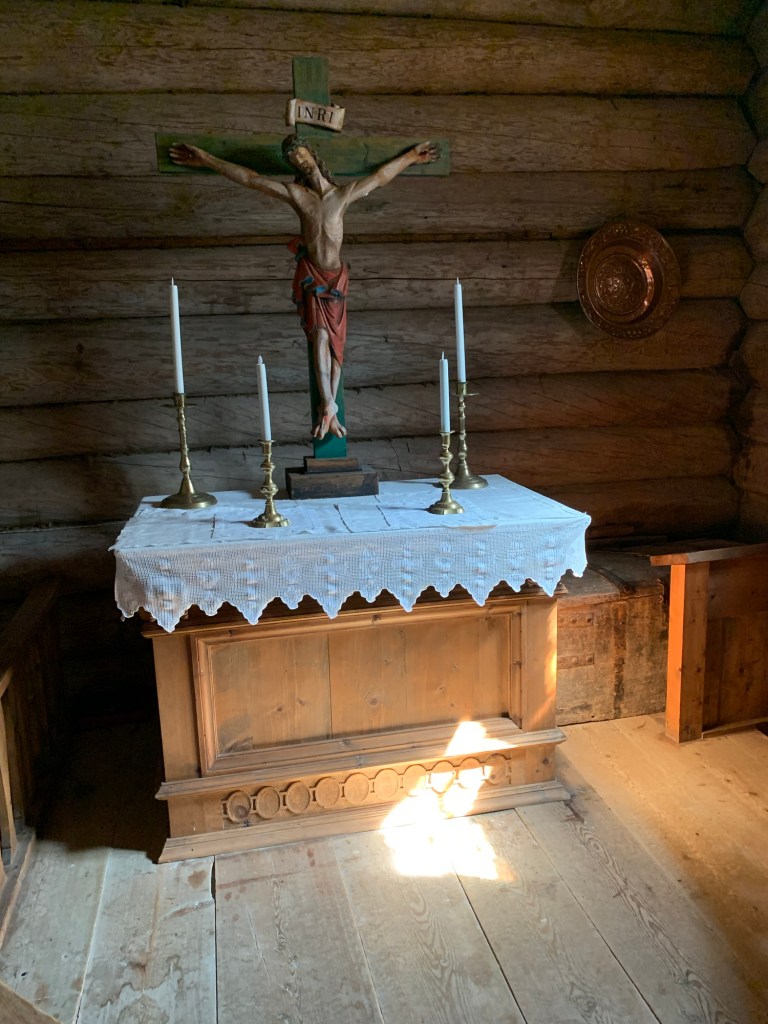
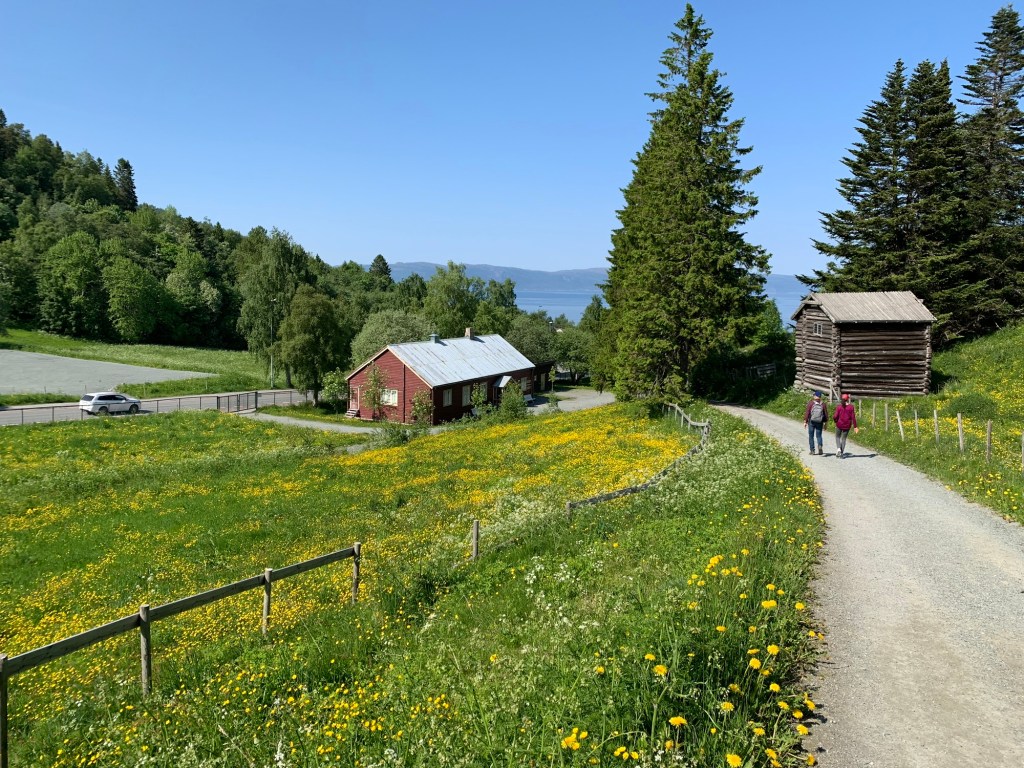
After an amazing visit at the cathedral we were driven slightly out of the center of town to the Museum. Norway’s first Medieval Castle was built in Trondheim as a Royal Seat and defense of King Sverre who had vanquished all his enemies in the Civil war in the 1100’s. This was built at the top of the hill with an impressive view of the fjord and surrounding area. The castle does not exist today, but the area around it has been converted to the Sverres Borg Trøndelag Folkemuseum – The Folk Museum – (www.sverresborg.no) which obtains historical buildings and now has some 80 structures that represent different aspects of life in Norway. There is the center of town recreated as it was in the 1700’s and 1800’s. There are many farm houses that date from the 1500’s to the 1900’s. And the two churches we visited one from the 1100’s and the other from the 1600’s. The young very attractive girl in period dress, who was our guide inside the museum was extremely eloquent, knowledgeable and provided us with a great deal of information and answered even the most difficult and esoteric of the questions. The first church – Haltdalen Stavkirkewas a “Stave” church from Haltdalen, although the door and portal were from a Stave church in Ålen. A Stave Church means that the 6 external pillars held up the entire church was built in th 1170’s and one of 28 stave-churches still preserved today. On the North side the walls were black as the wood is treated with tar to reduce leakage, whereas on the south side most of the tar has been melted off. The church was very small, perhaps holding some 30 people at most and had no windows. When the door was closed it was all but pitch black. A few rays of light came through the cracks in the wood. The church was dismantled and moved several times before arriving at the museum and during WW2 it was dismantled and held in a secret location in the North of Norway to protect against (German) invading armies. The altar and priestly area was in a separate room with an arched opening for the congregation to see the altar alone. There was virtually no decoration, only vestiges of painted flowers as there was no light. A couple of candles were brought in for the services. The building itself has nothing about it from the outside to signify it was a church. At some point about 200 years after it’s construction a large building was attached to the Western wall which was destroyed, as the congregation grew with the area we sat in and was the original church, becoming the choir stalls. Thus the Western Wall is relatively new and not the original wall. When it was moved, only the smaller church became part of the museum.
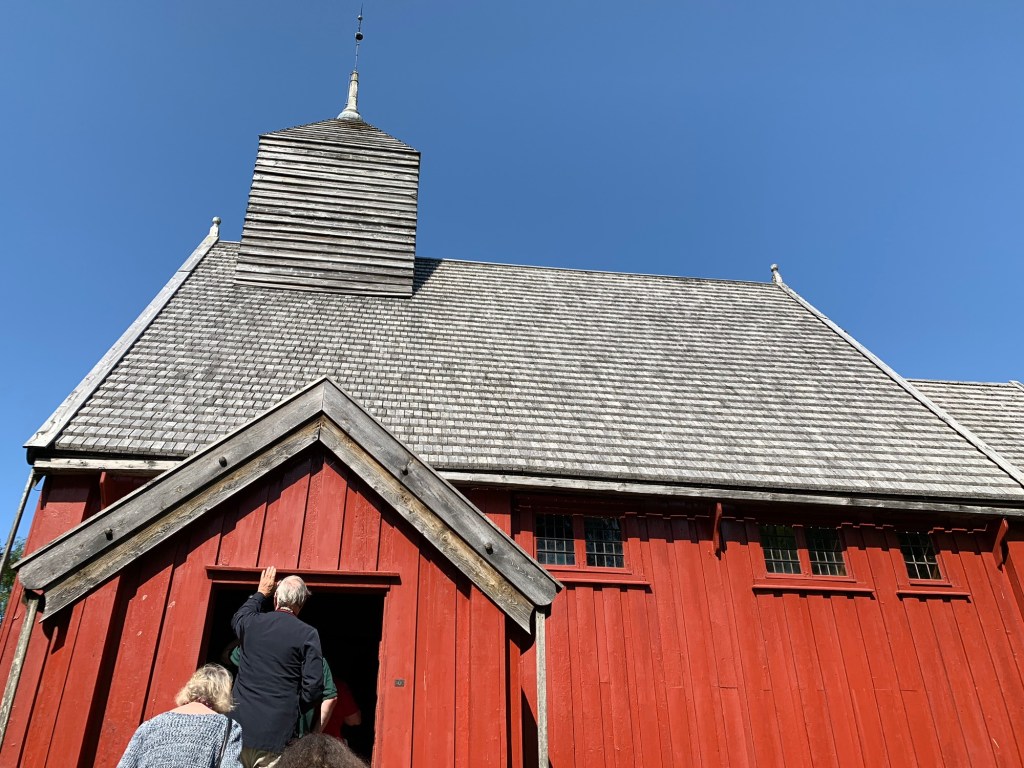
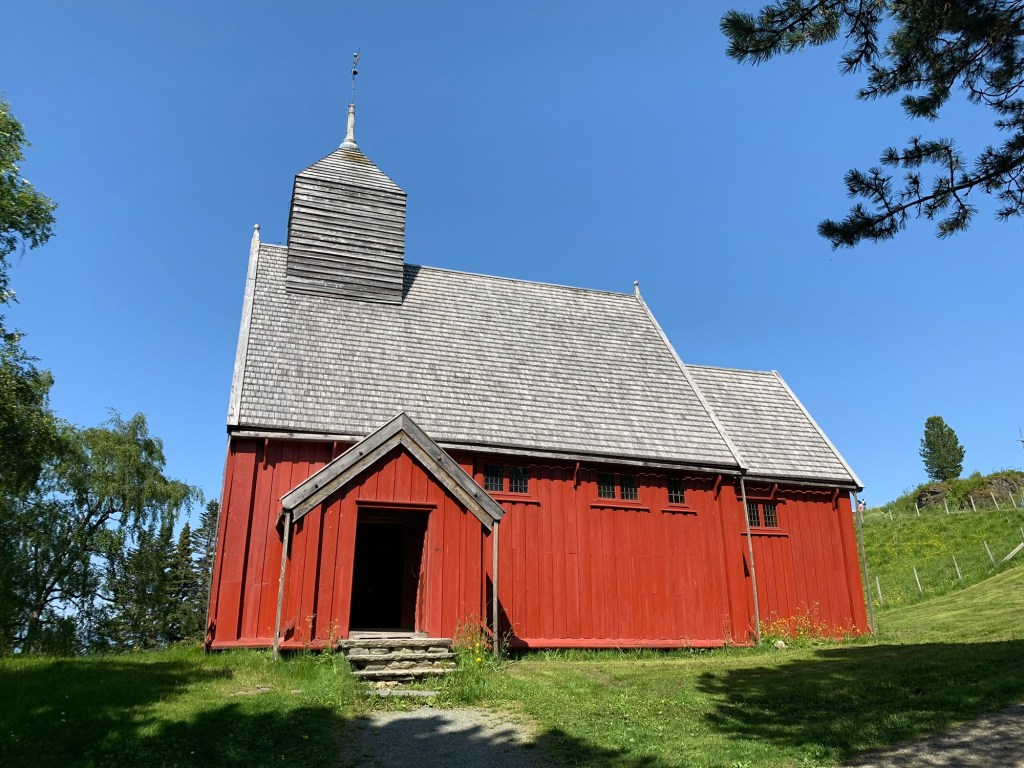
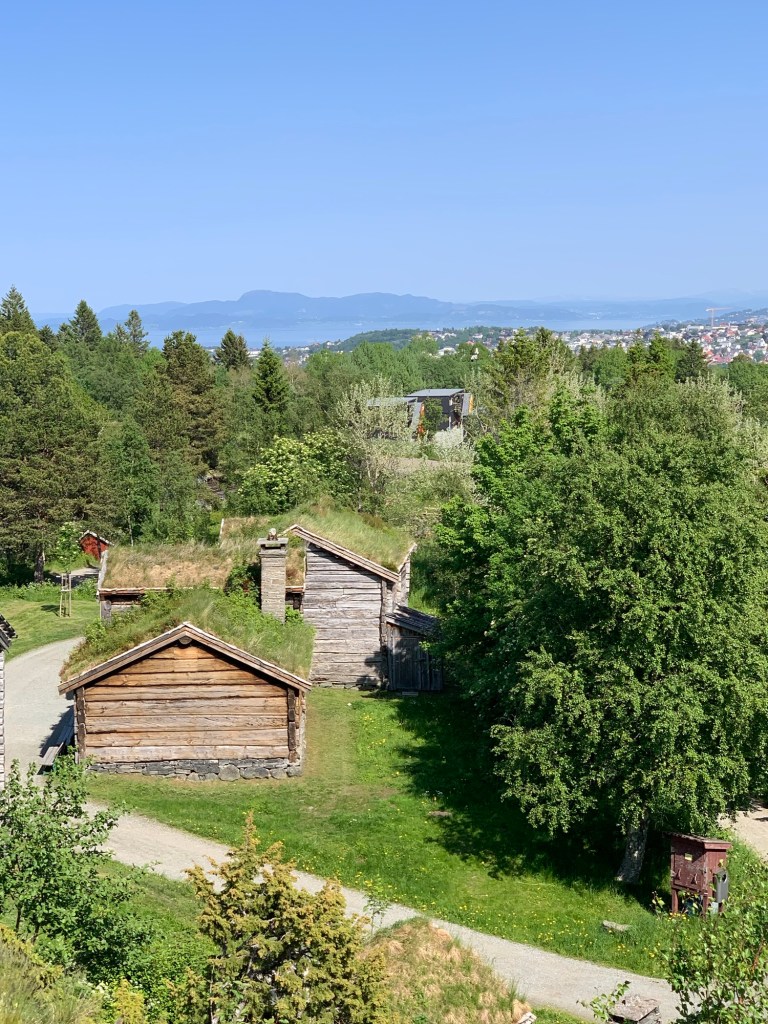
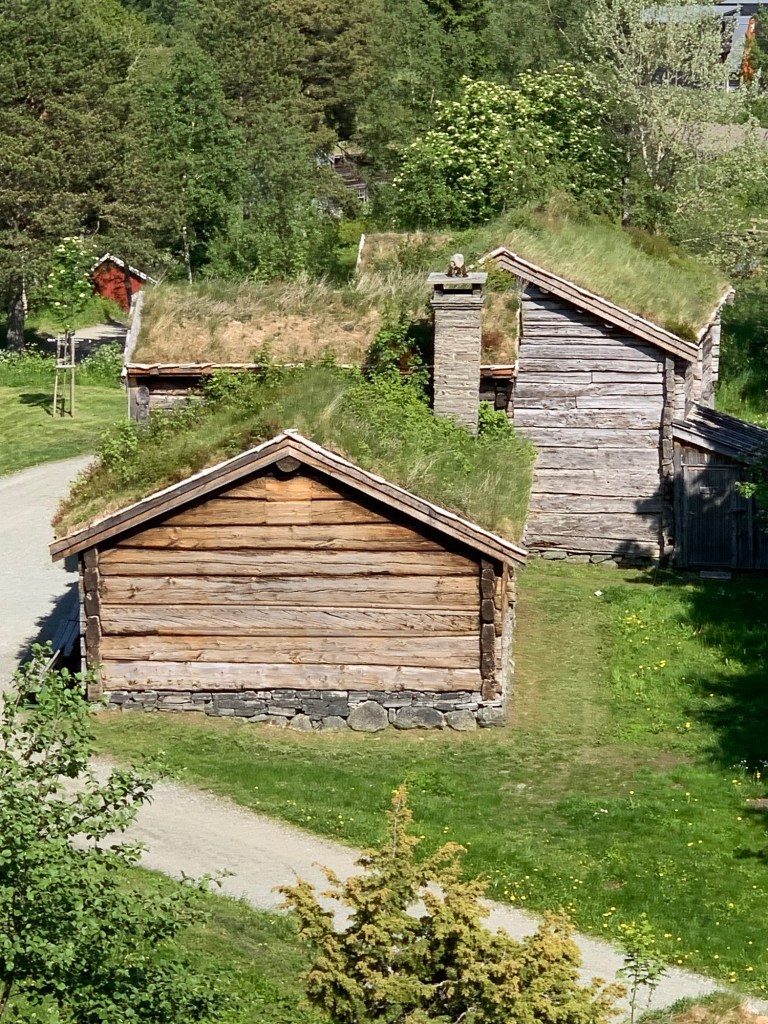
The second church – Lo Kirk built in 1615, had a steeple, painted red and much larger with 10 sets of pews each side each with a door that closed off yeh pro. The backs were straight up and down and the seating area small to make them uncomfortable so people did not sleep during the service. They even had a volunteer with a long stick that would poke anyone who might try and sleep. Attendance every Sunday was mandatory and the pries would talk for hours, then any baptisms, marriages etc would take place followed by town meetings and even a law court with a presiding judge. So the Sunday’s in the church could last 6 hours or more. The altar always faced East and was a lot more elaborate as was the pulpit and the decor. The only windows were on the South side. All the men sat on the South side of the Church under the windows while the women sat on the North side where there were no windows. The myth was that the devil entered from the North so by having no windows, it was more difficult for the devil to enter and if the devil did enter, the women would attack and eliminate the devil as the men were too tired from working in the fields all week! The weather people sat at the front which had wider pews and the poorer sat at the back. There was a second floor where the servants that were allowed to go, could sit, but the roof was so low it did not permit standing and the gallery only had like a 1 foot “slit” from which the servants could see the proceedings, but not be seen. After the service the young boys and girls looking for marriage would meet and chat as it was prohibited for individuals of marrying age to chat without parental chaperone. The young girls would carry their prayer book behind their backs and if the boy was not able to take the book away it meant – Not interested – stay away. However if the girl allowed the boy to take the book it meant that “perhaps I am interested”! The boy then had the excuse to go to her house that evening to return the book and chat. Another interesting feature was the roofs of many houses. As a way of saving money, they would lay strips of birch bark all over the roof’s of their houses. Then they would cover it with naturally composted leaves etc and plant grasses that grew up and others that grew down. The grasses hold the strips of bark in place and the root systems join to form a solid roof. Periodically if a shrub or tree started to grow on the roof, those would have to be removed. If it needed cutting, they would have a goat or other farm animal go onto the roof and take care of the grass. We did see a couple of animals on top of barns enjoying the grasses!
After the churches we climbed further up the hill to the castle in ruins for the view and soon returned to the coach for the trip back to the ship. We were the last group of passengers to board the ship as once we were aboard the gangway was raised and we were off. We enjoyed a nice cup of tea and scones, then a nice sinner and the show was the brilliant African-American singer who for 10 years was part of the group – The Drifters – Roy Hemming. He performed soul, Motown and even some Drifters songs with to young African-Americans who accompanied him. He sang all the songs the audience knew, had a terrific stage presence and all in all, one of the best shows we have seen aboard.





 Roger & Anne Travels