Wednesday May 8, 2024 – At Sea on route to Southampton
A nice day at sea heading North up the Iberian Peninsula returning to Southampton and the end of a very successful maiden voyage.
Today we had two very interesting lectures, the first by the maritime historian – Chris Frame. Today he spoke of the “many lives of the QE2”. It was, like it’s predecessors – the Queen Mary and Queen Elizabeth – built at Clydebank in Scotland and in the tradition, the name was kept secret until it was launched by HM Queen Elizabeth II of England and Queen Elizabeth I of Scotland. Cunard had never used 2, 3 or other such nomenclature for its ships so it was to be named Queen Elizabeth as the prior ship was being put out of service. The Queen had been told that it was to be named Queen Elizabeth, and assuming it was to be named after her, on the day of the ceremony she clearly started “I herby name you Queen Elizabeth II, may all be safe that travel within you”. Panic, and after consultation with Buckingham Palace, the decision was to name it QE2 not QEII although the latter is often, incorrectly used. It was in service for 40+ years and is now a functioning hotel in Dubai.
From the start there were many issues with the engines and there were many overhauls every 20 or so years, mostly dealing with the decor. It was the first to offer only 2 classes when crossing the Atlantic (as opposed to Cunard’s usual 3 – First, Second and Steerage), however as it was built as a dual purpose ship – Ocean liner to cross the North Atlantic and Cruise ship to do world cruises during the Northern winter months, there was only one class for these long voyages. It was brought into service as a group carrier for the Falkland war, but the soldiers were transferred to the Canberra as they got closer to the “Hot Zone”. It was converted to a troop carrier in a week, but once the war was over it took much longer to convert it back to a passenger ship and the decor was updated as well as the engines completely changed with the old and new being moved carefully into place through the funnel area, which was temporarily removed. On a personal note, I never travelled on the QE2, but did a transatlantic crossing on the original Queen Elizabeth (UK to NYC in 1959) and also the original Oriana (UK to Acapulco, Mexico via the Panama Canal in 1968), which was the Canberra’s sister ship.
The second lecture was by the Chief Yeoman Warder (Beefeater) – Peter McGowran MVO (Member of the Victorian Order) – who was in charge during the Queen Elizabeth’s Jubilee, her death and the crowning of King Charles III. He subsequently retired. He spoke of the events of the Jubilee, which was likely to be the Queen’s last as she was in frail health. One of the duties, as guardian of all the Royal crowns and other jewels and regalia, was to take the Commonwealth Orb, which was made of silver, gold and platinum, studded with precious stones, stones from the top of the UK’s highest mountains and was a map of all the commonwealth countries. The decision was to use it symbolically to start the lighting of the beacons, around the country and commonwealth from Buckingham Palace, set off by Prince William. He had trained and done the route several times and had it down well. Two days before he got a call that it was instead to start at Windsor Castle and the Queen was going to make the effort to start it herself as she realized this was to be her last jubilee. Again panic, and urgent change of plans and rehearsal was to be made. The globe sat on a cushion, inside which was a piece of wood, so it was rather heavy. Also the globe was held up by a metal crown like element, but neither were attached to the pillow, so could easily fall off. Furthermore, there was a special raised platform on top of which was the podium on which the pillow was to be placed. The issue was that he could not see where the step was as he had the pillow in front of him. So the dual worry of tripping on the step and the orb falling to the ground, was present. The latter was resolved with a pice of double sided celó tape and the first was rehearsed many times. As millions watched from around the world, he was able to perform his duty flawlessly and the Queen touched the Orb, setting off the beacons and the Jubilee celebrations. As a touching extra, she used the thumb stick (walking stick that you put your thumb on the top of) that she used was given to her by his regiment of the Royal Air Force. By the way, to become a Yeoman Warder you had to have at least 20 years in the UK military and be a Sergeant Major. At the time of the Queen’s death he and his wife had taken a holiday to the Canary Islands as a birthday present and in recognition of the time they were in lockdown in the Castle during COVID. He got a call after the second day and was able to get a flight back as there were many events – gun salute – one for each year of her life, standing guard at the coffin as mourners came by to pay their last respects (20 minute shifts) and other such events that he had to oversee. The other big event was the coronation where he was to lead the Yeoman Warder as they accompanied the carriage with the new King and Queen. A couple of days before he received an invitation to be a guest at the church service, so as a guest he was inside, but during the final hymn, he scurried out and was ready to do his duty leading the Yeomen Warders in the procession. There were lots more interesting facts, but this will suffice to show the interesting nature of the lecture.
The Captain’s noon watch comments indicated that we had travelled some 271 nautical miles from Lisbon and had 622 nautical miles to go to Southampton at an average speed of 16 nautical miles/hour.
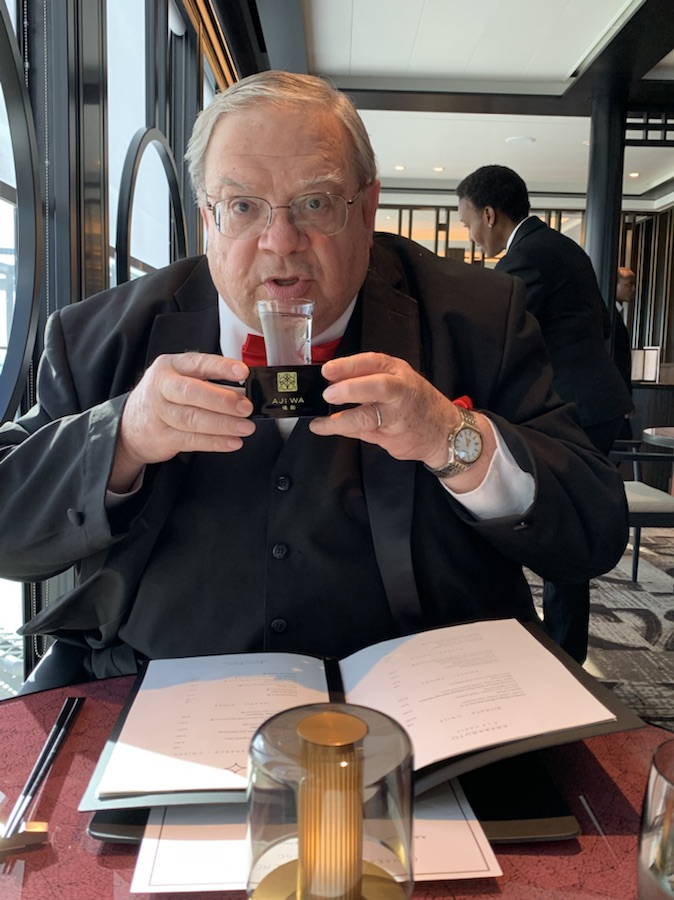
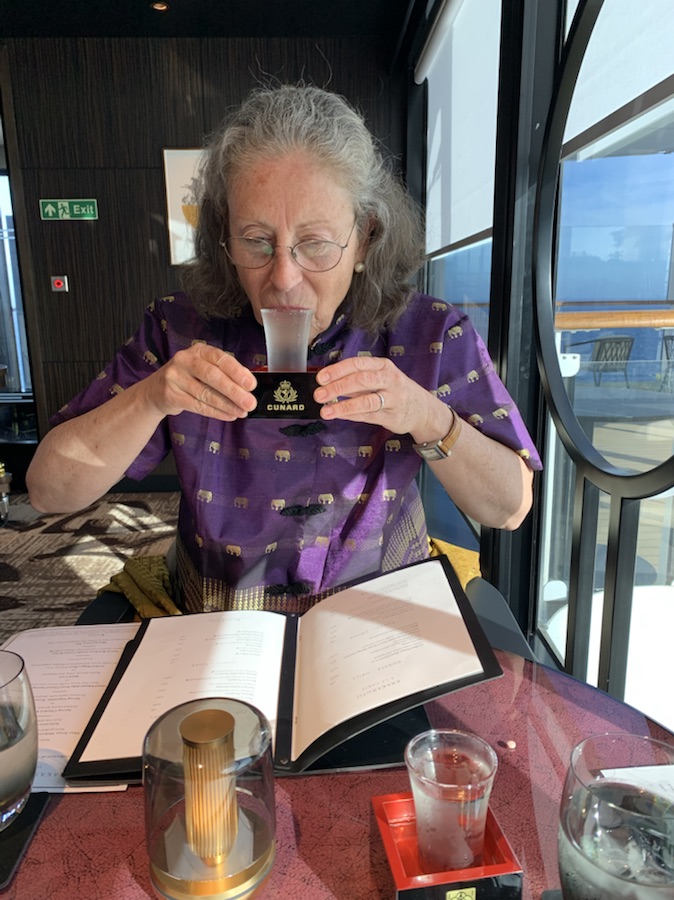
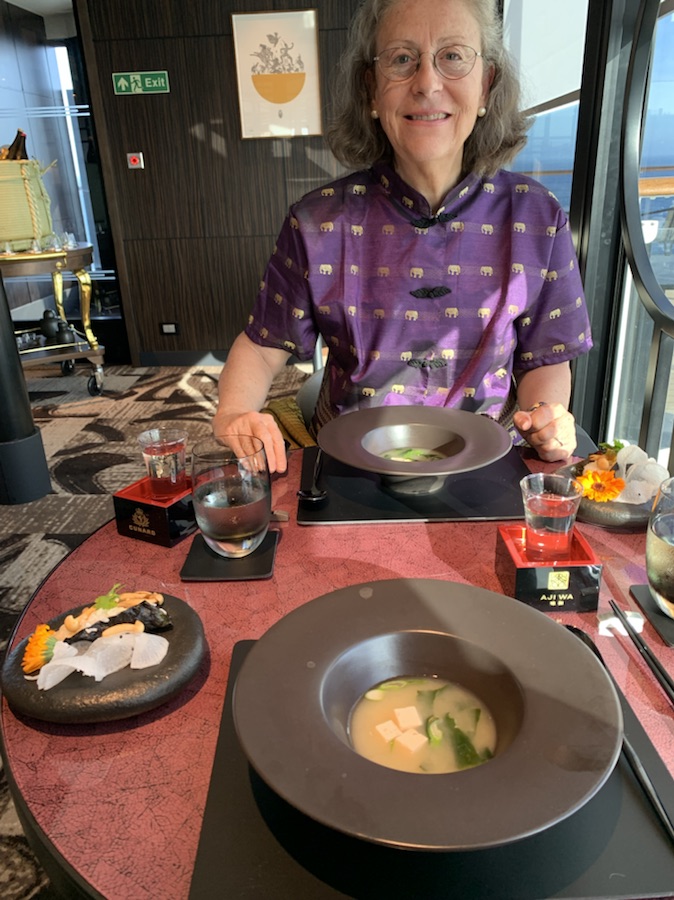
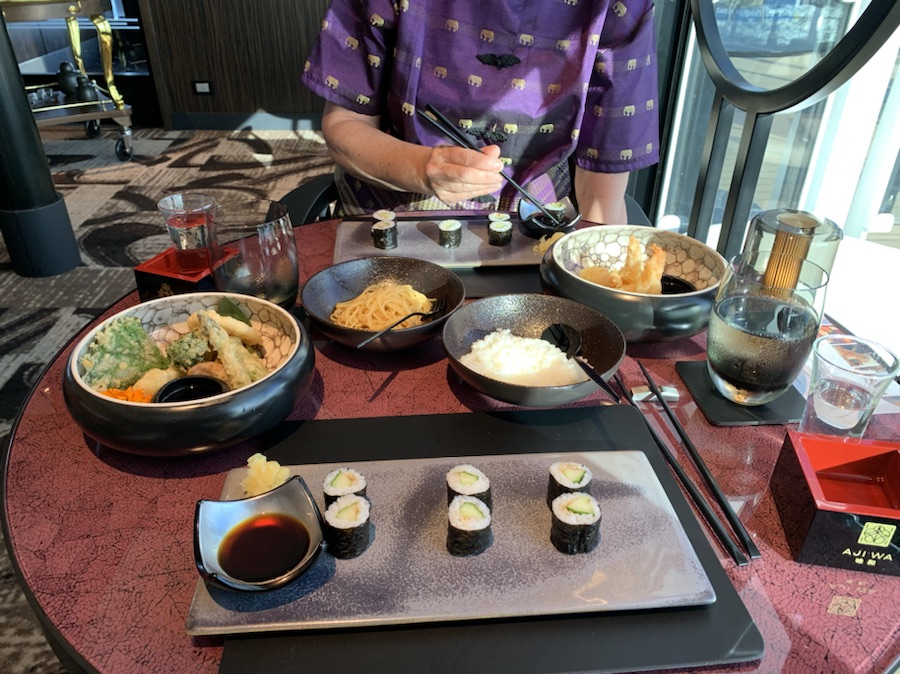
In the afternoon, Anne went to the gym and I wandered up and down the decks, looking for the viewing point of the bridge on each of the top 6 decks. This mission ended in failure and I believe it does not exist, but other interesting places that we had not explored before on the ship were found. This included hitting a few golf balls into a net and putting on the 6 hole putting green. We had made reservations to have dinner (thanks to an invitation from our travel agent – Howard) at the Japanese Restaurant – Ají Wa on the 10th Deck A. We had a delicious dinner of Sushi, Miso soup, Tempura, Green Tea Roll cake and Matcha Green Tea. Ekatarina (Katia) our friend the sommelier, gave us a personal education about the 40 types of Saki that are carried on board the ship. We learned a great deal, including the fact that Cunard owns and produces its own rice fields and brewery in Japan. We had to taste the Gold Cunard Saki, which was delicious, smooth texture and really superb. The polite way of serving it is to put the glass into a small rice measuring lacquer box and pour the sake into the glass so it overflows and goes into the box. A sign of generosity, by giving you more than you asked for. After holding the box in both hands and sipping the glass until it was 1/2 empty, one removes the glass and then also consumes the rest that has fallen into the lacquer box. Some Sake types are to be served cold, others warm, and a third type in between. Many people still think that it should be drunk warm, but there is also a vestige of the era when the poorer quality was served warm to help disguise the poor quality. With the Macha Green Tea, we also enjoyed a special aged and fruity flavored Sake that is under the only foreign (English) Sake Master, Philip ???, in Japan, who has won Gold medals for his Sake.
The evening performance was by the trumpet playing singer from Wigan that we have seen before and is good – Georgina Jackson. Tonight was Masquerade Gala night so we opted to go to the Photography station overlooking the Grand Lobby and hopefully did not “break the Camera” with our looks!!!!

 Roger & Anne Travels