Monday June 24, 2024 – At sea on Route to New York City, USA
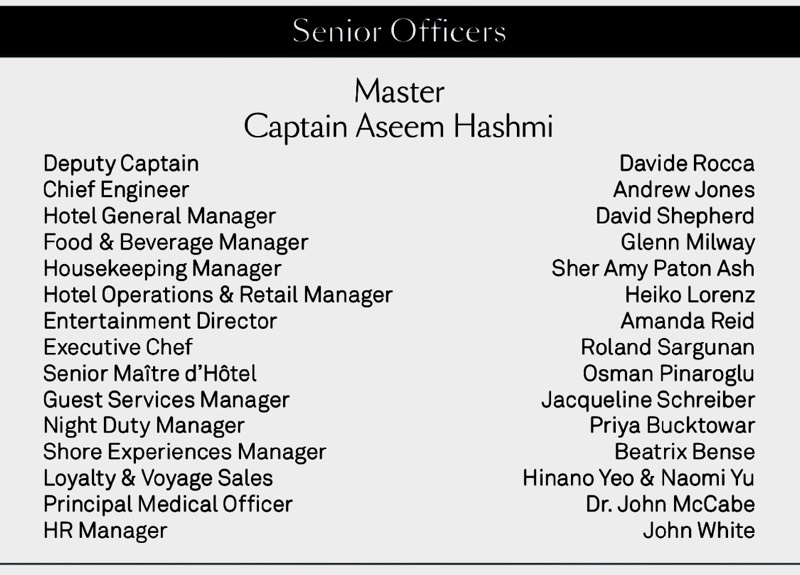
We boarded the Queen Mary and felt quite at home as we had been on the ship many times. The Officers for this trip were: –
A one hour time change overnight was a bit confusing and Anne was up at 5 AM thinking it was 6AM and wondered why everything on the ship was still closed down. Besides that, which we all get confused about, it was a day packed with four well attended and very interesting lectures plus we both had Zoom meetings. The internet is substantially better than it was, but still not up to the level of Queen Anne.
The first lecture was on Spies and the history of covert activity, which is considered the Second oldest profession (after prostitution). The speaker – Matthew Towler – has been in the profession all his life and opened with a disclaimer that he was not violating any oath or confidentiality in the series of talks, as all the information he was going to discuss, is in the public domain. The earliest documented spying incident is in the script on stone with drawing – The Beating of Shasta Spies following the Battle of Kadesh in 1274 BCE. Apparently they purposely communicated information that misled the attacking forces about the proximity of the enemy. Spying or Intelligence Gathering consists of :-
A) The direction or targeting of an intelligence gathering operation;
B) The collection of the intelligence product;
C) The analysis of the collected intelligence product; and
D) The dissemination of the intelligence product to the appropriate person or organization.
The three basic reasons for spying are 1) Money; 2) Power; and 3) Influence which together are known as the Spy triangle. An early text on military intelligence from 500 BCE is “The Art of War” written by Sun Tuz. The first “Special Forces” used in war is generally considered the “Trojan Horse”, where a statue of a giant horse was left at the gates as a “gift” but actually contained elite soldiers and two spies in the head that observed where and how to open the gate of the walled compound allowing the easy entry of the forces that were outside, thus avoiding a prolonged siege and easily able to overpower the enemy.
Darius the Great (550-486 BCE) had what he called “The King’s Ears” whereby the way he controlled what was happening in his far flung empire was by having a Military leader and a civilian leader managing his various provinces. He told each of them that he is not sure he trusts the other so please advise him if anything was happening. Not satisfied with that, he also got all the grain merchants to advise him if there was a larger than usual purchase of grain as that meant that an army, wo lives by the stomach, was being readied for attack. Hannibal (247-183 BCE) did something similar. At the time of Jesus, Judas Iscariot was “turned as a spy” for money to point out which bearded Hebrew man in a long tunic (almost 100% of the men looked like that) was Jesus in the dark night on the Mount of Olives. The Romans had Speculatores, Exploratores (both military) as well the civilian Frumentari intelligence gatherers. It was the Romans that started what is common in Police work today, or at least part of the model / various methods of obtaining intelligence. These include :-
1) Military Expeditions;
2) Reconnaissance Operations;
3) Dedicated Spy Missions;
4) Prisoner Interrogations;
5) Debriefing of Roman Merchants and travelers;
6) Interviews with Foreign Merchants, Traders and Ambassadors;
7) Intelligence obtained from Allies; and
8) Historical Archive Analysis.
It is this last point which was so critical as one often hears the expression “If you don’t know history, you are doomed to repeat it” (or words to that effect) so understanding what went right and what went wrong in the past helps the analysis and thus the future with more accurate and positive results. Julius Caesar came up with the “Caesar Cypher” whereby messages could be written in what was apparent gibberish, but actually understood by the receiving party. In its simplest fashion the letters of the words of the message using an alphabet are converted to other letters. So say the alphabet A, B, C, D etc is written out and below those letters are written the same letters in reverse order Z, Y, X, W etc then the letters of the words are written using the reverse alphabet, the message would appear to be gibberish. However once received, the person then goes to the same chart and converts back the letters in the reverse alphabet to those in the regular forward alphabet, the message becomes totally clear and intelligible. Variations where there is a shift of 3 or 5 etc letters creates a bit more complicated cypher and even more if there is a change depending on the day or other such factor. As long as the person writing and the reader agree on the permutation of the letters, messages are completely understandable to those two people, but gibberish to everyone else. This worked until Guglielmo Marconi invented the telegraph and transmission of messages over wires or the air, where someone had to listen and then convert to understand. The lecture then brought Spying into the 20th Century with the formation in England of the adversarial MI5 (Military Intelligence Section 5 – Domestic Counter-intelligence and Security Agency) under the command of Sir Vernon Kell (1873–1942) (thus still referred to as “K”) and MI6 (Secret Intelligence Service) under the command of Sir Mansfield Smith-Cummings (1859-1923) (still referred to as “C”). By the time of World War 2 – K (MI5) was headed by David Petrie (1879-1961); C (MI6) by Stewart Menzies (1890-1968) and a third branch “CD” (SOE) [Special Operations Executive] was headed by Sir Colin McVean Gubbins (1896-1976). MI6 is also known as SIS (Secret Intelligence Service). A very interesting chat with a great deal more information.
The second lecture was equally fascinating and was by a British Airways Pilot – Rick Reynolds, who flew the Concorde and spoke of the Magic that was the amazing Sound-breaking aircraft jointly conceived, designed and built by the British and the French. This was the first of four lectures which was going through the history of its creation with lots of interesting videos.
The third lecture by Jeff Rozelaar – Winston Churchill “History and Humor” Part 1. He got onto the stage slouched in a chair and proceeded to supposedly talk about Churchill his early years. I say supposedly as his microphone or speech was so low, that most people could not hear him and his slides were so light that one could not read them. A true shame because when he started he played to a full house and a very interesting topic. As people found they could not hear or gather what he was saying, started to walk out. As we both had Zoom meetings we missed the fourth lecture. The evening was a gala, dress up night, after which we retired as we had seen the show several times – “Be our Guest” by the Cunard Singers and Dancers.

 Roger & Anne Travels