Friday June 28, 2024 – At sea on Route to New York City, USA
Our last day at sea and the end of the 2 months at sea. A really fun and enjoyable holiday.
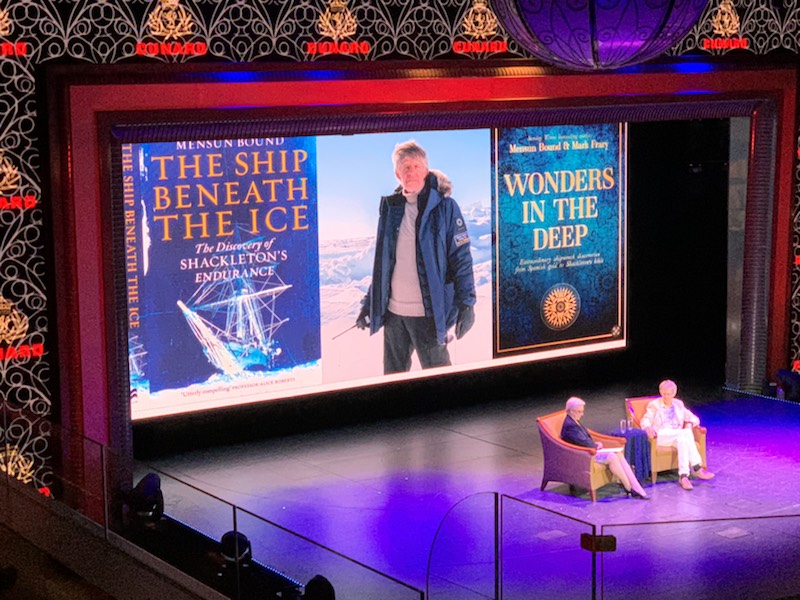
Interview with Mensun Bound. The entertainment director, sat down with Mensun for an interview about his various adventures. One of the questions was about the origin of his first name. It is actually a nickname, not sure what his actual name is, but apparently when he was a child, they kept giving him for a serious ailment, medicine that was not to his liking. So he would cry out to his parents “no more Medicine” but not able to say Medicine correctly he would call it Mensun, which stuck! He again spoke of his childhood on the Falkland Islands where he would spend the summers away from “The Big City” – Port Stanley with 1,000 people to one of the outer islands with an uncle, population 8, working on ships. Although hard, it was there he developed his love for ships and eventually got a job as a “Stoker” – putting coal into the furnace – and was finally “at sea”. After finishing his education in the Falklands and Montevideo, Uruguay, he wanted to go to University, applied and was accepted, but his parents could not afford to pay, thus he went to sea. Eventually, finding his way to New York, he went to one of the universities that had accepted him, one day before the semester started. Again the issue was Too late and no funds. However he heard of a scholarship and went to an office of The Leopoldo Schepp Foundation where the secretary was trying to usher him out, but one of trustees heard his story, spoke to the other trustees and he was given a full scholarship to Fairleigh Dickinson University in New Jersey where he did well reading Ancient History. He furthered his education, thanks to another scholarship, at Rutgers University in New Jersey in Classical Art and Archaeology. While there he worked at the Metropolitan Museum of Art as a research assistant in Greek Pottery. He applied and was denied permanent residency status in the USA so with a Commonwealth scholarship to Lincoln College Oxford in 1976 he read Classical Archaeology. Since he had a British Passport, which all Falkland Islanders have as it is part of Britain, he remained at Oxford for the rest of his professional life. He retired in 2013, but is still very active in Marine Archaeology, where he had many successes.
He spoke of George Fletcher Bass (1932 – 2021), someone who he had read about in a National Geographic Magazine who was a luminary in the field of Maritime Archaeology specializing in Byzantine, Bronze and Classical Archaeology. As a child he wrote to Bass asking for a job, and got a letter back saying – when you are older, contact me. After getting degrees, he again wrote letters and eventually his persistence paid off, but not before he was trained in Classical Archaeology, was a Certified diver and seaman. Bass was mounting an expedition and had very few places so needed someone who could fulfill more than one role on the expedition. So went the very interesting interview with lots more stories about how he and his wife Jo, work together on expeditions while she also is CEO of a travel company, thus bringing in the funds for him to do Archaeology work, which is not well paid, but one does it for the love of history. One final story, before I move on. I may have mentioned that the two things one hopes not (yes NOT) to find is Gold, Precious stones or bodies. Bodies or even body parts immediately raise the flag of Cemetery and the body not to be touched. Gold, brings on treasure hunters and the bad element of jealousy that it brings. Well, on one particular operation, they found lots of Gold, which was brought up and stored under the tiled floor of their accommodation. However, at one point they had to leave and the question was how to get the gold out. By sea was not possible as the marine patrols were omnipresent. By land, there were checkpoints between the remote region and the capital, where they could get a ship or aircraft out. Usually a small “compensation” to the officers on duty at the checkpoint would suffice, but trying to get all the gold past them, would not work. So they purchased a lot of lobsters from a local fisherman, stuffed the lobster shells, after enjoying a great dinner, with the gold, then allowed them to rot a bit in the sun for three days. They were packed into a wooden crate and when the Officials opened the box, got a whiff of the stinky lobsters, ordered it closed and ushered them through. Thus they were able to get the gold out undetected and to museums.
The next lecture was Jeff Rozelaar acting as Benjamin Disraeli – Queen Victoria’s favorite Prime Minister. He was dressed again in period dress and gave the second part of his very interesting portrayal of the Prime Minister. This started once he was well into the success of his career, through his wife’s death (she was years older that he was) by which time Queen Victoria’s beloved husband – Price Albert was dead. Thus the widow and widower, enjoyed a lot of time together, particularly when he was Prime Minister where the weekly Audience with the Monarch, usually an hour long, would last into meals and some all day. He lives in High Wycombe, Buckinghamshire, was a teacher and part time actor, has written a couple of books and still does some teaching. Being Jewish, he was drawn to the first Jewish Prime Minister Disraeli and developed a play around telling his life history. He does performances in various small venues, does not care much for travel, but his wife loves to, so now does some cruises, where he lectures on Churchill and performed the “living history” of Disraeli. He concluded the performance indicating that this was the largest audience he has ever had to his show and was happy that it was well received.
The third, very interesting and playing to a full house – Captain Rick Reynolds spoke on the Assassination of Concorde. The final decisions causing the end of the Concorde Program. While I have gone into some detail in prior days of this blog about the Paris Crash, which was the beginning of the end of the Concorde, so will not touch on that. However, the next, near disaster was an Air France Concorde traveling from Paris to New York, on February 19th, 2003 was forced to make an emergency landing in Halifax NS, Canada. There were 47 passengers aboard of which only 8 were paying customers. AF 002 developed a malfunction in one of the four engines (number 3 shut down) over the Atlantic so had to make an emergency landing. In January 2003 an AF Concorde on the same route, was forced to turn back to Paris as the Nose Cone would not return to its flight position. In November 2022, an AF Concorde had to urgently descend 8,000 feet as one of the engines failed. From July 2000 following the Crash and passenger deaths, all Concorde’s were grounded during the investigation, and resumed in November 2001. Of note, during all these Air France incidents, there was one person at Air France who held very senior positions. Jean-Cyril Spinetta (he was CEO and Chairman of the Board from 1997 to 2012) and was the key individual that caused the end of the Concorde. After the Halifax incident, as CEO he knew that at some point, as France always looks to find blame and punish one person, his time of “getting away with” being prosecuted / held responsible could easily end soon and he could be placed in Jail. Also of note, it was around this time that both British Airways and Air France were in the process of being privatized. Indeed AF and KLM became one organization in May 2004. So some Facts in 2003:-
- Air France was loosing money on the Concorde under its CEO and Chairman – Jean-Cyril Spinetta. He was concerned that he could be personally indighted for actions of the Concorde.
- British Airways was making a very nice profit on the Concorde. In 2003 Lord Marshall of Knightsbridge (Colin Marshall) was Chairman of the Board of British Airways (1996 – 2004) and Rod Eddington was the CEO of British Airways (2000 – 2005).
- British Airlines was looking at a way of reconfiguring the Concorde into a First and “Economy” classes, expanding the life of Concorde for at least another 5 years.
- Airbus was the sole provider of spare parts for all Concordes and was being paid a retainer of 40 million Euros a year, plus cost of parts.
- An agreement before the initiation of the project between the governments of France and the UK indicated that if one of the parties pulled out of the agreement, they would still have to pay 1/2 the cost. The British tried to do this, before the ‘planes were built and France invoked the clause, so Britain continued with the Project. In 2003, France stated that they would no longer stand by the agreement and they were cancelling all Concorde Operations. Britain tried to invoke the clause of the treaty, but France refused to pay anything. It was thus too expensive for Britain to carry the full load. Furthermore, Airbus said they would no longer make parts for the Concorde.
- In April 2003 Air France and British Airways announce the end of Concorde. Air France stopped operations soon thereafter and British Airways ceased operations a few months later.
- At one point Richard Branson stated that Virgin Airlines would take over the Concordes, but upon the study of the financial situation and the cost of the retainer and lack of parts, pulled out of any deal.
Thus France by invoking the clause, made Concorde a reality and France, refusing to honor that same clause, caused the end of Concorde in 2003.
While I realize this is a bit longer than usual, it was a fascinating lecture day and much knowledge gained.
The Evening show was a dual performance partly by the amazing guitar player Fabio Zina and the Edith Piaf portrayal artist – Camille Mesnard.


 Roger & Anne Travels