Friday February 14, 2025 – At Sea between Hawaii, USA and Apia, Samoa
Happy Valentine’s Day to all. Another day at sea with two interesting talks, the first a port lecture and the second was an interview with the Captain. This was followed by the first “Lunch and Learn” for Sake to be done on the ship. A great day to spend the first part of Valentine’s Day.
Let’s start with the Graham Howell Port lecture on Tonga. The Kingdom of Tonga – yes, it is the only Kingdom that still exists in Polynesia. It is a group of 171 Islands of which only 45 are inhabited. About 70% of the 120K inhabitants live on the main Island of Tongatapu with its capital city of Nuku’alola, which is where we will be visiting. Although it does have a quay, this ship is too large to safely dock so we will be traveling ashore in the tenders / lifeboats. The flag has a Red background with a while (Purity) rectangle in the top left corner with a Red Cross (for Christianity) on the white rectangle. About 97% of the country population are Christian, that was brought in 1882 by the Rev Walter Lawry of the Wesleyan Missionary Society, however the first London based missionaries arrived in 1797. At the time the King of Tonga (1760 to 1820) accepted Christianity and took the name of Slaosl (George) in Honor of King George III of the UK. From 1900 to 1970 Tonga had British Protected Status under a Treaty of Friendship between the two nations. During the Second World War, Tonga had very close ties with New Zealand. In 2010 there was a change from Absolute Monarchy to Constitutional Monarchy. When James Cook arrived in 1773 and returned in 1774 and 1777, he found the people very friendly so called the group “The Friendly Islands”. The Island was probably first inhabited between 1000 and 1500 BCE by the aboriginal group called the Lapita Culture. It was never conquered by any foreign power. The earliest known European interaction was the trading group of people from the Netherlands in 1616 with the Captain Willem Schouten and later Jacob Le Maire, then Abel Tasman in 1643, James Cook as stated, then Spanish explorers – Francisco Mourelle de la Rúa in 1781, Alessandro Malaspina in 1793 .
The Treaty of Frendship with Britain ended in 1970 based on arrangements made by Queen Salote Tupau III in 1965 prior to her death. Tonga joined the Commonwealth, with its own monarch in 1970, together with Malaysia, Brunei, Lesotho and Eswatini.
The latest history includes King Tuoou IV who died in 2006 weighing 470 lbs so there was a large group of people carrying his coffin at his funeral. Many people on the island are overweight and enjoy life, being very friendly. He was succeeded by King George Tupou 5th who died in Hong Kong after a kidney operation, so the present reigning monarch is King Tupou VI. Queen Elizabeth II of England visited Tonga in 1953, 1970 and 1977 during which time she apparently was shown the tortoise that was from Captain Cook’s era and died when it was 190 years old. The last “Royal UK Visit” was when Prince Harry and Megan – Duke and Dutchess of Sussex visited in 2018.
Tourism is still in its infancy, but efforts are being made to increase the same and a lot of wooden carved objects, weaving etc are good items to purchase for visitors. Coaches are primitive with no Air Conditioning of Public Address System. All Busses and taxis are privately owned and are available only when the owner decides to work. Sailors brought rugby to the island in the 20th century and is now the national sport playing in many International and World Cup matches, even winning some games in the process. The island is known for its “Flying Foxes” classified as part of the bat family but closer to monkeys in their structure. Graham then went through the various tours that are available and seem to include – The Wooden Royal Palace and Cemetery, Fresh Fruit snacks, Countryside, Flowers, local song and dance, Captain Cook’s landing site, Oholei Beach, the archaeological burial site at Mu’a, the ocean blowholes, as well as beaches and resorts.
Then Captain Inger Thorhague was interviewed by Entertainment Director Michael Harvey. It was really interesting to hear her “story” from a young child growing up in the Faroe Islands entering the commercial shipping industry and eventually deciding to join a cruise line so sent applications to all the Cruise Lines with Cunard replying first with an offer to start as a Second Officer. She was picked to be the Captain of the Queen Anne and spent the last 8 months of her manufacture and kitting out before being put into service. We had a great time spending the first 2 months of the ship’s maiden voyages with her and greatly enjoy being on her Maiden World Voyage. She got some tough questions from the audience and was strict, but polite in her answers. She was very impressive in the way she managed the interaction and brought a renewed admiration for her as the Leader / Master of the ship. By the way the Master refers to the Exam and Certification to become a Captain and the word Captain refers more to her as the Leader of the ship.
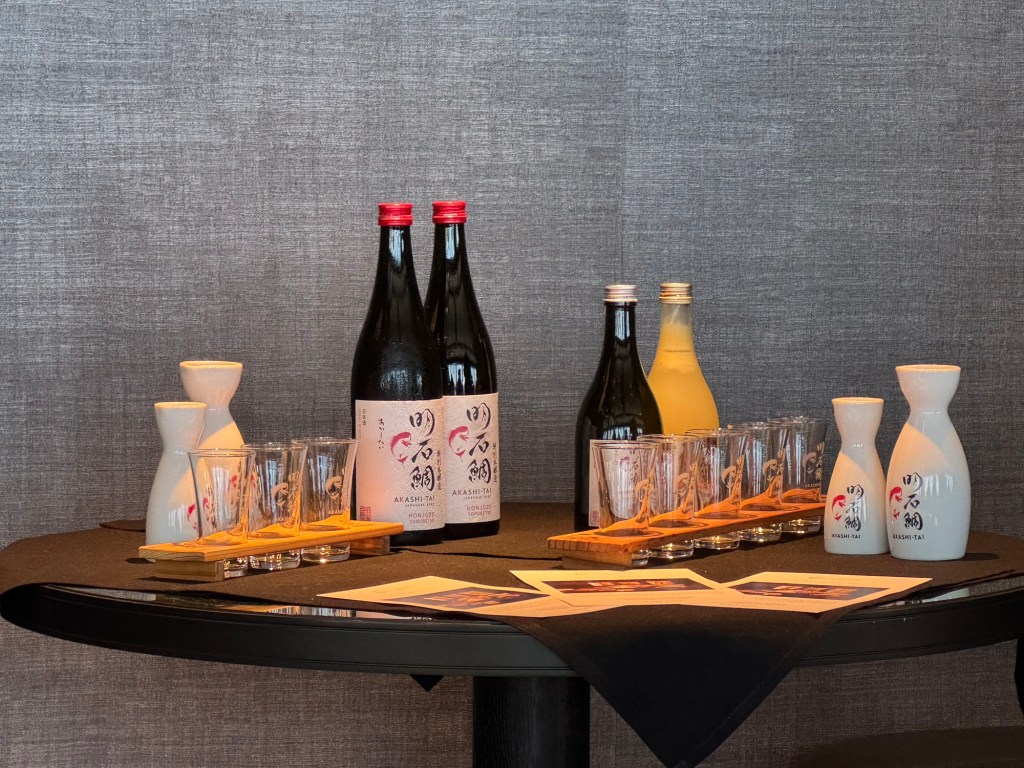
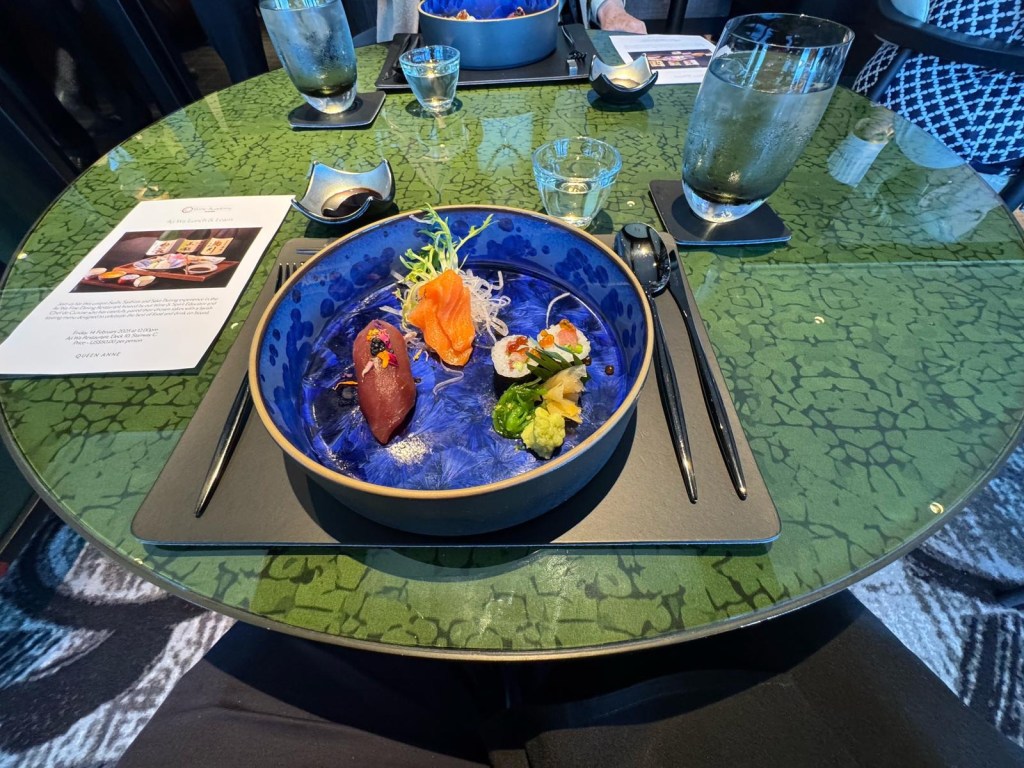
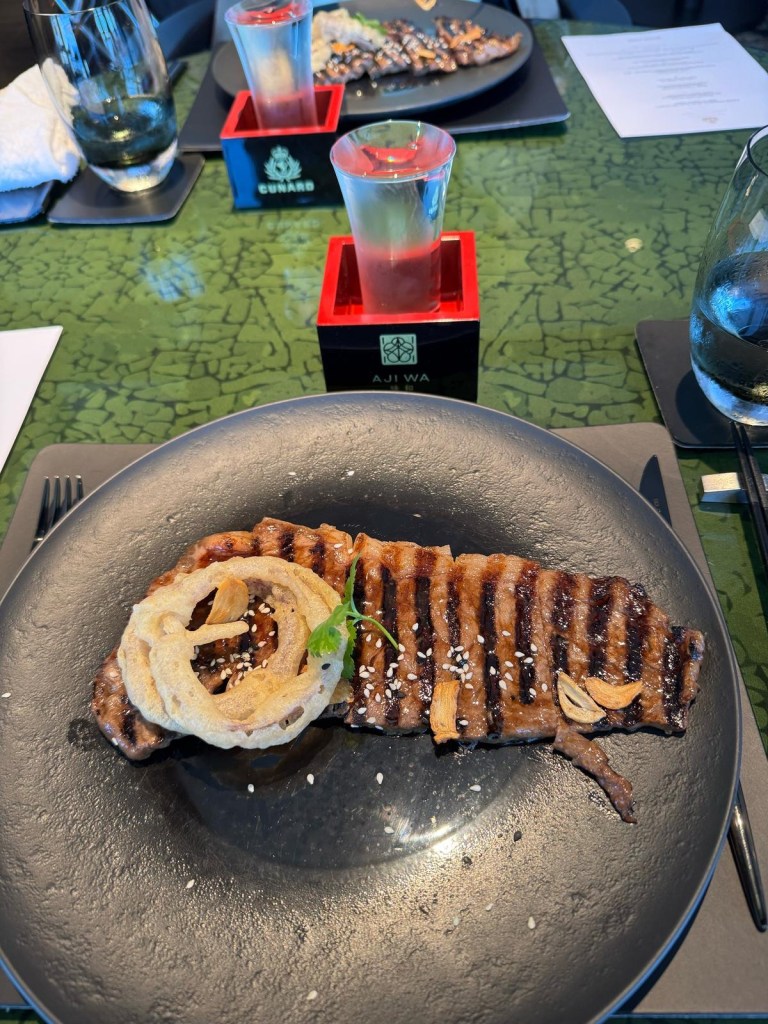
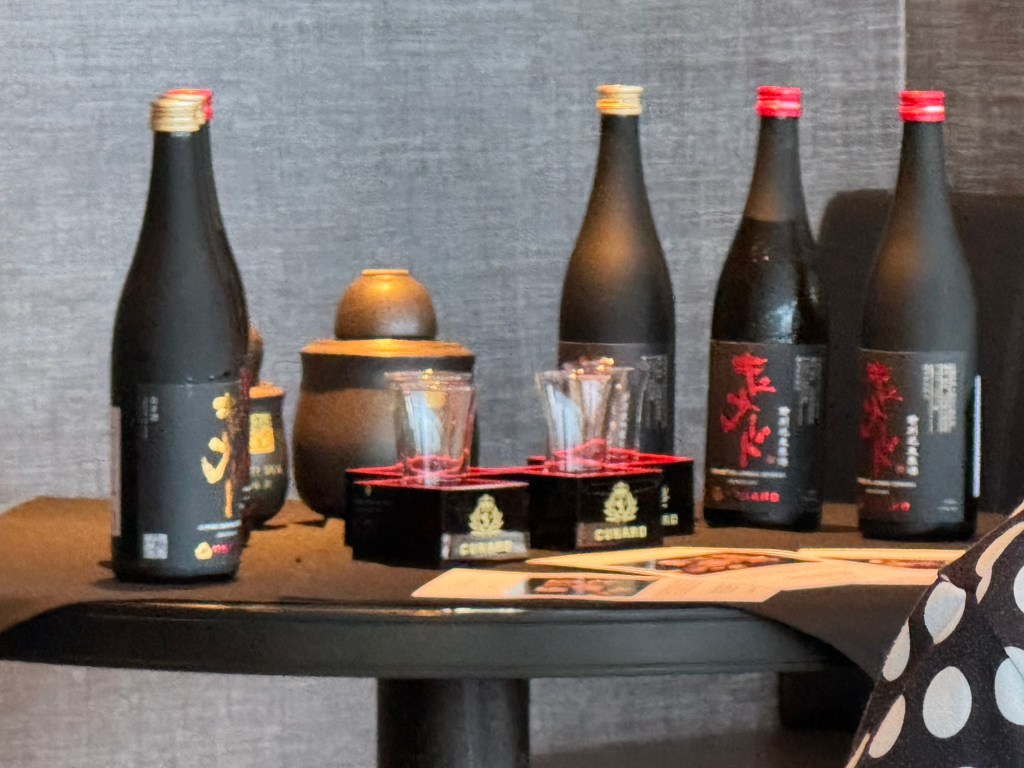
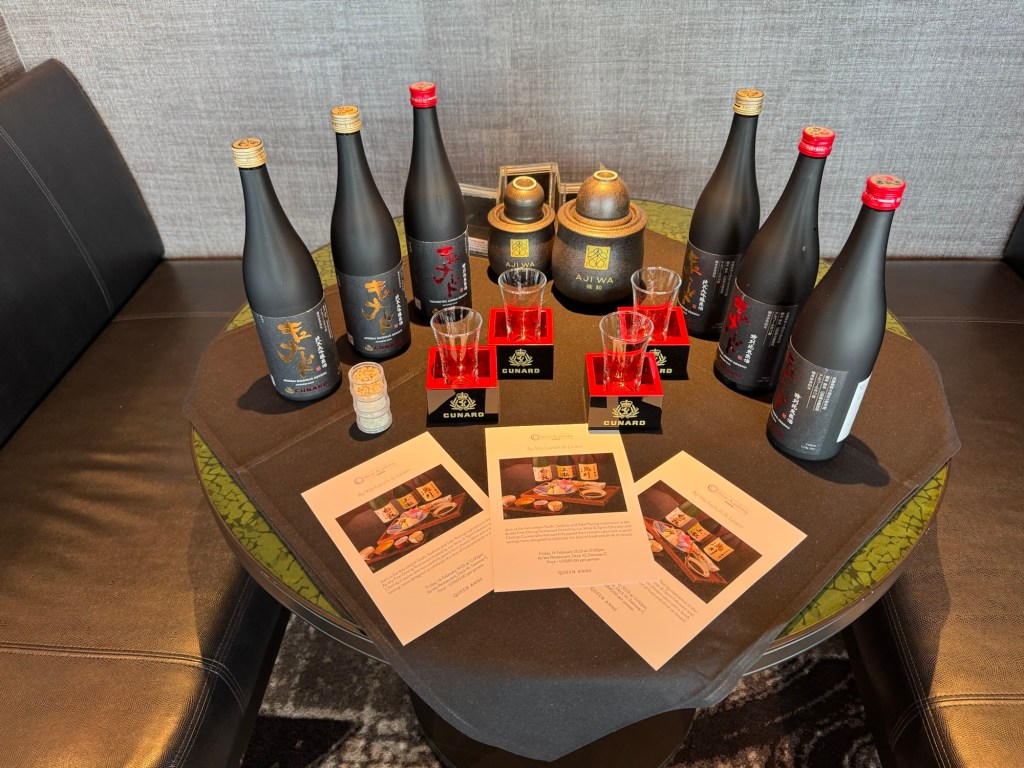
We then went to Ají Wa – The Japanese restaurant to join in the first “Lunch and Learn” all about Sake. Here is the Menu and Sake (all from the Akashi Town area near Kobe & Osaka in the Hyōgo Prefecture on the Pacific Coast of Japan) pairing:-
A Carefully crafted premium selection of Sushi, Nigiri and Sashimi
- Akashi-Tai Tokubetsu Honjozo
Miso, Kombucha and Shiitake Broth, Rice, Smoked Tofu, Bamboo, Nori and Broccoli
- Cunard Tokubetsu Junmai Genshu Karange
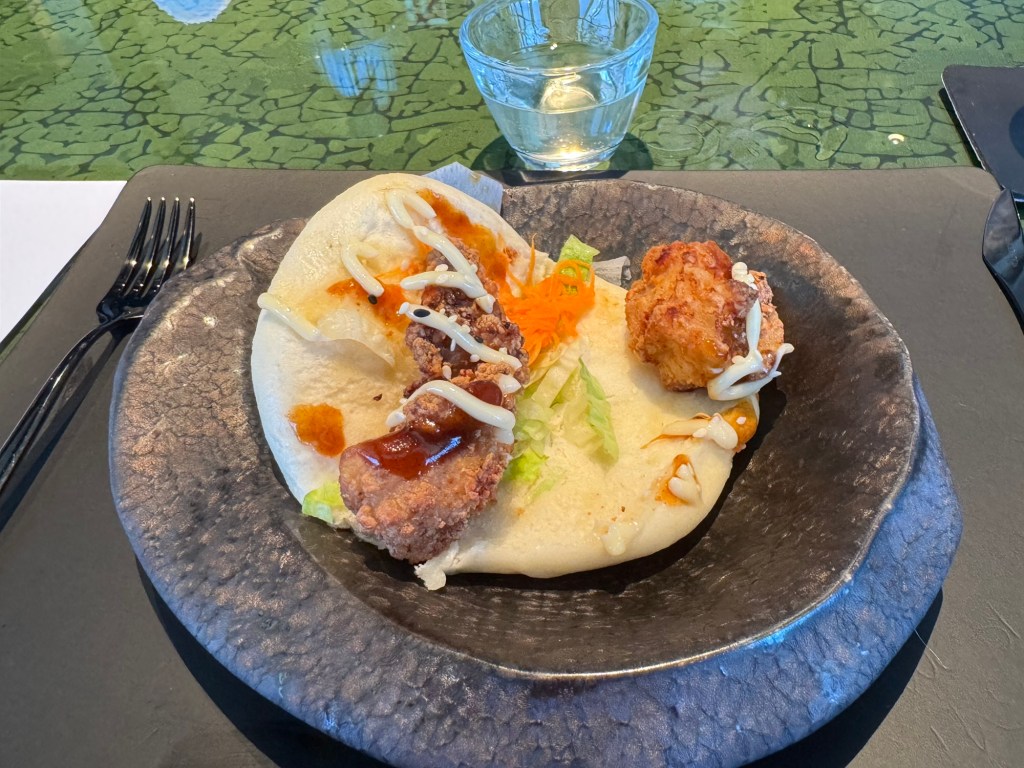
Crisp Buttermilk Chicken, Tonkatsu Sauce and carrot Pickle
- Cunard Junmai Muroka Nama Genshu
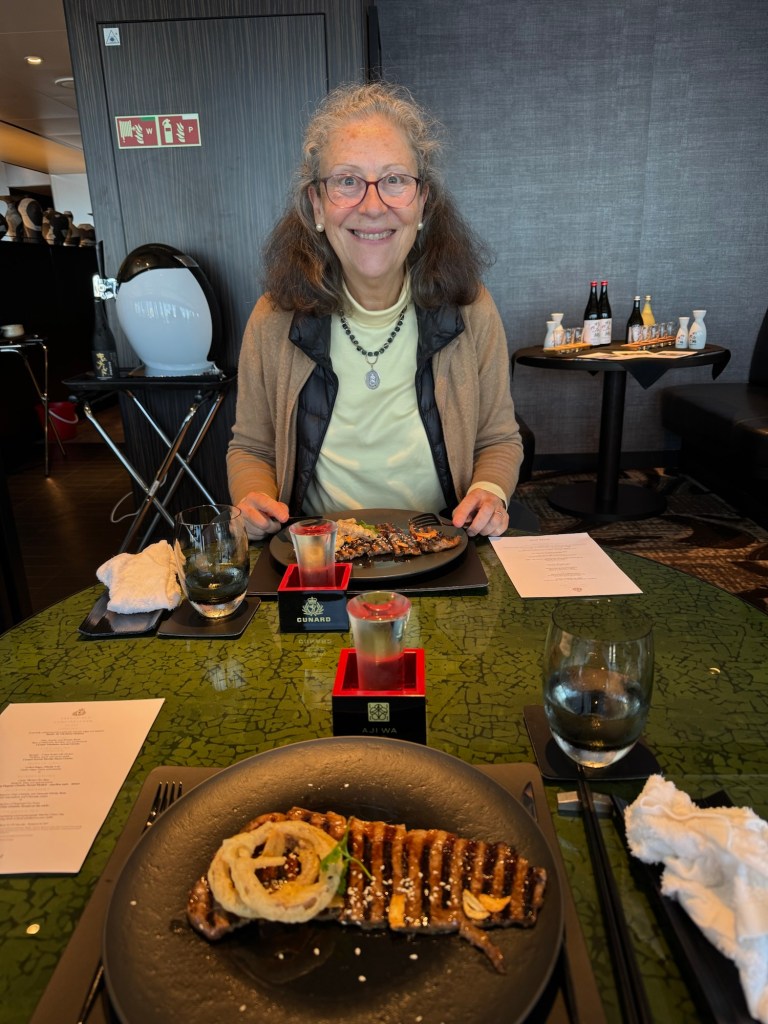
Grilled Wagyu (Marble 4-5) Garlic Crisps, Onion and Sesame
OR
Cedar Planked Sea Bass, Sudachi, Miso and spiced Panzu
- Cunard Junmai Daiginjo Genshu Served Mokkiri – Overflow Style – 180 ml
Akashi-Tai Shiraume Ginjo Umeshu and Hatozaki Whiskey Baba,
Lime Marmalade and Chantilly Cream OR Selection of Seasonal Cut Fruits
- Akashi-Tai Ginjo Umeshu Served on the Rocks
Matcha Green Tea
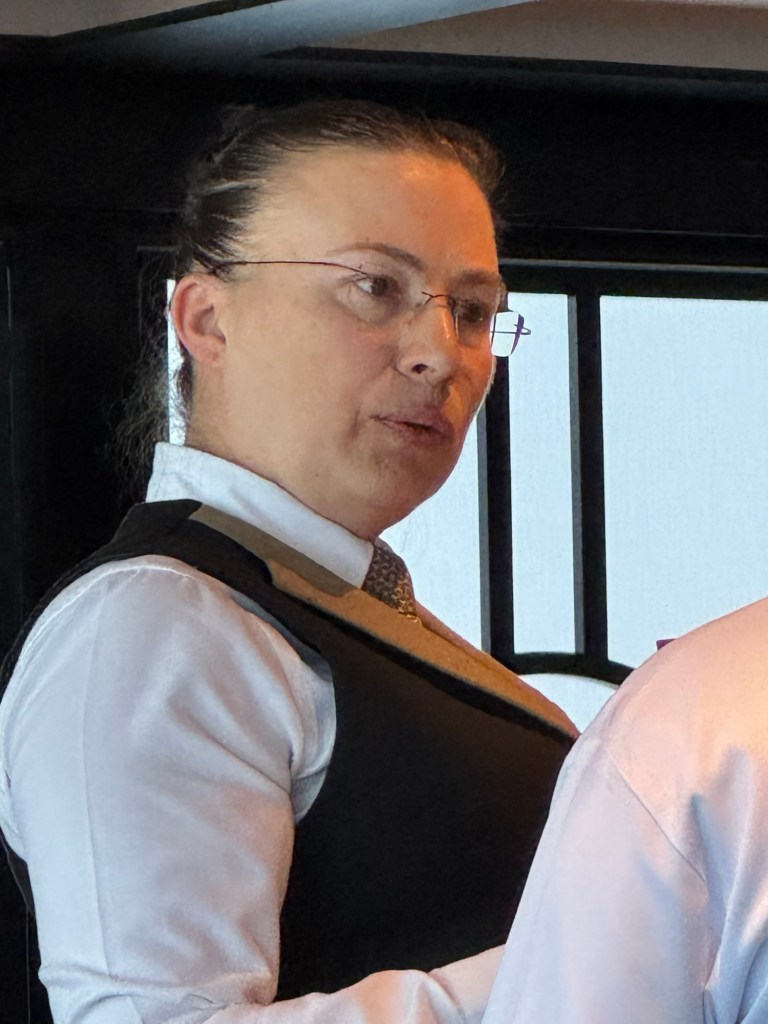
I’ll try and remember what all the different words mean, but Katia was brilliant at explaining in detail all the aspects of making Sake and the meaning of the different words.
Akashi-Tai – This refers to the town of Akashi where the distillery is located and Tai refers to the Sea-Bream fish which is abundant in the area. A red fish is on the label and refers to the characteristics of the fish – Hard working, swims against the stream and is considered a lucky omen. The Sake Master of this distillery – Kimio Yonexawa produces the Sake not only for that distillery label, but also produces Sake for Cunard under the Cunard label from the rice grown in the rice paddies owned by Cunard in the area. The rice used for Sake and not eaten as rice is the Yamadanishiki rice. The rice may have its outside husk or polished so that 65% of the rice grain remains or the best quality is when the rice is polished so that only 35% of the grain remains. The rice contains starch, unlike grapes where the sugar is converted into alcohol, in Sake the starch has to be converted into sugar and then into alcohol. In the early days (2000 years ago) men would sit in a circle around a bowl and chew on each grain then spit it into the bowl. The chewing would help break down the outside and the Ptyalin of saliva would act as the catalyst to convert the starch into sugar. Today the use of a diastatic enzyme mold (from Koji-fungus) replaces the need for the saliva. Once the starch is converted, it typically goes through the process of fermentation, filtration and pasteurization.
Tokubetsu – This really just means “special” brewing method which can mean better rice, or any other factor.
Honjozo – This indicates that a small amount of alcohol is added to the Sake after fermentation. This was started during the war when rice was mainly used as food and thus the amount of rice used to make Sake was diminished. This practice continues today and adds a dryer taste to the Sake. Overall the weight of alcohol can never exceed 10% of the weight of the Sake rice used in the brewing.
Junmai – Pure Sake made without the addition of additional alcohol and using rice polished down to 60% or more of its initial size.
Genshu – This refers to the fact that it is undiluted or that no water is added to the Sake to increase the volume and thus a lower level of alcohol. Sake typically has a 14%-15% apv.
Muroka – Sake that only goes through one filtration process and thus a bit yellower in color.
Nama – Unpasteurized Sake thus needs to be consumed rapidly after opening as it does not keep.
Daiginjo – Sake made with polished rice down to 50% or less and thus the purer the starch and the best quality.
Mokkiri – A way of serving Sake that shows generosity. A glass is placed inside a box (a 1 cup measure of rice) and the Sake poured into the glass until it overflows into the box showing that the person is giving more than the agreed measure.
Ginjo – Sake made with rice polished to 60% or less (remaining) and low temperature fermentation thus giving a more fruity aroma.
Umeshu – liquor made from ume plums
The evening show was the Australian winner of the talent show – Liam Burrows. He sang Frank Sinatra type songs and did reasonably well. It was an enjoyable evening, but he lacks a bit of experience. He needs a bit more depth to the voice, it is still a bit immature, but has good potential to make a good show and living from singing.

 Roger & Anne Travels